

Last Updated on October 28, 2026
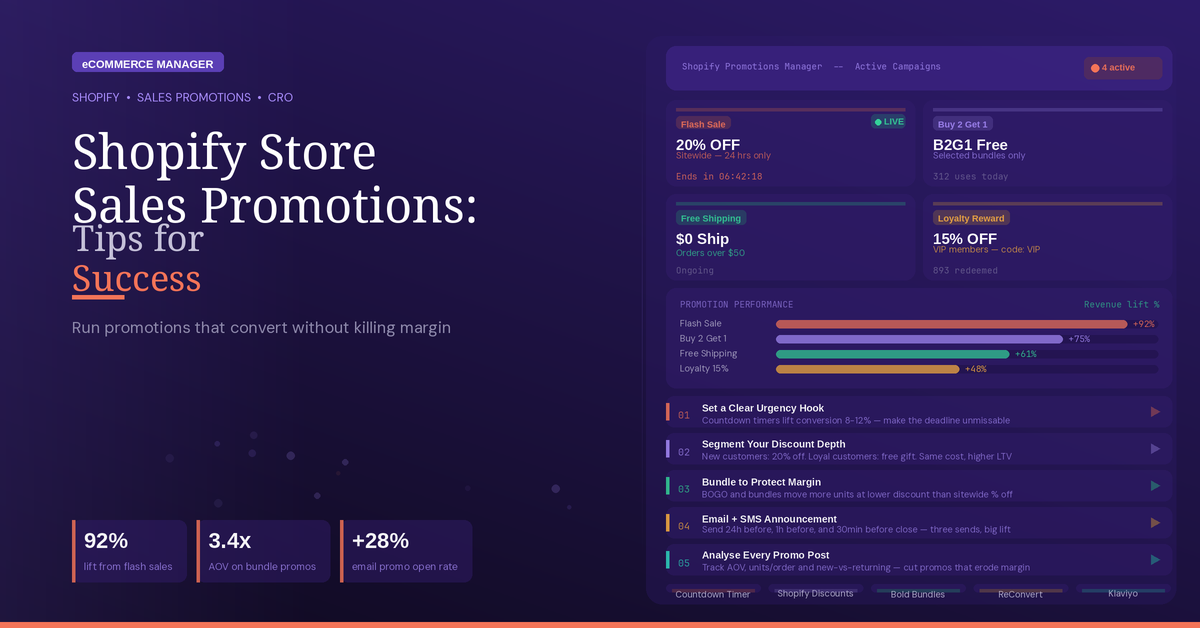
Shopify Store Sales & Promotions: Tips for Success
Turning Shopify traffic into sales takes more than occasional discounts. This guide shares practical promotion ideas, from handwritten thank-you notes and targeted offers to smoother checkout and smarter follow-ups. Insights from ecommerce experts show how to attract buyers, increase order value, and protect profit.
- Automate Genuine Manufacturer Reversions
- Remove Checkout Friction, Auto-Apply Price Cuts
- Sell Live, Preserve Margins
- Align Claims Throughout Subscription Touchpoints
- Tailor Campaigns to Product-Line Journeys
- Target Unfinished Jobs on Dedicated Landing Pages
- Honor Deadlines, Send Timely Abandonment Follow-Ups
- Explain Occasion, Set Firm Deadline, Protect Inventory
- Restrict Introductory Incentives to New Customers
- Greet Initial Orders Through Handwritten Notes
- Reserve Discounts for Final Cart Reminder
- Match Codes to Wash-Day Routines
- Reactivate Churned Subscribers Around Contextual Packages
- Bundle Spa Services Into Take-Home Experiences
- Gamify Offers Via Spin-to-Win Urgency
- Educate Shoppers, Then Reveal Glove Value
- Synchronize Prices Across Ads, Feeds, Pages
- Drive Bigger Baskets From Visual Milestones
- Capture Emails, Showcase Social Proof
- Trigger Behavioral Tiers Amid Dynamic Scarcity
- Secure Reliable Payments Before Traffic Acquisition
Automate Genuine Manufacturer Reversions
Tie every sale to a real, dated manufacturer promotion, and automate the end.
At Bath Supply Pros we sell bathroom vanities, tubs and fixtures at the manufacturer’s advertised price, so we only lower prices when a brand funds a promotion for a set window. In September, one of our suppliers ran a month-long promotion on its tubs and steam shower products. We loaded the promo prices for that window and scheduled the switch back to regular pricing for 12:15 a.m. on October 1. Overnight, more than 1,500 prices returned to regular with zero errors.
The element that mattered most was the honest deadline. A “sale” that never ends trains shoppers to ignore your promotions, and Google Shopping can flag listings for misleading pricing. A real end date is more believable, and automating the switch means the sale ends exactly when you said it would.
Kim Smith, President & CEO, Bath Supply Pros (bathsupplypros.com)
Remove Checkout Friction, Auto-Apply Price Cuts
To run a successful sale or promotion on a Shopify store, one tip I would suggest is create a clear sense of urgency tied to a simple, low-friction offer, such as a tiered discount or limited-time bundle. Avoiding complex discount codes ensures a smooth checkout experience for customers.
One specific element that contributed to the success of a recent promotion was a prominent, dynamically updated banner and countdown timer at the top of the store, paired with an auto-applied discount at checkout. Instead of forcing shoppers to hunt for promo codes, the store automatically calculated and displayed their savings directly in the cart while the header timer visually reinforced the sale deadline. This frictionless setup drastically reduced cart abandonment, boosted conversions, and resulted in a 35% increase in average order value during the promotional window compared to standard baseline sales.

Sell Live, Preserve Margins
Our most successful sales are the ones we host as an event on Live video, not just a banner on the site. When our team goes Live and shows the markdowns on real, size-inclusive bodies and answers fit questions in the moment, a clearance sale becomes a shopping experience, and the urgency comes from the energy in the room instead of a fake countdown clock. The one element that makes it work is discipline on depth: we only discount deep enough to clear while still netting positive, so volume never costs us the margin. A sale should move product and protect profit at the same time, or it is not a win.
-Whitney O’Keefe, co-owner, Avery Mae Boutique (averymae.com)

Align Claims Throughout Subscription Touchpoints
Before APMZEE ran its last Shopify subscription push, I locked every discount line to the same claim gate as the product page so the sale price could not outrun the jar.
Creatine Gummies from $25 and Saffron Sleep X from $31 went out on a 20% subscription offer, not a louder disease-style hook. Early banners had drifted into sharper language than the label, and the inbox filled with about 10 confused messages a month. Now every promo block, including the sale price and the day-3 follow-up, has to match checkout copy. Shoppers who clicked the discount landed on the same promise they saw in the email at https://apmzee.com/, and that sameness is what kept conversion steady while support noise dropped.

Tailor Campaigns to Product-Line Journeys
One tip is to build the promotion around how customers actually shop the brand instead of coming up with a generic sale page. With one of our clients, Buddha Brands, we structured their eCommerce experience around its two main product lines: Hungry Buddha and Thirsty Buddha. Each line has its own product pages, messaging, and visual identity, while the overall shopping experience remains consistent. We also built conversion funnels around those collection pages. For a promotion, I’d use the same approach by creating an offer around a specific product line or customer need instead of simply discounting the entire store. The promotion becomes part of the shopping journey rather than an interruption.

Target Unfinished Jobs on Dedicated Landing Pages
Sell one unfinished job at a discount, not the whole catalog.
My tip for a Shopify promotion is to pick a single SKU set or bundle with a clear reason to buy now, put it on a dedicated landing URL with one CTA, and exclude recent buyers so you are not paying to discount loyalty. The element that improved results for me was writing the offer as a journey step (cart completion or first purchase of that bundle) with a short deadline and a tracked code, instead of a sitewide percentage that trained people to wait. Clarity metrics: conversion and revenue on the promo URL, not email open rate alone.
If everyone gets the same deal forever, you trained a pause, not a sale.

Honor Deadlines, Send Timely Abandonment Follow-Ups
The tip that actually moves a Shopify sale is honesty about the deadline. Set an end date and use it everywhere, on the banner, in the emails, on the checkout page. Fake countdown timers that reset next week train shoppers to ignore urgency entirely.
The specific piece I put in is follow-up automation. A cart gets abandoned during the sale, and a reminder email or text goes out while the discount still works, not after it’s gone. Marketing automation like this drives 451% more qualified leads, according to Nucleus Research. Applied to a sale, that reminder lands at the moment it can still convert instead of apologizing for a deal that already expired.
The other piece worth naming is a real reason for the sale. Inventory clearing, a seasonal cutoff, a restock date. Shoppers can tell when a sale is just a sale, and they discount it in their head before they even open the email.

Explain Occasion, Set Firm Deadline, Protect Inventory
We run Olooq on Shopify across the US, Australia and India, and the element that made the biggest difference to our promotions was giving the sale a reason and a hard end, then stating both plainly.
A discount with no stated reason reads as a brand admitting it overprices the rest of the year. A discount with a reason reads as an event. The reason can be small as long as it is true: a seasonal changeover, a packaging update, a batch we overbought, the shop’s anniversary. What matters is that it explains why the price is lower right now and why it will not be lower next week. That second half is what protects full-price sales after the sale ends.
The hard end does real work too. Open-ended promotions get browsed. A deadline stated as an actual date and time, not a vague “this week”, gets acted on.
The operational element most people skip: check stock depth before you set the discount, not after. The worst outcome of a good sale is selling out of your hero product on day two, then spending the rest of the window paying for ads that drive traffic to an out-of-stock page. Discount the products with enough cover to survive the full window and leave the thin ones alone. Running three regional stores off shared inventory makes that mistake expensive in a hurry.
And plan for the week after. Promotions pull demand forward, so the following week looks weak and somebody suggests another sale to fix it. If you know the dip is coming and roughly how deep, you do not panic into a second discount and teach customers to stop paying full price.

Restrict Introductory Incentives to New Customers
My tip is to run fewer promotions, not more. On my Shopify store I have exactly one: a 10% welcome code, one use per customer, good on every product. That’s it. No flash sales, no countdown timers, no stacking codes. The specific element that made it work is the single-use limit. A first-time buyer gets a real reason to try us, and nobody learns to wait for the next markdown. For a supplement brand built on full clinical doses, the ingredient cost is real, so deep discounts would quietly push me toward cheaper formulas. Holding the line on price is part of the product. If I ever add a second promotion, it’ll be tied to subscriptions, not a calendar.

Greet Initial Orders Through Handwritten Notes
Simply Noted actually ran on Shopify for our early e-commerce before we built our own platform, HIVE, so I lived through a bunch of promo cycles there. The one tip that consistently worked for us was tying the discount to an action instead of just a date, so instead of “20 percent off this week” we’d do “your first handwritten note batch is 20 percent off,” something tied to a first order specifically. It framed the discount as a welcome instead of a markdown, and people didn’t wait around expecting a bigger sale later the way they do with generic seasonal promos.
The other thing that moved the needle was including a physical, handwritten thank you note in the first order that shipped during the promo. Sounds obvious given what we sell, but it turned one time promo buyers into repeat customers at a noticeably higher rate than email follow up alone. People remember getting something in the mail that felt personal way more than they remember a 20 percent code.
Rick Elmore, Founder/CEO, Simply Noted (simplynoted.com)

Reserve Discounts for Final Cart Reminder
My tip is to hold back any discount until the very end of the sequence, not the start. On a Christmas gift set promotion I ran for a client, the first reminder went out 47 minutes after cart abandonment with no discount and recovered 14 percent on its own. Adding money off to that first message dropped it to 9 percent. The discount only earned its place as a last resort on day four, and even then it added just 3 percent.

Match Codes to Wash-Day Routines
That short line in the email and on the cart was the Shopify promo tip that actually worked. I tied every sale code to the four-bottle wash-day path and the live product page, not a mystery discount on a haul kit we do not stock. Codes that fought the PDP created reopen tickets. Codes that pointed at the path moved restocks. In The UK Wash-Day Report 2026, the average UK curl routine used 5.2 products. Promotions that stay near that number convert cleaner.

Reactivate Churned Subscribers Around Contextual Packages
The idea is to quit creating site-wide sale events and treat your promotions like a retention event first. For example, at Happy V, the top performing promotion we have isn’t an all-customer Black Friday type promo — It’s a win back for lost subscribers. This is sent out to subscribers who have dropped off BEFORE we send out a cold traffic promo. It’s a bundle built around the product those subscribers originally churned from. We segmented this first to protect our profit margins, increase our repeat purchase rates, and reactivate subscribers at a fraction of new-acquisition CAC. What really mattered here, wasn’t the discount – it was making sure there was a “reason why” associated with that subscriber’s initial purchase (churn reason, usage guidance, reorder timing), not generic percent-off. In a regulated category, context earns the click price alone doesn’t.

Bundle Spa Services Into Take-Home Experiences
We have had a number of promotions but one of our most consistent winners is bundling a service with a retail item for a small discount. We bundled our beer-based skincare products with seasonal spa bookings and increased the attach rate for the retail items from post-purchase to approximately a 40% increase in sales of the category during the time frame of the promotional offer.
The key to success here was connecting the product to the emotional high point of the visit. The guests did not buy the lotion; they bought a way to recreate the soaks at home. We followed this same approach on Shopify by creating the bundles as a single sku with an auto-discount applied when the guest added to their shopping cart. Additionally, we placed photos of experiences from the spa on the top of each product page versus listing ingredients. If you are selling an experience then you need your retail line to be viewed as souvenirs of that experience and priced accordingly (to add-on) vs. sold independently.

Gamify Offers Via Spin-to-Win Urgency
One thing I’d recommend is gamifying the promotion rather than relying on a standard discount code. For one of our Shopify clients, we introduced a “spin to win” mechanic where customers could unlock different offers, alongside a countdown timer showing how long the promotion had left.
The combination worked well because it added two things a normal sale often lacks: interaction and urgency. Instead of passively seeing “20% off”, customers had a reason to engage with the promotion, while the countdown gave them a clear reason not to put the purchase off.
The lesson for me is that you don’t always need a bigger discount to make a promotion perform better. Sometimes it’s the way you package the offer. Making it feel more interactive, rewarding and time-sensitive is what gets people to act.

Educate Shoppers, Then Reveal Glove Value
My number one tip is this: never run a sale without education attached to it. A discount without context is just a race to the bottom, and there are plenty of discount retailers out there already. Keeperstop is the goalkeeper glove and equipment expert. That expertise is what makes every promotion we run actually work.
The specific element that contributes most to a successful sale on our Shopify store is the highly technical, educational product review sitting right on the product page. When we put a goalkeeper glove on promotion, the customer isn’t just seeing a crossed-out price. They’re reading exactly why that glove performs, what latex it uses, which hand shape and playing surface it’s best for, and how it compares at its price point. By the time they see the sale price, they already understand the value. The education makes the offer compelling because the customer understands what they’re getting, not just what they’re saving.
This matters in our space because choosing the wrong goalkeeper glove wastes time and money. A parent who buys a discounted glove that doesn’t fit their child’s hand or falls apart after two weeks on turf hasn’t saved anything. They’ve wasted money and their kid’s confidence takes a hit. Our focus is always customer service first and product knowledge to help the goalkeeper select a glove that meets their budget and playing need. That philosophy doesn’t pause when something goes on sale.
When we do run promotions, they’re tied to real situations. When we choose a style that doesn’t connect with our goalkeepers, because goalkeeping is a fashion-forward position and keepers want matching kits and gloves, it goes on sale to turn the product back to cash so we can learn and get it right next time. That’s honest, not manufactured.
We also bundle gear around how goalkeepers actually play. Match glove plus practice glove plus protective gear in one purchase at a better price. That solves a real need rather than pushing random add-ons.
The bottom line: pair every promotion with education that helps the customer buy with confidence. That’s the element that turns a sale into a relationship.

Synchronize Prices Across Ads, Feeds, Pages
I don’t own the store. I run the ads for it, so I watch promotions from the traffic side, and the same thing breaks every time.
The sale price goes live on the product page and nowhere else. The feed still carries the old price, so Shopping shows one number and the landing page shows another. Google flags the mismatch, products drop out, and the owner decides the promotion just didn’t land.
Last night a client’s price moved at midnight. This morning a callout asset in the account still read €549 while the site said €749. Two minutes to fix, and for those hours every click paid for a promise the page wasn’t keeping.
So before a sale goes live I open four things side by side. The feed, the ad copy, every promotion asset in the account, and the landing page. They have to say the same number. It takes five minutes and almost nobody does it.

Drive Bigger Baskets From Visual Milestones
I always run tiered bundle discounts during my promotions.
Instead of offering a flat discount across the entire catalog, I add a clear, visual milestone bar directly inside the shopping cart. For example, customers get ten percent off two items and twenty percent off three or more items.
This specific milestone bar is the main element behind my success. Shoppers instantly see how close they are to the next discount tier. It encourages them to pick an extra item before checkout. My average order value increases by twenty-two percent during these events. It helps buyers save more money and clears my inventory quickly.

Capture Emails, Showcase Social Proof
Gate the discount behind an email. I put a welcome offer in a pop-up so a one-time promo becomes a list I own, and the next sale costs me nothing in ad spend. I keep the discount modest and test the depth rather than defaulting to the deepest cut I can stomach.
The second element I lean on is social proof sitting right next to the offer. I put reviews on the product page and in the promo email, and that does more for my conversion than another few points off the price while protecting the margin I’m trying to keep.

Trigger Behavioral Tiers Amid Dynamic Scarcity
The effectiveness of a Shopify promotion hinges on moving away from generic discounts and toward the use of behavior-based segmentation, time-sensitive urgency, and tiered promotions. The most successful promotions when managing clients’ online growth strategies are those that concentrate on consumer data related to browsing history and cart items, rather than simply sending out promotional codes to entire lists of subscribers. The latest delivery experience to teams dealing with growing e-commerce brands reveals that the use of automated behavioral segmentation flow that is activated only when certain actions are accomplished is much more efficient than lowering overall prices of the products. What makes such promotions work well is the application of dynamically changing the elements that create urgency on the product and cart pages, like messages indicating the number of products left on the stock. Besides, dividing the promotion into tiers (e.g., giving prompt buyers twenty-four-hour access to special sales prior to public announcements) makes it possible to better manage server operations and generate revenue sooner. The main miscalculation made by brands when conducting store promotions is over-discounting the low-intent traffic.

Secure Reliable Payments Before Traffic Acquisition
In 2025 I launched my own Shopify dropshipping store and built everything myself from scratch – the website design, colors, logo, social media pages, Google Ads account, and I also created and edited all the video content.
I learned a lot from that experience.
For me, success on Shopify comes down to three things.
First is audience targeting. I focused on targeted keywords on both Meta Ads (Instagram) and Google Ads. Instead of broad targeting, I targeted people who were actually searching for the product. That helped me spend less than $50 on promotion but still get a lot of leads. I had customers from different countries placing orders and filling in their delivery details.
Second is content. Good video and clear text descriptions on Google Ads really matter. Consistent posting on social media built trust.
Third is location. This is where I faced my biggest challenge. Shopify Payments was not available in my country, and the alternative payment gateway in my region was having technical issues. From my Shopify analytics, I could see customers adding their delivery information but failing at checkout due to payment gateway errors. Because of that, I had to pause the store.
That experience taught me that even with good targeting and low ad spend, payment availability is critical. Now I can help Shopify store owners in countries where Shopify Payments is supported to avoid that same issue.

Related Articles
- Shopify Product Launch Strategies: Tips & Examples
- Effective BigCommerce Promotion Strategies: Examples & Results
- Driving Traffic & Sales: Content Marketing Strategies for Shopify