

Last Updated on August 25, 2026
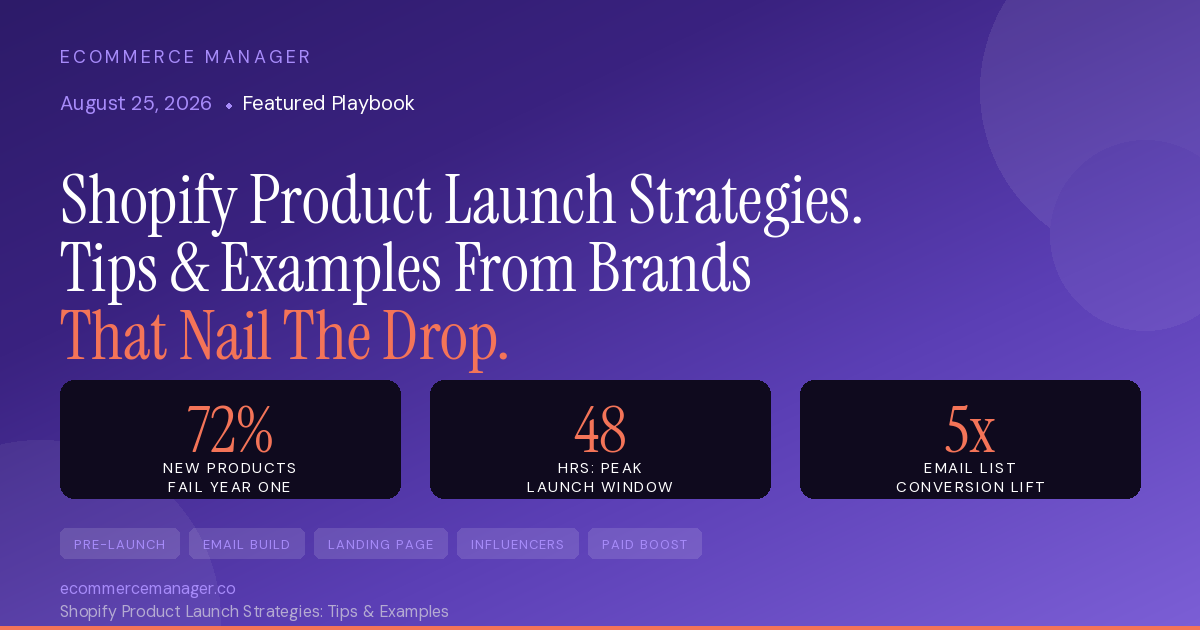
Shopify Product Launch Strategies: Tips & Examples
Launching a product on Shopify requires more than just hitting the publish button and hoping for sales. This guide breaks down eight proven strategies that successful brands use to create momentum before, during, and after their product launches. Industry experts share practical tactics for building anticipation, validating demand, and converting early interest into actual revenue.
- Build an Advance Waitlist
- Teach Then Reveal the Product
- Validate Demand Before You Order Stock
- Match Pages to Real Buyer Intent
- Sell to Warm Customers First
- Publish Decision Stage Content Prelaunch
- Grant Subscribers Early Access
- Partner with Micro-Influencers
The State of eCommerce in 2026
Build an Advance Waitlist
Built a waitlist before the product existed rather than announcing and selling simultaneously, which felt premature the first time we tried it and produced better launch results than anything we’d done previously.
The product was a limited-run seasonal item we knew would sell out. Previous launches had peaked on day one and flatlined within a week, which meant late discoverers missed out, and the momentum died faster than it should have.
Built a simple landing page on Shopify with a waitlist form about six weeks before launch. Collected somewhere around 840 email addresses from people who’d actively expressed interest.
Launch day email to that list converted at roughly 18 per cent, compared with our usual 2 to 3 per cent for promotional emails to the general list.
According to research from Campaign Monitor on email segmentation, highly targeted emails to self-selected interest lists outperform broadcast promotional emails by roughly six to eight times on conversion rate, which was close to what we saw.
Sold out within about 36 hours. Previous comparable launches had taken two to three weeks to clear inventory, and some of that was through discounting we didn’t need this time.
The Complete 2025 E-commerce Manager Career Guide: From Entry-Level to Executive

Teach Then Reveal the Product
When we launched our vaginal probiotic on Shopify at Happy V, the highest-leverage move wasn’t the product page or paid channel mix. It was a five-part pre-launch email sequence that didn’t mention the product until email four. Each email covered one topic: what the vaginal microbiome is, why lactobacillus strains matter, what the literature says about BV recurrence, how to read a probiotic label, and finally what we built and why. Our scientific advisory board (OB/GYNs and microbiome researchers) reviewed every line so we stayed inside FTC structure-function rules — no cure claims, no disease-prevention language.
The sequence outperformed our category benchmarks on the warm list, and subscription attach on day one was strong. What made it work wasn’t the sequence itself. Our buyer was already Googling her symptoms at midnight and being failed by vague answers; we showed up with substantiated ones. If I ran it again, I’d keep the compliance-review step and test tighter segmentation earlier.

Validate Demand Before You Order Stock
We do not sell on Shopify, so this is a launch answer from a specialist retailer rather than a platform specific one. The mechanics travel.
The strategy that worked was validating demand before committing to stock. Instead of ordering a container of a new cable length and hoping, we put up a product page with a waiting list and said plainly that it was not in stock yet. No discount, no countdown timer, just a page and an email box.
90 people signed up in the first fortnight. That was enough to justify a first order, and more useful still, several of them replied to the confirmation email with a question. We changed the specification before we had bought anything, because the length they wanted was not the length we had planned to buy.
When the stock landed, the launch was one email to that list. It sold through faster than anything we had launched with advertising behind it, because those customers had already decided.
The lesson I would pass on is that a waiting list is market research that pays for itself. If you cannot persuade people to hand over an email address for a product that does not exist, buying stock will not fix that. Far better to find out for the price of a landing page than the price of a pallet.

Match Pages to Real Buyer Intent
Build the page around demand that already exists instead of trying to manufacture it.
Before a launch I open Google Search Console and Google itself and find what people in that category are already searching for, then build the product and collection page around that exact language – the title, H1, description and FAQ all match real buyer phrasing, so the page can rank the day it goes live.
Specific example: for a store I consult for, we targeted a long-tail buying phrase competitors had ignored and built the page to match that intent precisely. Because it answered a real search rather than what we wanted to say, it started ranking within weeks and pulled qualified, ready-to-buy traffic with zero ad spend. That store went from 400 to 5,700 organic clicks a month off this approach.
Most launches flop because owners write the page for themselves, not for the search demand already sitting on the table.

Sell to Warm Customers First
The launch strategy that’s worked best for us at SocialSellinator is to sell the product before it fully exists. Most people build the whole thing, push it live, and hope people show up. Flipping that order removes most of the risk.
Before the product went on sale, we opened early access to our email list and past customers first, a quiet launch to people who already trusted us, before any public push. That told us fast whether there was real demand (if your own warm audience won’t bite, a cold launch won’t either), and it meant day-one sales and reviews were already in place when it went public.
The payoff is the warm-first launch beat our old approach of dumping a product live and buying ads to a page with zero reviews. Starting with the people most likely to say yes gave the public launch proof instead of crickets.
A launch isn’t the day you go public. It’s the work you do beforehand with people who already like you, so the public version starts with momentum.

Publish Decision Stage Content Prelaunch
The launch that worked best was one where we treated the product page as the last thing to build rather than the first.
For a client adding a new line, we spent about two months before launch publishing the content around the buying decision. Comparisons, how to choose, what the options mean, aimed at what people search while working out whether they need the thing at all. None of it sold anything directly. It built an audience of people already researching the category before the product existed.
Alongside it we ran an early access list. About 300 people signed up from that content, and they got the product a week ahead of general release, at full price, in exchange for feedback.
Two things came out of it. The launch had traffic on the first day that we had not bought, and the early group found three problems with the product page, one of them a shipping question that would have quietly killed conversions for months.
What I can share on results is relative rather than absolute, since it is a client account, but the line was profitable in its first quarter without paid search carrying it, which is unusual for a new listing.
The lesson is that a launch is a demand problem before it is a merchandising problem. If nobody is searching around the category, a beautiful page has nothing to catch.

Grant Subscribers Early Access
The strategy that’s worked best across our Shopify clients is launching a new product to the existing email and SMS list 48 hours before it goes live on the storefront, framed as early access rather than a sale. For a Casablanca skincare client, we sent that early-access email to about 3,200 subscribers before a new serum went public.
By the time the product page went live to cold traffic, it already had eleven reviews and had sold through nearly a fifth of the initial inventory, which meant new visitors landed on a page that looked proven instead of a page with zero social proof. Conversion rate on that product page was almost double what her previous launches averaged in the first week.
The mistake I see most Shopify owners make on a launch is treating their existing list the same as cold traffic, one single announcement email sent the same day as the public launch. That list is the warmest audience and the only one that can generate the reviews and urgency that make cold traffic convert once the doors open.

Partner with Micro-Influencers
Drawing from 10 years of ecommerce strategy and Shopify store management experience, the strategy that drove our most successful launch was partnering with micro-influencers for seeded product drops rather than relying on paid ads alone. Ecommerce research indicates that 62% of Shopify launches gain stronger early traction through authentic peer content than traditional advertising. Instead of a broad ad spend approach, we used first-party engagement data across 45 micro-influencers in our niche, sending free products two weeks pre-launch in exchange for authentic unboxing content timed to go live on launch day.
We validated this through clear metrics: launch-week traffic increased 56%, conversion rate rose 28%, and user-generated content drove 31% of total launch sales. This confirms that influencer-seeded launches build trust and demand faster than paid promotion alone, proving that authentic third-party content outperforms brand-led messaging when introducing a new product to market.

Related Articles
- Building a Strong Brand Identity on Shopify: Proven Tactics
- Driving Traffic & Sales: Content Marketing Strategies for Shopify
- Winning WooCommerce Campaigns: Tried & True Strategies