

Last Updated on October 6, 2026
The 3PL RFP Template for 2026: What to Ask, What to Benchmark, What to Reject
The data pack to send, the unbundled pricing schedule to demand, the SLA minimums that disqualify providers before pricing talks, and the 2026 benchmarks to score every quote against. Built as a working template, section by section.
On this page
The RFP is a forcing function, not paperwork
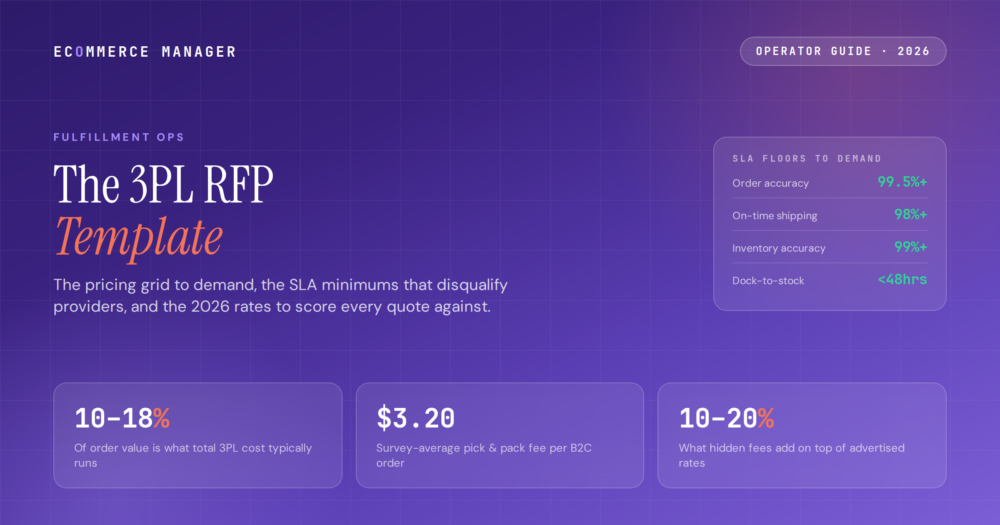
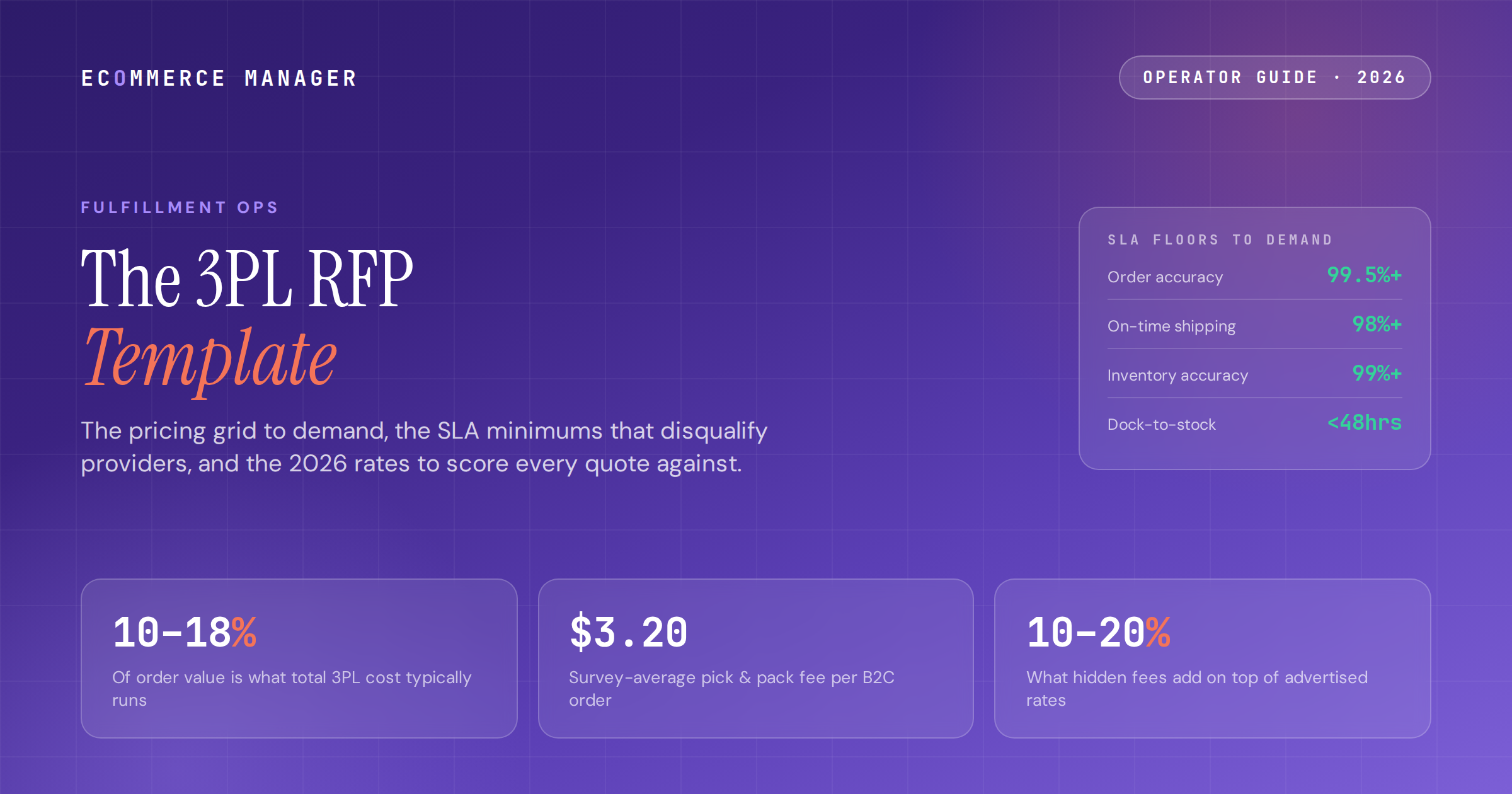
Two facts justify the work of a structured 3PL RFP. First, total fulfillment cost typically runs 10–18% of order value: for a $10M brand, a $1M–$1.8M annual line that compounds with every error. Second, quotes for identical volume routinely diverge because providers unbundle differently, and hidden fees add 10–20% on top of advertised rates. Nearly half of warehouses (48.6%) now add long-term storage surcharges on aged inventory alone. The RFP's job is to force every provider onto the same grid so the numbers become comparable and the surcharges become visible before signature, not on the third invoice.
The 2026 benchmarks make the scoring objective. Pick-and-pack consensus sits at $2–$3 per B2C order first item (survey average $3.20; B2B around $4.80) plus $0.30–$0.75 per additional item. Pallet storage runs $18–$25 a month, receiving $5–$15 per pallet, monthly minimums average $517, and all-in DTC fulfillment lands at $5.50–$9.00 per order before postage. On the service side, the floors are equally checkable: 99.5%+ order accuracy at top-quartile operators, 98%+ on-time shipping, inventory accuracy above 99%, dock-to-stock under 48 hours.
What follows is the template, section by section: the data pack you send, the operational questions that expose weak providers, the unbundled pricing schedule, the SLA section with penalties, and the scoring and transition annex. Send it to 3–5 candidates, hold every answer against the benchmarks above, and disqualify on those minimums before a single pricing conversation.
The data pack: what you send before you ask anything
Half of bad 3PL quotes are caused by bad inputs. A provider quoting blind pads the number or lowballs it to win; either way, the quote you compare is fiction. The RFP opens with your data, stated precisely.
-
01Order profile, from real exports: monthly order volume (trailing 12 months, month by month, so peak is visible), average items per order, single-item order share, average weight and dimensions, and channel split (DTC, B2B, marketplace) — B2B order share matters because core B2B tooling now ships on every Shopify plan and changes the EDI conversation. Items-per-order is the quiet one: multi-item orders are where per-order economics diverge most between providers, because the additional-item fee ($0.30–$0.75 market rate) compounds.
-
02Catalog reality: SKU count, inventory turns, pallet and bin storage footprint at today's volume, fragile or oversized exceptions, lot/expiry tracking needs, and kitting or subscription-box assembly if any — kitting adds $0.50–$1.50 per order and changes which providers can quote at all.
-
03Current-state performance, honestly stated: your existing order accuracy, on-time ship rate, cost per order, and the contract exit obligations at your incumbent. This is the weeks-1-to-4 audit that precedes any selection process, and it doubles as your negotiation baseline; pull the figures from your core KPI set rather than memory.
-
04Growth and peak math: projected 12-month volume, Q4 multiplier, and any planned channel or region additions. Seasonal scalability is one of the five criteria that separate good 3PLs from bad ones, and a provider can only prove capacity against a number you gave them.
-
05The integration map: platform (Shopify, Adobe Commerce, or other), OMS/ERP, returns software, and EDI requirements for retail or B2B. Integration quality with your platform is a top-five evaluation criterion, and the answers change which WMS connectors matter — inventory the current stack in a tech stack audit so nothing surfaces during onboarding.
The operational questions that expose weak providers
Every provider claims strong service levels. The RFP's job is separating measured performance from marketing. These questions do it in writing.
-
01"Provide order accuracy, on-time shipping, and inventory accuracy for the trailing 30–90 days AND your last two peak seasons — with methodology." Not annual averages, which smooth over the Q4 that matters. Require how each number is calculated, how often it's reported, and whether you'll see it in a real-time dashboard or a month-end PDF. A provider measuring continuously and showing customers live data is giving you the standard of proof to demand from everyone else.
-
02"What is your average dock-to-stock time, and your receiving discrepancy process?" The standard is under 48 hours from inbound arrival to pickable inventory. Receiving is the most overlooked SLA line: inventory that sits on the dock is inventory you own but can't sell, and discrepancies found late become shrinkage arguments.
-
03"Walk us through your error resolution: acknowledgment time, reship process, and who pays." Every tenth of a point below 99% accuracy surfaces as reships, credits, and escalation calls. The mature answer names a timeframe, a credit policy, and a root-cause process; the weak answer is 'errors are rare.'
-
04"Show us two references who scaled 2–3x while with you, and one who left." The first pair proves scalability; the exit reference proves professionalism in the one scenario every contract eventually reaches. A provider who won't produce a departed client is telling you how departures go.
-
05"Which warehouse locations would serve us, at what transit coverage?" Geographic coverage drives both delivery speed and zone-based shipping cost. Ask for the specific buildings, their 2-day ground coverage percentage against your order map, and whether multi-node inventory splitting is included or an upcharge.
-
06"What happens at 3x volume in Q4 — labor plan, cutoff changes, and surcharge schedule?" Peak is where fulfillment relationships break. The answer should include named peak surcharges (in the pricing schedule, not discovered in November), labor scaling mechanics, and whether your SLA commitments hold or get a seasonal carve-out, and if they carve out, by how much.
Pricing the rest of your stack too?
Run your platform, order volume, and cost structure through the ECM Platform Calculator for a three-year TCO view — fulfillment is one line in the unit economics the calculator maps.
The unbundled pricing schedule, with 2026 benchmarks
Require every provider to quote the same line items on the same grid. Here's the grid, with the going rate next to each line so scoring is arithmetic rather than impression.
The core lines
-
→Setup/onboarding: market range $250–$1,000 one-time (average ~$425; roughly half of providers charge it). Anything above the band needs an itemized justification; integration complexity is real, but 'setup' is also a classic pad.
-
→Receiving: $5–$15 per pallet standard, with container unload quoted separately (published rate cards run $299–$499 per container). Per-unit receiving at $0.35–$1.50 appears for complex products; make providers state which model applies to you.
-
→Storage: $18–$25 per pallet per month, with bin/shelf storage quoted separately (typically $0.45–$0.55 per bin equivalent on published cards). Demand the long-term storage surcharge schedule explicitly: 48.6% of warehouses now charge one on aged inventory, and it's the single most common invoice surprise.
-
→Pick and pack: $2–$3 first item B2C (survey average $3.20), $0.30–$0.75 each additional, B2B around $4.80 per order. Get the tier table in writing if volume pricing applies, and model YOUR items-per-order against it: the first-item fee decides single-item economics, the additional-item fee decides bundles.
-
→Shipping: the rate methodology, never a bare 'discounted rates' line. Pass-through with a stated markup (0–12% exists in market) or marked-up published rates — either is quotable, but the mechanism must be named, because 3PL-negotiated carrier discounts of 10–30% are real value only if they reach your invoice. Require a sample rate card for your top five zones and weight breaks.
The lines that hide
-
→Monthly minimums: the market average is now $517. Model your slow months against it: a minimum that's invisible at 2,000 orders is a 15% effective surcharge at 400.
-
→The full surcharge schedule, enumerated: returns processing, packaging materials ($0.30–$1.50/order), account management fees, technology/portal fees, peak-season surcharges, address correction, and special handling. Hidden fees add 10–20% on top of advertised rates precisely because they live outside the headline grid; the RFP's pricing section exists to drag them into it.
-
→The all-in test: ask each provider to price three named sample orders from your actual data (your modal single-item order, your average multi-item order, your heaviest bundle) end to end. Published 2026 rates put a standard DTC order at $5.50–$9.00 all-in before postage; a provider whose sample-order math lands far outside the band, in either direction, has either a different cost structure or a different definition of 'included', and the three-order test reveals which.
The SLA section: floors, penalties, and the methodology clause
A 3PL will tell you their accuracy rate in a sales conversation. The SLA section converts the conversation into contract language with consequences. These are the floors and the clauses.
-
01Order accuracy: 99.5%+ contractually committed. Top-quartile operators run 99.5%+ (the best publish 99.9%+); median operators track 98–99%, which sounds close and isn't: at 50,000 annual orders, the gap between 99.5% and 98.5% is 500 extra wrong shipments, each a reship, a credit, and a support ticket. Disqualify below 99% before pricing discussions begin.
-
02On-time shipping: 98%+ against a defined cutoff. The ladder runs >97% acceptable, 98%+ good, >98.5% top-tier, and the cutoff definition matters as much as the percentage. 'Orders placed by 1:00 PM ship same day' is enforceable; 'fast turnaround' is not.
-
03Inventory accuracy above 99%, dock-to-stock under 48 hours, and returns processing time — all three in the SLA, not the sales deck. Receiving metrics feel like internal warehouse concerns until a PO sits unpickable for a week in October. If any of the three is missing from a provider's standard SLA, append it and watch the reaction; the reaction is data.
-
04Service credits with teeth, and the measurement clause. Credits attach when attainment slips below the contracted floor. Get the credit schedule in writing, plus the methodology: how each metric is calculated, measured continuously or sampled, and visible to you in real time or reported month-end. A 2026 industry study found SLAs are the most common structure connecting shippers and 3PLs, often paired with continuous-improvement targets; providers fluent in that structure welcome the clause.
-
05The composite check: Perfect Order Rate. Multiply on-time × complete × damage-free × documentation-accurate and the picture gets honest fast: a provider at 98.5% on-time, 99.8% accuracy, 99% damage-free, and 99% documentation runs a 96.3% perfect order rate, meaning roughly 1 in 27 customers still gets a flawed delivery. Tracking the composite in quarterly reviews keeps individual KPIs from flattering the operation.
-
06The exit triggers, written while everyone's friendly: order accuracy below 98% for two consecutive months, or repeated SLA misses without root-cause response, triggers a no-penalty exit window and defined data/inventory handback terms. The clause you'll most wish you had is the one that's awkward to request later.
Need specialists for the operational side?
The ECM directory lists vetted ecommerce agencies and operations specialists with published budgets and verified client reviews — filterable by service, platform, and vertical.
Scoring the responses, and the transition annex
The template ends with how you'll decide and how you'll move — both stated in the RFP itself, so providers price the real project including the cutover.
-
01Score on the five criteria that separate good 3PLs from bad ones: integration quality with your platform, geographic coverage against your order map, pricing transparency on the unbundled grid, error-rate guarantees (the sub-0.5% error standard maps to the 99.5% accuracy floor), and demonstrated seasonal scalability. Weight them for your business — a subscription brand weights accuracy and kitting; a heavy-goods brand weights zones and damage rates.
-
02Run 3–5 candidates through the full grid, not a long list through a shallow one. The audit-and-selection phase runs weeks 1–4 in a well-run switch; depth beats breadth because the failure modes live in the fine print the shallow pass skips.
-
03Require the onboarding plan in the RFP response: 4–8 weeks contract-to-first-shipment is the realistic window, driven by integration complexity and physical inventory transfer. The response should name an onboarding project manager, the SKU-mapping and integration-testing milestones, and the go-live criteria. A provider who quotes two weeks is quoting a demo, not a cutover.
-
04Write the parallel run into the plan: days 31–60 running live orders through both providers while tracking pick accuracy, ship speed, and error rates weekly, with full cutover only after the new operation holds your SLA targets under live conditions. Skipping parallel fulfillment to save a month is the classic switching failure, and stockouts during cutover are how it presents.
-
05Time the whole project away from Q4. The same calendar discipline as a platform migration applies: cutover complete by early October or start in January, because a fulfillment transition colliding with peak converts your best quarter into a stress test — the same reason replatforming projects hold the same rule. The phase logic mirrors the ECM migration checklist: audit, validate in parallel, cut over at low tide, review at 90 days. ECM tracks how fulfillment economics keep moving in weekly Insights.
What a smart operator does with this
Lead with your own data. A precise data pack (real order profile, items-per-order, peak multipliers, integration map, and your current accuracy and cost-per-order baseline) is what makes five quotes comparable and what keeps providers from padding against uncertainty. The RFP is a forcing function, and the force starts with your inputs.
Make the pricing section a grid, not a conversation. Every line against its 2026 market rate: $2–$3 first-item pick and pack, $0.30–$0.75 additional items, $18–$25 pallet storage, $5–$15 receiving, $517 average minimums, and the three-sample-order all-in test against the $5.50–$9.00 band. Then drag the hidden 10–20% into daylight: long-term storage surcharges, peak schedules, returns, packaging, portal fees, enumerated or excluded, in writing.
Disqualify on SLA floors before pricing talks: 99.5% order accuracy committed contractually, 98%+ on-time against a defined cutoff, 99%+ inventory accuracy, dock-to-stock under 48 hours, service credits with a stated methodology, and exit triggers written while the relationship is still friendly. Then protect the switch itself: 4–8 week onboarding with a named PM, a days-31–60 parallel run, and a cutover calendar that never touches Q4.
Frequently asked questions
What should a 3PL RFP include?
Five sections. A data pack with your real numbers: trailing-12-month order volumes, items per order, SKU count, storage footprint, peak multipliers, and integration requirements. Operational questions demanding trailing 30–90-day and peak-season performance data with methodology. An unbundled pricing schedule covering setup, receiving, storage, pick and pack, shipping methodology, minimums, and the full surcharge list. An SLA section with contractual floors (99.5% order accuracy, 98%+ on-time shipping, 99%+ inventory accuracy, dock-to-stock under 48 hours), service credits, and exit triggers. And a transition annex requiring a 4–8 week onboarding plan with a named project manager and a parallel-run period.
How much does a 3PL cost per order in 2026?
Standard DTC fulfillment lands at $5.50–$9.00 all-in per order before postage. The components: pick and pack at $2–$3 for the first B2C item (survey average $3.20; B2B around $4.80) plus $0.30–$0.75 per additional item, storage at $18–$25 per pallet per month, receiving at $5–$15 per pallet, setup fees of $250–$1,000 at roughly half of providers, and monthly minimums averaging $517. Total 3PL cost typically runs 10–18% of order value, and hidden fees — returns processing, packaging materials, long-term storage surcharges, peak surcharges — add 10–20% on top of advertised rates when left unenumerated.
What SLA benchmarks should I require from a 3PL?
Order accuracy of 99.5% or higher, contractually committed — top-quartile operators run there, while median operators track 98–99%, and anything below 99% should be disqualified before pricing discussions. On-time shipping of 98%+ measured against a defined cutoff time (97% is the acceptable floor, 98.5%+ is top-tier). Inventory accuracy above 99%, dock-to-stock time under 48 hours, and returns processing time all written into the SLA with service credits when attainment slips. Require the measurement methodology in the contract: how each metric is calculated, whether it's measured continuously or sampled, and whether you see it in real time.
How long does switching 3PLs take?
Plan 3–5 months end to end. Audit and selection runs weeks 1–4: documenting your current setup, volumes, SLA performance, and contract exit obligations, then running 3–5 candidates through a structured RFP. Onboarding runs 4–8 weeks from signed contract to first shipment, driven by integration complexity and physical inventory transfer, with a named onboarding project manager and tested integrations before cutover. Then a parallel-run period around days 31–60, fulfilling live orders through both providers while tracking accuracy and ship speed weekly, with full cutover only after the new operation holds your SLA targets. Never schedule the cutover into Q4 peak.
What hidden fees should I watch for in 3PL contracts?
The surcharges that add 10–20% on top of advertised rates: long-term storage surcharges on aged inventory (now charged by 48.6% of warehouses), monthly minimums (averaging $517, which hit hard in slow months), returns processing fees, packaging materials at $0.30–$1.50 per order, account management and technology portal fees, peak-season surcharges, address correction fees, and special-handling charges. Shipping markup is the other quiet line: 0–12% markups over negotiated carrier rates exist in market, so require the rate methodology and a sample rate card rather than accepting 'discounted shipping.' The RFP fix is enumeration — every fee named in the pricing schedule or contractually excluded.
The playbook top eComm operators actually read
One weekly brief. Five stories that matter. Zero fluff. Written for managers at $5M–$50M DTC brands who want to sound sharper than everyone else in the meeting.
References
- 01 How Much Does a 3PL Cost in 2026? 16 Fee Benchmarks — fulfill.com
- 02 3PL Pricing Explained: A Complete Cost Guide for 2026 — redstagfulfillment.com
- 03 How to Choose a 3PL: 6-Dimension Framework (2026 Guide) — redstagfulfillment.com
- 04 Average Ecommerce 3PL Pick and Pack Cost by Order Size, 2026 — eightx.co
- 05 Ecommerce Fulfillment Costs (2026 Data) — warehousingcosts.com
- 06 3PL for Ecommerce: How to Choose, Evaluate, and Switch Fulfillment Providers — esellsphere.com
- 07 What KPIs Should You Track for Your 3PL? Metrics, Benchmarks, and SLA Guidance — dclcorp.com
- 08 What Is 3PL? The Definitive Guide to Third-Party Logistics — dclcorp.com
- 09 3PL Contracts, SLAs, and Switching Providers — invwhs.com
- 10 How to Evaluate a 3PL: The RFP Checklist for Shippers — bgdcdistribution.com
- 11 Onboarding a New 3PL: A Risk-Control Timeline for Switching Without Chaos — 3plbridge.com
Make your fulfillment decision data-backed
Join 12,000+ ecommerce managers reading the ECM newsletter every Wednesday — or browse the directory to find vetted operations, migration, and CRO specialists.