

Last Updated on October 12, 2026
The Best Website Ecommerce Builder Bundles for 2026
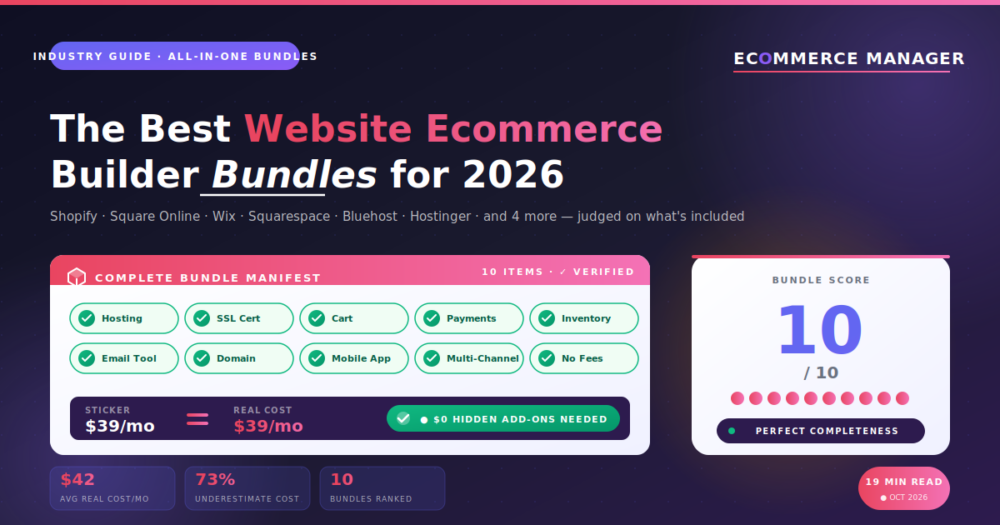
The honest ranking of all-in-one builder+host+store bundles, judged by what's actually included out of the box — not the $14.99 sticker price that balloons to $85 the moment you try to launch.
Here's the shell game nobody wants to call out loud: when a website builder advertises $14.99/month and calls itself "everything you need to sell online," they're counting on you not reading the fine print until month three. By then you've discovered the plan doesn't include enough bandwidth for product images, the email tool is a separate subscription, abandoned cart recovery is a $29/mo add-on, the "included" domain is actually only free for year one, and the payment processor adds 1-2% in transaction fees on top of normal card rates. Your $14.99/mo builder is now $65-$85/mo and you've spent 40 hours configuring extensions that should have been bundled. This guide ranks the 10 serious all-in-one builder bundles by what's actually included at the advertised price — the completeness that turns "website builder" into "I can actually run a business from this today."
Why Bundles Beat Piecing It Together (Even When Piecing It Looks Cheaper)
There's a certain breed of DIY-minded founder who looks at ecommerce builders and thinks: I can just buy hosting for $8, grab a free theme, use the free tier of a cart plugin, and connect Mailchimp's free plan. Why pay Shopify $39/month? And on paper, that math works. In practice, the person who tries this is still debugging checkout 60 days later while their all-in-one neighbor is on sale number 400. The bundle premium — paying one vendor one price for one integrated stack — is almost always worth it for anyone whose goal is to run a business rather than to run an infrastructure project.
What a real all-in-one bundle gives you is coherence. The hosting is tuned for the store software. The SSL renews automatically. The cart knows about the inventory which knows about the checkout which knows about the customer database which knows about the email tool. When something breaks, there is one phone number to call, not seven. For most SMB operators, that's worth paying $20-40/month more than the piecemeal alternative — because the piecemeal alternative costs you a weekend every time a plugin update breaks something.
But not all bundles are actual bundles. Some are marketing. The honest difference between a real bundle and a fake one shows up in a single question: at the sticker price, can I open for business and start taking real orders, with no mandatory add-ons? If the answer is yes, it's a real bundle. If the answer is "yes, but you'll want to add these five things," you're looking at a Trojan horse priced below the real cost.
The 10-Point Bundle Completeness Score
Every bundle in this guide is scored on 10 things that an actual working ecommerce store needs. The vendors that score 9-10/10 are legitimate all-in-one bundles. The vendors that score 5-6/10 are marketing dressed as bundles.
A perfect 10/10 bundle gives you hosting, a free SSL that auto-renews, a working cart with checkout, built-in payment processing, inventory management that handles real SKU counts, an email marketing tool with usable send limits, a free domain (at least for year one), a mobile admin app for order management, multi-channel selling (social, marketplaces, in-person), and no transaction fees beyond the standard card processing rate. Only one bundle in this list hits all ten. Most hit 7-8. The weak ones hit 5.
The Sticker-vs-Real-Cost Framework
Every bundle in this guide gets two prices: the sticker price (what the vendor advertises on the pricing page) and the real monthly cost (what you'll actually pay after the mandatory or near-mandatory add-ons the vendor conveniently leaves off the page). The gap between the two tells you more about the vendor than any marketing copy ever will.
Advertised Sticker Price
What the vendor's pricing page shows for the "ecommerce" or "commerce" or "business" tier. Usually the mid-tier offering, usually billed annually to make the number look smaller than it is.
Real Monthly Cost (Our Estimate)
Sticker price plus the add-ons most actual stores need: adequate bandwidth or product count, abandoned cart recovery, email marketing tool, essential apps, year-two domain renewal, SSL (if not included), and any mandatory transaction fees above standard card rates.
Transaction Fees Above Card Rates
Some bundles charge an extra 0.5-2% on top of normal card processing fees if you don't use their payment processor. On $100K/year revenue, 1% is $1,000/year in pure margin loss.
Year-Two Price Jumps
Introductory pricing that only applies for 12 months. Bluehost, GoDaddy, Hostinger, IONOS all do this. The year-two sticker is 50-150% higher than year one. Always calculate 3-year total cost.
Complete Comparison: 10 Website Ecommerce Builder Bundles
Ranked by Bundle Completeness Score with sticker vs real cost side-by-side. "Real Cost" is our honest estimate of what a serious SMB store will actually pay monthly after essential add-ons. "Transaction Fees" column is extra fees on top of standard 2.9% + $0.30 card processing.
| Builder Bundle | Best For | Bundle Score | Sticker / Real | Extra Txn Fees |
|---|---|---|---|---|
SH Shopify |
Serious SMB | 9/10 | $39/mo$55/mo real |
+0.5-2% |
SQ Square Online |
Hybrid Retail+Online | 10/10 | Free$0-$29/mo real |
NONE |
WX Wix Business |
Design-Flexible SMB | 8/10 | $27/mo$52/mo real |
NONE |
SS Squarespace |
Design-First Brands | 8/10 | $23/mo$45/mo real |
NONE |
BH Bluehost Ecom |
WordPress Devotees | 7/10 | $9.95/mo$42/mo real yr-2 |
NONE |
HG Hostinger Ecom |
Budget Launch | 7/10 | $3.99/mo$18/mo real yr-2 |
NONE |
WB Weebly (Square) |
Simple Starter | 7/10 | $12/mo$26/mo real |
NONE |
IO IONOS Ecom |
European SMB | 7/10 | $1/mo yr-1$30/mo real yr-2 |
NONE |
JM Jimdo |
Solo Founders | 6/10 | $19/mo$32/mo real |
NONE |
GD GoDaddy Online Store |
Domain-First Buyers | 6/10 | $16.99/mo$48/mo real yr-2 |
NONE |
Real cost accounts for essential add-ons the sticker price conveniently omits — email marketing at useful send limits, abandoned cart recovery, apps most stores actually need, bandwidth upgrades at real traffic levels, and year-two renewal pricing on bundles that use introductory discounts. Two bundles in this list have no gap between sticker and real cost: Square Online (because free actually means free) and Wix Business (because the add-ons are optional rather than near-mandatory). The biggest gaps show up in Bluehost and GoDaddy — not because they're bad products, but because the sticker prices rely on 36-month introductory contracts that renew at 2-4x the rate. If budget stability matters more than year-one savings, pay attention to the yr-2 real cost.
1. Shopify — The Gold Standard All-in-One Bundle
Shopify
Shopify is the honest right answer for "what's the best website ecommerce builder bundle" for the overwhelming majority of SMB operators. The $39/month Basic plan includes hosting, SSL, unlimited products, checkout, Shop Pay, inventory, discount codes, abandoned cart recovery (yes, actually included), basic email marketing through Shopify Email (10,000 free sends/month), a mobile admin app that genuinely works, and native multi-channel selling to Instagram, Facebook, TikTok, Google, and Amazon. The 9/10 bundle score drops a point only because Shopify Payments adds 0.5-2% in transaction fees if you use a different processor — a mild tax, not a dealbreaker.
The real cost of $55/mo (vs $39 sticker) accounts for the two or three apps most stores add in month one — usually a review tool like Judge.me, a loyalty tool, and sometimes a more sophisticated email tool like Klaviyo at a higher send volume. Those are optional additions, not mandatory. At the sticker price, you can open for business and take real orders. That's the test, and Shopify passes it cleanly.
2. Square Online — The Only Genuinely Free Bundle
Square Online
Square Online is the only bundle in this list that scores a perfect 10/10 on completeness, and it's the only one where "free" is actually free. The free tier includes hosting, SSL, a working cart and checkout, inventory management, native integration with Square POS (if you add physical retail later), basic email marketing, order management, and shipping tools. You pay only standard card processing fees (2.9% + $0.30 online, 2.6% + $0.10 in person). No monthly sticker to pay. No add-ons quietly required. This is as clean as the SaaS bundle category gets.
The honest trade-off: Square Online is optimized for simplicity, not for depth. Design flexibility is limited (you'll pick from a smaller template set than Wix or Squarespace). Advanced features like deep abandoned cart flows, sophisticated personalization, and complex multi-currency setups aren't here. For hybrid retail-online operations and businesses under $500K/year where simplicity beats sophistication: this is often the pragmatic right answer, and it's genuinely free. For scale operations that need deeper tooling: you'll outgrow Square at some point, and that's fine.
3. Wix Business — The Design-Flexible SMB Pick
Wix Business
Wix Business is the SMB-focused all-in-one that delivers more design flexibility than Shopify Basic without requiring a dedicated designer. The Core plan at $27/month includes hosting, SSL, unlimited products, abandoned cart recovery, Wix Payments, basic analytics, a free domain for year one, Instagram and Facebook selling, and the Wix Owner app for mobile management. Design freedom is genuinely stronger than Shopify — the drag-and-drop editor lets you build layouts that would require Shopify theme customization or Shogun add-ons.
The real cost gap ($27 sticker to $52 real) comes from Wix's app store, which is designed to upsell. Email marketing beyond a tiny free limit, advanced SEO tools, review widgets, and bandwidth upgrades at real traffic levels all cost extra. Transaction fees are zero (nice) but the mandatory year-two domain renewal and the stacked optional-but-needed apps push the real monthly cost closer to $50. For design-conscious SMBs who want flexibility beyond Shopify templates: Wix Business is a legitimate choice, as long as you set a strict apps budget on day one.
4. Squarespace Commerce — The Design-First Brand Builder
Squarespace Commerce
Squarespace is the honest right answer for anyone who cares about the site looking premium out of the box without hiring a designer. The Core plan at $23/month includes hosting, SSL, templates that competing builders can't match aesthetically, basic ecommerce, Squarespace Payments, a free domain for year one, abandoned cart recovery, product reviews, and the Fluid Engine editor (significantly better than Wix's drag-and-drop). For creators, service businesses, boutique brands, and anyone selling physical products where presentation matters: Squarespace is a legitimate consideration.
The real cost gap ($23 to $45) comes from the add-ons premium brands typically add: Squarespace Email Campaigns ($5-50/mo depending on sends), additional domain renewals, and sometimes Acuity Scheduling if you sell appointments. Transaction fees are zero at the Core tier and up, which is competitive. The honest limitation: ecommerce depth is weaker than Shopify, Wix, or BigCommerce — advanced inventory logic, complex shipping rules, and large SKU catalogs stretch Squarespace fast. Best fit: businesses under 500 SKUs where design matters more than depth.
5. Bluehost Ecommerce — WordPress + WooCommerce Bundle
Bluehost Ecommerce
Bluehost's ecommerce plans bundle managed WordPress hosting with WooCommerce pre-installed, giving you the open-source extensibility of WordPress with the convenience of a one-click launch. Year-one pricing at $9.95/month includes hosting, SSL, WooCommerce setup, Jetpack VaultPress backups, and basic analytics. The real appeal is what WordPress + WooCommerce gives you: ownership of your store, 60,000+ plugins, and the ability to scale without vendor lock-in.
The honest caveats: that $9.95 is year-one introductory pricing. Year two renews at $26.99-$32.99/month on the same plan. Add in a decent WooCommerce extension or two (shipping zones, email tool, abandoned cart recovery — none native) and the real yr-2 cost lands at $42/month. You're also responsible for WordPress updates and plugin compatibility, which is a time cost most SMB owners underestimate. For WordPress devotees who want ownership: legitimate. For launch-today-and-forget-it SMB operators: Shopify or Square Online will serve you better. (See our managed WooCommerce hosting guide for serious WooCommerce operators.)
6. Hostinger Ecommerce — The Aggressive-Pricing Bundle
Hostinger Ecommerce
Hostinger is the aggressive-pricing option in this list — $3.99/month gets you a legitimate ecommerce bundle with hosting, SSL, Hostinger Website Builder (their proprietary builder), basic cart, inventory for up to 500 products, 100 payment methods, and no transaction fees. The lineup is real enough that for operators with tight budgets and simple stores, Hostinger is a legitimate consideration — not just a cheap trap.
The fine print that gets you there: $3.99/mo requires a 48-month upfront commitment. Year-two renewal lands around $11.99/mo even at the discounted tier. Add essential upgrades (email marketing, more products, Hostinger Horizons for AI assistance) and you're at $18-22/mo real cost. Still cheap compared to Shopify, but no longer eyebrow-raising. Best fit: cost-sensitive solo founders, side projects, test stores, or budget-constrained non-profits where $18/mo matters more than any missing feature.
7. Weebly (by Square) — The Legacy Simple Starter
Weebly (by Square)
Weebly is now part of the Square ecosystem (acquired in 2018), which actually makes it more useful than when it was independent. The $12/month Pro plan includes hosting, SSL, drag-and-drop builder, cart, Square Payments backend, and native Square POS integration if you add physical retail. Square's commerce DNA makes this a legitimate hybrid starter at a lower price point than most alternatives.
The real cost of around $26/mo accounts for the more useful ecommerce features that live in higher Weebly tiers plus a modest email tool. The honest limitation: Weebly's drag-and-drop editor is dated compared to Wix or Squarespace, and the template library hasn't been refreshed as aggressively. For simple SMB stores where ease of launch and Square-native commerce matter more than modern design: Weebly is a legitimate budget pick. For anyone focused on brand presentation: Squarespace or Wix will serve you better.
8. IONOS Ecommerce — European SMB All-in-One
IONOS Ecommerce
IONOS is the European-strong all-in-one most US operators have never heard of, but it's a serious player across EU markets. The bundle includes hosting, SSL, free domain, website builder, shop module, GDPR-compliant tooling, and multi-language support that's genuinely better than most US-first competitors. For businesses selling into European markets or operating under GDPR requirements, IONOS removes a compliance burden that Shopify and Wix leave to apps and configuration.
The honest fine print: that $1/mo year-one price is promotional. Year two renews at $20-30/mo depending on tier. The template library is more utilitarian than aesthetic — if design flexibility matters, Wix or Squarespace serves you better. US customer support is weaker than EU support (reflecting IONOS's center of gravity). For EU-based SMBs or US businesses that need serious European presence: legitimate consideration. For US-only operators: Shopify or Wix make more sense.
9. Jimdo — The AI-Assisted Solo Founder Bundle
Jimdo
Jimdo is the German-born AI-assisted builder that pairs a conversational site creator ("Dolphin") with an ecommerce bundle aimed at solo founders. Answer a dozen questions and Jimdo generates a complete site structure, content, and store setup — then you edit from there. The $19/mo Grow plan includes hosting, SSL, store with up to 100 products, custom domain, basic email features, and the AI assistant. For non-designers who want a site live in an afternoon: legitimately useful.
The 6/10 score reflects ecosystem limits — fewer apps, weaker multi-channel integrations, and modest advanced features compared to Shopify or Wix. Real cost of around $32/mo accounts for upgrading to Grow Legend (higher product limits, better store features) and modest email add-ons. Best fit: solo founders, service businesses adding light ecommerce, operators who prize launch speed over long-term depth. For scale operations: outgrows quickly.
10. GoDaddy Online Store — The Domain-First Bundle
GoDaddy Online Store
GoDaddy's Online Store is the massive-brand-recognition bundle designed to convert the 21M+ customers who buy domains from GoDaddy into GoDaddy store owners. The $16.99/mo tier includes hosting, SSL, a builder, basic cart, inventory, and multi-channel selling to Facebook, Instagram, Amazon, and eBay. For buyers already in the GoDaddy ecosystem who want everything on one bill: the convenience is real.
The honest fine print: $16.99 is year-one introductory. Year two renews closer to $29.99-$36.99/mo depending on tier, and essential add-ons (abandoned cart recovery, better email, SEO tools) push real yr-2 cost toward $48/mo. GoDaddy's builder is functional but not as polished as Wix or Squarespace, and the ecommerce depth is weaker than Shopify. Best fit: existing GoDaddy customers who value one-vendor convenience over best-of-breed tooling. For anyone starting fresh: Shopify, Wix, or Square Online will serve you better per dollar.
The Sticker-vs-Real Cost Math on $100K/Year Revenue
Let's run the honest 3-year math on a hypothetical store doing $100K/year in revenue, because this is where the sticker price games really hurt operators who didn't do the math:
The Mandatory Domain Renewal Trap
Every bundle in this list advertises "free domain" — and every single one of them means "free for year one only." Year-two renewal lands at $15-25 for standard .com domains, and premium domains renew at 2-5x the standard price. Vendors won't warn you before auto-charging. Set a calendar reminder 60 days before your year-one anniversary to decide whether to renew, transfer the domain to a cheaper registrar, or let it expire. Over 10 years, a mis-renewed premium domain can quietly cost you $500-$2,000 you never budgeted for. Treat the "free domain" line as a year-one gift, not a permanent feature.
Red Flags Every Builder Bundle Buyer Should Watch For
- 36-48 month contracts required for sticker pricing. If the advertised price requires signing up for 3-4 years upfront, you're locked into a vendor whose service may degrade over that timeframe. Monthly or annual billing with price-lock is the healthy pattern.
- Abandoned cart recovery as a paid add-on. In 2026 this is a basic ecommerce feature. If a vendor charges extra for it, the bundle isn't actually a bundle.
- "Free email tool" with absurd send limits. 100 sends/month isn't an email tool, it's a demo. Verify the actual send volume included before signing — most useful tiers start at 10K+ sends.
- Transaction fees above standard card processing. If you're paying 2.9% + $0.30 for card processing, that's normal. If the bundle also takes an extra 1-2% because you didn't use their payment processor, that's a tax on your margin.
- Year-two renewal pricing hidden on the pricing page. Honest vendors show both year-one and year-two pricing. Dishonest ones hide the renewal price in footnotes or terms of service. Hunt for the number before signing.
- SSL as a paid add-on. Any bundle that charges extra for SSL in 2026 is quietly admitting their stack is 10 years out of date. Walk away.
- No mobile admin app. In 2026 you need to manage orders and respond to customers from your phone. If the vendor only has a mobile preview, not a working admin app, scale will be painful.
How to Actually Choose Your Builder Bundle
1. What's your realistic 12-month budget?
💸 Under $300/year total
Square Online Free — the only genuinely free option that scales
💰 $300-$600/year total
Wix Business or Squarespace Core
💳 $600-$1,000/year total
Shopify Basic — depth-for-dollar leader
🏢 $1,500+/year total
Shopify Advanced or Shopify Plus for scale
2. What's your biggest need right now?
Launch today: Square Online Free (fastest, free). Deep ecommerce features: Shopify Basic. Design flexibility: Wix Business or Squarespace. WordPress ecosystem ownership: Bluehost Ecommerce or managed WooCommerce hosting. Hybrid retail+online: Square Online or Shopify (with Shopify POS). European markets with GDPR: IONOS.
3. What's your realistic 3-year revenue projection?
Under $100K: free or $23-39/mo tier is fine. $100K-$500K: $39-79/mo tier matters because feature depth starts paying for itself. $500K-$2M: $79-299/mo tier is justified by the apps and features saving operational time. $2M+: Shopify Advanced or Plus, or move to BigCommerce/custom. Pay for the tier your realistic 12-month-forward volume justifies, not the tier your current size requires.
4. What's your tolerance for ongoing maintenance?
Zero tolerance (want to focus on marketing and products): Shopify, Square Online, Wix. These are managed SaaS that update themselves. Medium tolerance (willing to configure plugins and manage updates): Bluehost + WordPress + WooCommerce. High tolerance (want full ownership and control): managed WooCommerce hosting with your own developer. Match the tool to your actual appetite for infrastructure work.
The Honest Bottom Line
Across 10 serious website ecommerce builder bundles, three honest winners emerge for different buyers. Shopify is the right answer for serious SMB operators who want depth and are willing to pay $39-55/mo real for it. Square Online is the right answer for hybrid retail+online operators and budget-constrained starters who want a legitimate free bundle (and the only perfect 10/10 completeness score in this list). Wix Business or Squarespace Commerce are the right answers for design-conscious SMBs where presentation matters more than ecommerce depth.
Everything below the top four is a situational pick: Bluehost for WordPress devotees, Hostinger for aggressive budgets, Weebly for Square-ecosystem simplicity, IONOS for EU operations, Jimdo for AI-assisted solo launches, GoDaddy for existing GoDaddy customers. None of these are bad products — they're just better matched to specific operator profiles than the top four.
The move that will cost you the most money is picking any bundle based solely on sticker price without doing the sticker-vs-real-cost math. Spend 20 minutes writing out what each vendor actually includes versus what you'll pay extra for in month three. The vendor that wins that honest comparison is almost always worth $5-15/month more than the headline cheapest option, because you'll stop paying for mistakes you didn't know you were making. For related angles see our general website builders guide, our SMB-focused builders breakdown, and our stage-fit platform guide.
Running a Builder Bundle Evaluation?
The eCommerce Manager helps operators pressure-test builder bundles against real-world cost — no vendor affiliate incentives, no sticker-price nonsense.
Get an Unbiased Bundle Review →