Last Updated on November 1, 2026
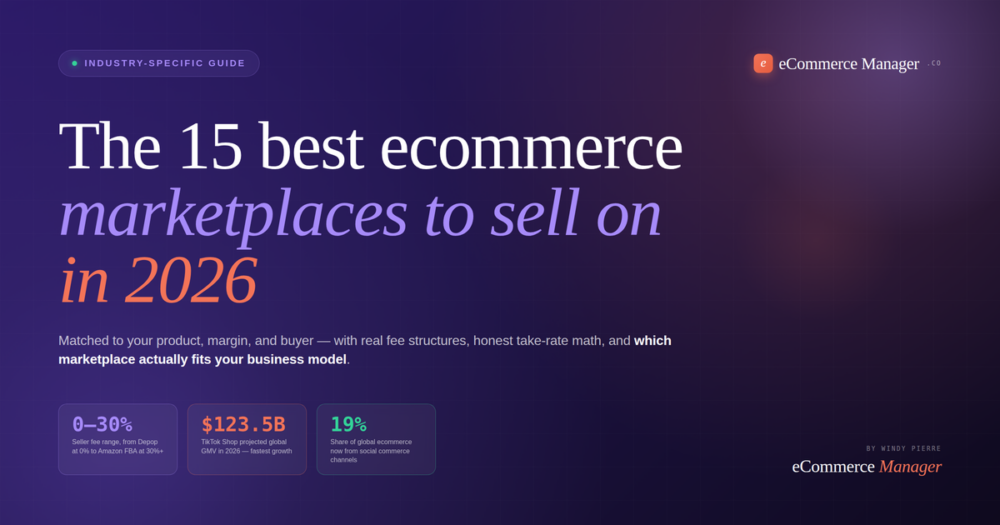
The 15 best ecommerce marketplaces to sell on in 2026 — matched to your product, margin, and buyer
Most "best marketplaces for sellers" listicles rank Amazon first and call it a day. That's useless if your margins can't absorb 15% referral plus 25% advertising spend. This guide breaks down 15 marketplaces across five tiers — major general, social commerce, niche vertical, wholesale B2B, and resale — with real 2026 fee structures, buyer-base data, and the operator take on which actually fits your business model.
Why fee percentage isn't the right lens
Every "best marketplaces" roundup makes the same mistake. It ranks platforms by fee percentage and calls that analysis. Fee percentage is the least important variable in whether a marketplace works for your brand.
Here's the real framework. A marketplace is a buyer base plus a fee structure plus a set of operational demands. The right one for your brand is the one where the buyer base genuinely matches your product, the fees your margins can actually absorb, and the operational demands you can meet without burning out. Pick based on fee alone and you'll end up on Walmart Marketplace selling a $12 handmade candle to shoppers looking for $4 commodity goods — technically cheaper fees, zero sales. Pick based on hype alone and you'll end up on TikTok Shop trying to sell $200 skincare to a Gen Z audience shopping for $8 impulse buys. Fit matters more than any single variable.
The 15 marketplaces below cover five tiers that solve genuinely different problems. Major general-purpose marketplaces (Amazon, Walmart, eBay) are the volume plays — biggest buyer bases, highest fees, most competitive, worth it only when your product-market fit is already proven and you have margin to feed the machine. Social commerce platforms (TikTok Shop, Instagram Shopping, Facebook Marketplace) convert content into commerce when your product has visual appeal and your creative pipeline can keep up. Niche vertical marketplaces (Etsy, Reverb, StockX, Depop) have smaller buyer bases but dramatically higher intent for category-specific products. Wholesale B2B marketplaces (Faire, Alibaba, Tundra) exist for brands selling to retailers rather than consumers. And resale/peer-to-peer platforms (Poshmark, Mercari, Whatnot) serve specific resale and secondary-market dynamics most brands shouldn't touch but some should prioritize.
Pick the wrong tier and even the "cheapest" marketplace will fail you. Pick the right one and even a 20% fee can be the most profitable channel in your mix. That's what this guide is about.
The full comparison table
All 15 marketplaces grouped by tier, with current fee structure, best-fit category, and the honest operator take. Full write-ups follow below.
| Marketplace | Tier | Seller fees | Best-fit category |
|---|---|---|---|
| Amazon | Major general | $39.99/mo + 8–15% | Broad DTC at scale |
| Walmart Marketplace | Major general | 6–15%, no monthly | Established brands |
| eBay | Major general | ~13.6% + $0.40 | Used, collectibles, deals |
| Target Plus | Major general | 5–15%, invite-only | Premium DTC brands |
| TikTok Shop | 6% (3% first 30 days) | Impulse + video-friendly | |
| Instagram Shopping | 5% per shipment | Visual DTC brands | |
| Facebook Marketplace | Free local / 5% shipped | Local sales, basics | |
| Etsy | Niche | $0.20 + 6.5% + 3% | Handmade, vintage, craft |
| StockX | Niche | 8–10% + 3% processing | Sneakers, streetwear |
| Reverb | Niche | 5% + 2.7% processing | Musical instruments |
| Faire | Wholesale | 25% first / 15% after | DTC-to-retail wholesale |
| Alibaba | Wholesale | $1,999–$5,999/yr | B2B global export |
| Poshmark | Resale | 20% ($2.95 under $15) | Brand-name fashion |
| Whatnot | Resale | 8% + 2.9% + $0.30 | Live auctions, collectibles |
| Depop | Resale | 0% + 3.3% processing | Y2K, streetwear, vintage |
Major general-purpose marketplaces
Four marketplaces competing for the biggest share of general ecommerce in 2026. Each has a buyer base in the hundreds of millions and fees that reflect that scale. These are the volume plays — the right pick when you have product-market fit, pricing muscle, and the margin to feed advertising budgets that make visibility possible.
01Amazon
Amazon is the largest buyer base in ecommerce and the most expensive marketplace to actually win on. The published fees look reasonable — $39.99/month Professional plan plus 8-15% referral fee by category. The reality is messier. Successful Amazon sellers typically spend 15-30% of revenue on Amazon PPC advertising to maintain visibility. FBA fees run $3.45-$8+ per unit for fulfillment plus $0.87-$2.40/cubic foot/month for storage. By the time you've added all of it up, Amazon takes 30-40% of gross revenue on most products shipped FBA.
What Amazon buys you for that take-rate: buyer traffic no other marketplace can match. Prime delivery infrastructure. A review system that compounds credibility over years. The real question isn't whether Amazon fees are high — they are — it's whether your margin structure can absorb a 30-40% take and still generate the net profit your business needs. Fast-moving $25-$75 products with 70%+ gross margins thrive on Amazon. $8 commodity goods with 40% margins get crushed.
Model your target net margin at a 35% Amazon take-rate including ads before you sign up. If the math doesn't work with those assumptions, Amazon won't rescue the economics — it'll amplify the problem. Walmart Marketplace is often the smarter first choice for brands with tighter margins.
Walmart Marketplace is the leanest fee structure of any major marketplace and the right pick for established brands with clean operations. No monthly subscription. Referral fees of 6-15% by category (most goods land at 6-8%, which beats Amazon's 15% baseline). Payment processing bundled into the referral. The all-in take-rate typically runs 8-18%, meaningfully cheaper than Amazon's 30-40% with FBA. That difference compounds — a $100K/month Walmart seller saves roughly $20K/month in fees versus the same volume on Amazon.
The catches are real. Walmart uses an application-based approval process and favors established brands with clean track records, clear supply chains, and competitive pricing. New sellers and tight-margin dropshippers often don't get approved. The buyer base is smaller than Amazon's but genuinely substantial — Walmart.com now accounts for the second-largest US ecommerce traffic share after Amazon. For sellers who can clear the approval bar, Walmart is frequently the highest-profit marketplace channel.
Walmart Marketplace is the smartest major-marketplace pick for established DTC brands with margin pressure. Apply once you have 6+ months of clean operations and competitive pricing. The approval delay is real but worth the wait — the fee savings versus Amazon pay for themselves fast.
03eBay
eBay in 2026 is a different marketplace than most sellers remember. The auction mechanic still exists but Buy It Now dominates. The buyer base skews toward deals, used goods, collectibles, refurbished electronics, and category-specific hunters who know exactly what they want. For new DTC brands launching mainstream products, Amazon and Walmart are better fits. For brands with used inventory, surplus stock, open-box returns, refurbished product lines, or genuinely unique collectible items, eBay remains the best-converting marketplace in the category.
Fees run around 13.6% final value plus $0.30-$0.40 per order for most categories, plus 1.65% additional for international sales. Store subscriptions ($4.95-$299.95/month) reduce insertion fees for high-volume sellers but aren't necessary for most. The real cost consideration is promoted listings — eBay's advertising mechanic that adds 2-15% on top of base fees when attributed. Most serious sellers end up at 15-20% total take-rate once promoted listings are active.
eBay is overlooked by most DTC brands and underrated as a channel for the right products. If you have refurbished inventory, open-box returns, limited-run products, or anything in the collectibles-adjacent category, eBay converts measurably better than Amazon for those SKUs. Skip it for new mainstream DTC product launches.
Target Plus is the invite-only marketplace layer on Target.com, and the hardest marketplace on this list to get into. Target hand-selects brands based on fit with their customer base (median household income higher than Amazon shoppers, skews toward home goods, beauty, baby, and lifestyle categories). Referral fees run 5-15% depending on category. The approval process can take 6-12 months of outreach and isn't guaranteed to land even for well-qualified brands.
Where Target Plus wins: the buyer base is one of the highest-converting in US ecommerce. Target shoppers are category-loyal, higher-AOV, and genuinely willing to buy mid-premium DTC products they wouldn't bother clicking on Amazon. For brands fitting Target's aesthetic (clean branding, home/beauty/lifestyle, mid-premium pricing), this is often the most profitable channel in the mix. For brands outside that fit, it's not even worth applying.
Target Plus is worth pursuing only if your brand fits Target's existing customer base and aesthetic — home, beauty, baby, wellness, lifestyle. For mass-market or discount-tier brands, Walmart Marketplace is the better fit. Target Plus application is a 6-12 month play; start the conversation early if the fit is there.
Launching across multiple marketplaces? The operational complexity scales faster than most brands expect.
Browse our directory of vetted DTC agencies specializing in multi-marketplace management and Amazon/Walmart optimization.
Social commerce platforms
Social commerce now accounts for roughly 19% of global ecommerce sales, led almost entirely by TikTok Shop's explosive growth. These three platforms turn content into commerce — the right pick for visually-interesting products with creative pipelines that can keep up.
TikTok Shop is the fastest-growing marketplace of 2026 and the cheapest flat fee of any major platform. A 6% referral fee covers everything including payment processing. New sellers get a promotional 3% rate for the first 30 days. Fulfilled by TikTok (FBT) is available for brands wanting hands-off shipping. The platform now has 15M+ sellers globally and is projected to hit $123.5B in GMV in 2026.
What TikTok Shop demands in exchange for low fees: content velocity. The platform rewards sellers who produce short-form video consistently, partner with creators through the Affiliate Program, and run livestreams. SKUs that work are visual, demonstrable in 15-60 seconds, and priced for impulse ($10-$75 sweet spot). Static listings without content support rarely gain traction. The fee is low because the content is what drives discovery, not the listing itself.
TikTok Shop makes sense if you can produce or source short-form video content weekly. Without a creative pipeline — your own, your creators', or an agency's — the low fees don't matter because the algorithm never surfaces your SKUs. Fee advantage is useless without content velocity.
Instagram Shopping is less a marketplace and more a discovery layer that routes buyers to your Shopify checkout or Instagram's native in-app checkout. The fee structure is 5% per shipment for native checkout orders, or zero if you route traffic to your own store. For visual DTC brands — fashion, beauty, home, accessories, lifestyle — Instagram's product tagging in posts, Reels, and Stories remains one of the highest-intent discovery channels available.
The honest 2026 take: Instagram Shopping's native checkout usage has declined versus its peak and most savvy brands route to their own storefronts instead. The real value is tagging products in organic content, Reels, and influencer collaborations to drive traffic to your own margin-preserving checkout. Treat it as a discovery and attribution channel rather than a destination marketplace, and the ROI math works consistently.
Use Instagram as discovery, not as a destination. Set up the shop, tag products in every piece of content, and route traffic to your Shopify store rather than enabling in-app checkout. The 5% selling fee adds up fast when you could keep that margin by sending clicks to your own site.
Facebook Marketplace is the overlooked channel most DTC brands dismiss and some use quietly for meaningful revenue. For local pickup transactions, listings are free. For shipped sales, Facebook charges 5% per shipment or $0.40 minimum. The buyer base skews toward value-conscious shoppers, local pickup transactions, and surplus/overstock buyers. For DTC brands, the specific use case is clearing surplus inventory, open-box returns, or seasonal overstock at discount prices without cannibalizing primary channel pricing.
The limitations are real. Facebook Marketplace isn't a brand-building channel. The listing experience is utilitarian. Discovery is uneven. Most product categories convert worse there than on dedicated commerce marketplaces. But for specific use cases — liquidating 500 units of discontinued seasonal product you don't want polluting your Amazon or Shopify presence — Facebook Marketplace clears inventory with minimal fees and maintained brand hygiene.
Facebook Marketplace is a surplus-and-liquidation channel for DTC brands, not a primary marketplace. Use it quietly to clear overstock without affecting your main channel pricing or brand positioning. For primary sales, every other marketplace in this guide is a better fit.
Niche vertical marketplaces
These three marketplaces trade general audience size for category-specific intent. Smaller buyer bases, but buyers who are actively hunting for exactly what you sell. For the right product category, intent-driven marketplaces consistently out-convert general ones at the same fee percentage.
08Etsy
Etsy remains the dominant marketplace for handmade, vintage, and craft categories by a margin that no competitor has meaningfully challenged. The buyer base genuinely searches for unique, artisanal, and gift-oriented products that would convert poorly on Amazon. Fees run $0.20 per listing (valid 4 months) plus 6.5% transaction plus 3% + $0.25 payment processing — roughly 10% all-in before advertising. The catch is Offsite Ads, which can add 12-15% when attributed, pushing total costs above 25% on individual sales.
Where Etsy excels: handmade goods, personalized items, vintage/thrift, wedding and gift categories, print-on-demand, digital downloads. Where it struggles: mass-produced DTC product (buyers filter it out), high-ticket items ($200+), tech-adjacent categories, products with no "crafted" angle. Match the product to the buyer intent and Etsy's conversion rates are category-leading. Mismatch and you'll pay 10% fees for zero sales.
Opt out of Offsite Ads if you can — it caps total attributed advertising costs that quickly erode margin. Sellers above $10K/year in Etsy sales are automatically enrolled and can't fully opt out, so model the attributed-ad cost into your pricing from the start.
09StockX
StockX is the dominant marketplace for sneakers, streetwear, trading cards, and collectibles with authenticated-item resale as the mechanic. Every product shipped through StockX gets authenticated before reaching the buyer, which eliminates the counterfeit anxiety that drives buyers away from eBay for these categories. Fees run 8-10% transaction based on seller level plus 3% payment processing. The platform works both as a resale marketplace and a direct-sell channel for brands with limited drops.
Where StockX wins: anything in sneakers, streetwear hype drops, trading cards, electronics, luxury handbags. The transparent pricing (last sale, bid/ask spreads) creates genuine price discovery that benefits sellers of hot inventory. Where it's not a fit: anything outside those categories, lower-value items where authentication adds friction without matching value, or new launches without existing resale velocity. Not every brand should be on StockX; the ones that should know who they are.
StockX is category-locked. If you don't sell authenticated-item-adjacent categories (sneakers, streetwear, cards, watches, electronics), skip it entirely. For brands IN those categories, StockX is often more profitable per unit than Amazon or eBay for hot SKUs.
10Reverb
Reverb is the dominant marketplace for musical instruments, gear, and audio equipment — guitars, synths, drums, effects pedals, studio gear, DJ equipment. The buyer base is category-expert, intent-driven, and willing to pay fair-market prices for specific items in ways that generic marketplaces can't match. Fees run 5% selling plus 2.7% + $0.25 processing — roughly 8% all-in, among the cheapest fees of any specialty marketplace.
Why this works: music gear buyers want to be on Reverb specifically. The platform's search, category expertise, and community credibility mean a $1,500 vintage synth sells faster and at better prices there than on eBay. For brands in instrument-adjacent categories (gear accessories, strings, cables, software), Reverb is often the first marketplace to list on even before Amazon. For brands outside music, it's not relevant at all.
Reverb is the model for what niche marketplaces should do. If your product fits a specific vertical community (fishing, cycling, 3D printing, home brewing, specific hobbies), look for the Reverb-equivalent in that niche before defaulting to Amazon. The intent-matching conversion lift usually justifies the smaller audience.
Wholesale & B2B marketplaces
These two marketplaces exist for brands selling to other businesses — retailers stocking shelves, boutiques buying wholesale, or B2B buyers sourcing commercial inventory. Different economics, different scale, often different division of the brand's revenue stack.
11Faire
Faire is the dominant wholesale marketplace connecting DTC brands with independent retailers — boutiques, gift shops, home stores, coffee shops, bookstores. For brands wanting to expand distribution beyond their own ecommerce site without the enterprise-sales motion of going direct to retail chains, Faire is the clear path. 700K+ active retailers browse the platform. Commission runs 25% on first orders from a new retailer, dropping to 15% on all subsequent orders from that retailer.
The economics work for brands with wholesale-ready margins (typically products with 60%+ margins at direct retail pricing) because Faire's 15% commission on repeat orders is substantially cheaper than hiring sales reps or doing trade-show prospecting to reach the same 700K retailers. For brands without wholesale margin headroom, Faire isn't profitable — the 25% first-order commission alone would eliminate the margin on most direct-to-consumer products priced at retail.
Faire requires genuine wholesale pricing structure (typically 50% off MSRP to the retailer). If you don't currently sell wholesale, Faire isn't a shortcut around setting up wholesale operations — it's a distribution channel for brands that already have wholesale pricing nailed. Set up your wholesale economics first, then list on Faire.
Alibaba.com (the B2B marketplace, not consumer-facing AliExpress) is the global wholesale platform most US sellers associate with sourcing but under-use as a selling channel. For manufacturers, private-label brands, and B2B suppliers wanting international distribution, Alibaba connects you with buyers in 190+ countries looking to source bulk inventory. Fees run on an annual subscription model — Gold Supplier membership at $1,999-$5,999/year — plus 0% transaction fees for most categories (2% for US sellers in specific categories).
The reality for most DTC brands: Alibaba as a selling platform is overkill unless you're manufacturing at scale or specifically targeting international wholesale buyers. The platform's buyer base is sourcing wholesale, not retail quantities. Minimum order quantities (MOQs), international shipping logistics, and B2B payment terms all add operational complexity most consumer DTC brands shouldn't take on. For brands that fit the profile, however — manufacturers, private-label operators, international wholesale ambitions — Alibaba is the only platform at this scale.
Alibaba as a selling channel makes sense for manufacturers and private-label brands with real wholesale ambitions. Skip it entirely if you're a consumer DTC brand without manufacturing capacity — the operational complexity of international B2B shipping and payment terms isn't worth the exposure.
Modeling the true take-rate across multiple marketplaces at your target revenue?
Run our Marketplace Calculator to compare total fees — including advertising spend and processing — across your top channel options.
Resale & peer-to-peer platforms
These three marketplaces serve resale and secondary-market dynamics that most brands shouldn't touch — but some should prioritize. For brands with excess inventory, used-item returns, or category-adjacent resale communities, these platforms unlock revenue that primary channels can't.
13Poshmark
Poshmark is the highest-fee marketplace on this list — 20% flat on sales $15 and up, or $2.95 under $15 — and remains dominant in brand-name fashion resale because the social-selling community mechanic genuinely works. Sellers "share" each other's listings into followers' feeds, which creates discovery that no algorithm-only marketplace matches. For brand-name fashion, athletic apparel, handbags, and accessories, Poshmark converts measurably better than eBay despite the higher fees.
For most DTC brands, Poshmark isn't a primary channel. It's a resale platform for brand-name goods, not a merchant marketplace. The specific use case: liquidating returns, excess seasonal inventory, or sampling fulfillment of brand-name fashion items where the Poshmark community explicitly looks for them. For non-fashion DTC brands, skip it. For fashion brands with resale-worthy inventory, the 20% fee is often worth it for the community-driven conversion.
Poshmark's 20% is only worth it if you have brand-name fashion resale inventory the community actively hunts for. For original DTC product sales, every other marketplace in this list has better fee economics. For fashion resale, Poshmark's conversion rate justifies the premium.
14Whatnot
Whatnot is the fastest-growing live-auction marketplace, specializing in collectibles, trading cards, sneakers, vintage, and comics. Sellers broadcast live streams where buyers bid in real-time on individual items, often opening sealed products on camera. Fees run 8% commission plus 2.9% + $0.30 processing — meaningfully cheaper than Poshmark's 20% for collectible-category sellers who can hold audience attention.
The energy cost is real. Whatnot requires actual live streaming — typically 2-6 hour sessions multiple times per week to build audience. Successful Whatnot sellers are entertainment-first, product-second. For DTC brands with collectible or trading-card adjacent products and the willingness to stream, the economics can be exceptional. For brands without the energy for live streaming, the time investment doesn't justify the lower fees versus static listing marketplaces.
Whatnot requires live-streaming commitment that most ecommerce brands aren't built for. If you can commit to 2-6 hour streams multiple times per week in collectibles-adjacent categories, the audience-building is real. If not, pass — the fee advantage is irrelevant without the live-selling muscle to use it.
15Depop
Depop removed its 10% selling commission for US and UK sellers in 2024 and remains the lowest-fee marketplace on this list for the categories it serves. US sellers pay 0% commission plus 3.3% + $0.45 payment processing — effectively just the credit card processing cost. The audience skews Gen Z (16-26), heavily fashion-focused, with specific intent for vintage, Y2K, streetwear, and secondhand designer pieces. Buyers expect styled photography; competent product shots don't win on Depop.
For DTC fashion brands with Y2K-adjacent aesthetic, vintage inventory, or styled resale potential, Depop is genuinely competitive. For mass-market DTC fashion or non-fashion brands entirely, the audience fit isn't there. The fee advantage is only meaningful if the buyer base matches your product. 0% fees on zero sales is still zero revenue.
Depop's zero commission is category-locked to Gen Z fashion with styled visuals. For non-fashion DTC brands, the fee advantage doesn't translate because the audience isn't there. For fashion brands with the right aesthetic and visual commitment, Depop is one of the most profitable marketplaces of 2026.
5 filters before you list
Every marketplace on this list is genuinely profitable for the right seller. Every one of them will burn margin for the wrong seller. Run your shortlist through these five filters before you create an account.
Match marketplace buyer base to your product category
Buyer-base fit matters more than fee percentage. A $12 handmade candle on Walmart earns zero sales at 6% fees; the same candle on Etsy at 10% fees sells consistently. Pick based on where your buyers actually shop, not where fees are cheapest.
Model total take-rate including advertising
Published fees are only part of the cost. Amazon with FBA plus ads runs 30-40% total take-rate. Etsy with Offsite Ads can exceed 25%. Model your target net margin against realistic total costs, not the headline referral fee.
Audit your margin headroom honestly
Different marketplaces require different margin structures. Amazon needs 70%+ gross margins to work. Walmart needs 50%+. Faire needs genuine 50%-off-MSRP wholesale pricing. Picking a marketplace your margins can't sustain is slow bleeding.
Test the operational demands before scaling
TikTok Shop needs content velocity. Whatnot needs live streaming. Amazon needs PPC management. Each marketplace has specific operational demands beyond listing creation. Pilot one SKU before committing full inventory to confirm you can meet the demands.
Focus one marketplace fully before adding another
Multi-marketplace selling sounds appealing until you're running 5 channels poorly instead of 1 channel well. Nail your first marketplace completely — reviews, ranking, pricing, operations — before expanding. The threshold to add a second is roughly $20K/month on your first.
The single most common marketplace mistake sellers make: picking Amazon by default without modeling the real take-rate math. A $25 product with a 50% gross margin feels like a healthy sale until Amazon takes 15% referral, FBA takes $5.45, advertising takes 20%, and you're netting roughly $3 per unit after cost of goods — before paying yourself, inventory financing, or any growth investment. Meanwhile the same product on Walmart Marketplace at 8% referral with lower advertising requirements nets $8 per unit on the same volume. Published fees aren't the economics. The real economics are what hits your bank account after all costs. Model the full picture before you list.
Channel stack by revenue stage
Here's the honest, stage-by-stage priority stack for which of the 15 marketplaces should be your focus based on where your ecommerce business is today.
Prove product-market fit
- Primary: Your own Shopify store
- Add 1: Etsy if handmade/craft
- Add 1: TikTok Shop if video-friendly
- Skip: Amazon until ready
- Focus: One channel, nailed completely
Scale channel mix
- Add: Amazon or Walmart as volume play
- Keep: Shopify as margin-preserving home
- Add: Faire if wholesale-ready margins
- Pilot: TikTok Shop if content fits
- Focus: 3 channels max, operational quality
Omnichannel infrastructure
- Full: Amazon, Walmart, Shopify
- Add: Target Plus if brand fit (invite)
- Add: Faire for retail distribution
- Tools: Multi-marketplace mgmt software
- Focus: Attribution, inventory, team
Every "best marketplaces" listicle wants to declare one winner. The truth in 2026 is that there are five different winners depending on your product category, margin structure, and operational capacity: Amazon for scale when margins can absorb 30-40% take-rate, Walmart for value when you're margin-pressed but established, Etsy for intent-driven handmade and vintage, TikTok Shop for impulse buys with content pipelines, and Faire for wholesale distribution. The brands winning marketplace strategy in 2026 aren't the ones listed on every platform — they're the ones that picked the two or three that genuinely fit their product and operational capacity, nailed those completely, and ignored the rest. Match the marketplace to your business model, not to fee percentage or hype.
FAQ
The best marketplace depends on what you sell and your margin structure. For general broad-category DTC brands chasing scale: Amazon ($39.99/mo Pro + 8-15% referral) remains the biggest buyer base. For established brands with clean branding and the margin to absorb competitive pricing: Walmart Marketplace (no monthly fee + 6-15% referral) has the lowest all-in cost structure. For handmade, vintage, and craft: Etsy ($0.20/listing + 6.5% + 3%+$0.25 processing) has the intent-driven buyer base. For social commerce and short-form video: TikTok Shop at 6% referral is the cheapest major marketplace and the fastest-growing. For wholesale/B2B: Faire (25% first order, 15% after). The strategic mistake is picking a marketplace by fee percentage alone — the right question is which marketplace's buyer base actually matches your product.
For traditional marketplaces with full features: TikTok Shop at 6% (3% promotional for new sellers' first 30 days) is the lowest flat rate. Depop charges US sellers 0% commission (just 3.3% + $0.45 processing) after removing its 10% fee in 2024. Vinted charges 0% to sellers entirely. Among major general marketplaces, Walmart's 6-15% referral range beats Amazon's 15% for most categories. Poshmark is the most expensive at 20% flat on sales $15+. But the lowest-fee marketplace isn't automatically the best one for your brand — a 6% fee on a marketplace with no buyer traffic for your category earns you less than a 15% fee on Amazon where your product actually sells. Match the marketplace to buyer base before fee percentage.
Both. The honest 2026 answer for most DTC brands: Amazon for discovery and volume, Shopify for brand building and margin preservation. Amazon's 15% referral plus 15-30% advertising spend plus FBA fees (if used) often eat 30-40% of gross revenue, versus Shopify's roughly 3.2% all-in using Shopify Payments. But Amazon brings buyer traffic Shopify never will. The playbook most successful brands run: launch on Shopify to establish brand and margin, add Amazon once product-market fit is clear to capture buyers already shopping there, use Amazon inserts and email capture to migrate repeat customers back to the Shopify store where margin is 10x better. Treating the two as competing channels is the wrong framing — they serve different stages of the customer journey.
The published fee percentages are only half the story. On Amazon with FBA, total take-rate typically runs 30-40% of gross revenue after referral fees (15%), FBA fulfillment fees ($3.45-$8+ per unit), FBA storage fees ($0.87-$2.40/cubic foot/month), and advertising (15-30% of revenue for most sellers to maintain visibility). On eBay with promoted listings active, 15-20% is realistic. On Etsy with Offsite Ads attributed, total costs can exceed 25% on individual sales. On Walmart Marketplace without the advertising requirement, 8-18% is the realistic range. Model your target revenue against the realistic take-rate including advertising, not just the published referral fee. Most sellers who think they're netting 85% on a $100 sale are actually netting 60-65% once all fees are counted.
Focus one, then expand. The pattern that works for most sellers: nail one marketplace completely — rank for your core keywords, build review velocity, nail your pricing — before adding a second channel. Multi-marketplace tools (Sellbrite, Linnworks, ChannelAdvisor, Zentail) genuinely help once you're running 3+ marketplaces, but they're overkill when you're on just Amazon or just Etsy. The threshold to justify multi-marketplace management tools is roughly $50K/month across platforms — below that, direct platform management is faster. Above that, the operational savings of unified inventory, orders, and listing management typically pay for the tool subscription in a month. Don't buy multi-marketplace tools because you plan to expand; buy them when expansion is genuinely creating operational friction.

Ready to systematically pick the right marketplace mix?
Run our Marketplace Calculator to model total take-rate including advertising across your top channel options, or browse vetted agencies that specialize in multi-channel ecommerce.