Last Updated on October 28, 2026
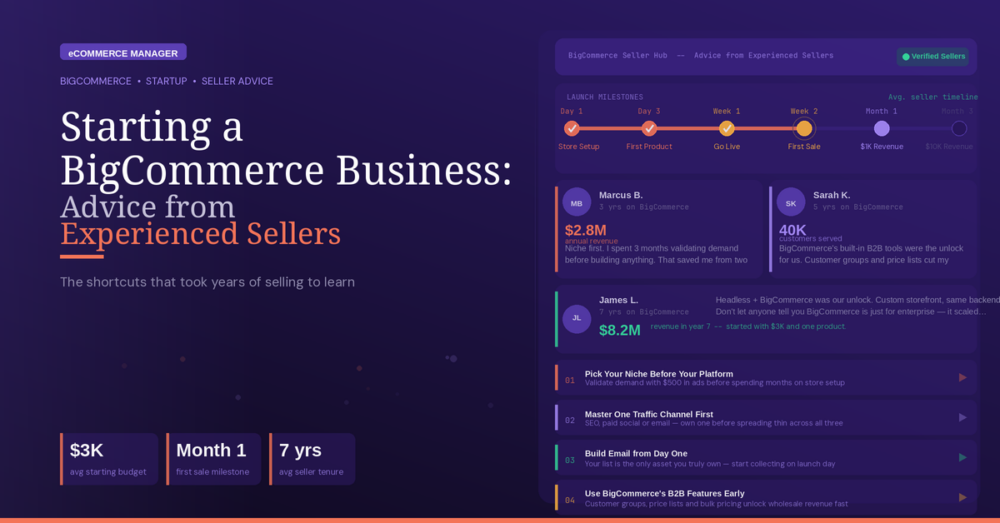
Starting a BigCommerce Business: Advice From Experienced Sellers
Starting a BigCommerce business takes more than choosing products and opening a storefront. Experienced sellers share practical lessons on reading purchase intent, validating demand, improving product pages, and protecting cash. These insights can help new owners avoid costly mistakes and build a store that grows with evidence.
- Plan Taxonomy Ahead of Go-Live
- Cultivate Networks and Protect Cash
- Take Manual Control of Ad Audiences
- Ship Early, Let Evidence Guide Design
- Address Real Pain, Not Scientific Credentials
- Sell Retainers, Not One-Off Projects
- Prioritize Buyer Needs Over Platform Features
- Standardize SKUs and Favor Native Apps
- Let Product Pages Close Sales
- Validate Demand, Then Expand
- Improve Catalog Discovery Ahead of Promotion
- Establish Schemas Ahead of Custom Code
- Follow Purchase Intent, Not Raw Traffic
- Favor Modular Systems and Fast Experiences
Plan Taxonomy Ahead of Go-Live
I’d tell myself to take an additional couple of weeks in developing your Category Architecture prior to posting a single Product Page, as the first time you go live with a broken structure will be the first day you begin paying compounding interest on what turned out to be a structural mistake you never knew existed.
What I failed to realize is just how permanent the initial choices of URLs and categories are. The same pattern has played itself out in the projects I have managed. Every new product added, every incoming backlink created, every internal link built only serves to solidify the structure established at inception. It may be possible to fix these issues later; however, this means rewriting Canonical Tags, creating redirects at a large scale and watching your rank fluctuate over several months as the Quality Classifiers revisit the entire site.
Now I understand: category architecture is a routing decision based upon user demands, not a merchandising decision. Internal linking decides which pages receive traffic and which quietly step aside — that is distribution, not navigation. Determine how users query information, group your products accordingly (by how users search), and then develop your taxonomy. If the foundation is wrong, nothing above it saves you.

Cultivate Networks and Protect Cash
Build your network of suppliers, advisors, and fellow store owners before you need them. I spent my early months heads-down on product pages and ad spend, and when I hit my first inventory crunch I had nobody to call. No backup supplier, no mentor who’d been through it, no peer who could recommend a fulfillment workaround. That scramble cost me weeks of sales and a lot of sleep.
The same goes for how you talk about your business. I used to dread getting on calls with potential partners because I hadn’t practiced articulating what we did and why it mattered. I’d ramble, lose their attention, and walk away empty-handed. Once I committed to rehearsing a tight 5-minute pitch and delivering it to anyone who’d listen, those conversations started converting into partnerships.
Protect your cash flow. Set aside a reserve before you reinvest in the next campaign or product line. I burned through early revenue chasing growth and nearly stalled the whole operation.
Pace yourself, too. Running a store on 4 hours of sleep didn’t make me productive, it made me sloppy.

Take Manual Control of Ad Audiences
If I could give my earlier self one piece of advice when launching an ecommerce store, it would be to avoid relying on platform-automated ad targeting. The biggest lesson from our hands-on Facebook ads work is that default targeting makes your audience far too generic and burns through budget fast.
Taking manual control over who sees your campaigns keeps customer acquisition tight while you get established. It forces you to define your core customer before spending heavily. Alongside paid social, brand visibility is also shifting as more buyers research products directly through ChatGPT, Gemini, and Claude.
Keeping tight manual oversight on your initial ad spend gives you the runway to test properly without blowing cash on generic clicks.

Ship Early, Let Evidence Guide Design
Would have told myself to stop customizing the theme so heavily in the first three months, since almost every change I made back then got undone within a year anyway once I actually understood what customers responded to.
I treated the store like a design project before it had any real traffic or sales data to design around, which meant I was making aesthetic decisions based purely on personal taste rather than anything resembling evidence.
Wish I’d known that a nearly default BigCommerce theme, left mostly alone, would have let me launch considerably faster and start actually learning from real customer behavior instead of spending those early months polishing something nobody had seen yet.
The specific thing I’d tell my past self directly: your homepage banner design does not matter nearly as much as you think it does right now. Your product descriptions and your checkout flow matter enormously more, and you’re about to spend six weeks on the wrong one of those three things entirely.

Address Real Pain, Not Scientific Credentials
My advice to my younger self would be don’t allow the scientist within you (the one who will describe your products) write your marketing copy. I launched our first Happy V vaginal probiotic with strain names and CFU counts front and center — it barely moved. That is an important piece of credibility but isn’t a sales message. Instead lead with what is causing this woman to search at 11pm about her vagina. Then present the evidence from the science on the second pass.
I built the new version of the webpage based upon the issues the woman had – recurring discomfort, confidence, day-to-day feeling. And put the data regarding the strains used in the product underneath the fold – so it can serve as proof rather than being presented as part of the headline. This process also helped us have discipline in terms of making claims – we were able to use structure function language approved by our scientific advisory board – we weren’t allowed to make any claims that could be construed as a treatment for disease. We saw meaningful conversion lift on that same product – same price – same inventory. Founders with deep domain expertise almost always overweight what impressed their mentors and underweight what the customer is actually feeling. Write the label for the shelf, not the boardroom.

Sell Retainers, Not One-Off Projects
I would have told 2010 David, “Don’t sell them one-off projects, sell them permanence.” I spent years closing audit jobs — a client pays for the job, receives a report, and then disappears until they get scared again by a lawyer. Cash was nice but that wasn’t really winning. Each time there was another audit or project to complete, I had to win back their trust, learn about their technology stack, quote from scratch. The compliance services my clients actually needed were on-going, not episodic and I charged them as if they were haircuts.
The contrarian view: I also had to stop selling what I was good at. Compliance sprint remediations, single shot VPATs, compliance training days — they all produced revenue, but they were bad for developing a retainer relationship with clients. If it could not exist within an on-going engagement, I did not offer it.
What I know today: In a regulatory services business, the retainer is the product, not just a pricing strategy. Engaging clients in multi-year agreements allowed us to combine three very powerful elements — predictable revenues; deeper client results; and ability to build our internal staff as specialists rather than generalists. That allowed us to go from me working alone to being a group with no external capital.

Prioritize Buyer Needs Over Platform Features
One piece of advice I would give my younger self is to not view the e-commerce system as the business. No matter what e-commerce system you use, including BigCommerce, e-commerce tools can help your business sell, but they can’t overcome other problems, such as unclear descriptions and images, shipping issues, and lack of customer service. When I was younger, I focused too much on learning about e-commerce tools and their capabilities rather than the customer’s perspective. Running an online plant business showed me the importance of building customer confidence to increase sales. Customers want to know details about the plants they are buying, such as whether the plants will survive in their areas and what to expect in terms of delivery timing. I wish I had learned earlier about the postpurchase benefits of providing this information. I recommend focusing on basic business needs first and then adding e-commerce tools to address barriers to sales. Simple websites that provide customers with needed information will generally sell more than complex ones that do not.

Standardize SKUs and Favor Native Apps
Get a clean data structure up and running from day one. Upload your poorly mapped product catalog(s) and all your variously named SKU variants for that store. Later problems with inventory updates etc. are guaranteed.
I wish I knew sooner just how powerful native apps and the corresponding features are for us. Our complex custom code typically will break during platform updates, and I wish we would have kept the store simple and clean instead of adding all that bells and whistles. Simple and clean setups just scale so much better.

Let Product Pages Close Sales
I did not start The Monterey Company, but I came in as a sales rep in 2017 and later became owner, so I have seen our BigCommerce setup evolve rather than build it from scratch. If I could go back, I would tell myself to get the product pages doing more of the selling earlier, clear structure, real answers to buyer questions, and enough detail that a customer does not have to ask before they trust what they are ordering.
The other thing I wish I understood sooner is that a store does not need every feature turned on to perform well. We spent time chasing add-ons before we had nailed the basics, clean checkout, clear proofing expectations, and fast follow-up on quotes. Getting those right mattered more than any plugin.

Validate Demand, Then Expand
The biggest advice for an early e-commerce business would be to validate customer demand before investing heavily in products, technology, or advertising. Early enthusiasm can make it tempting to build a polished store and scale traffic quickly, but customer behavior is a far better guide than assumptions. Starting with a focused product range, collecting direct customer feedback, and testing messaging with small campaigns can reveal what actually drives purchases. Baymard Institute research puts the average online cart abandonment rate at around 70%, showing how often purchase intent disappears before checkout is completed. In hindsight, more attention would have gone toward understanding the customer journey, particularly product information, pricing clarity, checkout friction, and trust signals, before trying to increase traffic. Marketing can accelerate demand, but it cannot fix a weak customer experience. That lesson applies well beyond e-commerce: sustainable growth starts with understanding the customer problem, validating the solution, and then scaling what consistently works.

Improve Catalog Discovery Ahead of Promotion
If I could give my younger self one piece of advice when starting an ecommerce business, it would be to spend much more time getting the product catalogue and customer journey right before trying to scale traffic.
Early on, it’s easy to think the main challenge is getting more people onto the website. As the catalogue grows, you realise product discovery becomes just as important. If customers can’t quickly narrow down thousands of products by price, colour, material or what they actually need the item for, more traffic doesn’t necessarily help.
We see this very clearly at Cubic Promote because we sell a large range of promotional products. The way we categorise products, structure filters, name products and connect related categories can have a direct impact on how quickly someone finds a suitable option.
There’s a technical term for part of this called “faceted navigation.” It’s basically the filters customers use to narrow a large catalogue. I wish I’d understood earlier how much work needs to go into the data behind those filters. If your product attributes are inconsistent, the customer experience becomes messy very quickly.
I’d also have paid closer attention to internal site-search data. Searches that return no useful results are incredibly valuable because they show you what customers expect to find, the language they use and where your catalogue or navigation has gaps.
My younger self would probably have chased traffic first. Today, I’d spend much more time making sure the traffic we already have can actually find what it came for.

Establish Schemas Ahead of Custom Code
I would advise my past self to architect the product catalog taxonomy and custom attributes before writing a single line of custom frontend code. In the consumer technology sector, technical specifications and variant configurations multiply rapidly. Early on, I focused heavily on visual customizations and unique interface layouts rather than clean product data structures. As catalog volume expanded, retrofitting custom fields, faceted search filters, and automated inventory sync with our fulfillment centers required a massive operational overhaul. Had I leveraged native BigCommerce custom fields and standardized product schemas from day one, we would have saved hundreds of engineering hours and prevented fragmented customer search journeys. Build the operational data foundation first, then refine the storefront presentation.

Follow Purchase Intent, Not Raw Traffic
I would tell my past self to stop treating traffic as the main goal and start with customer intent. It is easy to focus on getting more visitors, publishing more content, or adding more products. But traffic means little if those visitors are not the people most likely to buy.
I wish I had understood earlier that every marketing decision should connect to a specific customer problem. Before creating a landing page or blog post, I would ask: What question is this answering? What product need does it connect to? What should the visitor do next?
Instead of chasing broad, high-volume keywords, I would build content around specific buying questions and connect it directly to relevant category and product pages. It creates a clearer path from search to purchase and makes the marketing effort much easier to measure.

Favor Modular Systems and Fast Experiences
It is advisable to think of the platform as a central engine for transactions rather than a place that can do everything. While working with new-niche founders in e-commerce that go through the first stages of their growth, I’ve noticed one common mistake which is creating complicated storefront architectures during the very beginnings. People usually develop some custom features in their core platform which leads to creating a big structure that slows the site down and makes it difficult to upgrade. If a business builds a clean and adaptable structure with APIs from the very beginning by using other software for CRM, analytics, and inventory management, it will be easier in the future.
Another frequent mistake is concentrating on aesthetics rather than on user experience and speed. Founders pay too much attention to creating complex design elements, while ignoring such factors as mobile usability and cart optimization. An efficient tech solution has to make user experience and speed the most important factors because no marketing can work well if software fails. With the help of a good integration solution and some monitoring of users’ behavior, an e-commerce startup can expand its business.

Related Articles
- Starting Out with BigCommerce? 7 Tips for Beginners
- Scaling Your BigCommerce Business: Expert Advice and Strategies
- Shopify Store Advice: 18 Tips for Getting Started – eCommerce Manager