

Last Updated on October 28, 2026
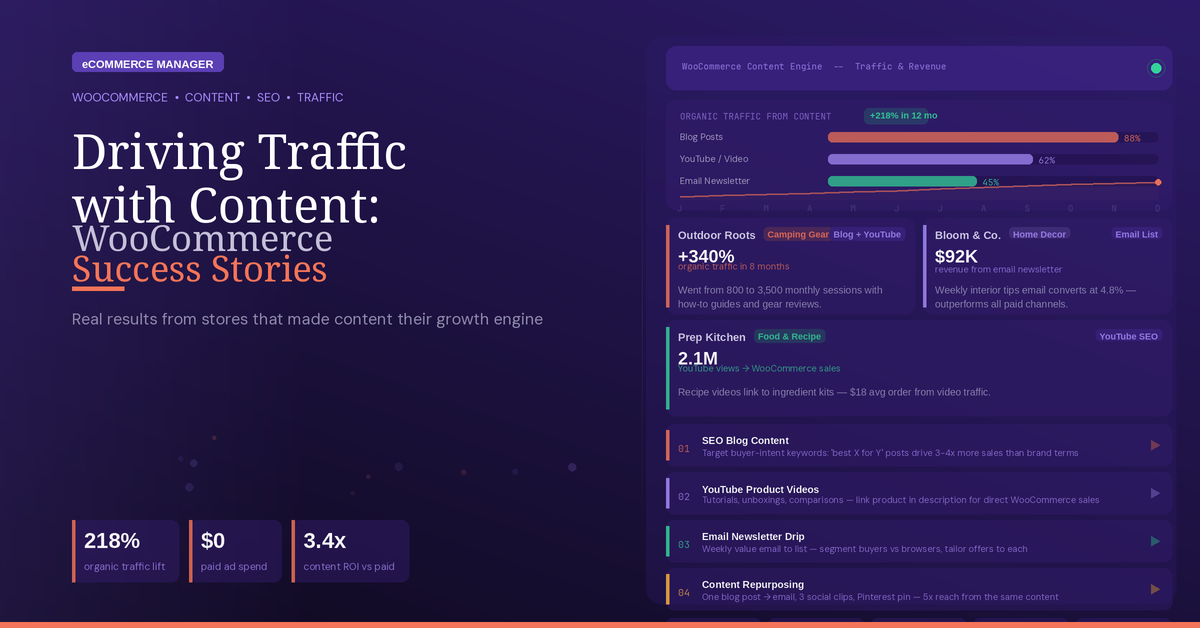
Driving Traffic with Content: WooCommerce Success Stories
Want more shoppers to find and trust your WooCommerce store? These success stories show how practical content, product comparisons, tutorials, and honest guidance can turn search traffic into sales. Insights from field experts reveal what works, what to measure, and how to connect helpful advice with the right products.
- Embed Cart Buttons in Coffee Matchups
- Answer Search Queries Through Practical Tutorials
- Feature Customer Media for Swimwear Confidence
- Target Jewelry Curiosity Before Sales
- Reveal Your Handmade Production Process
- Repurpose Podcasts Into Keyword-Led Clips
- Capture Rival Searches Through Versus Content
- Route Researchers Toward Relevant Merchandise
- Tie Each Objection to Collections
- Resolve Prepurchase Choices With Decision Pages
- Link High-Intent Advice to Inventory
- Track Commercial Articles Beyond Clicks
- Turn Herb Education Into Discovery
- Elevate Collections With Buyer-Focused Copy
- Create Clinician-Vetted Health Resource Hubs
- Demystify Beer Spas Before Visits
- Win Buyers With Honest Alternatives
- Test Goalkeeper Gloves Across Social Channels
- Prioritize Bottom-Funnel Comparisons
- Clarify Hardware Compatibility With Charts
- Match Specifications to Exact Variants
- Put Size Advice Where Shoppers Need It
Embed Cart Buttons in Coffee Matchups
The most effective content strategy for our WooCommerce store was developing detailed, solution-oriented product comparison guides aimed at high-intent shoppers. Instead of publishing broad lifestyle articles, we focused on long-tail search queries like “Hario V60 vs. Chemex: Which Brew Method Fits Your Daily Routine?” to target buyers actively researching a purchase. Because WooCommerce integrates natively with WordPress, we embedded dynamic product blocks and one-click “Add to Cart” buttons directly inside the guide’s narrative flow. Readers could instantly purchase the recommended gear without navigating away from the article. By addressing specific customer pain points and providing a frictionless path to checkout, this single comparative post drove a 180% surge in organic traffic over six months. More importantly, blog-assisted sales accounted for over 20% of total revenue. Shifting from generic content to transactional, problem-solving guides proved to be our most reliable method for converting passive readers into paying store customers.

Answer Search Queries Through Practical Tutorials
For driving traffic to our WooCommerce store, blog posts changed things for us more than any ad campaign did. Early on, I wrote a simple guide answering a common question in our category and linked our products naturally inside it. That one post started ranking on Google within four months and still brings in steady traffic today.
What worked was answering real questions people were already searching for, not writing about our products directly. I also noticed how-to content performed far better than general brand posts. One practical guide got shared multiple times on social media too.
Since then, I write one detailed guide every two weeks instead of scattered short posts. Traffic from search has grown steadily, and customers often mention finding us through a blog post before ever seeing our products.

Feature Customer Media for Swimwear Confidence
At Oh Lola Swimwear, customer photos and videos have been among our most effective content for bringing visitors to our WooCommerce store, alongside email marketing.
One example is sharing a customer’s photo or video wearing a particular bikini and directing viewers to that product. With swimwear, shoppers want to understand fit, coverage, and how the fabric looks when worn. Seeing a piece on a customer helps answer those questions and gives people a reason to explore the product page.
Email marketing complements that content by bringing subscribers back to discover new collections and styles. Social content introduces the product through someone’s experience, while email helps us maintain an ongoing connection with people who already know our brand.
The lesson for us is to create content that helps customers picture themselves wearing the product. A polished campaign image has its place, but customer photos and videos offer a relatable perspective. Combined with relevant emails and clear links to the featured products, they give shoppers a straightforward path from discovering a bikini to exploring it in our store.

Target Jewelry Curiosity Before Sales
At FARUZO, question-led jewelry guides have brought measurable Google Search traffic to our WooCommerce store. From June 21 to September 18, our Search Console data shows 478 clicks to an article explaining necklace parts and 834 to one about broken jewelry meanings. These pages meet readers before they are ready to choose a piece. I count those clicks as traffic, not sales. The next check is whether readers reach a relevant product page and whether that visit helps them choose. That tells me more than pageviews alone.

Reveal Your Handmade Production Process
The format that’s actually driven traffic isn’t the polished buyer’s guide everyone writes, it’s behind the scenes process content. Posts showing exactly how we build and ship handwritten notes at scale, including photos of our proprietary robotics writing machines, consistently outperform generic best of lists.
The reason is simple once you see it, people searching for a WooCommerce store like ours aren’t just comparison shopping, a good chunk of them are curious how a small operation actually pulls off something that looks handmade at volume. That curiosity content brings in organic search traffic from people typing questions like how do handwritten note companies scale, and it also gets picked up and shared way more than a straightforward product post ever does.
We paired that with AI assisted drafting for the first pass and human editing for the final version, which cut our content production time by about 40% and let us publish three times the volume without hiring more writers. That extra volume matters because search traffic compounds with more indexed pages answering more specific questions.
If I had to give one piece of advice, it’s stop writing content that sounds like every other store in your niche. Show the actual process, warts and all, even the parts that took us three tries to get right. Rick Elmore, Founder and CEO, Simply Noted.

Repurpose Podcasts Into Keyword-Led Clips
I used a repeatable system that repurposes podcast content into keyword-led social posts and short-form clips to drive traffic to a WooCommerce store. I batch record episodes, use Riverside to automate editing, pull transcripts, and select short clips for promotion. I place target keywords near the start of captions and use keyword research to match search intent so each post can appear in search. The content types that have been most effective for discoverability are full podcast episodes, short-form clips, and keyword-optimized social posts derived from transcripts. This process is run as a documented workflow so it can be repeated consistently without guesswork.

Capture Rival Searches Through Versus Content
For me, the greatest amount of project traffic-to-conv-in my experience working on e-commerce sites powered by WooCommerce has come from creating pages comparing products for customers looking at alternative or competing product options when using search terms like “X v/s Y” or “Alternative to Z”. A buyer searching “X vs Y” or “alternative to Z” is three steps closer to checkout than someone reading a how-to. So we created maps of our competitors branded keywords with a customer intent to buy; then, we developed individual pages based upon each competitor keyword map; finally, we used an internal link strategy to create links from all product category and informational post links (on our site) that pointed toward those comparison pages.
The two reasons this worked were:
a) The pages were formatted to clearly identify what the #1 answer was (One question per-page, one self contained block of answers per-page, etc.) and included features such as spec sheets and honest comparisons, so they held up in AI Overviews and Perplexity citations, not just classic SERPs.
b) Our internal linking strategy didn’t treat these comparison pages as additional links to add to the sidebar. Instead we treated them as destinations where users would convert once they reached there. This meant that we could use how-to type articles as top-of-funnel feeders, and point those users directly into the comparison layer.

Route Researchers Toward Relevant Merchandise
I’m Charles Liu, founder and Marketing Director of Cubic Promote, a Sydney-based business employing around 30 people across Australia, the Philippines, Vietnam, and India.
One of the most effective ways we’ve used content to bring traffic into our store is through educational articles built around the questions customers are already searching for.
We sell thousands of promotional products, so there are plenty of searches that happen before someone knows exactly what they want to buy. They might be looking for ideas for an event, comparing different merchandise options or working out which branding method suits a particular product.
We create content around those searches and then link naturally to the relevant product and category pages. From an SEO perspective, this is about matching search intent and creating a clear internal linking structure. In simple terms, we answer the question first, then make it easy for the reader to continue into the part of our store that solves the problem.
The content that tends to work best for us is quite practical. Buying guides, product comparisons, event merchandise ideas and articles answering specific customer questions have more value than broad articles written simply to attract traffic.
For example, someone researching merchandise for a university open day might land on an article about what products work well for students, then move into our tote bag, drink bottle or stationery categories. They arrived looking for advice rather than a particular SKU, but the content creates a natural path into the catalogue.
We’ve also found that topical authority becomes important when you publish consistently around the same subject areas. Instead of having one isolated article about promotional merchandise, we have related content covering products, industries, events, branding methods and real client case studies.
I wouldn’t look at blog traffic as a separate marketing activity from the ecommerce store. For us, the useful content is part of the store’s acquisition funnel. It brings people in earlier, helps them narrow down what they need and gives them a logical route to the products afterwards.

Tie Each Objection to Collections
Publish for the unfinished job, not for a blog calendar.
The content that moved ecommerce traffic for me was a narrow problem page tied to one product category and one next step: a short guide that answered a buying objection, then sent readers to the matching collection with a single clear CTA. I avoided general “tips” posts that earned vanity sessions and never named a SKU or offer. Clarity metrics mattered: organic visits to that guide, click-through to the collection, and add-to-cart from that path, not total blog pageviews. On a WooCommerce setup the same rule holds: own the URL, map it to the catalog, and cut posts that cannot show a next-step count.
If the article cannot name the product job, it is not a traffic system.

Resolve Prepurchase Choices With Decision Pages
The content that consistently drove traffic to WooCommerce stores we have worked on was not blog posts about the product category in general, it was comparison and buying guide content built around the actual decision a shopper is stuck on right before purchase: which size, which material, which of two similar products to pick. Broad top of funnel posts brought visits, but the buying guide style pages brought visits from people who were closer to actually checking out.
The format that worked best combined a short, plain answer near the top, so someone skimming gets the gist in ten seconds, with a longer breakdown further down for people who want the reasoning. That structure served two audiences at once instead of forcing a choice between quick answers and depth.
The lesson I keep applying elsewhere is that traffic volume alone is a weak signal for a WooCommerce store. A post that answers a real pre purchase question, even one with lower search volume than a broad category post, tends to bring people who convert at a noticeably higher rate, because they arrived already deciding between specific options instead of just browsing.

Link High-Intent Advice to Inventory
A how-to buying guide brought in the most useful traffic for a WooCommerce store because it matched the exact point where people were comparing options, not just browsing. The structure did the work. It answered the main pre-purchase questions, showed product differences in plain language, linked to the right category and product pages, and picked up long-tail searches that product pages usually miss.
The strongest format has been comparison and decision-stage content, not broad blog posts. “Best for” pages, buyer’s guides, and problem-led articles tend to convert better because the reader already has intent. I’ve found this works best when the content is built from real search terms in Google Search Console and Ahrefs, then supported with internal links, FAQ schema, and product snippets so the article helps both rankings and clicks.
Traffic goes up when the article is treated like part of the store, not a separate blog. That means linking into collections, surfacing stock or pricing where appropriate, and updating the piece when product ranges change so it keeps matching what shoppers are looking for.

Track Commercial Articles Beyond Clicks
In our SEO work with ecommerce brands, one practical content pattern is building a buyer’s guide around a specific decision customers make before purchasing. Instead of publishing a broad article about a product category, the guide answers a focused question such as which product suits a particular use, budget or environment.
The most valuable guides explain the selection criteria, compare the relevant options and link directly to the appropriate WooCommerce category or product pages. This attracts people who are researching with commercial intent while helping search engines understand the relationship between the informational content and the store’s products.
I would measure performance in two stages. Search Console shows whether the guide is earning relevant impressions and clicks, while ecommerce tracking shows product-page visits, add-to-cart actions and purchases originating from that content.
I cannot identify a particular WooCommerce store or verified traffic increase without the client analytics and permission to disclose them. The strongest content is not the article with the most visits. It is the one that helps the right visitor make the next buying decision.

Turn Herb Education Into Discovery
Nicolas Duval, Founder, Smokably (WooCommerce)
The content that moved the needle for us wasn’t clever ads or another homepage rewrite. It was simple educational guides that answer what people actually search about the herbs we sell: what they are, how people use them, and what the experience is like.
We run a niche dried-herb shop on WooCommerce. Over the last year in Search Console, those guides became our real front door. One mullein piece alone brought about 3,000 clicks and more than 160,000 impressions. Chamomile, lemon balm, blue lotus, and a handful of other herb guides followed. Product pages matter for buying, but they sit way behind the guides for discovery. Our strongest shop pages are only in the low hundreds of clicks over the same stretch.
People aren’t typing our brand first. They’re asking practical questions about specific herbs. We meet them there with honest, claim-safe writing, then link into the matching product. That guide-to-product path is the content marketing that actually fills the store.

Elevate Collections With Buyer-Focused Copy
One concrete example is focusing content marketing on WooCommerce category and collection pages rather than only on individual product pages. I led a rewrite of category pages to include 300 to 500 words of buyer-oriented copy, clear internal linking, FAQ schema, and meta tags aligned with search intent to build subject authority. We also improved technical site hygiene with clean URL structures, consistent schema for products and reviews, Core Web Vitals optimization, and removal of thin or duplicate tag pages to aid crawling. Those changes produced significant growth in organic search traffic by turning many competitive product pages into a single authoritative domain.

Create Clinician-Vetted Health Resource Hubs
The number one source of new customers has been the learning center content, specifically long form articles on the things women are searching for – including bacterial vaginosis, vaginal probiotics, menopause and anxiety, digestive enzymes. Since Meta and Google have so many restrictions on how you can write about ads related to “intimate health”, a learning center article will continue to rank on google after being restricted from ad copy because of a restriction on a vaginal health claim.
When your ad account is restricted at midnight, your learning center article will still be ranking on Google by 2am.
What made this work: An OB/GYN or Microbiome Researcher on our Advisory Board would review the clinical aspects of the information, then we would rewrite it into the consumer’s language – symptom first, not strain first. This was a difficult lesson to learn; our first vaginal probiotic launch was done with a clinical style label (with Strain Names and CFU Counts), but did very little as far as moving product.
We remain within the Structure Function Lines defined by the FDA, allow for no more than a single link to the relevant sku, and allow the article to do the educating. Organic compounding lowered blended CAC in ways that paid could not alone.

Demystify Beer Spas Before Visits
REFRAME: We are not a standard WooCommerce store – Oakwell offers experiential services and has an attached retail component. However, the content-related question can be translated one-to-one. When launching a new product category that hasn’t been introduced into the U.S., you’re not competing for click-throughs. You’re competing against customers’ confusion.
The most effective educational content we created prior to booking was “what is a beer spa” before asking customers to purchase. A short behind-the-scenes video of the soak experience, cedar tubs and self-pour wall without a sales-oriented voice-over, generated results better than any polished versions we developed at the time of opening in Feb. 2021, when we had zero word-of-mouth. The same video also helped to reduce the number of “how do I use this?” questions our front desk staff were receiving by serving as pre-book FAQ content.
Educational content drives initial purchases from new customers; promotional content drives repeat business. Most founders get this formula wrong and develop their promotional content first.

Win Buyers With Honest Alternatives
On one of my earlier eCommerce brands, I wrote a 2,000-word comparison guide pitting my top-selling product category against two popular alternatives. No fluff, no sales pitch in the body. Just honest pros, cons, and use-case breakdowns based on the customer questions I’d been fielding through support tickets.
I published it on the WooCommerce blog, added a handful of internal links to relevant product pages, and let it sit. Within about six weeks, that single post was pulling in more organic traffic than the entire product catalog combined. People were landing on the comparison, reading through it, and clicking into the store already knowing what they wanted. My add-to-cart rate from that page ran higher than from my paid traffic sources.
The post answered a question buyers were typing into search before they’d committed to any brand. They weren’t browsing, they were deciding. I met them at that decision point, so I didn’t have to convince them to buy, I just had to make the next click easy.

Test Goalkeeper Gloves Across Social Channels
The type of content that drives the most traffic to our Keeperstop Shopify store is educational goalkeeper glove reviews. Not promotional product descriptions. Not manufacturer specs repackaged with a buy button. Real, technical, experience-backed reviews written by goalkeepers who have tested every glove in live training sessions.
Here’s a specific example of how it works. A parent searches “best youth goalkeeper gloves with finger protection” or a coach searches “most durable goalkeeper gloves for turf.” Those are real questions from real people trying to solve a real problem. Because we publish highly technical, educational reviews on every product page that address exactly those questions, our content matches what goalkeepers and parents are actually searching for, written in the language they actually use. That’s what drives organic traffic. Not ad spend. Earned trust.
But the product page review is just the anchor. We amplify that same expertise across every platform. The review becomes a short-form Instagram or TikTok video that helps soccer goalies select the best youth goalie glove that meets a budget and playing need. It becomes a deeper breakdown on our Goalkeeper Show with Paul on YouTube. And it becomes a personal response when I answer that same question on a community forum or subreddit. One piece of goalkeeper knowledge, amplified everywhere our community spends time.
The content works because it’s rooted in something no competitor can replicate. We test all soccer goalie equipment ourselves across turf, grass, wet weather, cold, and high-repetition training environments. We evaluate every product to assess what need does it satisfy and is it the best at the price point. That depth of knowledge comes through in every review, and goalkeepers and parents recognize it.
A content marketing strategy leveraging all social media platforms allows us to amplify our knowledge and passion for the art of goalkeeping. That approach has built a growing community of 600,000+ with 13 million+ impressions monthly.
Choosing the wrong goalkeeper glove wastes time and money. Our content exists to make sure that doesn’t happen. That’s why it drives traffic. It solves problems.

Prioritize Bottom-Funnel Comparisons
The content that drives store traffic is rarely the blog post, it’s the page built around a buying decision. For an ecommerce client, I rebuilt the content plan as a pyramid instead of a funnel: comparison pages and “best for [use case]” pages, built to match exactly how a shopper searches right before buying, got first priority even though they were a small slice of total output. Educational posts supported them with internal links and topical authority instead of competing for the same traffic. Within two content cycles, organic traffic to those buying-intent pages had grown several times over, while general blog traffic barely moved. If you only have budget for one type of content this quarter, write the comparison pages first.

Clarify Hardware Compatibility With Charts
The most effective content marketing format for my consumer technology store has been detailed hardware compatibility guides. In the consumer electronics space, prospective buyers frequently search for clear answers on whether new accessories will work seamlessly with their existing devices. I developed thorough comparative guides featuring clear compatibility charts that link directly to specific product pages in WooCommerce. This educational content resolved immediate technical hesitations for high intent shoppers researching exact specifications before making a purchase. Over a six month period, this dedicated content hub delivered a 145 percent increase in organic search traffic to the store, reduced customer support inquiries, and generated a 32 percent lift in overall checkout conversions.

Match Specifications to Exact Variants
Our own stores run on Shopify rather than WooCommerce, so I will stick to the content mechanics, which transfer across platforms. We run Olooq across the US, Australia and India and manage Amazon for client brands, so the content I can speak to is the kind that has to earn traffic against a search results page rather than sit on a homepage.
The format that worked most consistently was fit and compatibility content: the piece sitting between a shopper’s question and the purchase. Not listicles. Specific things like which size suits which application, what the spec on the box actually means in practice, this material versus that one and when each one fails.
Why it works: it answers the exact question a product page cannot answer without becoming cluttered, and it is what people type before they are ready to buy. It also gets cited by other people, which matters more every quarter now that roundups and AI answers pull from third-party comparison pages rather than brand copy.
Two mechanics made it convert instead of just attract traffic. Every piece linked to a specific product variant rather than a category page, so a reader landed one click from checkout with the right option preselected. And we sourced topics from support tickets and from review text where customers complained about fit or compatibility. That is keyword research with purchase intent already attached, and it beats a volume tool.
The part most brands miss: publishing is not the finish line. Content that pulls traffic needs the product page it points at to stay in sync. If the sizing guide says one thing and the product page says another, you have built an efficient machine for generating returns.

Put Size Advice Where Shoppers Need It
I expected our style posts to resonate the best, but they did not. The page that drove us consistent traffic was our simple guide about sizes and fit. People looking for clothes are often concerned with the size they should pick, so they searched for answers to these questions. We have prepared the guide based on the most frequent customer questions and added it to the bottom of each product page. It took us a few months to get to the top, and I wish we had invested more attention to it earlier. Since all customers looking at this page were interested in our clothes and had the intention to purchase, we got great traffic quality. Accordingly, we saw a significant drop in wrong size returns. If you sell a product that cannot be tested before purchase, provide an answer to the most common concerns right away.

Related Articles
- Driving Traffic & Sales: Content Marketing Strategies for Shopify
- How to Attract Customers to BigCommerce: Effective Content Marketing Examples
- Driving WooCommerce Sales: Social Media Strategies For Your Business