

Last Updated on August 25, 2026
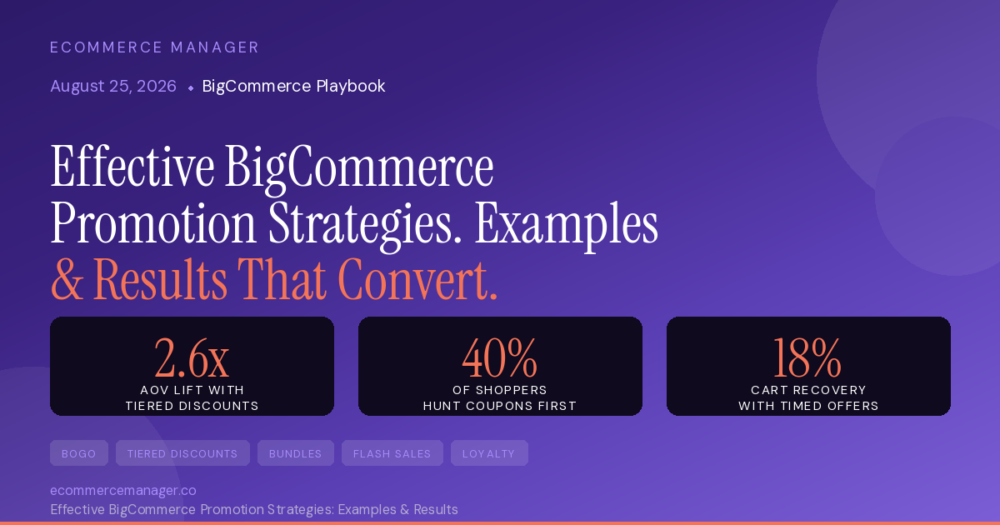
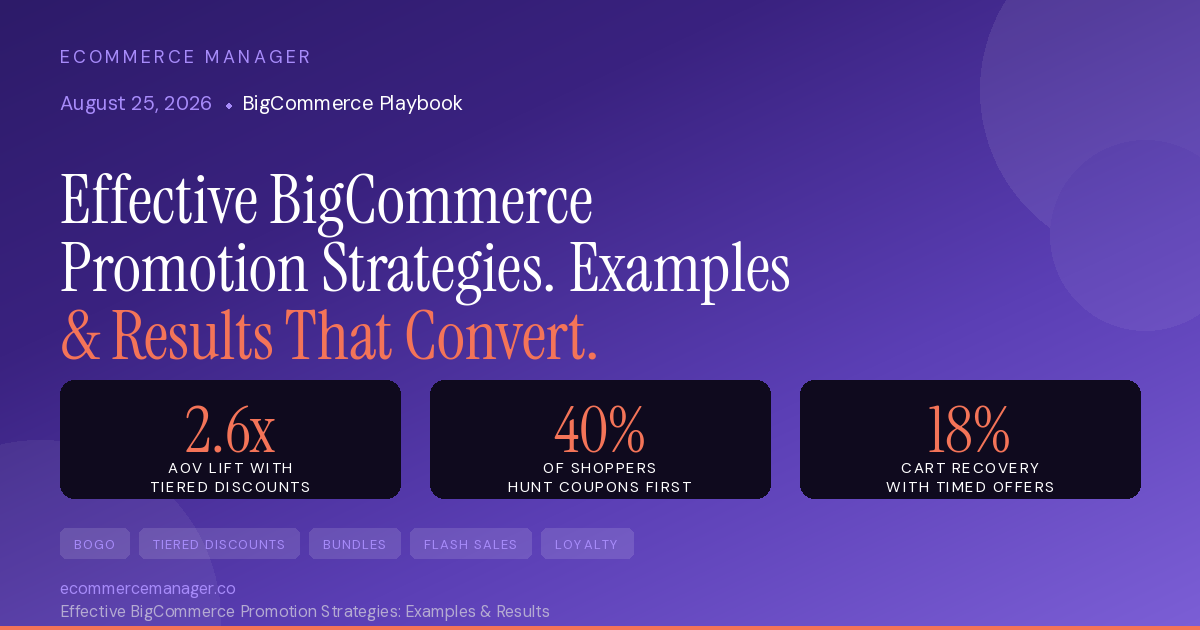
Effective BigCommerce Promotion Strategies: Examples & Results
BigCommerce merchants have access to powerful promotional tools, but knowing which strategies actually drive sales requires real-world testing and experience. This article breaks down six proven promotion tactics with concrete examples and measurable results, drawing on insights from ecommerce experts who have implemented them successfully. Whether the goal is increasing average order value, building customer loyalty, or boosting repeat purchases, these strategies offer practical frameworks that can be adapted to any online store.
- Set Smart Thresholds With Desirable Gifts
- Use Deadlines With High-Value Perks
- Discount Consumables to Win Repeat Orders
- Subscribe and Save With Routine Bundles
- Treat Promotions as Targeted Ad Levers
- Push Higher Carts With Free Delivery Minimums
Set Smart Thresholds With Desirable Gifts
What works for us is threshold and bundle promotions instead of sitewide percentage discounts. A blanket sale teaches customers to wait for the next one, and in a considered purchase category that delay is expensive. A threshold promotion does the opposite. It rewards somebody for adding the thing they were going to need anyway.
The version that worked best was a free cable holster over a modest spend threshold, run for a fortnight. Average order value rose 52% against the fortnight before, and margin held, because the free item cost us a fraction of the extra spend it triggered. Customers who came for a cable added a lock or a longer lead to reach the threshold.
Two things made it work. The threshold sat just above our usual order value, close enough that one more item got you there. And the free product was something we knew people wanted, not surplus stock we were trying to shift, which customers can smell straight away.
The promotion I would not repeat was a straight percentage off everything before Christmas. Sales rose, margin fell, and January was silent because everyone who intended to buy had already bought at a discount.

Use Deadlines With High-Value Perks
The promotion structure I keep coming back to is time-gated, non-discount value adds tied to a specific action. Discounts alone train customers to wait. Value adds that expire don’t.
For a blockchain project we worked with last year, we ran a promotion on their BigCommerce store selling developer tools and API access subscriptions. Instead of a percentage off, we offered three months of premium support free when customers upgraded to an annual plan within 72 hours. Premium support was already part of our internal cost structure, so the margin hit was minimal, but the perceived value was high because support response time mattered more to developers than price.
We pushed the promotion through three channels: an email to their existing trial users, a LinkedIn post from the founder, and a banner on the store homepage. No retargeting ads. No complex funnel. The 72-hour window created urgency without feeling manipulative because the offer was real and the deadline was firm.
The result was 41 upgrades in three days from a list of around 600 trial users. That’s a 6.8% conversion rate on a cold list that had been sitting dormant for months. Average order value was $1,200 per annual subscription. Total revenue from the promotion was just under $50,000, and 38 of those 41 customers were still active six months later, so retention held.
What made it work wasn’t the offer itself. It was pairing a tight deadline with something customers actually wanted more than a discount. Developers don’t care about 15% off if the product breaks and no one answers. They care about response time.
The Complete 2025 E-commerce Manager Career Guide: From Entry-Level to Executive

Discount Consumables to Win Repeat Orders
We never discount the hives. The promotion runs on frames and foundation only — buy any brood box and the frames come at half price, applied automatically at the cart so there’s no code to hunt for.
Twenty-one years selling beekeeping equipment, and the logic is that beginners buy the box once and the consumables forever, so the discount buys the second order rather than the first.
Shifted 380 frame kits in the fortnight before the season opened. Discount what they’ll rebuy, never what they’ll only buy once. Doesn’t travel outside spring — nobody expands a colony in October, and the same offer in autumn did roughly nothing. One customer worked out he could take about forty frames without the box, and the rule allowed it for a day before we fixed it.

Subscribe and Save With Routine Bundles
At Happy V, the promotion that’s done the most for us is a subscribe-and-save bundle, not a sitewide flash sale. We pair two or three products that work together in a women’s wellness routine—a daily probiotic with a targeted intimate-health formula, for example—and trade a modest recurring discount for the subscription commitment. Every opt-in is a retained margin line, not a redemption we absorb once and never see again.
Two things make it work in a regulated category. First, the copy sells the routine, not a claim—we talk about consistency and daily use without wandering into structure-function territory. Early on we launched a vaginal probiotic with a clinical-style label (strain names, CFU counts) that barely moved; rewriting it in plain routine language changed the curve. Second, being vertically integrated means we know our unit economics well enough to price the discount against a real repurchase cycle. On BigCommerce we segment the offer to buyers past their second order. Flash sales spike a dashboard. Bundles compound.

Treat Promotions as Targeted Ad Levers
Treat the promotion as a paid-traffic lever, not a storewide event. Scope the offer to one product line or first-order buyers, and mirror those exact terms in the ad copy and on the landing page so click intent matches what the shopper sees at checkout. Broad sitewide sales train returning customers to wait for the next cut, and non-brand search efficiency usually sags for weeks after the sale ends because demand got pulled forward at a worse margin.
Example: for a home fitness accessories store we ran 15% off first order on a single accessory line for 10 days, promoted only through non-brand search, with the same terms in the headline and on the landing page. Non-brand conversion rate went from 1.8% to 2.9%, ROAS moved from 2.4 to 3.3, new customers were 71% of orders, and full-price sales on the rest of the catalog held steady with no post-sale dip in the following month.
The counterintuitive move is to run a quieter, narrower offer instead of a loud storewide discount: you attract fewer pure deal-seekers, keep full-price demand intact, and can actually tell which creative and audience drove the lift. I see this from the Google Ads side of ecommerce accounts rather than as a BigCommerce merchant myself.

Push Higher Carts With Free Delivery Minimums
The best-performing promotion we run on BigCommerce isn’t a discount at all. It’s a free-shipping threshold set deliberately above our average order value. Percent-off sitewide sales train customers to wait for the next one; a shipping threshold nudges them to add one more pair of socks to qualify, which raises average order value instead of eroding margin. We save real markdowns for true end-of-season clearance, so full price stays believable the other ten months of the year. A discount teaches customers to wait. A threshold teaches them to add to cart.

Related Articles
- Building Brand Loyalty on BigCommerce: 8 Proven Strategies from Top Sellers
- Effective Upselling and Cross-selling on BigCommerce: Strategies from E-commerce Experts
- Effective Shipping Strategies for Your BigCommerce Store