

Last Updated on October 28, 2026
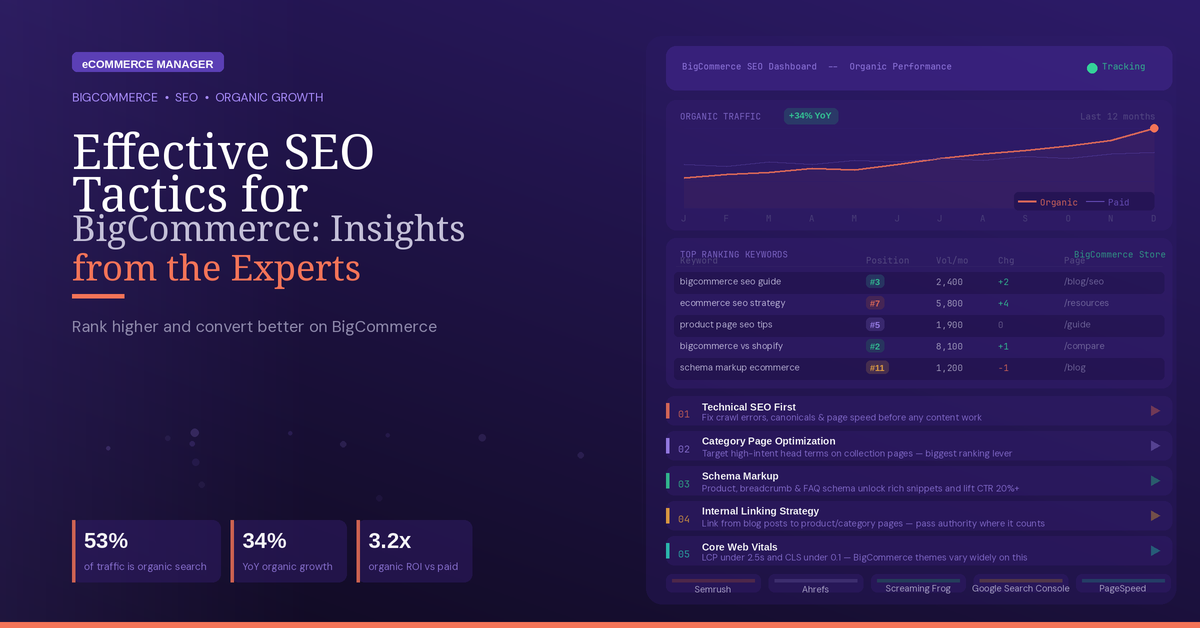
Effective SEO Tactics for BigCommerce: Insights From Experts
BigCommerce stores can gain more qualified traffic with focused SEO tactics. Experts in the field share practical ways to improve category pages, product listings, technical structure, and content. These strategies help search engines understand large catalogs while guiding shoppers toward the right products.
- Center Large Catalogs on Commercial Hubs
- Tame Filter Sprawl, Prioritize Essentials
- Build Intent-Led Content Clusters
- Match Listings to Purchase Needs
- Stop Crawler Waste From Filters
- Validate Rich Results
- Reflect Shopper Queries in Taxonomy Copy
- Consolidate Variant Links
- Unlock Demand-Driven Facets
- Turn Category Pages Into Decision Guides
- Make Catalog Gateways Rank
- Earn Citations With Linkable Assets
- Improve Foundations Before Pursuing Rankings
- Embed Structured Q&A Modules
- Strengthen Every Optimization Layer
- Answer Plant Care Questions
- Craft Unique Meta Descriptions
- Route Learners Toward Compliant SKUs
- Govern Parameters With Granular JSON-LD
- Describe Visuals With Exact Alt Text
- Remove Deceptive Titles and Duplicates
Center Large Catalogs on Commercial Hubs
I’m Charles Liu, founder and Marketing Director of Cubic Promote, a Sydney-based business employing around 30 people across Australia, the Philippines, Vietnam, and India.
One SEO tactic we’ve used on our e-commerce site, and one that translates directly to BigCommerce, is putting more effort into category pages rather than trying to optimise every individual product page equally.
We sell thousands of promotional products, so it would be easy to end up with a huge catalogue where similar products compete against each other in Google. Instead, we treat important categories such as promotional pens, tote bags or drink bottles as the main search hubs, then use internal links to connect relevant products, guides and articles back to those pages.
In SEO terms, this creates a clearer site hierarchy and consolidates authority. Put simply, rather than asking Google to choose between hundreds of similar product pages, we’re giving it a stronger central page that clearly explains the category and then points people to the right products.
We’ve also found that category pages give us more room to answer the questions buyers actually have. We can cover things like minimum quantities, branding methods, lead times, product choices and common ordering mistakes without forcing all of that information onto an individual product listing.
The impact we’ve watched most closely is organic visibility at the category level, particularly impressions, clicks and rankings for broader commercial searches. We’ve seen stronger category pages pick up a wider range of relevant searches than individual products typically can, which is why they remain a major part of our SEO work.
For a large e-commerce catalogue, I think that’s often more valuable than chasing tiny SEO improvements across hundreds of individual SKUs.
 Mr Charles Liu, Marketing Director, Cubic Promote
Tame Filter Sprawl, Prioritize Essentials
The single highest-ROI fix I’ve implemented on BigCommerce stores is taming faceted navigation. A fashion client had thousands of filter combinations — size, color, price — each generating its own crawlable URL, so Google was drowning in near-duplicate pages while the money pages starved. We noindexed the filtered variants, canonicalized them back to the parent category, and rewrote the top 20 category pages with genuinely useful copy instead of the default two-sentence blurbs. Organic traffic to those categories tripled within six months. Most BigCommerce SEO advice obsesses over keywords; the real win is usually just telling Google which pages actually matter.
 Abdessamad Elmo, CEO, Creativeor
Build Intent-Led Content Clusters
One of the most effective tactics I’ve used to optimize a BigCommerce store is building topic-based content clusters around high-intent product and category keywords, then strengthening those pages with strategic internal linking.
For example, I worked with an eCommerce brand selling car accessories where the store had good products but wasn’t generating enough organic visibility for competitive category and product searches.
The Complete 2025 E-commerce Manager Career Guide: From Entry-Level to Executive
Instead of publishing random blog posts, we mapped keywords across the entire customer journey:
TOFU: Informational content targeting searches around car accessories, buying guides, comparisons, and common customer questions.
MOFU: Commercial-investigation content such as “best,” “top,” “X vs Y,” and product comparison topics that helped users move closer to a purchase.
BOFU: Optimized category, collection, and product pages around high-intent searches, with better titles, headings, supporting copy, FAQs, structured internal links, and stronger contextual relevance.
The important part was connecting the content together. Blog posts linked naturally to relevant category and product pages, while category pages linked to priority products. This created a stronger topical structure and helped search engines better understand the relationship between the content and products.
We also optimized BigCommerce technical elements such as URL structure, metadata, canonicalization, indexation, duplicate content issues, image optimization, and structured data.
The biggest lesson for me was that eCommerce SEO isn’t just about optimizing individual product pages. It’s about building a content ecosystem where informational content supports commercial pages and commercial pages support conversions.
That approach helped increase organic visibility and qualified traffic while creating a scalable SEO framework the brand could continue expanding.
 Being Rajbhir, Search Engine Optimization Expert, RankJacker SEO
Match Listings to Purchase Needs
One tactic that has worked well for us on BigCommerce is treating category and product pages as answers to real buyer questions instead of just catalog listings. At The Monterey Company, we sell a wide range of custom products like lapel pins, patches, challenge coins, and keychains. Buyers often search with a use case in mind, like pins for a company event or patches for a team, so we write each main page around the query it should answer and make the headline and first few sentences address that clearly.
The other piece is linking our educational content back to those product pages. When we publish a guide on something like choosing between patch types or how custom pins are made, it links directly to the matching product page. That helps search engines understand how our content fits together, and it gives a buyer who is still researching a clear next step once they are ready to order.
The lesson is that a store can look great and still struggle in search if the pages are built around what you want to say instead of what the customer is looking for.
 Eric Turney, President / Sales and Marketing Director, The Monterey Company
Stop Crawler Waste From Filters
The tactic that moved the needle most for one of my BigCommerce clients wasn’t content. It wasn’t backlinks. It was fixing a crawl budget problem they didn’t even know they had.
Here’s what was going on. The store had a few thousand SKUs with the usual filters size, color, material, price. Looked totally normal. But when we ran a crawl audit, we found that Googlebot was spending almost half its time crawling filter-generated URLs like /category?color=blue&size=medium&sort=price. Thousands of them. None of them worth ranking. And while Google was busy crawling that junk, the actual product and category pages the ones we wanted to rank were getting crawled once every few months.
That’s the crawl budget trap. The filter combinations create a flood of near-duplicate URLs, and BigCommerce, by default, doesn’t block them. Google just keeps following them, burning through its crawl allocation, and your money pages get left behind.
The fix was straightforward once we knew what we were looking at. We updated robots.txt to block those parameterized URLs, then went through and corrected the canonical tags on every category page. BigCommerce auto-generates canonicals, but on a large catalog, plenty of them were either wrong or pointing back at themselves instead of the clean category URL.
The Complete 2025 E-commerce Manager Career Guide: From Entry-Level to Executive
Within about eight weeks of making those changes, organic impressions picked up noticeably and we hadn’t touched the content at all.
That’s the part most people miss. You can write great product descriptions and still plateau if Google is lost in your filter structure. Before investing in content, run a crawl audit. Find out where Google is actually spending its time. The fastest wins on BigCommerce are almost always technical.
 Aktarul Islam, Sr. Local SEO Strategist, Grid Rankers
Validate Rich Results
Product schema markup is the piece I’d point to. Adding structured data so price, availability, and review stars render in the search result changed what our listings looked like on the results page, and a listing with stars attached earns clicks a plain blue link doesn’t. For a doctor-developed pain relief product, that visible proof matters, because someone searching at 11pm for help with heel pain is scanning for a reason to trust one result over the eight others.
The State of eCommerce in 2025!
Early on I treated BigCommerce’s built-in structured data as finished work. The tool exists. Whether it’s configured correctly for your catalog, and whether your review data is feeding into it, is a separate question. I test real URLs in a rich results tool rather than assume the platform handled it.
The same thinking applies to the rest of the technical layer. Access to the robots file, the XML sitemap, canonical tags on variant URLs, automatic 301s when a URL changes. Those are all configuration decisions, not features you switch on.
And schema only pays off if the page behind the click deserves it. You need unique product copy, a real H1, and a meta description written for a person in pain rather than a crawler. Otherwise you’ve just made a bad page easier to find.
 Ben Frederick MD, Founder, Dr. Frederick’s Original
Reflect Shopper Queries in Taxonomy Copy
Being an SEO Strategist at Ubuy, one tactic I’ve found effective is optimising BigCommerce category pages around specific search intent rather than one broad keyword.
For one category, I mapped 1 primary keyword and 8-10 supporting terms, then rebuilt the title, headings, category copy, internal links, and product links around those terms. Over the next two months, the page saw roughly a 35% increase in organic clicks and started ranking for 20+ related queries.
The important part was matching each section to a real shopper question instead of adding keywords for their own sake. I then monitored rankings, clicks, and product-page visits to decide where further optimisation was needed.
 Fahad Khan, Digital Marketing Manager, Ubuy Germany
Consolidate Variant Links
The tactic I keep coming back to on BigCommerce is canonical tags on product variant URLs. A store selling a shirt in six colors and four sizes can end up with dozens of crawlable URLs that all show essentially the same page. Google picks whichever one it wants, link equity gets split across the set, and the version that converts is not the one ranking.
So I set the canonical on every variant back to the parent product URL, then check the store’s XML sitemap to make sure only that parent is being submitted. BigCommerce gives you the URL controls and automatic redirects to do this without touching code, so it counts as basic housekeeping.
The second half is on-page work on that consolidated page. One unique description written for the customer, not the manufacturer, with the main keyword in the title and inside the first paragraph. Structured data on the product so price and reviews show in the results.
What I tell people in my consulting group is that the stores I audit do not have a content problem, they have a duplication problem. You are competing against yourself in the index. Consolidate the variants first, then optimize the one page that survives.
 Will Mitchell, Founder, StartupBros
Unlock Demand-Driven Facets
In many of the BigCommerce projects I have managed, I most often utilize a strategy to treat a segment of facet URL’s as purposeful landing pages, rather than blocking all facet URL’s altogether.
The majority of businesses have an immense number of indexable facet combinations — for example by material, size or use case — which correlate directly to legitimate user searches. However, these facet combinations can be blocked due to conventional wisdom in regards to facets creating duplicate content. A very broad brush is being used when a precision tool should be utilized.
Our process: Facet combinations are inventoried versus actual search demand; those facet combinations are subsequently selectively unblocked based upon the amount of search query volume (for instance “oak floating shelves” as a material/product facet combination). Static-feeling URLs are given to the unblocked facet combinations; each will have a unique H1 and introductory copy; each will contain a self-canonical tag; and — perhaps most notably — links will be created from the parent category and associated product detail page (PDP) to each respective facet combination. The thin combinations remain noindexed so crawl does not become spent filtering out garbage.
 Roman Sydorenko, CEO, seobro
Turn Category Pages Into Decision Guides
One effective tactic I recommend for BigCommerce is turning category pages into buying-decision resources. This connects SEO with AEO/GEO: help customers choose while giving search engines and AI systems clear, credible product information.
For example, a commercial coffee machine category could answer: “Which coffee machine is suitable for a small cafe?” I would use customer enquiries, site-search terms and search performance data to identify the criteria that matter: daily capacity, space, maintenance and budget.
The hands-on implementation includes aligning the page title, H1 and introduction with that intent, adding a concise model comparison, and answering genuine customer questions. Each recommendation links to the appropriate product, with consistent specifications across category and product pages. I would also check crawlability, validate structured product data against visible content, and control unnecessary filter URLs that could create competing pages.
Agentic AI helps scale the workflow by identifying missing attributes, flagging inconsistencies and preparing updates from verified catalogue data. Product claims and publishing decisions still require human review.
The strategic goal is to build product knowledge that remains useful as discovery evolves. Clear, well-supported information helps customers buy confidently and gives AI answer engines useful material to reference, although citations are never guaranteed.
I would measure success through qualified organic traffic, category-to-product engagement and organic revenue, alongside visibility for relevant buying questions.
My principle is simple: answer the purchase question, substantiate the recommendation and make the route to the right product obvious.
 Modi Elnadi, Head of AI Marketing Growth & SEO/AEO, IntegratedSocial
Make Catalog Gateways Rank
One effective tactic in our ecommerce SEO work is treating category pages as primary search landing pages rather than leaving them as thin product grids. Product pages capture searches for individual items, but category pages can address the broader buying decision and direct customers towards the appropriate range.
For example, a category page for outdoor dining furniture should not contain only product tiles. I would map it to the relevant commercial search intent, give it a unique title and heading, and add concise guidance covering size, materials, conditions and the differences between the available options. Relevant buying guides should link back to that category, while the category must provide crawlable links to its subcategories and products.
This creates a clear path from informational content to the commercial page and then to individual products. It also helps prevent important products from being discoverable only through an internal search box or filter.
I would measure non-branded impressions and clicks to the category page in Search Console, then track product-page visits, add-to-cart actions and purchases originating from it. Rankings alone do not show whether the page helps customers progress towards a purchase.
I do not operate a BigCommerce store, so I cannot present this as a result from my own shop. My relevant experience comes from helping ecommerce brands with SEO and website growth, and I cannot claim a specific uplift without the client analytics and permission to disclose them.
 Callum Gracie, Founder, Otto Media
Earn Citations With Linkable Assets
My work sits on the link-building side of ecommerce SEO rather than platform configuration, and the same mechanics apply whether the store runs on BigCommerce, Shopify, or something custom.
The tactic I use on ecommerce stores is building one asset tied to a category, a comparison guide, a sizing calculator, a buying checklist, something a competitor’s product page has no version of. Other sites end up linking to that page because nothing else on the web covers the same ground with real data behind it. That authority passes down through internal links to the category and product pages that actually convert, which holds up a lot longer than tuning meta tags on pages nobody outside the store has ever referenced.
Before touching anything on-page, every ecommerce project at Asset Linkable starts from one question: does this store have even one page worth citing from outside its own domain? Most don’t, and building that page first is the whole strategy.
Donnie Strompf
Founder, Asset Linkable
assetlinkable.com
 Donnie Strompf, Founder & Marketing Strategist, Good At Marketing
Improve Foundations Before Pursuing Rankings
Depends on the store issues and what was done.
At the very least, create lots of appropriate categories, good filtration, good product’s description. Obviously.
I saw some pages do different pages for Google so they rank higher. They are less User friendly and more Google friendly so you can try that. Like rozetka.com.ua, try to look at it as a Google bot.
There are lots of things to do, man. It’s too generic a question; people make books about that.
 Serhii Dovzhenko, SEO, North SEO
Embed Structured Q&A Modules
The most effective tactic we run on BigCommerce stores is turning static product specs into structured Q&A content embedded directly on category and product pages. While basic keyword tagging gets pages indexed, structuring comparison data–like sizing, use cases, and compatibility–helps search engines and AI engines surface exact matches for complex queries.
On BigCommerce, we use custom fields to feed automated, schema-backed FAQ modules on high-priority catalog items. Instead of competing solely on broad category keywords, the product pages directly answer specific buyer questions right where the sale happens. It helps traditional rankings, and it gives AI search engines the factual context they need to cite your store.
 Ben Harper, Founder, LLM Listed
Strengthen Every Optimization Layer
As per the hands-on experience and knowledge, along with 8 years of experience in SEO. The most effective and results-driven tactics for optimising the website for search engine results pages are to follow the right steps in a systematic order.
Firstly, optimise the landing page, such as the meta title and the description that informs the crawlers about what the page content is. Write helpful content that describes the product/services in a helpful, trustworthy manner, with real insights along with the case studies.
Work on the Core Web Vitals, such as the speed of the landing page and image optimisation, and optimise the server response time to load the page faster.
Once the page is optimised, check the technical aspects such as broken links and canonical tags, and check that the page is crawled and indexed properly. Add alt text to images, add schema markup, breadcrumbs, and internal and external linking.
Lastly, work on off-page activities like building quality backlinks, PR releases, guest posting, and creating business directories.
When all these things work together, resulting in good traffic and keyword rankings, the organic traffic turns into organic leads or revenue.
 Dheeraj Sharma, Marketing Manager, Dog D Originals
Answer Plant Care Questions
One effective SEO strategy we’ve used is to create product and category pages based on frequently asked questions about products rather than keyword density in the title. For plants, buyers looking for specific plants often have additional questions about hardiness zone, light needs, mature size, soil type, flowering period, planting tips, and other questions about the product once it’s delivered. We added information to our product and category pages beyond basic supplier information to address these questions. Rather than writing a short page with the plant name and “for sale,” we wrote longer pages with answers to common questions that buyers might have before and after purchase. We also added links on our product and category pages to help search engines and buyers see connections between products and other content on our site. My lessons learned about e-commerce SEO include the fact that longer pages aren’t necessarily better for SEO purposes. The goal should be to provide the best possible information about a product to people who search for that plant.
 Tammy Sons, Founder/CEO, TN Nursery
Craft Unique Meta Descriptions
One effective tactic I use to optimize my BigCommerce store is writing custom meta descriptions for every product. I keep the text short and friendly. I always include the main keyword naturally. For example, when I sell handmade soap, I write a description that highlights the organic ingredients and uses the keyword “natural lavender soap.” This simple strategy helps my store stand out in search results. Shoppers see exactly what they get, and my daily search traffic goes up!
 Robert Fausette, Owner & CEO, Revival Homebuyer
Route Learners Toward Compliant SKUs
The first strategy in creating our BigCommerce store was making the Learning Center the primary natural entry point (not the Product Detail Pages). For a regulatory category such as ours, you cannot have “cures BV” or “treats yeast infection” on a PDP — FDA/FTC Structure-Function rules limit product page content to what a legal Supplement could possibly claim; this effectively shuts off all of the highest intent keyword territory an unregulated brand could simply write into an H1.
Therefore we reversed it. PDPs will remain compliant with FDA/FTC regulations and low on SEO ambitions. The Learning Center – articles written by my team about Bacterial Vaginosis Symptoms, Menopause Anxiety, Digestive Enzyme Basics, etc., are ranked for the search terms a woman is actually Googling when she doesn’t know yet that a Probiotic is her answer, with internal links from each article to the applicable SKU. That path also tends to convert better than cold PDP traffic, since the reader has now learned enough prior to clicking the “Buy” button.
 Hans Graubard, COO & Cofounder, Happy V
Govern Parameters With Granular JSON-LD
The optimization of delivering organic search visibility to a BigCommerce store requires a programmatic approach with respect to both faceted navigation and technical specification, including automating nested structured data which allows for laying out Product structured data in the hierarchy of variants. In our practice of improving e-commerce presence, we have run into crawl budget losses resulting from the generation of hundreds or thousands of non-indexable URLs caused by product options variations. To fix the issue, we have customized a Stencil theme in order to automatically inject precise JSON-LD structured data for each SKU data like availability, price, condition criteria instead of loading generic structured data on the page level. Moreover, we have set strict rules for canonical tagging that structured all the pages with parameters to point at the main product, while also employing some logic that does not allow crawlers to index filtered and thin results. Not only specified structured data but also technical optimization was done with regard to third-party scripts and making product images use the proper width and height parameters so that no Layout Shift occurred.
 Amit Agrawal, Founder & COO, Developers.dev
Describe Visuals With Exact Alt Text
Writing out a detailed description of the item and including relevant keywords in the description for all of your product images can be a very effective tactic as well for your home decor BigCommerce store. For example, a picture of a woven natural fiber basket would have the words “boho natural seagrass storage basket” as the alt text instead of just “basket”.
An example of written alt text for a photo of a woven natural fiber basket would be “boho natural seagrass storage basket”. This way search engines can know what kind of home decor product you’re offering and image search can rank your home design images high. Many of my customers get excited searching for home design products and end up on my site.
 Julia Mathers, Marketing & Finance Executive, Pasha Funding
Remove Deceptive Titles and Duplicates
The tactic that moved the most for me was auditing title tags at scale and killing the ones that lied. On one store I found the word “FREE” sitting in over a hundred title tags on a site that sells paid products. Every one of those was a promise the page couldn’t keep, and search engines and shoppers both punish that mismatch. Pulling that single word out cleaned up click quality fast.
The mechanic is dull and that’s why it works. Export every URL and its title tag with Screaming Frog, sort for the claims that don’t match the page, and fix the pattern rather than the page. On a store with hundreds of product URLs you are never fixing these by hand.
The second thing was killing duplicate URLs from trailing slashes, where /product and /product/ both resolved and split the same page’s ranking signals. One canonical, enforced, and the page stopped competing with itself.
None of this is a growth hack. It’s removing the ways your own store confuses the crawler. Fix the self-inflicted problems before you touch anything clever.
 Daria Turanska, Legal Manager, FasterDraft
Related Articles
- Ecommerce Optimization: Conversion Strategies From The Experts – eCommerce Manager
- 7 Tips for Optimizing Your BigCommerce Store for Mobile
- Effective Shipping Strategies for Your BigCommerce Store