

Last Updated on October 28, 2026
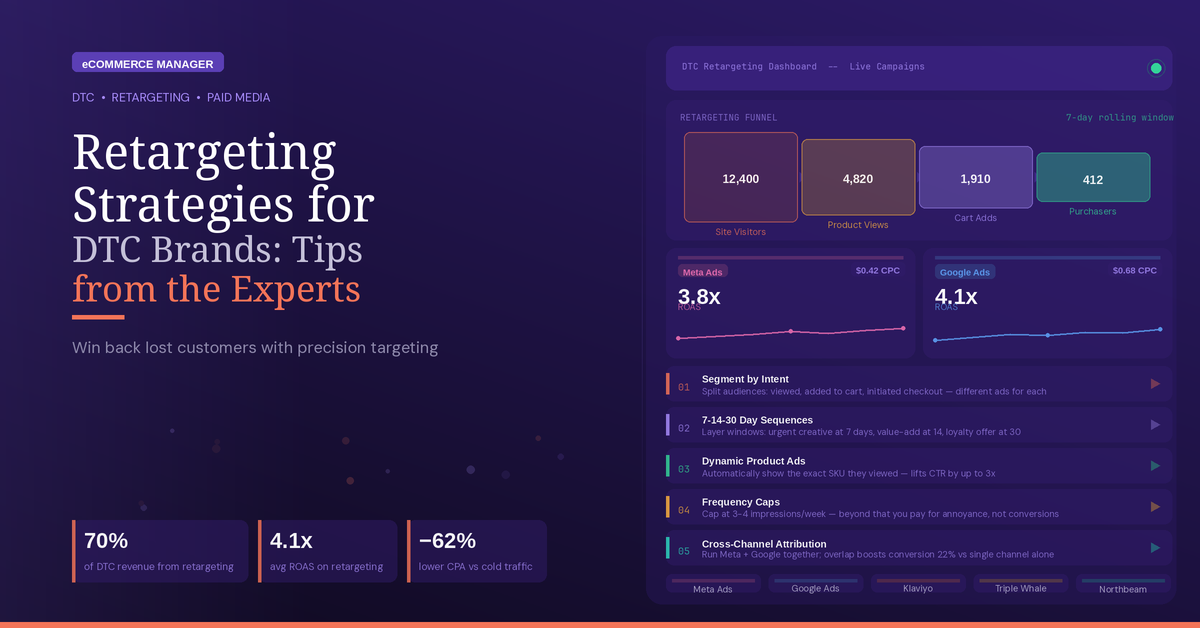
Retargeting Strategies for DTC Brands: Tips From the Experts
Most DTC brands lose potential customers long before the final purchase step. Smart retargeting uses timely messages, useful follow-ups, and trust-building content to bring shoppers back. Experts in the field share practical strategies for turning hesitation and abandoned carts into completed orders.
- Sequence Delayed Orders by Urgency
- Qualify Intent Before You Reengage
- Leverage Live Clips That Build Trust
- Use Honest Reminders Without Coupons
- Reuse Product Copy on Timed Notes
- Feature New Releases for Warm Audiences
- Target Recent Amazon Detail-Page Viewers
- Advance Every Unfinished Purchase Step
- Nurture Guests Toward a Third Visit
- Isolate Basket Abandoners From Casual Browsers
- Tailor Rapid Messages to Drop-Offs
- Answer Hesitations With Useful Follow-Ups
- Advertise Sign-Up Savings
- Mail Handwritten Cards After Deep-Funnel Exits
- Match Checkout State With One Choice
- Teach Prospects Before You Sell
- Address Visitors’ Specific Objections
- Segment Audiences by Engagement Depth
Sequence Delayed Orders by Urgency
During my 4 years overseeing the process of managing direct consumer advertising campaigns, one of the most proven methods of retargeting is Sequential High-Intent Cart Recovery. Instead of showing general advertisements to all visitors of the site, we target customers who have put products into their cart in the past 3 days but have not made a purchase. In the first 48 hours, we show customer videos which provide solutions to possible product objections.
The State of eCommerce in 2026
By the third day, if there is no purchase, we use an urgent advertisement which provides free express delivery. As a result, during 8 months of application, this strategy helped us increase ROI of our retargeting campaign by 138% and reduced our cost of acquiring by 31%. It also managed to convert 26% of abandoned carts.
 Fahad Khan, Digital Marketing Manager, Ubuy Kuwait
Qualify Intent Before You Reengage
We build campaigns around the next best action, not the last page viewed. Page views are useful, but they can hide the difference between casual browsing and active interest. We combine signals such as return timing, engagement depth, and the path visitors take. Together, these signals give us a clearer and more reliable view of intent.
The Complete 2025 E-commerce Manager Career Guide: From Entry-Level to Executive
Our strongest tactic is to reserve retargeting for visitors who show enough signs of interest. Once they qualify, we use a sequence that supports their likely next step. We stop the sequence quickly when their interest does not grow. This reduces noise and helps each impression feel relevant rather than simply adding more reach.
 Mark Bietz, CMO, Halloween Costumes
Leverage Live Clips That Build Trust
The retargeting that works best for us leans on our Live content, not static product ads. We re-reach people who engaged with a Live or a product using short clips from that same Live, so they see the garment moving on a real body instead of a flat image, which carries the trust our brand is built on. Pairing that with margin-based audiences, so we are not overspending to re-reach people who would have bought anyway, has been the difference. Retarget with the content that made them interested in the first place, not a generic reminder.
-Whitney O’Keefe, co-owner, Avery Mae Boutique (averymae.com)
 Whitney O’Keefe, Co-Owner, Avery Mae Boutique
Use Honest Reminders Without Coupons
My retargeting is basically all email, not display ads. I run Klaviyo and the flow that actually pays off is a simple abandoned cart sequence: one email a few hours after someone leaves without buying, a second the next day with nothing but the product and a plain reminder, no discount attached to either one.
I skip the coupon because Shuven only has one promo, a 10% welcome code for first-time buyers, and I don’t want an abandoned cart email teaching people to expect a discount every time they hesitate. The email just answers the question they probably had: what’s actually in the bottle, at full clinical dose, no proprietary blend, and links straight back to the product page.
It works because most people who add a supplement to cart and leave aren’t rejecting the product, they’re just not ready yet. A plain, honest nudge a day later closes more of those than a markdown would, and it doesn’t put a dent in margin the way a blanket retargeting discount does.
Ryan Pepple, Founder, Shuven, https://shuven.co
 Ryan Pepple, Founder, Abovance
Reuse Product Copy on Timed Notes
We do not buy a second retargeting stack. We reuse the same words shoppers already saw on the product page, then send them again on a fixed clock.
I am Neill David Watson, founder of APMZEE. On our Shopify store a few hundred customers a month buy Creatine Gummies from about $25 and Saffron Sleep X from about $30 to $31. When someone browses and leaves, the day-3 email restates what is in the jar and points to Are Creatine Gummies Legit? How to Tell If Yours Has Creatine. The day-24 email comes back with the 20% subscribe-and-save offer on Saffron Sleep X, still using the same claim-gated copy. Roughly 6 AI creative hooks feed those sends, and none of them ship until the claim gate matches the jar, the product page, and both emails. Support stays near 10 tickets a month, which is how I know the retargeting is clarifying rather than confusing. Skip this if you already run a full ads agency with separate creative for every funnel stage. From a lean UK and Dubai DTC desk, one gated message on two timed emails beats inventing a pixel theatre we cannot staff.
 Neill David Watson, Founder, APMZEE
Feature New Releases for Warm Audiences
One approach we use at Demons Behind Me is product-specific retargeting around new releases. Rather than giving every warm customer the same generic message, we build the campaign around the featured product and exclude customers who have already purchased it.
For an apparel brand, that keeps the message relevant: someone who knows our brand can discover a new flannel or hoodie without receiving another acquisition pitch for an item they already own. We also distinguish warm-audience performance from new-customer acquisition when reviewing results, because those campaigns serve different purposes.
My advice is to define who the retargeting campaign should help and what they should see next before choosing the creative. Product relevance and purchaser exclusions matter as much as the audience size.
 Jim Thelen EdD, MBA, MEd, Co-Owner, Demons Behind Me
Target Recent Amazon Detail-Page Viewers
Most retargeting conversations stop at pixel-based social ads. On Amazon, where we spend most of our time, the warmest retargeting audience is already sitting inside the ad console and most brands leave it idle.
The strategy that works is Sponsored Display views remarketing. It reaches shoppers who viewed your detail page, or a closely similar one, and did not buy. Those people already cleared search results and the thumbnail. They looked at your price, your reviews and your images, then walked. That is a much stronger signal than a cold click on a social feed.
Two things separate a campaign that works from one that just spends. First, split your own-ASIN viewers from similar-product viewers into different campaigns. Own-ASIN viewers convert at a far higher rate and deserve their own bid, and blending them means the weaker audience sets your economics. Second, tighten the lookback window. The longer defaults sweep in people who bought elsewhere weeks ago, so a shorter window concentrates spend on shoppers still deciding.
Then give them a reason to come back. A retargeting impression pointing at the exact price they already rejected changes nothing. Run it alongside a coupon or a Subscribe and Save discount so the offer is genuinely different the second time.
We built BidBison partly because of this pattern. Remarketing audiences are the campaigns people set up once and never revisit, and the right bid on a view-based audience should move with recency and with what the audience is actually converting at, not stay parked at whatever number felt right in month one.
 Jimi Patel, Director, eStore Factory LLC
Advance Every Unfinished Purchase Step
Retarget the unfinished job, not every visitor who glanced.
My rule for DTC retargeting is one sequence per intent stage: cart or checkout abandoners see the same product and a friction fix, while content or collection browsers get a narrow proof asset or diagnostic, not a sitewide 10% blast. The tactic that stayed effective for me was capping frequency and excluding recent buyers so the ad only asked for the next step the person already started. Clarity metrics mattered more than reach: add-to-cart completion and checkout starts from the retarget set, not clicks alone. Broad “we miss you” creatives train discount hunting and muddy the journey.
If you cannot name the unfinished step, do not retarget yet.
 Redha Alayesh, Founder, BMD
Nurture Guests Toward a Third Visit
For a customer-experience driven brand, sending a discount code to a cold website visitor is the opposite of what you want to do. It’s the first time visitors (the ones who’ve walked through the doors before) that come back. We retarget them with follow-up emails and SMS messages 72 hours after their initial visit – thank you message, then a “Invite someone who has never visited” message at about 2 weeks later, and finally a “Book now” message during a slower weekday slot we’re trying to fill.
Why does this work? In Wellness Hospitality, Visit Three is when Curiosity becomes Loyal – Habits form, they invite friends to join them for visits, etc. We learned early that spending all of your marketing dollars on Top-of-Funnel Ads on Google and Facebook will burn a lot of cash with poor returns. So, we shifted money towards Retention Triggers. Get a Guest in for 3 Visits and they are likely going to be a Fan for Life. Every Retargeting Dollar we Spend is Optimized towards getting to that Third Visit versus the First Click – because Repeat Booking Rate vs. CTR is the CAC payback Metric that Matters most.
 Damien Zouaoui, Co-Founder, Oakwell Beer Spa
Isolate Basket Abandoners From Casual Browsers
From the paid ads side of DTC accounts, I give cart and checkout visitors their own campaign and keep people who only viewed a product out of it. A product view is curiosity and a cart is a stalled purchase, so mixing them lets automated bidding chase easy clicks while recoverable orders sit in the smaller pool. That hot layer stays on a short window, and the ad answers why they hesitated, shipping or fit, instead of leading with a coupon. A bigger visitor list feels safer in the interface, and that dilution trains the auction to buy cheap revisits instead of finished checkouts. When cart volume is too thin to learn from, I wait for the list rather than padding it with page views.
 Dr. Igor Ivitskiy PhD, Founder, Doctor Ads
Tailor Rapid Messages to Drop-Offs
The retargeting setup I keep coming back to splits people by what they did, then follows up on that action quickly. Someone who got to checkout and stopped needs a different message than someone who looked at one product page and left.
Checkout abandoners get an email or SMS within the first hour that shows the exact item they left and answers the usual hesitation, which is shipping cost, return policy, or a missing payment option. Cart abandoners get a lighter reminder with reviews for that product. Product page browsers get paid social ads showing the item they viewed, and nothing about a discount yet.
The mistake I watch brands make is sending every visitor the same discount ad for 30 days. It trains people to wait for the coupon and burns margin on shoppers who were going to buy anyway. I hold the offer back until the second or third touch, and only for people who showed real intent.
Timing matters more than most teams admit. MIT research found you’re 21x more likely to qualify a lead if you respond within five minutes. That study looked at sales leads, not carts, but the habit carries over. Interest fades quickly, so the first message should go out while the shopper still remembers what they wanted.
I also suppress anyone who already bought, so they don’t keep seeing ads for the thing they own. Buyers move into a separate flow built around replenishment and cross-sells.
 Victor Smushkevich, Founder, Tested Media
Answer Hesitations With Useful Follow-Ups
I do not like retargeting that simply follows someone around with the same ad they already ignored. I would rather use the second touch to answer the question that may have stopped them. In our storage and removals business, someone who visited a mobile storage page might later see content explaining delivery, access, or how the unit fits into a renovation. That makes retargeting feel like the conversation is moving forward. Repetition creates frequency, but useful progression is what builds confidence.
 Nicholas Gibson, Marketing Director, Stash + Lode
Advertise Sign-Up Savings
Highlighting a coupon has been effective for my clients. Many visitors don’t realize that they can save when they sing up for emails so we will remind them through a retargeting ad with a message such as “Sign Up and Save 10%” and this has shown to be more effective than generic ad copy.
 Kristina Cutura, PPC Consultant, OnlineAdsCafe.com
Mail Handwritten Cards After Deep-Funnel Exits
Our best retargeting channel isn’t a pixel. It’s the mailbox.
Here’s what we do at Simply Noted, and what a lot of our DTC customers copy. When someone gets deep in the funnel, say they added to cart or started checkout and bailed, we trigger a real handwritten card mailed to them within a couple days. Robots with actual pens write it, so it looks like a person sat down and wrote it, because the ink is real. Short message, first name, something like “Saw you were checking out the leather tote, it’s still here if you want it” plus a small code.
Why it works: everybody’s already getting hit with the same carousel ad on six apps and they’ve learned to scroll past it. A handwritten envelope gets opened. We track around a 99% open rate on those envelopes, and the cards tend to sit on a counter for days instead of disappearing in a feed.
It costs more per touch than a display impression, obviously. So we only fire it for high intent actions or higher AOV carts, and we let email and ads handle the cheap early nudges. That tiering is the whole trick. Don’t mail everybody who glanced at a product page, mail the people who almost bought.
 Rick Elmore, CEO, Simply Noted
Match Checkout State With One Choice
My rule is simple: retargeting traffic is not an audience, it is a paused checkout. The moment you treat it as a segment you start running creative that does not match the state the visitor is actually in, and that mismatch is where the money leaks.
The one strategy that keeps working for DTC brands is state continuity with a single decision. If someone left with three items in the cart, the ad and the landing page show those three items, the same prices, and one question: buy now or ship later. No new products in the recommendation block, no stacked discount banner, no newsletter modal on top of the cart.
The evidence for the single decision rule comes from our own shop tests, not from ad platforms. In one B2B shop we added volume tiers plus a shipping calculator to the cart and revenue per user roughly halved, tested over 100 days on 1,770 users. We stopped it. The cart is where an already-interested returning buyer makes a decision, and extra options there read as procurement friction rather than as help.
Two measurement rules. First, cap frequency and kill the sequence on purchase, because post purchase retargeting views are the single biggest reason platform reported retargeting ROAS looks better than it is. Second, judge the channel on a geo or time window holdout. Last click reporting hands retargeting credit for sales your branded and direct channels would have closed anyway, so budgets get cut exactly when the channel is working.
One honest limit: I will not quote a retargeting ROAS figure. Most of the ones I have seen on DTC dashboards were never incrementality tested, and I have no figure from our own data that would survive that scrutiny.
 Jörg Dennis Krüger, Author, Expert and Mentor, The Conversion Hacker®
Teach Prospects Before You Sell
Our most successful paid-social retargeting ad lead with education and not product. The initial “retarget” does not include an offer for money off the happy V product — nor does it show a hero image of the product. It is instead a short-form video or carousel from our Learning Center, answering the questions that likely led you to the happy V website (what is bacterial vaginosis? Why are lactobacillus strains important? What do researchers say about d-mannose?)
This was not simply a “creative” decision. This was a compliance-driven decision. Due to FDA/FTC structure-function rules we cannot promote products using medical claims — therefore, our retargets needed to be educational enough to get clicks. We found out early on this held true on label as well — a clinical style vaginal probiotic launch with strain names & CFU counts did little to move units until we explained it in plain consumer language. As we have tested, educated shoppers convert at a materially higher rate than the discount first audience and stay on subscription longer. Coupons bring one-time buyers. Education brings people who understand why they would stay.
 Hans Graubard, COO & Cofounder, Happy V
Address Visitors’ Specific Objections
My approach to retargeting is much like my approach to follow-up in real estate. No one has ever forgotten a property they viewed. They have simply been ‘stuck’ on some one particular objection and it is the real estate agent that can close the sale by identifying what that objection is. My approach to retargeting at CheapForexVPS is to try and establish where someone ‘dropped off’ and then serve them relevant content.
Objection-matched retargeting is our most effective strategy so far. I treat visitors in retargeting the same way I treated follow-ups in real estate. Nobody who walked away from a viewing has ever forgotten the property. They’re stuck on one specific worry and the agent that closes is the one who figures out what that worry is. So at CheapForexVPS we look at where someone paused and let that hesitation decide what they see next.
Surprisingly, the customers found this to be far more acceptable than typical ‘you forgot something’ style retargeting ads. The impression given is that of someone who cares, reminding them of something that they had forgotten, rather than a relentless brand following them around the internet. The trust of the hesitant buyer is earned through relevance.
 Corina Tham, Sales, Marketing and Business Development Director, CheapForexVPS
Segment Audiences by Engagement Depth
Most DTC brands retarget based on recency alone, which is why they’re bleeding money on people who clicked once and will never convert. The ones that actually win are ruthless about segmenting by intent signal, not just touchpoint.
At Pageloot we ran a test with our marketing agency customers, who were using QR codes for campaign tracking. We split our retargeting into two buckets: people who had opened the analytics dashboard (showed intent to measure ROI) versus people who just landed on the pricing page and bounced. The dashboard group got messaged about advanced features and attribution. The pricing page group got messaged about cost savings and faster setup.
The cost per acquisition on the dashboard segment was 3.2x lower, and they had 40% higher LTV because they were already thinking operationally about the product. The pricing group just wanted a deal, and deals don’t create good customers.
The real move is this: track the depth of engagement, not just the visit. Did they read the case study or skim the homepage? Did they open the email about features or just the discount code? Did they visit once or five times? Build your retargeting message around what that tells you about what they actually care about. You’ll kill your CAC if you treat all visitors the same.
 Siim Kostabi, CEO, Pageloot
Related Articles
- 12 Effective DTC Advertising Campaign Strategies
- Nurturing DTC Customer Relationships: 16 Email Marketing Strategies
- Boosting DTC Conversions With Pop-Ups: Effective Tactics Revealed