

Last Updated on October 27, 2026
Leveraging UGC for Your Shopify Store: Strategies From the Pros
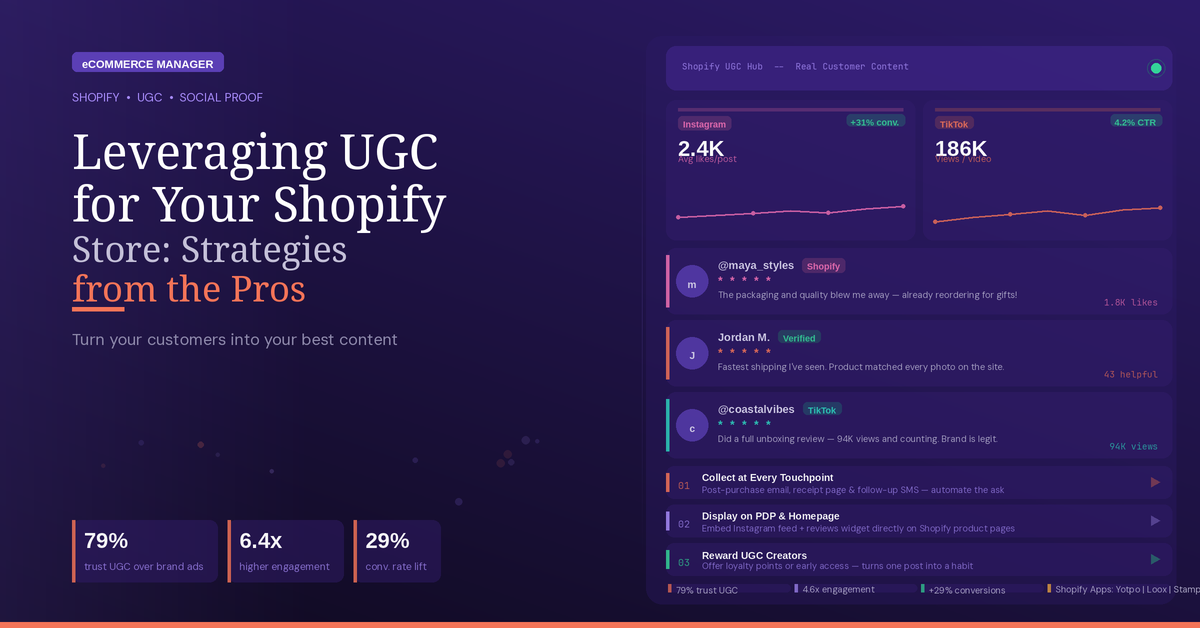
Customer-created content can turn shopper hesitation into confident purchases. Experts share practical ways to collect, verify, and place videos, reviews, and photos where they matter most. These proven strategies help Shopify stores build trust and drive more sales.
- Prompt Product-Use Submissions
- Amplify Community Outfit Posts
- Guide Customers Toward Better Shots
- Prioritize Detailed Customer Praise
- Put Authentic Clips by Buy Buttons
- Collect Post-Purchase Videos With Rights
- Turn Support Wins Into Creative
- Feature Verified Visual Testimonials
- Repurpose Creator Fitness Content
- Share Recovery Narratives With Permission
- Pair Event Imagery With Feedback
- Localize Permissioned Proof by Market
- Ask What Changed, Stay Compliant
- Design Shareworthy Spa Scenes
- Put Before-and-After Stories Near Checkout
- Place Reviews at Buyer Doubts
Prompt Product-Use Submissions
One of the strategies that worked best for us is converting photo reviews taken after purchase into product page content. Rather than asking the customers to provide general testimonials, we emailed one question 10 days after shipping, which read: “Show us how you’re using it.”
We provided some small store credit to all people who were able to send us a photo, and collected submissions via a Shopify reviews app straight to our moderation queue.
The State of eCommerce in 2026
Best pictures were used in three locations: a customer gallery on the product page, email sequences, and paid social media content with their permission (always giving them credit).
The photo submission rate was around 14%, which is way above the low single-digit rates that we had while sending just a text-based survey. Customer galleries increased conversions by about 22% compared to those products that didn’t have a customer gallery. One of my suggestions would be to ask a specific question rather than a general prompt. “Show us how you use it” will get much better content than “Leave a review.”
 Fahad Khan, Digital Marketing Manager, Ubuy Peru
Amplify Community Outfit Posts
Our best user-generated content comes straight from our community, not a campaign. Inside our 115,000-member VIP group, customers post photos of themselves in what they bought and other women cheer them on, which gives us a constant stream of real, size-inclusive outfit photos on real bodies. We reshare that with permission across our app, website, and socials, because a customer seeing someone the same age or shaped like her loving a piece sells it better than any studio shot we could produce. Build a place where customers genuinely want to show off, then simply amplify them.
-Whitney O’Keefe, co-owner, Avery Mae Boutique (averymae.com)
 Whitney O’Keefe, Co-Owner, Avery Mae Boutique
Guide Customers Toward Better Shots
The UGC approach that worked best for us was simple. We asked customers for photos, but we told them how to take them.
Early on we’d locked in a consistent look for our product photos: same background, same lighting, same angle on everything. The pages looked clean, maybe a little too clean. People liked them, but polished studio shots don’t prove anyone actually uses the product. We needed photos from real customers.
The ask went out in a post-purchase email about 10 days after delivery. Instead of a generic “share a photo with us,” we gave three quick tips: shoot in natural light, near a window, with the product where you actually use it. That one change made the submissions much better. Anyone whose photo we featured got 15% off their next order, and we asked for permission to use it right in the email so there was no back and forth later.
We put those photos where proof matters most. A row of customer shots sits under the main images on each product page. There’s a highlight on our Instagram just for them. A few of the best ones went into retargeting ads, and they beat our studio photos on click-through by 25%.
The reason it worked is that the two kinds of photos did different jobs. The studio shots kept the brand consistent, and the customer shots made it believable. We didn’t try to make the UGC look like our brand photography, and we didn’t let it replace our brand photography either.
 Miguel Estrada, Founder & CEO, MAD Monkey Media
Prioritize Detailed Customer Praise
The UGC strategy that’s worked best for me is leaning on real customer reviews instead of chasing influencer content I can’t really afford as a solo founder. I run Shuven, a small gut-brain supplement brand on Shopify, and I use Trustpilot to collect reviews after every purchase. I pull the strongest, most specific ones, the kind that mention an actual routine or result instead of just “love it,” and put them on the product pages and in my Klaviyo emails. That’s really the whole strategy. No paid UGC deals, no free product for content swaps. My advice for other small brands is don’t wait around for glamorous content. A stack of honest, specific reviews builds more trust than a handful of polished posts, and it costs a lot less than either running ads or courting influencers.
 Ryan Pepple, Founder, Abovance
Put Authentic Clips by Buy Buttons
Collect proof from real use, then put it where the purchase decision happens.
The UGC approach that worked for me was asking recent buyers for one short photo or clip of the product in their actual context, with a clear brief and permission to use it on the product page and in ads, not a vague “tag us” hope. I then placed the strongest pieces next to the buy button and in a simple email or retarget creative that showed the same scene. Clarity metrics moved: higher time on the PDP and better conversion on that SKU than when the page relied only on studio shots. Vanity follower UGC that never reaches the page is decoration.
Ask for one usable asset tied to one SKU. Then ship it on the journey, not only the feed.
 Redha Alayesh, Founder, BMD
Collect Post-Purchase Videos With Rights
One strategy that worked was adding a post-purchase “show us how you use it” request to our Shopify email flow. About 10 days after delivery, customers received a short email asking for a photo or video and offering a small future-purchase discount. We used a simple form to capture the asset, order number, and permission to feature it on product pages, in emails, and on paid social.
The best submission was a customer video showing real-world use. After getting written permission, we placed it beside the product’s FAQ and tested it in a retargeting ad. It outperformed studio creative because it answered actual shopper questions.
I always collect rights before repurposing UGC, and disclose incentives per FTC guidance.
 Faizan Khan, PR and Content Marketing Specialist, Ubuy Singapore
Turn Support Wins Into Creative
When a support ticket closes and the shopper still has the answer on screen, that is when we ask for a review. Hashtag campaigns can wait.
I am Neill David Watson, founder of APMZEE. We handle about 10 support tickets a month on a Shopify store selling Creatine Gummies from $25 and Saffron Sleep X from $31. When a ticket ends clean, we ask once for a one-line review while the win is fresh, never with a discount that muddies attribution. Those review lines feed the next batch of about 6 AI creative hooks, and nothing from that batch ships until the claim gate matches the jar, the 20% subscribe-and-save wording, and the day-3 and day-24 emails. I still feel the pull to chase volume metrics. What we actually use is the small loop: ticket, review ask, gated creative. For a few hundred customers a month that loop beats inventing a UGC programme we cannot staff.
The Complete 2025 E-commerce Manager Career Guide: From Entry-Level to Executive
 Neill David Watson, Founder, APMZEE
Feature Verified Visual Testimonials
My post-purchase email sequence includes a photo request along with the review ask, and that single addition changed how my product pages perform. When someone buys a waxing kit and uses it for the first time, there’s a natural moment of surprise that the process worked at home. I time my review request to land a few days after delivery so the experience is still fresh, and I ask customers to snap a quick before-and-after or show their setup. Those photos go straight onto my product pages with a verified-purchase badge next to the review.
I also run a branded hashtag on Instagram and TikTok that feeds into a searchable library of customer content. When someone tags a post, my team reaches out for usage rights before we pull anything onto the site or into ads. That consent step adds a little friction, but it keeps everything clean and builds goodwill with the customer.
Marketing Calendar: A Complete Guide
Every week, new visual UGC lands on my product detail pages and social channels without me producing it. Shoppers browsing my store see dozens of real people using the product in their bathrooms, rather than a studio shoot. That proof helps convert browsers who are on the fence about trying at-home waxing for the first time, and it costs almost nothing to maintain once the capture flow is running.
 Dan McElwee, Head of Retail, Tress Wellness
Repurpose Creator Fitness Content
One strategy I’ve used to leverage user-generated content (UGC) for my Shopify store, Fortira Fit, is incorporating authentic customer experiences and influencer-created content into social media marketing and product promotions. I believe UGC is especially valuable in the fitness industry because potential customers want to see how equipment performs in real-life settings before making a purchase.
A specific example is my influencer outreach strategy, where I connected with fitness content creators and offered opportunities to collaborate with Fortira Fit. This included arranging product collaborations and encouraging creators to demonstrate fitness equipment through workout videos, product reviews, and lifestyle content. My goal was to collect authentic content that could be repurposed, with permission, across Instagram, Facebook, and Shopify product pages to showcase product functionality and build consumer confidence.
I also focus on encouraging customers to share their experiences and feedback, creating opportunities to feature genuine testimonials and product demonstrations. My biggest takeaway is that UGC helps humanize a brand, strengthens credibility, and provides relatable social proof that traditional advertising often cannot achieve. By integrating authentic customer and creator content into the marketing strategy, a Shopify store can build stronger relationships with its audience and create more opportunities to improve engagement and conversions.
 Dmitriy Lyubarskiy, Owner, Fortira Fit
Share Recovery Narratives With Permission
Our customers often have something in common: they’re intentionally leaving something from their past behind and focusing on moving forward with their lives. That shared experience has naturally created a community around Demons Behind Me, and it continues to grow as new customers find something they can relate to.
We support that connection by sharing real customers wearing our gear and, when they choose to share it, the stories behind what they’re leaving behind. One way we gather UGC is by asking customers to tell us what Demons Behind Me means to them, along with a photo of themselves rocking our gear. They may also share their Demons Behind Me story: a hardship they’ve overcome and how they’re moving forward.
With our customers’ permission, we share those photos and stories to help others see that if they’re struggling, they’re not alone. We all face challenges at some point in our lives, and we believe facing them together as a community can make a difference. Sharing our customers’ experiences helps us support and grow the community that has naturally formed around Demons Behind Me.
 Jim Thelen EdD, MBA, MEd, Co-Owner, Demons Behind Me
Pair Event Imagery With Feedback
We don’t run our main Cubic Promote website on Shopify, although we do use Shopify to operate smaller online stores where we sell products to clients.
One UGC strategy we’ve found useful is collecting customer feedback after an order and pairing it with photos of the actual products. In our industry, customers want to know what the merchandise looks like once it’s printed, not just what it looks like in a digital mock-up.
A good example is a client called CCD, who ordered custom-branded umbrellas for an outdoor event. After the event, the customer told us how pleased she was with the umbrellas and said she’d recommend us to colleagues. We used her feedback alongside photos of the umbrellas at the event to create a client case study on our main website.
We also collect reviews through platforms such as Google, Trustpilot and Reviews.io, then feature customer feedback on our website. I think genuine customer comments are particularly useful for custom merchandise because people are often ordering hundreds of products without seeing the finished items in person.
The approach I’d carry across to any Shopify store is fairly simple. Show people what previous customers actually received, let those customers speak for themselves and make the feedback relevant to the products being sold.
I’ve found that a customer’s experience can often explain the value of a product better than another paragraph of sales copy. You don’t need every review to sound polished. Sometimes a straightforward comment and a photo from a real event tell people exactly what they want to know.
 Mr Charles Liu, Marketing Director, Cubic Promote
Localize Permissioned Proof by Market
The UGC that earned its keep on our own Shopify stores was not influencer content. It was customer photos and review text, collected properly and put back into the places where people are actually deciding.
Collection first. The request goes out timed to when the product has been used, not when it shipped. For a consumable that is two or three weeks in. For apparel it is after the return window closes, because asking for a photo before someone has decided to keep the item gets ignored. And the ask is specific: not “leave a review” but “show it in the room you use it in” or “show how it fits you”. Specific asks produce usable images. Generic asks produce five stars and no photo.
Where it goes matters more than where it came from. Most brands dump UGC into a homepage gallery, the lowest-value real estate available. The placements that move the needle: directly under the size or spec block on the product page, because that is exactly where doubt lives; inside ad creative, where customer photos consistently beat studio shots in a feed; and as the imagery in your objection-handling content, so a sizing guide shows real people instead of a chart.
The step almost everyone skips: capture written permission at the moment of collection, with a reuse scope that explicitly covers paid ads, not just your own site. Chasing rights afterwards is slow and you lose the best assets to it.
Running Olooq across the US, Australia and India taught us one more thing: UGC does not travel between markets as well as you hope. Customers trust photos of people who look like them in settings they recognise, so we collect and deploy per storefront rather than sharing one global library.
 Jimi Patel, Director, eStore Factory LLC
Ask What Changed, Stay Compliant
The most successful tactic for us has been an automated post-transactional email — at approximately day 45 of purchase (once customers have used our products long enough to take notice) — asking a single open-ended question, “What changed for you?”. In a regulated category, the prompt shapes the reply, and the reply ends up on our product pages. We are very intentional about the questions we do not ask.
Ask, “Did it cure X,” “Were your symptoms resolved,” etc. If you ask a medical question, you’ll receive a medical claim which you cannot legally display on product pages or any other marketing materials. However, if you ask, “What changed”, customers will respond using their own words regarding how they feel, their daily routine, what they noticed etc.
Those quotes are then displayed in rotating blocks across various product pages and in lifecycle emails. Our regulatory reviewer reviews each and every quote before we go live. Those product page blocks featuring customer language have demonstrated higher conversion rates than our branded content. One surprising learning: the less we lead, the more usable the reply. Ask what changed, not whether we cured anything — that one word swap keeps us compliant and keeps the stories real.
 Hans Graubard, COO & Cofounder, Happy V
Design Shareworthy Spa Scenes
Our most successful UGC tactic was not a marketing tactic but rather an architectural/Interior Design choice. The building we converted into a spa from a 1904 former church had an old ceiling; we were able to purchase approximately 70% of the equipment for the spa at auctions so the Cedar tubs, Copper Fixtures, Candles etc. provide a very “one of a kind” experience. We did not create a sign saying “tag us.” Instead we designed each nook of the property to give guests a reason to pull out their phone.
Guest posts photos of the rooms, we share guest posted photos on social media (feed & story) and this creates educational awareness in our category as there are many who do not understand what a beer spa is. A friend posting a picture of themselves enjoying the Beer Spa educates other about what a beer spa is much better than any advertisement we could possibly place. The same happened when we launched a line of beer-based cosmetic products. Guests took pictures of the product in the tub because the shot was already composed for them, and these organic photos became our advertising product photos.
 Damien Zouaoui, Co-Founder, Oakwell Beer Spa
Put Before-and-After Stories Near Checkout
My most useful User-Generated Content (UGC) to date was collected by asking a more meaningful question to customers rather than trying to ask more customers for reviews. At CheapForexVPS, instead of sending out the typical “review us please” email and getting one-line responses that were never remembered, I waited until about 30 days had passed and the customer had used the service long enough to form an opinion. I then sent a very simple question to them: “What were you worried about before signing up with us, and how did things actually work out for you?” The responses were very valuable. Traders were worried about slippage and downtime during big news releases. But in their first busy week of trading, none of those issues had materialized. I took their stories with permission to share and trimmed them slightly, and placed them on the pricing pages and checkout pages where people have second thoughts about buying. A real person’s story of similar concerns and how they were alleviated is far more powerful than any similarly-worded assurance from the company itself. I’d recommend this same approach to any Shopify store owner. Ask for the before-and-after stories, and then place them next to the “Add-to-cart” button, as opposed to burying them on some “Testimonials” page that no one ever visits. I know this works well in real estate too, where buyers trust the stories of previous owners (or neighbors) far more than the brochure of the real estate agent.
 Corina Tham, Sales, Marketing and Business Development Director, CheapForexVPS
Place Reviews at Buyer Doubts
The strategy is placement, not volume. Most brands collect reviews and then put them where nobody is deciding anything, at the bottom of the page or on a separate tab. Reviews only do work where the buyer has a specific doubt. For a fashion store that is size and fit, so the reviews that quote garment measurements sit directly under the size selector. For a supplement or medical supply shop it is legitimacy, so the reviews that mention documentation and delivery sit next to the quantity field.
On collection, the only method that worked consistently for us was a single email after delivery asking one question, with the reply going straight into the product page rather than into a review platform. A popup on the product page catches people who are still undecided, and an undecided customer writes a different review than a delivered one. We let customers answer questions we actually get in support tickets, because that is the doubt list, and it converts support load into on page proof.
The part nobody wants to print: we have watched on page trust content fail badly. In an anonymised B2B medical shop, medical certification badges plus technical specs on the product page cut revenue per user by roughly three quarters over 66 days on 1,779 users, and we stopped the test. Trust signals on a product page backfire when they add complexity or trigger procurement friction instead of removing a doubt. The rule we use now is one doubt, one piece of proof, placed at the decision.
I will not attach a conversion figure to our UGC work, because I do not have one that survived a proper test.
 Jörg Dennis Krüger, Author, Expert and Mentor, The Conversion Hacker®
Related Articles
- Leveraging UGC for E-commerce: Examples & Strategies
- Shopify Product Launch Strategies: Tips & Examples
- Building a Strong Brand Identity on Shopify: Proven Tactics