

Last Updated on October 27, 2026
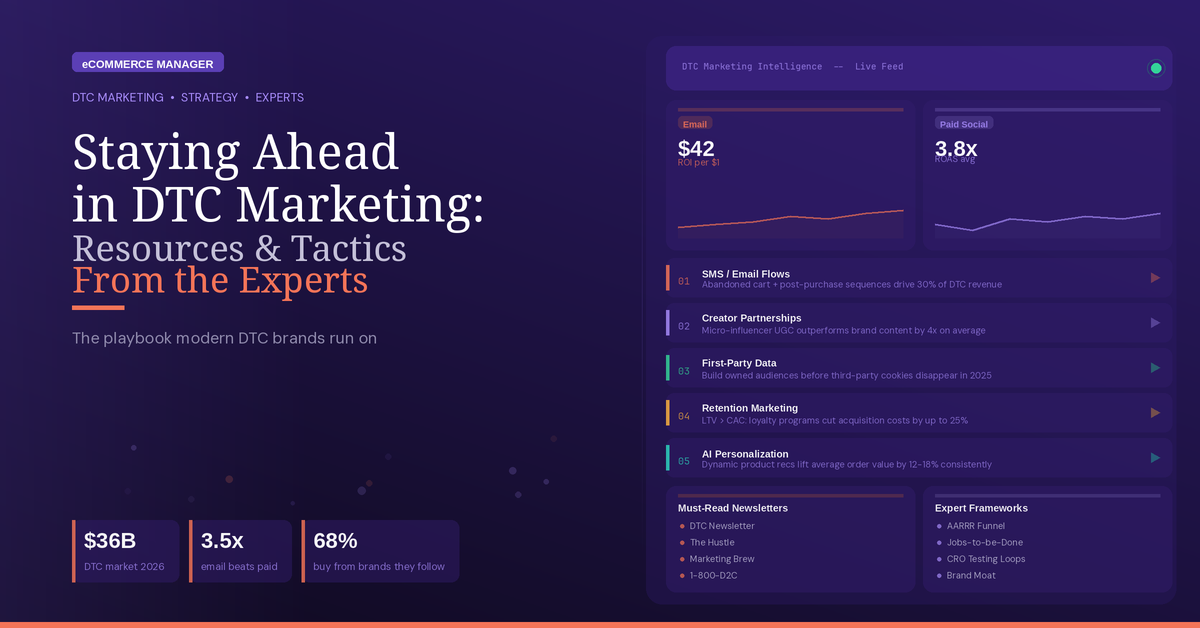
Staying Ahead in DTC Marketing: Resources & Tactics From the Experts
DTC marketing changes quickly, and small shifts can create major gains or costly misses. This article shares practical tactics for spotting trends, learning from customers, testing ideas, and improving decisions. Insights from field experts show what leading brands are doing to stay ahead.
- Read Low-Star Outside Reviews
- Refine Strategy With Query Reports
- Query Generative Tools
- Review Monthly Customer Language
- Track AI Referrals
- Test Short-Form Video Clips
- Maintain Weekly Prediction Logs
- Check Console Data Daily
- Order From Unfamiliar Shops
- Study Proven Rival Creatives
- Monitor Seller Central Releases
- Build Real-Time Behavior Dashboards
- Mine Category Subreddits
- Archive Failed Experiments
- Use Return Reasons as Signals
- Score Quarterly Forecasts
- Tag Recurring Feedback Themes
- Ask Buyers After Checkout
- Analyze Marketplace Terms
- Deploy a News Watchlist
- Curate Cross-Category Swipe Files
- Publish Answers to Common Inquiries
- Treat Your Store as a Lab
- Audit Meta Library Weekly
- Listen Within Niche Communities
Read Low-Star Outside Reviews
I stopped trying to stay current through marketing newsletters a while back, mostly because they all seemed to repackage the same three trending tactics within days of each other.
What’s actually worked is spending an hour weekly reading reviews, specifically one-star and two-star reviews, for DTC brands outside our category entirely, unrelated industries with no competitive overlap.
Complaints in categories we don’t touch reveal friction patterns that generalise surprisingly well; a recurring complaint about confusing size charts in an apparel brand’s reviews pushed me to audit our own sizing information, even though we sell something completely different.
That review turned up a genuine gap nobody on our team had flagged internally.
It’s a slower, less efficient way to stay informed than any curated newsletter, but it surfaces real friction rather than whatever tactic happens to be trending that particular week.
 Fahad Khan, Digital Marketing Manager, Ubuy Peru
Refine Strategy With Query Reports
One resource I use is the search-terms report, because it shows how customers describe what they want rather than how marketers describe a trend. In our published Q1 2026 Backroad Mapbooks case study, broad searches for ‘map’ included people looking for navigation apps, free PDFs and school materials, so category interest alone was a poor signal of buying intent. We reviewed the real queries weekly and refined exclusions and messaging around activity, product and location. For a DTC brand, I would turn that review into a short list of changing customer questions and searches that clearly don’t fit the offer. Those patterns can guide the next ad or product-page test, with purchases and customer quality deciding whether the change deserves to stay. Staying informed is useful when it changes a specific decision, not simply when it adds another trend to a reading list.
 Ian McGavin, Founder & CMO, Strataigize
Query Generative Tools
The Monterey Company is more custom ecommerce than classic DTC, but one tactic that keeps me informed is regularly asking AI search tools the same questions our customers ask before they buy, like which type of patch or pin fits a project, and seeing which brands and sources show up in the answers. It tells me quickly how buyers are being educated, which competitors are getting mentioned, and where our own content has gaps. Paired with what our sales team hears every day, it gives me a much clearer read on what is changing than most trend reports do.
 Eric Turney, President / Sales and Marketing Director, The Monterey Company
Review Monthly Customer Language
We schedule a monthly customer language review. Instead of beginning with dashboards, I read search queries, onsite questions, review themes, and customer care transcripts. We look for changes in the words people use to describe uncertainty, urgency, and identity. Those shifts often appear before performance reports reveal a broader change.
We then turn one pattern into a small experiment with a clear learning goal. For example, if customers increasingly ask comparison questions, we test whether clearer decision support improves confidence rather than simply increasing clicks. This keeps our marketing close to real decision-making. It also gives creative and analytics teams a shared starting point. In DTC, customer vocabulary offers an early market signal.
 Mark Bietz, CMO, Halloween Costumes
Track AI Referrals
Track AI search referrals, not just Google Search Console. For a Web3 payments client, we built AI agents that generated over 200 programmatic landing pages across product categories and use cases. Within three months, organic traffic rose 308% and ChatGPT referral sessions doubled. DTC buyers already ask ChatGPT and Perplexity for product recommendations before they open Google, so if you’re only watching traditional rankings, you’re missing where the research phase has moved. Build for how AI engines summarize your product, not just how Google ranks it.
 Victoria Olsina, Web3 SEO + AI Content Systems, VictoriaOlsina.com
Test Short-Form Video Clips
I’m Charles Liu, founder and Marketing Director of Cubic Promote, a Sydney-based business employing around 30 people across Australia, the Philippines, Vietnam, and India. We’ve been selling online for more than 20 years, mainly to business customers, and we also operate smaller Shopify-powered stores.
One thing I’ve learned is that marketing trends change so quickly that reading about them isn’t always enough. I prefer trying things on a smaller scale to see what actually works for our audience.
We’ve recently been exploring short-form video as a way to get more out of our podcast interviews. We regularly talk about business, marketing and promotional merchandise, so we’re looking at how to turn those longer conversations into shorter clips for LinkedIn, Instagram and TikTok.
Rather than filming completely new content for every platform, we can take a 30-minute conversation and identify a few useful moments that might interest different audiences. It also gives us a chance to experiment with opening hooks, video lengths and different ways of presenting the same topic.
I pay attention to things like watch time, shares, profile visits and whether the content leads to genuine enquiries. A video getting thousands of views is encouraging, although I’m more interested in whether we’re reaching people who might eventually become customers.
Talking to other business owners and marketers through our podcast has also become a useful way to keep up with what’s changing. I get to hear what they’re experimenting with, which channels they’re finding useful and where they’re spending less money than they used to.
I’ve found that the best way to keep up is to stay curious and make room for small experiments. You don’t have to jump on every new platform or AI tool, although it’s worth testing promising ideas before deciding whether they deserve a bigger share of your marketing budget.
 Mr Charles Liu, Marketing Director, Cubic Promote
Maintain Weekly Prediction Logs
One tactic we rely on is maintaining a small weekly prediction log. We write down emerging customer behaviors, unexpected campaign results and changes in the questions people ask before purchasing. Each entry includes a possible explanation and one low-risk test. After a few weeks, we review which predictions held up and which were simply noise.
This creates a disciplined way to stay curious without becoming distracted by every new platform feature or viral format. Most marketers consume a great deal of information but fewer build a system for checking whether their assumptions were right. The prediction log turns observation into a learning loop. It also makes patterns easier to see over time. The aim is not to predict every change perfectly. It is to recognize meaningful movement earlier and respond with evidence.
 Vaibhav Kakkar, Founder and Group CEO, Digital Web Solutions
Check Console Data Daily
The one tactic I use to stay ahead in DTC is checking Google Search Console every day, because traffic patterns change there before anyone writes about them. I’ve also tested over 300 marketing tools on real campaigns, and that tells me faster than any report what’s shifting in DTC, from checkout friction to how people find a brand through AI search now. Trend pieces usually arrive months after the data already moved.
 Lilach Bullock, AI Implementation Consultant and Fractional CMO, Lilach Bullock
Order From Unfamiliar Shops
My honest answer is that I pay more attention to what’s happening in my own inbox than to any DTC newsletter. We sell handwritten notes (99% open rate on the envelopes, which no email list gets close to), so I’m always watching what channels people are tired of. When every brand is fighting for the same crowded inbox and the same retargeting ad, the thing that stands out is the thing that feels physical and human.
The tactic I’d recommend is simple: every few weeks, order from five DTC brands you’ve never bought from, and just look at what shows up. The packaging, the insert, the follow-up email, whether anyone bothers to say thanks. You learn more from being a customer than from reading ten trend reports, and you steal the good ideas fast.
We’ve also learned a lot from our own customers, who tell us what landed in their mailbox and what they threw out. That feedback loop beats any podcast I’ve listened to.
 Rick Elmore, CEO, Simply Noted
Study Proven Rival Creatives
The resource I use most is the Meta Ad Library. It’s free, it’s public, and it shows what other DTC brands are running right now. I check a handful of competitors every week and look at how long each ad has been live. An ad that’s been up for ninety days is almost always paying for itself, because nobody funds a loser that long. That tells me which hooks and offers are working before any trend article gets written about them.
Then I open the landing page behind each long-running ad. If the headline, the offer, and the proof all match the ad, the brand built it as one funnel, and that’s the part worth copying.
I also watch the follow-up side, since the baseline keeps moving. McKinsey reports 78% of businesses now use AI in at least one function. So I sign up for the big brands’ email and SMS lists with a spare inbox and read what lands after an abandoned cart. Five minutes of that tells me more than most newsletters do.
 Victor Smushkevich, Founder, Tested Media
Monitor Seller Central Releases
Most DTC marketers stay informed by reading other marketers. I would rather read the platform. The habit that pays for itself is a weekly pass through the Seller Central news feed and the Amazon Advertising API release notes, because changes land there with a date attached weeks before anyone writes a newsletter about them. New targeting types, placement behaviour, listing policy updates, they all surface there first.
The tactic that turns reading into something actionable is a diff. Every Monday we pull the Search Term Report and the Business Report and compare them against the prior week at the ASIN level, looking at impression share and session counts rather than sales. When a platform quietly changes how a placement serves, it shows up as a session shift well before it shows up as a revenue shift. That gap is where the margin sits, and it closes fast once everyone else notices.
For outside reading, the one source I would keep is Marketplace Pulse, because it covers structural shifts in how marketplaces work rather than tactics that stop working in a quarter.
The broader point: a resource that tells you what to do ages badly. A report that tells you what changed does not. Build the second one into your week and the first one stops mattering much.
 Jimi Patel, Director, eStore Factory LLC
Build Real-Time Behavior Dashboards
Every product I’ve sold online over 20+ years eventually hit a wall where the old playbook stopped converting. My tactic for catching that moment before it costs me money is building no-code AI tools that scrape and organize buyer behavior data from my own funnels in close to real time.
I’ll spin up a quick automation that pulls purchase patterns, abandoned cart triggers, and ad engagement signals into one dashboard. When something moves, I can see it within hours instead of waiting for a monthly report or reading about the trend in someone else’s newsletter two weeks later.
That same approach feeds into the masterminds I run with other operators. Everyone brings their own live data to the table, so we’re comparing real signals across multiple businesses at once. A pattern that looks like noise in one funnel becomes obvious when three people are seeing it at the same time.
The practical result is I’m usually adjusting creative, offers, or targeting a full cycle ahead of when I’d catch the problem through conventional tracking.
 Will Mitchell, Founder, StartupBros
Mine Category Subreddits
I dedicate approximately 2-3 hours each week to reading “has anyone tried,” or “what should I buy” type posts from category-based subreddits (not individual brand based) – the research ones. The majority of trending topics that show up on DTC newsletters have already been debated for months by Reddit users, which is where you can do legitimate market research. For one Health & Wellness client, we spotted the ingredient skepticism shift in subreddit threads a full quarter before it showed up in their paid search data, and reworked landing page copy around the actual objections buyers were raising.
 Roman Sydorenko, CEO, RedditServices
Archive Failed Experiments
The resource that filters best is our own archive of tests that lost. Anyone can read the industry newsletters about what is converting this quarter. Almost nobody publishes what failed, so the losers are the actual signal.
The rule my team works with: every stopped test gets written up with the same care as a winner, control and variant revenue per user, sample size, run length, and the sentence explaining what we think happened. That log is what tells us which widely held belief is not paying off for our kind of product mix.
A recent example. We tested medical certification badges plus full technical specification blocks on a product page in an anonymised B2B medical shop. Live test, 1,779 users over 66 days. Control 11.37 EUR revenue per user, variant 2.96 EUR. A 74 percent loss. We stopped it and kept the original page.
The insight we carried out of it is now a standing rule before we ship any reassurance block: a trust signal only earns its place if it reduces uncertainty. If it makes the buyer verify something or reads like a tender document, it is friction with a good excuse.
So the tactic is not reading more. It is writing down what cost us money, and then refusing to run the same experiment twice.
 Jörg Dennis Krüger, Author, Expert and Mentor, The Conversion Hacker®
Use Return Reasons as Signals
We use cancellation and return reasons as a content signal, when the transaction never closes. A reason such as “too gray” is about color alone. It may reflect screen calibration, warm bathroom bulbs, tile undertones, or the shopper’s assumption that a finish would match chrome, brushed nickel, and black hardware well.
When those themes recur, teams revise expectation-setting material before treating the issue as an operations problem. That makes the tactic valuable beyond conversion rates. It identifies where a digital presentation is asking a customer to make an expensive leap of faith. Staying ahead in DTC means shrinking that leap with precise information, not masking it with more aggressive retargeting.
 Todd Harmon, Founder & Owner, BathGems
Score Quarterly Forecasts
My favorite way to stay current is to run a prediction ledger. At the start of each quarter, I write down five beliefs about how buyers may behave, such as whether they will respond better to comparison tools, more concrete proof, or lower-friction replenishment. I include the evidence behind each prediction and define what would prove me wrong.
This creates a healthier relationship with new information. Instead of collecting trends passively, I actively test whether they change my view. At the end of the quarter, I score each prediction and examine the misses. The wrong calls are often more instructive than the correct ones because they reveal where intuition was shaped by noise. DTC marketing rewards speed, but disciplined learning is what makes speed useful rather than reactive.
 Sahil Kakkar, CEO / Founder, RankWatch
Tag Recurring Feedback Themes
The tactic I rely on most is using customer reviews as a real-time market research channel.
DTC changes quickly because customer expectations change quickly. A brand can watch TikTok trends, newsletters, ad libraries, competitor emails, and platform updates, and all of that is useful. But the fastest signal usually comes from what customers are already saying after they buy.
I like to track recurring review themes every month: what people praise, what they complain about, what almost stopped them from buying, what surprised them, and what language they use when describing the product. That gives a much more practical view of the market than only looking at campaign metrics.
For example, if several customers mention the same hesitation around shipping, pricing, product quality, sizing, returns, or support, that is not just reputation feedback. It can shape ad copy, landing pages, FAQs, email flows, creator briefs, and product page messaging.
The same applies to positive reviews. If customers keep saying a product saved time, felt more premium than expected, solved a specific pain, or made a routine easier, that language should not stay buried in review widgets. It should become part of the brand’s messaging.
My simple process is to tag reviews into 5-7 themes and compare them against campaign performance. If a theme appears in customer feedback and also affects conversion or repeat purchases, it becomes a marketing priority.
So my answer is: stay close to the customer’s words. DTC marketers often chase trends, but the best trend signal is usually hidden in repeated customer language. It shows what people believe, what they doubt, and what they need to hear before buying again.
 Vladislav Evtukhov, Brand Marketing & Online Reputation Manager, RealReviews.io
Ask Buyers After Checkout
I’m John Mac, founder of Exit Evidence and OPENBATT. We help Shopify brands doing $1M to $20M in revenue grow better and prepare for exit.
The best way to keep your ear to the ground that I’ve found is to ask your customers. I’m not talking about some convoluted survey, just a one-question survey at the end of the checkout process.
Recently, one of our DTC clients was finding that the CPA on TikTok was twice that of Meta and that it should be turned off. This made sense from a pure ad-spend perspective, but something didn’t add up. Branded search, direct traffic and total transactions were all going up as their TikTok spend increased.
We added a one-question survey after checkout (for this we use KnoCommerce) and got a 45% response rate. It turned out that 35% of their customers cited seeing an ad or creator on TikTok as how they found out about them. This was far more than the pixel was giving credit for and would have been a mistake to turn off that channel while it was driving top of funnel demand that other channels were taking credit for.
The key to this question is how it’s asked. You don’t ask what ad lead them to buy, because they don’t know and it will give you inaccurate data. You ask how they found out about you. We then compare this to what the different platforms say in regards to attribution and what the last click source is. If we find that X platform is a significant source of new customers, even if Y platform is taking credit for the sale, we then adjust what we’re willing to pay to acquire a customer on X since it’s the top of funnel demand generator.
As a small DTC team, you can run this weekly and track if any channel goes up or down by more than 5% week over week. You know what platform is taking credit for the sale, this will tell you what channel is actually making the sale.
 John Mac, Founder, Exit Evidence
Analyze Marketplace Terms
My best resource is our own Amazon search term reports, read every week. Amazon has become the first search box for a huge share of DTC shoppers, so the wording people use there tells you what they want weeks before it shows up in trend articles or Google data. When we see a new phrase climbing (a feature, a use case, a gift angle), we test it in ad copy and on the DTC site before competitors catch on.
Across the 200+ brands we have worked with, the teams that stay ahead are not the ones reading the most newsletters. They are the ones closest to their own customer language. A practical routine: pull your top search terms every Monday, flag anything new in the top 50, and give one person the job of turning it into a test that same week.
 Gilad Warter, Co Founder and COO, Enso Brands
Deploy a News Watchlist
One tactic I’ve developed is a news-monitoring workflow that collects information from selected industry publications, YouTube channels, Reddit communities and social accounts. It groups coverage of the same story and scores each topic against criteria relevant to the business, producing a focused reading list with links to the sources.
For DTC marketing, I would focus those criteria on changes in product discovery, customer questions and ecommerce platforms. Grouping related coverage makes it easier to see which developments deserve closer investigation and decide how they apply to a particular store.
 Nils Abegg, Freelance Software Developer & AI Automation Consultant, EinfachAI
Curate Cross-Category Swipe Files
I stay ahead by keeping a swipe file, a habit that goes back to my advertising career in my 20s. Whenever an ad makes me stop scrolling, I screenshot it into one folder on my phone straight away, before I’ve worked out why it caught me, because that first reaction is the one a customer has too. Every month I go back through the folder and delete anything that no longer grabs me. Most of what I save comes from brands outside period care altogether, as a fresh idea often turns up in another category before it reaches yours. If an ad still stops me a month later, it has found something real, and that’s the bit worth learning from.
 Nina Alexander, Founder, Annahitah
Publish Answers to Common Inquiries
I’ve stepped back from the company’s day-to-day operations, so the tactic I’d share for staying informed in DTC is one I used myself: read the questions your own customers send you, because they show where shoppers get stuck. It ties to advice I gave Collabs.io Mag, which was to build your business on a shop you own, since a marketplace can delist your products or show them to fewer people without warning. When the store is yours, those questions land with you, and our contact page invites people to email us about products, online orders, store experiences and more. One example from my own writing is the short juniper berry guide I posted in April 2023, prompted by how frequently customers wanted my help choosing between our juniper oils. If a question keeps coming back, publish the answer where every future shopper can find it.
The Complete 2025 E-commerce Manager Career Guide: From Entry-Level to Executive
 Hope Johnson, Founder, Miracle Botanicals
Treat Your Store as a Lab
I don’t really read marketing roundups anymore, I stopped trusting them a while back. What actually keeps me current is just building inside the tools. I run Shuven solo, so I’ve got the Shopify Claude Connector App wired straight into my store, and I use it to test things on the actual storefront instead of reading about what’s supposedly working for someone else’s brand. When I rebranded from CalmGut to Shuven earlier this year I had to rebuild a lot fast, new domain, product pages, email setup, and that forced me to learn what was current by doing it under pressure, not by scrolling LinkedIn. Klaviyo’s own send-time data taught me more about email timing in a month than any newsletter did in a year. My tactic, if you can call it that, is to treat my own store as the lab. The lesson I keep coming back to is that DTC moves too fast for secondhand advice, you have to watch your own numbers change in real time.
 Ryan Pepple, Founder, Shuven
Audit Meta Library Weekly
To keep TAOAPEX LTD ahead in consumer technology, I review active campaigns in the Meta Ad Library every Monday morning. Instead of relying on broad marketing commentary, I dissect the exact creative angles, video hooks, and landing pages that competitors and category leaders test in real time. Observing which concepts brands scale and which ones they quietly turn off reveals genuine consumer sentiment much faster than industry reports. Earlier this year, this tracking showed a clear pivot toward raw, unpolished durability demonstrations over sleek studio renders. We rebuilt our paid social creatives to highlight authentic drop tests and customer battery benchmarks, which lowered our customer acquisition cost by twenty two percent within six weeks. Continuous observation of live market experiments delivers actionable clarity.
 RUTAO XU, Founder & COO, TAOAPEX LTD
Listen Within Niche Communities
I prioritise direct engagement with niche communities–Discord servers, specialized forums and social channels–because they reveal emerging aesthetic and functional needs before broader metrics do. We monitor conversations, requests and user-generated styling to inform quick product tweaks, marketing angles and limited drops on Cyber Techwear.
That qualitative insight, paired with A/B tests on our site and social ads, keeps our DTC marketing adaptive and focused on real customer signals rather than lagging trends.
 Nicolas Falourd, CEO, Cyber Techwear
Related Articles
- DTC A/B Testing: Real-World Examples and Insights
- Measuring DTC Marketing ROI: Key Metrics & Strategies
- Retargeting Strategies for DTC Brands: Tips From the Experts