

Last Updated on July 20, 2026
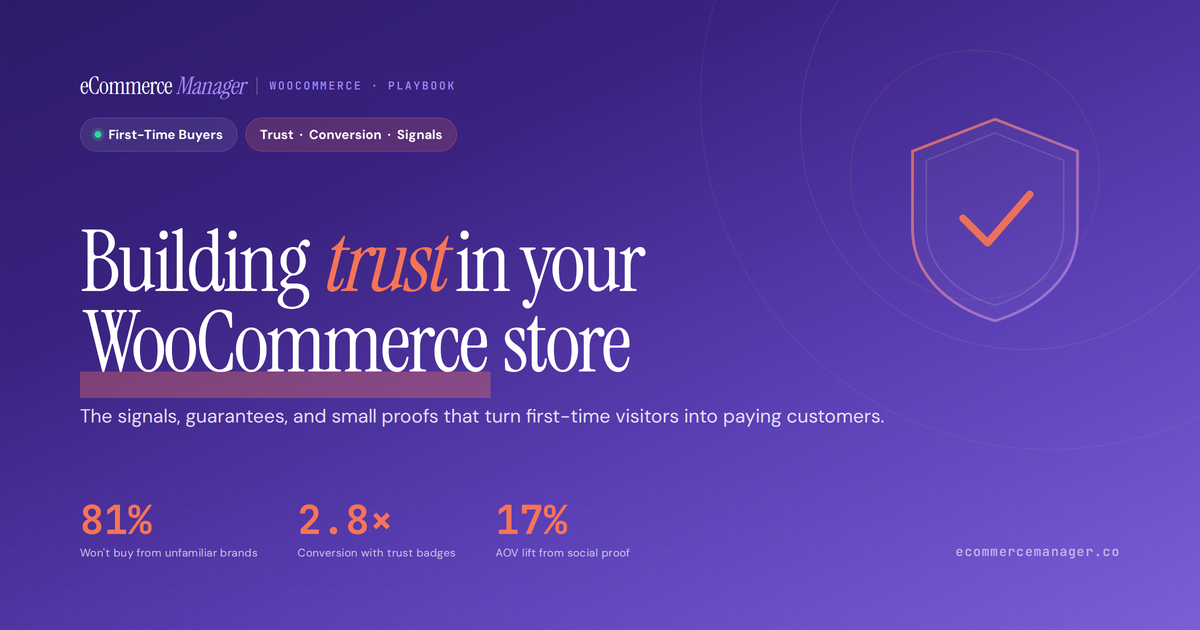
Building Trust in Your WooCommerce Store: Tips for First-Time Buyers
First-time buyers need clear reasons to trust an online store before they complete a purchase. This guide shares practical strategies for building credibility in WooCommerce stores, backed by insights from e-commerce experts who understand buyer behavior. These actionable tips focus on transparency, proof, and communication to convert hesitant visitors into confident customers.
- Publish COAs Plus Independent Results
- Feature Real Customers Via Social Proof
- Display Badges Beside Checkout Button
- Explain Craft Choices With Tests
- Address Concerns On Product Page
- Clarify Next Steps After Purchase
The State of eCommerce in 2026
Publish COAs Plus Independent Results
The biggest trust lever for first-time buyers in our category is putting the Certificate of Analysis and third-party testing directly on the product page, not buried in a footer. In supplements, you can’t make medical claims—so the trust signal has to be the proof, not the promise. We let independent test results do what a marketing claim legally can’t, and we pair that with OB/GYNs and microbiome researchers on our advisory board so the science is attached to real people.
On WooCommerce, we treat the CoA as a product attribute tied to lot, refreshed when manufacturing releases a new batch—same QA cadence we run on the factory floor. People just want to see the test. Once we stopped hiding it and moved verification above the fold, first-time conversion improved and repeat purchase followed, because the buyer’s first impression was proof, not persuasion. In a regulated category, that sequencing is what compounds.
The Complete 2025 E-commerce Manager Career Guide: From Entry-Level to Executive

Feature Real Customers Via Social Proof
I built trust for my WooCommerce store around visual proof from customers and influencer partners on Instagram and TikTok.
Every week my team collects tagged photos and short videos from customers who’ve received their orders. We feature those in product galleries and in Stories. When someone lands on a product page for the first time, they see that item on a real person with a real body.
I also work with a handful of micro-influencers who style our pieces on camera and post honest try-on content. Their followers come to my store already closer to trusting us because they watched someone they follow unbox and wear the clothes.
The impact has shown up in repeat purchases. Many of my first-time buyers come back within 60 days, and most of them cite the social content as the reason they felt comfortable placing that initial order.

Display Badges Beside Checkout Button
I have been working as a WooCommerce store operations executive for 2 years. The best method I used to build trust with first-time buyers was to display clear trust badges and security seals right next to the checkout button. This simple step proves the site is safe.
I place payment icons and safety seals where buyers feel the most anxious. I also show real customer reviews on product pages. We offer quick live chat support and display official security certificates to prove our online store is completely legitimate. I would advise website owners to focus on visual security signals at the final step of the purchase. You cannot force trust, but you can easily signal it with clean layouts, verified badges, and money-back guarantees that ease a new buyer’s mind. With this, our sales conversions from first-time buyers rose 25% higher, and checkout completion rates got 12% better.

Explain Craft Choices With Tests
I noticed early on that my first-time buyers were looking for signs that a real person built what they were about to buy. So I started putting product-build context directly on my product pages, showing how something was made, why I made certain decisions, and what tradeoffs I considered. The writing reads like a builder talking to another person. I include specifics about how I tested something, or why I chose one component over another, so a buyer gets evidence that a thinking person stands behind the purchase.
That product-build context on the page has been the strongest trust driver in my store. Customers who buy once and see that the product matches the description I gave tend to come back on their own, without a coupon or a retargeting ad pushing them. That repeat behavior has lowered my cost to retain a customer over time.

Address Concerns On Product Page
One method I rely on is making trust visible before the customer has to look for it. First-time buyers are usually asking quiet questions in their head: “Is this store real? Will my order arrive? What happens if there’s a problem?” On a WooCommerce store, I like to answer those questions right on the product page with clear shipping details, easy returns, verified reviews, secure payment messaging, and real customer photos whenever possible.
This has had a direct impact on conversions because it reduces hesitation at the exact moment someone is deciding whether to buy. For one store, we moved reviews, delivery expectations, and return details closer to the add-to-cart area instead of burying them in the footer. The site didn’t just feel more credible; customers spent less time second-guessing the purchase, and support questions from first-time buyers dropped because the answers were already in front of them.

Clarify Next Steps After Purchase
Coming from a sales background, I’ve learned that trust isn’t built by what you say about yourself — it’s built by removing the reasons someone has to hesitate before buying.
The one thing that moved the needle most for first-time buyers was making the “what happens next” crystal clear. Not just a confirmation email, but a visible, plain-language sequence: what they ordered, when it ships, who to contact if something’s off. Anxiety kills conversions after the click, not just before it.
The second piece is messaging alignment. If your store page talks one way and your checkout talks another, buyers feel it — even if they can’t name it. At Idea Farm, we treat every customer touchpoint as part of one connected system, and that consistency is what makes a brand feel credible before someone has any real history with you.
First-time buyers aren’t just evaluating your product. They’re evaluating whether you’re the kind of business that will actually show up if something goes wrong. Give them evidence of that before they have to find out.

Related Articles
- 7 Tips for Overcoming Your Biggest WooCommerce Challenge
- 8 Ways to Personalize Your WooCommerce Shopping Experience
- Reducing Cart Abandonment: 10 Strategies for WooCommerce Stores