

Last Updated on June 17, 2026
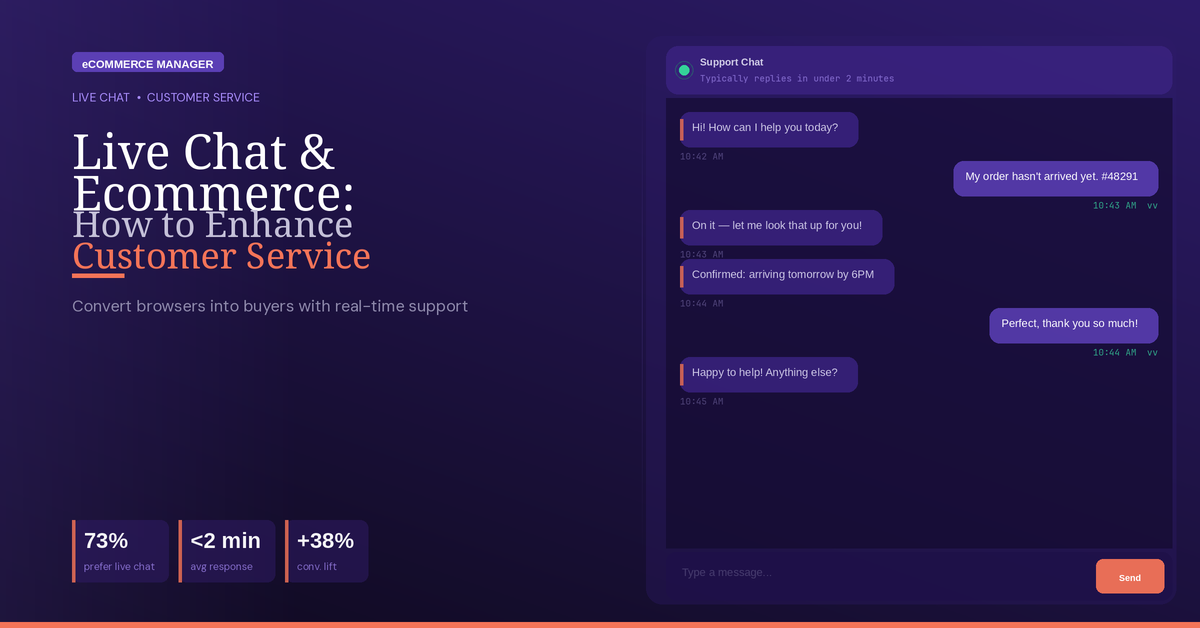
Live Chat & Ecommerce: How to Enhance Customer Service
Live chat has become essential for ecommerce businesses looking to boost conversions and keep customers satisfied. This article examines proven strategies for implementing effective chat support, backed by insights from industry experts who have successfully transformed their customer service operations. The tactics covered range from proactive checkout assistance to intelligent automation that balances efficiency with the human touch shoppers expect.
- Rescue Hesitant Checkouts with Proactive Prompts
- Resolve Factual Queries to Reduce Friction
- Solve Size Questions and Escalate Emotional Cases
- Let Data Bots Work and Free Closers
- Draft Answers with Oversight to Speed Replies
- Signal a Real Person Upfront
- Automate Intake and Launch Projects
- Build Trust with Swift Transfer to Experts
- Offer Brew Recipes Then Hand Off to Roasters
The State of eCommerce in 2026
Rescue Hesitant Checkouts with Proactive Prompts
As a Senior E-Commerce Conversion Strategist with 11 years of experience optimizing digital retail platforms across North America, I proactively deploy AI-powered chatbots triggered by real-time user behavior to reduce cart abandonment. Research indicates nearly 70% of online shopping carts are abandoned before purchase completion. In my recent role, I implemented a proactive chatbot that initiates contact when visitors linger over 45 seconds on checkout pages or display hesitation signals like back-button clicks. This system delivered personalized assistance, offering instant discount codes or shipping clarifications. The result was a 2.8x increase in completed transactions, aligning with industry findings that live chat can boost sales up to threefold. Additionally, our first-response time dropped 92%, matching performance metrics from top retailers. Analytics integration tracked chat-assisted sales, revealing 34% of conversions originated from chat interactions. Canned responses handled 68% of routine inquiries, freeing agents for complex issues. Visitor tracking enabled contextual help based on page history. This data-driven approach transformed customer service from reactive support into a proactive revenue engine, consistently improving CSAT scores to 95% while managing 900+ monthly conversations effortlessly.

Resolve Factual Queries to Reduce Friction
One useful way we’ve used live chat and chatbot style support is on high intent product pages where shoppers usually have one last practical question before buying. In our case that tends to be around ingredient sourcing, testing, shipping, or how two formats differ.
The key was narrowing the chatbot’s job. We don’t ask it to act like a nutrition coach. We use it to answer factual questions from approved product data, site policies, and support documentation, then hand the conversation to a person when the question gets nuanced. That boundary matters.
The result is faster response time on routine questions and fewer abandoned sessions on product pages that need a bit more explanation. It also gives us a clean read on what customers are confused about most often, which then improves product copy and FAQ content.
Live chat works best when it reduces friction, not when it performs a fake version of expertise. If the bot can answer simple questions accurately and escalate the rest quickly, it becomes a conversion tool instead of a frustration tool.
The Complete 2025 E-commerce Manager Career Guide: From Entry-Level to Executive

Solve Size Questions and Escalate Emotional Cases
We use a chatbot for one job it is genuinely good at, sizing and stock questions, and we hand everything emotional to a human fast. Most brands get this backwards and let a bot try to handle a frustrated customer, which only makes it worse.
The example: our number-one pre-purchase question is “What size am I?” and it used to sit in an email queue for hours, long enough that people left. We built a simple guided chat that asks two or three questions and returns a confident size with a fit note, instantly, any time of day. It also checks live stock, so it never recommends a size we cannot ship.
The result was fewer abandoned carts on the product pages where sizing doubt kills the sale, and a real drop in “what size” emails, which freed our small team to answer the complex questions properly.
The rule we follow: a bot should do the fast, factual, repetitive thing brilliantly and then get out of the way. The moment a message has feeling in it, a complaint, a delay, a problem, it goes to a person with full order context. Automate the lookup. Never automate the apology.

Let Data Bots Work and Free Closers
The majority of ecommerce chatbots are designed to perform the incorrect task. They welcome, they ward off, they irritate. In the meantime, the main team is typing tracking numbers all day long.
That’s a good waste of both.
The rule that I follow is that bots are supposed to answer questions that the order data already knows. Oh, where is my parcel? How do I return this? Will it make it before Friday. Human answers to the questions that involve a wallet. “Does this fit?” “Does the blue one still have any in the store?” Those buyers are 30 seconds away from checkout and closed with a quick human response.
On that homeware brand I mentioned, they picked up approximately two-thirds of chat volume and we ended up with not greeting people on the homepage anymore. Rather, a live prompt when they had sat on a product page or cart page for 40 seconds or so. Genuine hesitation. Human is where he belongs.
Put an end to evading customers with bots. Use them to release your best folks for chats worth having.

Draft Answers with Oversight to Speed Replies
I use AI to generate quick first-draft replies and to summarize long chat threads inside our shared inbox, then have humans review and send the final message. For live chat, that means routing common intents to drafted answers that agents can approve, which speeds handling while keeping our brand voice. In one implementation we combined auto-summaries and draft replies with a tone guide and human quick-edits, and the team saw 20-40% faster replies with more consistent messaging. Maintaining human oversight ensures accuracy and preserves the personal touch customers expect.

Signal a Real Person Upfront
One of the easiest things you can do is make sure people know they’re speaking to another human being on the other side. Too many live chats don’t make it clear or are flat-out just led by AI these days. What we do with our live chat is add “Not a bot!” to our display name so that people know it’s really our customer service team talking to them. A simple move like that makes a huge difference in a customer’s experience.

Automate Intake and Launch Projects
We use chat-based automation to capture customer intent immediately and to triage requests so a human team member can take the right next step. The bot gathers basic details, identifies the service type, and automatically starts a ClickUp project with a checklist tailored to that service. Automations then assign tasks and track progress across sales, marketing, and procurement so handoffs are quick. As a result, first responses come the same day and briefs are polished within hours, reducing dropped balls and speeding onboarding.

Build Trust with Swift Transfer to Experts
At MacPherson’s Medical Supply, one of the most effective uses of live chat has been deploying a hybrid chatbot-to-human handoff specifically built around product compatibility questions. In the DME space, customers aren’t usually browsing casually, they’re trying to figure out if a specific CPAP mask fits their machine, whether a wheelchair cushion works with their existing frame, or if a particular wound care dressing is covered by their insurance. Those questions kill conversions if they sit in an email inbox for 12 hours.
We programmed our chatbot to handle the top 30 recurring questions, sizing charts for compression stockings, replacement schedules for nebulizer parts, HCPCS code lookups, and shipping timelines for incontinence supplies. The bot resolves those instantly, 24/7. But the moment a conversation touches anything clinical, insurance-related, or involves a caregiver asking on behalf of a patient, it routes to a live rep with the full chat transcript already loaded. No one has to repeat themselves.
A specific win: we had a customer shopping for a hospital bed for her father who’d just been discharged. The bot recognized keywords like “hospital bed,” “discharge,” and “tomorrow,” and immediately escalated to a live agent instead of pushing her through a self-serve flow. The agent confirmed weight capacity, mattress compatibility, and same-day delivery zones within about six minutes. That order would have been abandoned otherwise, she’d already had two tabs open from competitors.
My biggest piece of advice: don’t try to make the bot do everything. In medical supply, trust is the whole game. Customers need to know a real person is one click away when they’re dealing with their mom’s oxygen concentrator. We track “time to human” as a KPI alongside resolution rate, and keeping that under 90 seconds during business hours has done more for our repeat purchase rate than any email campaign we’ve run.

Offer Brew Recipes Then Hand Off to Roasters
At Equipoise Coffee, the single most impactful use of live chat has been pairing a smart chatbot with a real human handoff for what we call “brew guidance” moments. Most of our chat traffic isn’t about shipping or returns, it’s customers standing in their kitchen at 7am with a bag of our Ethiopia Guji, asking why their pour-over tastes sour or what grind setting to use for their AeroPress.
We built a chatbot trained on our roast notes, brew ratios, and grinder compatibility charts. When someone lands on a product page, the bot proactively pops up after about 45 seconds with a question like, “Brewing this on espresso, pour-over, or French press?” Based on the answer, it serves a tailored recipe card with dose, water temp, and grind size right inside the chat window. That alone resolves roughly 60% of inquiries without a human ever stepping in.
The win came when we added a “Talk to a roaster” button inside the bot flow. If the customer’s question gets nuanced, say, they’re dialing in a single-origin on a Niche Zero and getting channeling, it routes straight to whoever is on the roasting floor that day, with the full chat transcript attached so the roaster doesn’t ask repeat questions. We staff this Tuesday through Saturday during roasting hours.
One concrete example: a wholesale cafe customer messaged us frustrated because a new lot was pulling bitter. Our head roaster jumped in within four minutes, asked two questions about their machine pressure and basket size, and suggested a coarser grind plus a two-degree temp drop. They replied an hour later with a photo of a perfect shot. That customer has since tripled their standing order.
The lesson: chatbots shouldn’t just deflect tickets. For specialty products, they should qualify the question and route the complex ones to someone who actually knows the craft. That’s where trust gets built.

Related Articles
- Leveraging UGC for E-commerce: Examples & Strategies
- June, 2025 – Excelling at Online Customer Service: 5 Tips and Examples
- November, 2024 – 4 Effective eCommerce Email Marketing Software Tools Recommended by Experts