

Last Updated on June 17, 2026
Leveraging UGC for E-commerce: Examples & Strategies
User-generated content has become one of the most powerful tools for e-commerce brands looking to build trust and drive conversions. This article brings together proven strategies and real-world examples, including insights from experts who have successfully implemented UGC campaigns across multiple industries. Whether you’re just starting with customer photos or ready to scale a comprehensive visual review program, these tactics will help you turn authentic customer experiences into sales.
- Embed Shoppable Customer Videos
- Turn Buyer Posts into Galleries
- Surface Wear-Occasion Quotes and Owner Clips
- Showcase Real-World Usage at Events
- Incentivize Visual Reviews with Discounts
- Answer Installation Objections with User Footage
- Ask for Tales Then Match to Claims
- Celebrate Wearer Stories across Channels
- Repost Restaurant Scenes for Trust
- Build Community through Morning Ritual Spotlights
- Collect Curate Amplify for Credible Proof
- Integrate Verified Photos on Product Pages
- Engage Authentic Reddit Debates with Disclosure
- Prove Everyday Fit with Routine Moments
Embed Shoppable Customer Videos
As the founder of Shopify’s top shoppable video app, I have quite a bit of experience with this.
Merchants should leverage user-generated content by integrating it directly into the shopping experience instead of treating it like a separate social media asset. One of the most effective things we’ve done is embed shoppable customer videos directly onto product pages so visitors can see real people using the product in real-world situations while being able to shop instantly from the video itself.
For example, we ran a campaign where we encouraged customers to submit short videos showing how they used the product day-to-day. Instead of heavily editing the content, we kept it natural and authentic. We then featured the best videos across product pages, homepage carousels, email campaigns, and even retargeting ads.
The impact was significant. Product pages featuring customer videos consistently outperformed pages without them, both in engagement and conversion rate. We also noticed shoppers spending more time on site because the content helped answer questions visually and built trust faster than polished brand photography alone.
What makes UGC so effective is that it feels relatable. Customers trust other customers far more than traditional advertising, especially in ecommerce where people cannot physically interact with the product before buying. When done well, UGC becomes both a marketing asset and a conversion tool.

Turn Buyer Posts into Galleries
I have been working on the role of an E-commerce Growth Specialist for 5 years. I use customer photos, short reviews, and unboxing clips directly on our product pages, ads, and emails. This strategy works because people trust real buyers far more than polished company text. In fact, a recent e-commerce guide notes that brands see much stronger trust and sales conversions when they reuse customer content across all their marketing channels.
I use a unique process to collect and reuse this customer content. I ask buyers to send a photo or a quick 10 second video right after their package is delivered, and then I feature the best posts with their permission. I sort the customer content by product type so I can reuse it in the exact right place, like placing a specific hoodie review directly on the hoodie purchase page. I aim to collect 1 user generated asset for every 20 orders we receive, and then I test that piece of content in 3 specific places: the product page, our Instagram account, and our email newsletters.
One great example is a customer styling campaign. When 12 customers posted photos of their outfits in one month, I turned those pictures into a gallery and placed it right next to the buy button. This makes the shopping page feel authentic and removes doubt before a customer buys.
The Complete 2025 E-commerce Manager Career Guide: From Entry-Level to Executive

Surface Wear-Occasion Quotes and Owner Clips
The UGC method that does the most work for PerfumeM is the least glamorous one. Real customer review quotes pulled directly onto the product page, paired with short verified-buyer wear-occasion clips when we have them.
I run PerfumeM (perfumem.com), an independent fragrance retailer based in Texas, since 2017. Over 30,000 customer reviews on file. We have never paid an influencer. We have never run a contest for posts. The two highest-converting UGC tactics on our store came out of the existing review corpus and out of customers we already had.
Method one. Review quote modules on every product page. We hand-curate three to five short verbatim quotes per product, pulled from real verified-buyer reviews, that name a specific wear occasion or pair-with scent. Something like “wore this to a wedding in July and got four compliments” works far better than a five-star review that says “love this.” The wear-occasion specificity is what converts an undecided browser. We tested this against a generic average-rating widget on the same page and the wear-occasion quotes lifted add-to-cart rate noticeably in the test window.
Method two. Verified-buyer short video clips on the small subset of products where customers volunteer them. When a customer leaves a review and uploads a clip of the actual bottle on their dresser or a quick wear-test, we feature that clip on the product page with attribution to the first name and city. Two important constraints. We do not pay for the clips. We do not edit them beyond trimming. The asymmetry of getting them for free is the entire reason they read as authentic.
The example that crystallised this for us was an older designer scent that had drifted to maybe two units a week. We added a wear-occasion quote module pulling three real reviews that talked about office wear and weekend wear specifically, and a single customer clip showing the bottle on a vanity. Weekly velocity roughly tripled inside a month. No paid amplification. No new ad spend.
The principle. UGC works in fragrance because shoppers cannot smell through a screen, so any second-hand evidence from a real wearer beats marketing copy. The cheaper the UGC was to acquire, the more it reads as honest. The minute it looks paid for it loses its job.
Ahmad Khan, founder of PerfumeM (perfumem.com)

Showcase Real-World Usage at Events
For a custom merchandise business, user-generated content works differently than it does for consumer retail. Our customers are organizations, teams, and groups that commission custom pins, coins, patches, and accessories, and when they share photos of their finished products, that content does real work for us because it shows the product in actual use rather than in a controlled product shot.
The most effective UGC we have leveraged is photos customers share of their products being distributed or worn by their teams. A photo of a military unit receiving challenge coins, a nonprofit handing out custom lapel pins at an event, or a sports team showing off their custom patches carries more credibility than anything we could produce ourselves because it shows the product meaning something to real people in a real context.
We encourage this by making it easy for customers to share and by featuring their content when they do. The example that worked best was a customer who posted photos of their organization receiving custom coins at an awards ceremony. That single post reached an audience we would never have reached through paid channels and generated several inbound inquiries from similar organizations who saw it.

Incentivize Visual Reviews with Discounts
An easy win for us here at Klatch Coffee <https://www.klatchcoffee.com/> has been to allow customers to include photos or video clips with their star rating / product review. We’ve built a nice library of UGC which includes customers sharing recipes, brewing tips, and showing off their home coffee setups using this method. To encourage submissions, we incentivize guests to include photos or videos with a tiered discount – they receive a discount code for leaving any star rating / review, but a larger discount if they include a photo, and an even larger discount when they include a video clip.
Example: https://www.klatchcoffee.com/products/wbc-worlds-best-espresso?_pos=1&_sid=99f880c5a&_ss=r
New customers find real-world feedback and tips from these product reviews to be useful for making future purchasing decisions.

Answer Installation Objections with User Footage
Installation anxiety kills more carts than price resistance in HVAC ecommerce. User videos calm that fear when instructions feel abstract or technical. Instead of generic testimonials, curated clips answered one installation objection each. Categories included wiring confidence, noise expectations, condensate management, and maintenance access.
During a garage heating campaign, we highlighted a mechanic’s winter retrofit diary. He filmed clearance measurements, startup noise, and energy bills weekly. Visitors stayed longer, asked sharper questions, and purchased higher-efficiency upgrades. That happened because relatable evidence beats polished persuasion in complex categories.

Ask for Tales Then Match to Claims
For anything that takes a moment’s thought to buy, nothing converts like a real customer’s words, but how you use that content matters far more than how much of it you have.
The shift that worked for us was asking customers for stories, not reviews. “What changed in your day?” pulls something specific and situational, whereas “leave a rating” produces wallpaper. Then we place those stories next to the relevant claim on the page, so the proof sits right beside the promise it supports rather than in a separate reviews section nobody scrolls to.
The difference is concrete. A wall of five-star quotes blurs into noise, but one customer describing the exact problem and the exact moment the product fit does real work, because the right prospect reads it and thinks, that’s me. Specific beats glowing every time.
The principle: user-generated content converts when it’s specific enough that the right customer recognises themselves in it. Collect stories, place them beside the claim, and let the page argue for itself.
The Complete 2025 E-commerce Manager Career Guide: From Entry-Level to Executive

Celebrate Wearer Stories across Channels
UGC is central to how we build trust and community at Portraits de Famille. We regularly encourage collectors to share photos and stories of themselves wearing our limited-edition pieces, often featuring their posts on our website, social channels and in email campaigns. One particularly effective example was during the launch of our “LIQUID” capsule: we invited customers to share their own “art of gathering” moments while wearing the new designs. The authentic photos and captions boosted engagement and reach, while inspiring others to see themselves as part of our creative community. This approach consistently drives higher conversion rates and repeat purchases, as new customers see real people valuing the artistry and experience behind every piece.

Repost Restaurant Scenes for Trust
We’ve found that user-generated content works best when it feels natural and experience-led rather than overly promotional. In wine, people tend to share moments rather than products, so the most effective content for us has usually been customers posting bottles being opened at dinners, celebrations, or gatherings with friends. Those kinds of images feel authentic because they show the wine in the context it was actually intended to be enjoyed.
One thing that worked particularly well was reposting content from trade partners sharing bottles in their restaurants, whether that was a sommelier talking through a wine on their list, a front-of-house team opening something for a table, or a chef pairing one of our producers with a seasonal dish. It created a stronger sense of credibility around the range and gave potential customers a more genuine impression of the wines than polished studio photography alone. We noticed noticeably stronger engagement on social content built around real on-trade moments because people trust the judgement of sommeliers and hospitality professionals far more than traditional advertising.

Build Community through Morning Ritual Spotlights
At Equipoise Coffee, we’ve found that user-generated content (UGC) is one of our most powerful marketing tools. There’s something inherently more authentic about seeing real customers enjoying our specialty coffee in their everyday lives rather than polished marketing shots.
We leverage UGC primarily through our social media channels and website. When customers tag us in their photos brewing our coffee at home or visiting our roastery, we make sure to engage with that content and often request permission to share it on our own channels. This creates a sense of community around our brand that we couldn’t build with traditional advertising alone.
One particularly successful UGC campaign we ran was our “Morning Ritual” series. We asked customers to share photos of their coffee brewing routines using our beans. The response was overwhelming. We received everything from elaborate pour-over setups to simple French press moments in tiny apartment kitchens.
What made this campaign effective was how we integrated it into our ecommerce experience. We featured these customer photos on product pages for the specific coffees they were brewing. When potential customers saw real people enjoying specific blends, it created social proof that our product descriptions alone couldn’t achieve.
We also implemented a review system where customers could upload photos alongside their written reviews. Products with these visual reviews consistently outperform those without. Our Colombia Huila single-origin, for example, saw a 23% increase in conversion rate after we added customer brewing photos to its product page.
The key to success with UGC is authenticity. We never stage these moments or overly filter the content. We celebrate the genuine relationships our customers have with our coffee. When someone shares a beautifully messy kitchen counter with our coffee as the centerpiece, that’s marketing gold.
I’ve learned that the best marketing doesn’t always come from your own creative team. Sometimes it comes from the people who love your product enough to share it with their world.
The Complete 2025 E-commerce Manager Career Guide: From Entry-Level to Executive

Collect Curate Amplify for Credible Proof
One of the most compelling trust signals in ecommerce is reviews, photos, videos and testimonials generated by actual customers. The key pillars to this strategy is to collect, curate, and amplify. Follow up with an automated email after each purchase, about 7-10 days after delivery, inviting customers to share a photo or short video with your brand hashtag, coupled with a 10% discount on their next purchase. This way, there is a consistent stream of genuine content that can be produced without a significant investment.
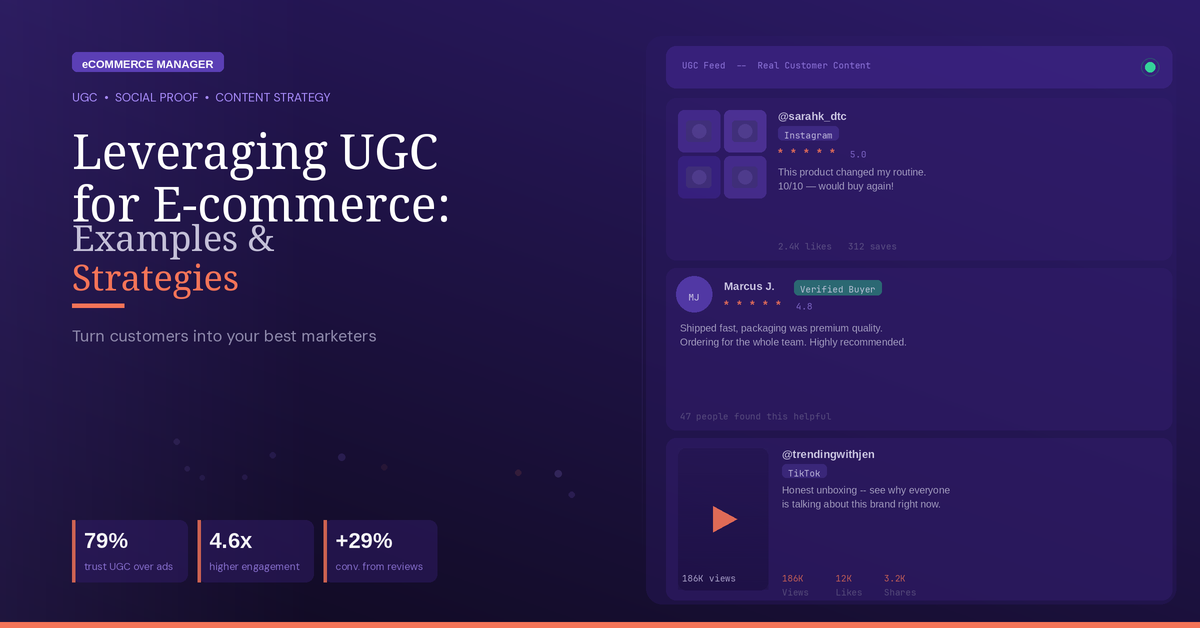
Not all UGC is the same; curation is important. Choose content that demonstrates how your product is used in real situations, shows different types of customers, and answers typical questions customers may have. Incorporate it by product categories and use it where it is needed most. When curated, spread it out on every crucial touch point, for example, by placing the photos of customers directly on product pages, which can increase conversion rates by up to 29%. Schedule UGC videos on social media, as they generally perform four times better than professionally produced videos. Include testimonials from actual customers in your email marketing and prominently showcase a live social feed on your homepage, so that you gain credibility as soon as you open the email.
An excellent real-life example of UGC: a hashtag challenge where participants share their career successes, job placements, or skill increases once they finish their digital marketing course. They use the best submissions to create Instagram and YouTube ads and post student success stories directly on their course landing pages. The proof is that aspiring learners witness career changes, not pretty marketing, and enrollment conversions happen on a large scale as a result. Genuine trust is what can be bought, and it’s the only thing that sells.
The Complete 2025 E-commerce Manager Career Guide: From Entry-Level to Executive

Integrate Verified Photos on Product Pages
How my agency uses user-generated content (UGC) to promote ecommerce client products:
**The single most effective UGC strategy across our ecommerce client portfolio: putting verified customer photos directly on the product detail page, not just on social.**
The conventional approach. Most brands collect UGC and use it as Instagram content, Facebook ads, or email-marketing imagery. The content lives on social channels and never touches the buying funnel directly. The conversion impact is real but indirect.
**The version that produces measurable lift.** We integrated a UGC widget directly onto the product detail page — verified customer-submitted photos and videos appearing immediately below the product imagery, before the description. The integration matters: not stock review snippets, not curated lifestyle photos, but real customer-submitted media tied to their published review.
**The specific result on one client.** UK ecommerce skincare brand, mid-market price point. Before UGC integration on the product pages, conversion rate sat at 1.4%. Eight weeks after integrating verified customer photos directly on the PDP, conversion rose to 2.7% — nearly doubled. Average order value held steady. Return rate dropped slightly (-0.6 percentage points), suggesting buyers were making more informed decisions because they could see how the product actually looked on real people rather than only on the brand’s models.
**Why it works in concrete terms.** Stock photography on ecommerce pages signals “this is the brand’s idealised version.” UGC signals “this is what you’ll actually receive.” The trust delta between those two signals shows up directly in conversion behaviour. For ecommerce categories where buyers worry about the gap between marketing imagery and reality (apparel, skincare, home goods), the UGC integration is the single highest-leverage on-page change available.
**The mistake to avoid.** Don’t curate UGC heavily. The aesthetic-perfect UGC reads as just-another-brand-image and loses the trust benefit. The slightly imperfect, real-customer-environment UGC is what produces the conversion lift. Keep the moderation light — block only the unusable, not the unflattering.

Engage Authentic Reddit Debates with Disclosure
Quick framing: I run a Reddit visibility service, not an ecommerce brand, so my UGC lens comes from client work across SaaS, FinTech, E-commerce, and Health & Wellness — not my own SKUs.
The most useful UGC for an ecommerce client usually isn’t the review widget or the solicited customer photo. It’s the existing Reddit thread where one stranger defends the product to another stranger at 2am. Nobody manufactured it, and the reader is already in research mode — that’s why it converts, and why AI systems like ChatGPT and Perplexity tend to ground brand answers on those threads when someone asks for a recommendation.
What we actually do: find threads where the category is being debated, participate honestly with disclosure, and make sure the product’s real strengths and weaknesses are represented accurately. We don’t seed fake testimonials — subreddits catch that fast and the brand damage is permanent. The white-hat line is simple: contribute context a buyer would thank you for, or stay out of the thread.
Outcomes vary by subreddit and category — Reddit is influenced, not controlled.

Prove Everyday Fit with Routine Moments
At NYC Meal Prep, we use user-generated content as proof of real routines, not polished marketing—because people trust how meals fit into everyday life more than staged photos. We encourage clients to share simple moments like unpacking deliveries, weekly fridge setups, or “what I’m eating this week” snapshots, and then repurpose those into stories that show consistency, convenience, and variety in a natural way. One of the most effective uses has been highlighting recurring customers’ weekly meal setups, which quietly demonstrates reliability and variety at the same time, helping new customers visualize how the service actually fits into their own routine.

Related Articles
- 12 Social Media Tactics to Drive Sales on Your BigCommerce Store (With a Campaign Example)
- 7 Effective Marketing Tactics for Ecommerce Businesses
- November, 2024 – 4 Effective eCommerce Email Marketing Software Tools Recommended by Experts