

Last Updated on October 27, 2026
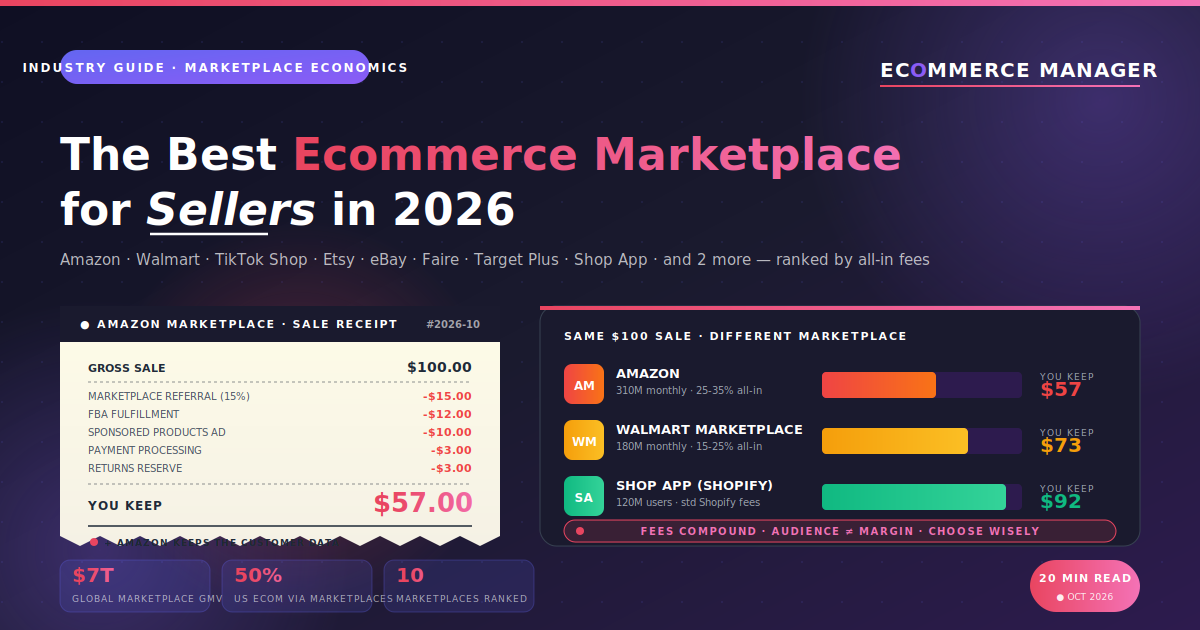
The Best Ecommerce Marketplace for Sellers in 2026
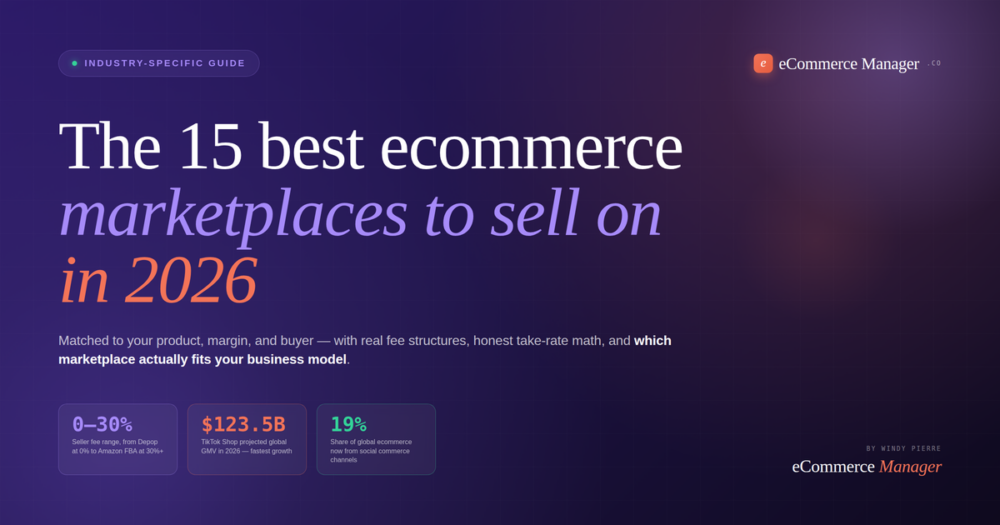
The honest ranking of marketplaces where you can actually sell your products — judged by all-in seller economics, audience fit, and the uncomfortable question nobody asks: who owns the customer after the sale?
Here's the strategic reality every DTC operator above $5M eventually confronts: the marketplace question is no longer optional. Half of all US ecommerce now moves through marketplaces rather than independent brand sites, and that number is still climbing. If you're not on at least one marketplace by $10M revenue, you're leaving meaningful growth on the table. If you're on the wrong ones, you're subsidizing them with margin that could have gone to brand building. If you're on Amazon badly, you're training a competitor to eat your category. This guide ranks 10 marketplaces by the only metric that actually matters: total seller economics — the all-in fees, the audience fit, the fulfillment math, and the uncomfortable question of who owns the customer when the dust settles.
Why Marketplaces Became Unavoidable (And Dangerous at the Same Time)
For about ten years in the pure-DTC era (roughly 2013-2022), the smart ecommerce move was to stay off marketplaces entirely. Build your own site, own the customer relationship, run paid acquisition through Facebook and Google, and treat Amazon as beneath your brand. That playbook worked beautifully for a specific window of time, and operators who followed it built real brands with real pricing power. Then two things happened: paid acquisition costs doubled, and marketplace discovery got dramatically better. The playbook stopped working, and most operators didn't update their mental model fast enough.
The current reality: for a mid-market DTC brand doing $10-$50M, marketplaces aren't a threat to your brand — they're one of three critical acquisition channels alongside your own site and paid social. The brands that figured this out early (Allbirds on Amazon, Bombas on Walmart Marketplace, Ridge Wallet across every channel including TikTok Shop) are the ones running laps around pure-DTC holdouts who refused to adapt. The real question in 2026 is not whether to be on marketplaces — it's which ones, with what SKUs, at what fee structure, and how to protect brand control along the way.
The danger is also real, and worth saying plainly. Marketplaces will happily train your competitors on your success. Amazon's private-label brands have eaten entire categories where third-party sellers proved the demand. Marketplaces own the customer data, which means your repeat purchase economics are theirs, not yours. And the "small" referral fees (15% on Amazon, 15% on Etsy, 5-20% on TikTok Shop) compound into real margin erosion at scale. The honest move is to approach marketplaces as paid acquisition channels — not as a replacement for brand building, and not as a free growth hack.
The Five Marketplace Seller Types (Which Are You?)
Match your type to the right marketplaces before you compare fee structures. The best marketplace for a DTC apparel brand is the wrong marketplace for a handmade jewelry seller, and vice versa.
DTC Brand Expanding Reach
You run an established DTC brand ($5-$50M) and need marketplace channels to accelerate growth beyond your paid acquisition ceiling. Audience size and brand-adjacent discoverability matter most. Best fits: Amazon, Walmart Marketplace, TikTok Shop, Target Plus.
Niche / Handmade / Craft Seller
You make something unique at smaller scale — jewelry, art, home goods, specialty food. Mass-market marketplaces will crush you on price; niche marketplaces built for your category are where buyers actually come looking. Best fits: Etsy, Faire (wholesale), Mercari.
B2B / Wholesale Seller
You sell to retailers rather than consumers, or you have a wholesale arm of your DTC brand. The B2B marketplaces work differently (net-60 terms, higher order volumes, retailer discovery). Best fits: Faire, Alibaba (global), Abound.
Resale / Vintage / Refurb Seller
Your inventory is secondhand, refurbished, vintage, or collector-focused. Mass marketplaces are poorly set up for condition grading; dedicated resale platforms are built for it. Best fits: eBay, Mercari, Poshmark, Depop, The RealReal.
Premium / Lifestyle Brand
Your brand positioning requires premium adjacency — being next to luxury/aspirational brands rather than next to the cheapest version of your product. You care about brand protection as much as sales volume. Best fits: Target Plus (invite-only), Shop App by Shopify (curated DTC), Instagram/Meta Shops, selectively Amazon via brand gating.
The Four Evaluation Criteria That Decide the Winner
1. All-in seller fees (not just the headline rate)
Every marketplace quotes a referral fee or commission as their headline price. The honest number is higher once you add fulfillment fees (FBA, Walmart WFS, Shop Promise), payment processing (usually 2.9% + $0.30), listing fees (Etsy charges $0.20 per listing), subscription fees (Amazon Professional at $39.99/mo, Walmart's referral review process, Target Plus invite-only onboarding), closing fees (eBay's final value fee), and advertising spend required to show up in search results on crowded marketplaces (Sponsored Products on Amazon is effectively a tax at this point). Real all-in fees run 15-35% on most marketplaces — the headline rate is roughly half the real cost.
2. Audience fit (does their traffic match your product?)
Amazon's 300M+ US monthly visitors is only useful if those visitors are shopping for what you sell. The highest-audience marketplace is useless if your product is niche. The lower-audience specialty marketplace (Etsy for handmade, Faire for retailers, Reverb for musical instruments) will convert 10x better for the right product. Match audience intent to product category — a decorative pillow buyer on Etsy converts dramatically better than the same buyer on Amazon's generic home goods aisle, even though Amazon has 50x the traffic.
3. Fulfillment support quality
Modern marketplace buyers expect 2-day shipping as table stakes. If you can't meet that bar on your own, the marketplace's fulfillment program (Amazon FBA, Walmart WFS, Shop Promise, Shop App native fulfillment) stops being optional. The trade-off is clear: fulfillment programs give you Prime-badge equivalent credibility and better search visibility, but they add 10-20% to fees, lock in your inventory to the marketplace, and expose you to storage fees that can wipe out your margin on slow-movers. Factor fulfillment math into your real per-order economics before signing up.
4. Brand control and customer data ownership
The uncomfortable question nobody asks on marketplace demos: when a customer buys your product on Amazon, Walmart, or Etsy, who owns that customer? Short answer: the marketplace does. You don't get their email, you don't own the review relationship, and you can't retarget them for your DTC site. Platforms like Shop App and TikTok Shop are starting to blur this line, giving sellers more direct customer relationships. For brand-driven operators who care about repeat purchase economics on their own site, this matters more than any fee rate.
Complete Comparison: 10 Ecommerce Marketplaces for Sellers
Ranked by combined DTC seller fit — audience quality, fee transparency, fulfillment support, and brand control potential. "Seller Fees (All-In)" is the realistic total take rate including referral + closing + payment + typical fulfillment, not just the headline referral rate.
| Marketplace | Best For | US Monthly Audience | Seller Fees (All-In) | Fulfillment |
|---|---|---|---|---|
AM Amazon |
DTC Scale | 310M+ visitors | 25-35% all-in | FBA |
WM Walmart Marketplace |
DTC Growth | 180M+ visitors | 15-25% all-in | WFS |
TT TikTok Shop |
Social/Viral | 150M+ users | 5-20% all-in | Shop Fulfilled |
EB eBay |
Resale/Niche | 110M+ buyers | 12-18% all-in | Self |
ET Etsy |
Handmade | 95M+ buyers | 18-22% all-in | Self |
FA Faire |
B2B Wholesale | 700K+ retailers | 15-25% + net-60 | Self |
TP Target Plus |
Premium | 170M+ visitors | 8-15% (invite only) | Shipt + Self |
SA Shop App |
DTC Discovery | 120M+ users | Standard Shopify + ad | Shop Promise |
IG Instagram Shops |
Social | 170M+ US users | 5% + processing | Self |
MC Mercari |
Resale/Casual | 50M+ users | 10-13% all-in | Self |
The "All-In" fees in this table assume you're paying realistic fulfillment and advertising costs — not just the headline referral rate. Amazon's famous 15% referral fee becomes 25-35% once you add FBA fulfillment ($5-15/unit depending on size), Sponsored Products advertising (now 10-15% of revenue for competitive categories), and the inventory storage fees. Walmart's 15% referral is more honest because WFS fees are lower and ad costs haven't fully inflated yet. TikTok Shop's seller fee is cheapest at 5% (promotional), but add live-stream production costs and creator affiliate commissions and you're at 15-25% real cost. The marketplace that quotes the lowest headline rate is rarely the cheapest marketplace — ask for the all-in math at your realistic order volume and advertising intensity.
1. Amazon — The 800-Pound Gorilla You Can't Ignore
Amazon
Amazon is the honest default answer to "which marketplace first" for 90% of DTC operators above $5M. The audience is irreplaceable (310M+ monthly US visitors, 200M+ Prime subscribers who convert at 2-3x the rate of non-Prime), FBA fulfillment solves the 2-day shipping requirement, and Sponsored Products ads give you controllable visibility if you're willing to pay for it. For most ecommerce categories, being absent from Amazon by $10M revenue is leaving $500K-$5M of growth on the table annually.
The honest trade-offs are everything the DTC community has been shouting about for a decade and all remain true. All-in fees run 25-35% once you add FBA, Sponsored Products, inventory storage, and returns — meaningfully above the headline 15% referral rate. You don't own the customer (Amazon won't give you their email). Amazon's private-label brands will eat successful third-party sellers in competitive categories (Amazon Essentials, Solimo, Amazon Basics all built on third-party seller signal). Compliance is strict (one wrong move and your listing is suspended). Brand gating exists but requires work. For most DTC brands above $5M, the right posture isn't avoidance — it's deliberate strategy: specific SKUs on Amazon, protected pricing floors, aggressive brand registry enrollment, and FBA for the SKUs where fulfillment economics work.
2. Walmart Marketplace — The Underrated Second Channel
Walmart Marketplace
Walmart Marketplace is the most underrated channel for DTC operators who've maxed out Amazon economics. Audience is substantial (180M+ monthly US visitors, growing faster than Amazon in grocery and household categories), fees are more honest (15% referral with lower all-in costs than Amazon), the WFS fulfillment program is competitive with FBA on cost, and the seller base is quality-controlled — Walmart approves sellers rather than opening the floodgates. For brands that are strong on Amazon and want to diversify without taking a margin haircut: Walmart is almost always the right second channel.
The honest trade-offs: approval is required and the process takes 2-6 weeks (less democratic than Amazon's open signup but higher-quality seller base as a result). Walmart's advertising platform (Walmart Connect) is less mature than Amazon's — less sophisticated bidding, fewer targeting options, more friction. Audience skews slightly older and more price-sensitive than Amazon, which affects category fit (groceries, household, basic apparel do better; premium lifestyle does worse). Best fit: DTC brands with established categories, grocery/household/basic consumer goods, and brands wanting less-saturated competition than Amazon offers.
3. TikTok Shop — The Live Commerce Discovery Engine
TikTok Shop
TikTok Shop is the single most important new channel in US ecommerce — and it's a completely different operating model from Amazon or Walmart. Discovery is driven by content (short-form video, live streams, creator affiliate campaigns), not by search. Buyers find your product because a creator showed it in a video, not because they typed your category into a search bar. The GMV growth is real ($20B+ US in 2026, from near zero in 2023), and the demographic is young enough to be building long-term purchase patterns. For brands with content-friendly products (beauty, wellness, home gadgets, apparel), TikTok Shop is a legitimate 10-30% revenue channel.
The honest reality: TikTok Shop requires a fundamentally different go-to-market strategy. You need either in-house content production or a creator affiliate program (or both). The 5-8% headline commission climbs to 15-25% all-in once you add creator affiliate commissions (typically 10-20% to the creator per sale), content production costs, and Shop Ads. Attribution is messy — your TikTok Shop sales often cannibalize or augment your DTC site sales in ways that are hard to disentangle. Fulfillment via Shop Fulfilled by TikTok is improving but less mature than FBA. Best fit: brands with visually demonstrable products, operators willing to build content capability, and products priced $15-$80 (TikTok Shop's conversion sweet spot).
4. eBay — The Specialty / Resale / Collector Powerhouse
eBay
eBay gets dismissed as "the old marketplace" by DTC operators who've never actually looked at the category data. The reality: eBay still dominates specific verticals — refurbished electronics (unmatched for consumer electronics resale), collectibles (trading cards, sports memorabilia, vintage), auto parts (OEM and aftermarket), industrial surplus, used musical instruments. For sellers in these categories, eBay's audience converts at rates that make Amazon look weak. For general consumer DTC: eBay is less relevant, but not dead — specific SKUs can still move at reasonable margin.
Trade-offs: eBay's platform shows its age (search UX is dated, mobile app is adequate but not polished, seller tools require manual work). Advertising via Promoted Listings is simple and effective at low cost (2-5% ad spend typically). Fulfillment is still self-managed (eBay doesn't have an FBA equivalent, though eBay Managed Delivery is piloting). Best fit: refurbished/vintage/specialty sellers, auto parts, collectibles, and any category where buyers specifically search eBay first.
5. Etsy — The Handmade / Craft / Vintage Specialist
Etsy
Etsy is still the honest right answer for handmade, craft, vintage (20+ years old), and craft supplies sellers. The audience (95M+ active buyers) comes specifically looking for unique, non-mass-produced goods — meaning your conversion rates on Etsy will dwarf your conversion rates on Amazon for the same product. Fees are reasonable at the headline level ($0.20 listing + 6.5% transaction + 3% payment processing + offsite ads if you opt in), though the all-in reality lands closer to 18-22% once you factor Etsy Ads for visibility and the near-mandatory Offsite Ads program.
The honest tension: Etsy has been slowly losing its "handmade" soul as the platform allows more resellers, dropshippers, and manufacturer-partnered sellers to list under creative category interpretations. Legitimate handmade sellers increasingly complain about being drowned out by faster-shipping volume sellers. For a true handmade/craft brand, Etsy is still essential — but no longer a growth guarantee. Diversifying with your own Shopify site plus Etsy as a discovery channel is the modern honest strategy.
6. Faire — The B2B Wholesale Marketplace
Faire
Faire is the dominant B2B wholesale marketplace, connecting consumer brands with 700K+ independent retailers (boutiques, gift shops, specialty stores) globally. For DTC brands expanding into wholesale, Faire is almost always the right first channel — the retailer discovery, net-60 payment terms, free returns on first orders, and streamlined onboarding make it dramatically easier than traditional wholesale rep relationships. For wholesale-first brands (makers, specialty manufacturers), Faire can represent 50-80% of revenue within 2 years of launch.
The honest math: Faire's 15% commission on new retailer orders (dropping to 10% on repeats after year one) sounds reasonable but combined with the free returns policy and wholesale margins already being thinner than DTC, the net economics are tight. Most sellers maintain their wholesale pricing at 50% of MSRP, which after Faire's cut means ~42-45% of MSRP in actual revenue — real wholesale economics. Faire's recent moves toward "brand-first" marketplace features (direct relationships, exclusive terms with retailers) are improving brand control but still less than independent wholesale. Best fit: makers, consumer packaged goods, gift and specialty retail categories.
7. Target Plus — The Invite-Only Premium Marketplace
Target Plus
Target Plus is the most selective major marketplace in US ecommerce — approval requires invitation, and Target curates sellers to maintain brand alignment with the Target shopping experience. For brands that get in (approximately 1,200 approved sellers in a market where Amazon has 2M+ sellers), the economics are legitimately favorable: lower fees than Amazon or Etsy, less competitive marketplace environment, and association with the Target brand aesthetic. Target shoppers tend to be slightly more affluent than Walmart shoppers and more trusting of marketplace sellers because of the Target gatekeeping.
The challenge: getting in. Target Plus prioritizes brands that already have strong independent brand recognition, retail distribution elsewhere, or hero products in Target-aligned categories (home, lifestyle, specialty food, beauty, kids). Cold applications rarely succeed; relationships with Target buyers or category managers help significantly. If you can get accepted: Target Plus is often the highest-margin marketplace channel available. If you can't: don't waste time pursuing it instead of channels that will actually accept you.
8. Shop App by Shopify — The DTC-Native Discovery Marketplace
Shop App by Shopify
Shop App is Shopify's answer to "how do we help our 2M+ merchants reach new customers without them losing to Amazon?" The app aggregates products from Shopify stores into a shoppable discovery experience, powered by Shop Pay for one-tap checkout. For DTC brands on Shopify, Shop App is uniquely valuable because — unlike every other marketplace in this list — you keep the customer relationship. Your Shopify customer record is created, their email is yours, and your repeat purchase flows apply.
The honest reality: Shop App discovery is still finding its product-market fit. Organic reach for most brands is modest (users browse specific categories and brands they already know), and the pay-to-play discovery options (Shop Ads) are improving but less sophisticated than Amazon advertising. For established Shopify brands with 2000+ orders/month: Shop App is a legitimate 5-15% incremental revenue channel at near-zero friction (no new SKU setup, no new fulfillment, no new customer service workflow). For smaller Shopify brands: it's effectively free optionality — list and see what happens.
9. Instagram / Meta Shops — The Social Commerce Discovery Layer
Instagram / Meta Shops
Meta Shops (Instagram Shop + Facebook Shop) is less a dedicated marketplace and more an in-feed extension of your DTC storefront. For brands already running Meta ads at scale, enabling Shops is near-friction (import products from Shopify or BigCommerce, tag products in organic posts and ads, enable shopping on the Shop tab). The 5% selling fee on in-app checkout is reasonable; the alternative is sending traffic to your DTC site for standard DTC conversion rates.
The honest limitation: Instagram shoppers overwhelmingly convert on the brand's own site, not on in-app checkout. Shops matters less as a transaction destination and more as a discovery enhancement for your DTC acquisition. For brands with strong Instagram presence and visual products (apparel, beauty, home goods, food), Shops is near-mandatory even if it drives most buyers to your site rather than through in-app checkout. For brands with modest Instagram presence, Shops delivers modest results.
10. Mercari — The Casual Resale / Secondhand Marketplace
Mercari
Mercari is the Japan-born marketplace that's quietly built a 50M+ US user base focused on casual peer-to-peer resale. The platform is optimized for individual sellers listing pre-owned goods (apparel, electronics, home items, collectibles) in a mobile-first experience that's dramatically simpler than eBay. For brands selling refurbished inventory, excess DTC stock, or secondhand goods: Mercari is a legitimate secondary channel at 10% selling fee plus payment processing (meaningfully cheaper than eBay).
The honest limitation: Mercari is positioned as a casual marketplace, not a professional one. Volume sellers can grow here, but the platform tools (bulk listing, inventory management, analytics) are less sophisticated than Amazon, eBay, or even Etsy. For brands with professional seller infrastructure, Mercari represents incremental revenue rather than a core channel. For individual sellers and small operations in resale categories: Mercari is often the easiest marketplace to start with.
The Honest All-In Fee Math at $100K/Year Marketplace Revenue
Here's what the realistic economics look like for the three most important DTC marketplace channels at $100K/year marketplace revenue, factoring all-in costs rather than just the headline fees:
The Advertising-Required Trap on Every Modern Marketplace
Every major marketplace has evolved to the point where organic visibility is effectively dead — your products won't be found unless you pay for Sponsored Products (Amazon), Walmart Connect (Walmart), Promoted Listings (eBay), Etsy Ads (Etsy), or Shop Ads (TikTok, Shop App). This advertising isn't optional for competitive categories; it's the price of visibility. Factor advertising spend into your realistic marketplace economics from day one. Amazon Sponsored Products commonly runs 10-15% of revenue for competitive categories, Walmart Connect runs 5-10%, Etsy Ads runs 5-12%. The marketplaces that "look cheap" in headline fees often cost more once you include the advertising required to actually sell anything. Don't let a vendor's 5% commission number trick you into ignoring the 15% ad spend you'll need alongside it.
Red Flags Every Marketplace Seller Should Watch For
- Private label competition in your category. If Amazon Basics, Walmart's Great Value, or Target's up&up already has a competitor to your product, you're training the marketplace to improve its version against you. Think twice before listing.
- Price erosion from marketplace listing. Being on a marketplace will create pricing pressure on your DTC site. If your DTC pricing is premium ($50+ for an item that competitors sell for $20 on Amazon), listing on marketplaces may force you to compete on price everywhere.
- No customer data access. Every marketplace in this list except Shop App keeps customer data from you. If your DTC business model depends on repeat purchase economics via email, marketplaces will hurt that math.
- Fulfillment lock-in. FBA, WFS, and Shop Fulfilled all require you to commit inventory to that marketplace. If your product sells slowly in that channel but well elsewhere, you're paying storage fees on stuck inventory.
- Suspension risk. Amazon suspensions happen fast and recovery is painful. If your business can't survive 30 days with your Amazon account disabled, you're over-exposed. Diversify from day one.
- Chargeback and A-to-Z claim fraud. Marketplaces favor buyers over sellers in disputes by default. Build chargeback cost into your margin assumptions; it's not an exception, it's a line item.
- Returns math. Marketplaces generally require accepting returns at seller cost. Factor 5-15% return rates into your category economics before committing to marketplace volume.
How to Actually Choose Your Marketplace Mix
1. What's your product category and buyer type?
🚀 Established DTC brand ($5M-$50M)
Amazon + Walmart for scale · TikTok Shop for discovery
🎨 Handmade / craft / vintage
Etsy primary · Mercari secondary · DTC site essential
🏪 B2B / wholesale seller
Faire primary · Independent wholesale secondary
💎 Premium / lifestyle brand
Shop App (if Shopify) · Target Plus (if invited)
2. What's your 12-month revenue projection?
Under $500K annual revenue: start with one marketplace (match type to category) plus your DTC site. Diversification without volume creates operational drag. $500K-$5M: 2-3 marketplaces plus DTC, matched to your buyer type. $5M-$50M: 3-5 marketplaces plus DTC, with each marketplace treated as a separate P&L with dedicated optimization. $50M+: full marketplace diversification across every channel where you have category fit, with dedicated marketplace team.
3. What's your margin structure?
If your gross margin is under 50%: avoid Amazon and Etsy (fees eat the margin), focus on Walmart (lower fees), Shop App (lowest fees), and direct DTC. If your gross margin is 50-65%: Amazon FBA works, but with disciplined ad spend. 65%+ margin: full marketplace optionality — fees are absorbable, and the audience access is worth it. Marketplace mix should match your margin reality, not aspirational growth plans.
4. What's your brand positioning strategy?
Premium brand protecting pricing power: minimize marketplace exposure, invite-only options (Target Plus, Shop App curation), avoid Amazon until necessary. Growth brand prioritizing scale: full marketplace diversification, treat each as a paid acquisition channel. Mass brand competing on price: Amazon-first strategy with FBA scale economics. Match your marketplace mix to your brand strategy, not to what competitors are doing.
The Honest Bottom Line
For most mid-market DTC operators ($5M-$50M), the right marketplace mix in 2026 is clearer than vendor marketing pretends. Amazon is unavoidable at scale — approach it deliberately with hero SKUs, Brand Registry, protected pricing, and disciplined ad spend. Walmart Marketplace is the honest second channel, with better margins than Amazon and quality-controlled competition. TikTok Shop is the emerging must-have for content-friendly product categories, requiring a different go-to-market mindset. Shop App is near-mandatory for Shopify brands as a near-zero-friction incremental channel that preserves customer ownership.
Everything else is situational: Etsy for handmade, Faire for wholesale, Target Plus if you can get invited, eBay for specialty categories and refurbished inventory, Mercari for casual resale, Instagram/Meta Shops as a social commerce enhancement rather than a destination. None of these are bad marketplaces — they're better matched to specific buyer types than the top four.
The expensive mistake isn't picking the wrong marketplace. It's listing without running the all-in fee math at realistic volume, treating marketplaces as free growth hacks instead of paid acquisition channels, and failing to protect brand control and customer data where that matters to your business model. Marketplaces are tools — powerful ones — but they are not strategy. Your strategy still has to be built around what you own: your brand, your product, your DTC site, and your repeat customer economics. Marketplaces amplify that strategy or expose its weaknesses. Choose with that honesty, and the ranking question gets dramatically simpler.
Running a Marketplace Channel Evaluation?
The eCommerce Manager helps DTC operators pressure-test marketplace mix decisions with real all-in fee math, category fit analysis, and brand protection strategy — no vendor affiliate incentives.
Get an Unbiased Marketplace Review →