

Last Updated on July 7, 2026
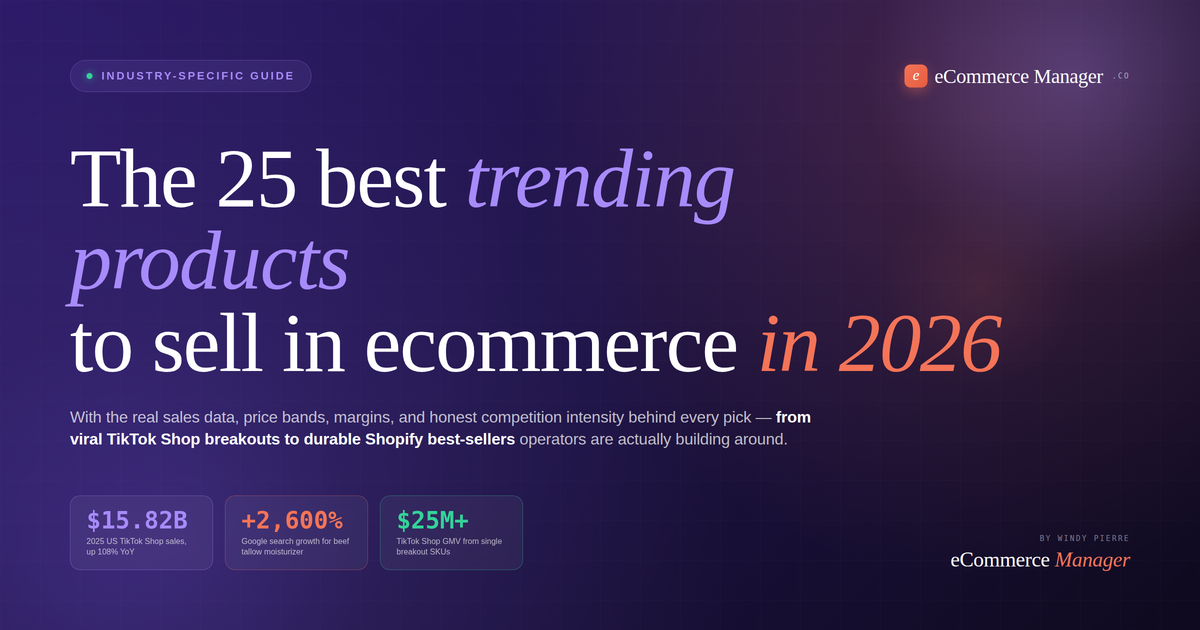
The 25 best trending products to sell in ecommerce in 2026 — with the real sales data behind each one
Most "trending products" lists are just AliExpress dropshipping catalogs with fresh clip art. This isn't that. Every pick below is backed by real Shopify merchant growth data, TikTok Shop sales figures, or Google Trends signals — with price points, margins, competition intensity, and the honest answer to whether you should actually build around it.
- Why most "trending product" lists lie
- The full comparison table
- Beauty & skincare picks
- Health, wellness & supplements
- Pet products that actually convert
- Home & ambiance winners
- Fashion & apparel breakouts
- Tech gadgets & smart devices
- 5 tests every trending product should pass
- What's shifting in 2026
- FAQ
Why most "trending product" lists lie
If a listicle recommends 30 products and doesn't cite a single sales number, it's a dropshipping affiliate page pretending to be advice. You deserve better math.
Here's what actually happens when a product goes viral. A creator with 40,000 followers films a 15-second demo of a $15 LED galaxy projector. The clip gets 3 million views in 48 hours. Sellers piggyback with the same product from the same three Chinese suppliers. Within two weeks, ten thousand orders have shipped. Within four weeks, Meta ad costs on that product have tripled because everyone is bidding. Within eight weeks, the product is on Amazon at half the price. The winners in that cycle aren't the sellers who spotted the trend — they're the ones who priced for margin, planned for saturation, and moved on before the CAC math broke.
The 25 products below all have real demand signals as of Q2 2026. Snail mucin serum. Beef tallow moisturizer. Magnesium supplements. Pet nail grinders. Puffer jackets. Weighted breathing plush toys. Wireless earbuds. Each pick includes the specific price point that's working, the typical margin band, the primary sales channel (Shopify, TikTok Shop, Amazon, or all three), and a competition grade so you're not walking blind into a bloodbath.
None of these are "get rich fast" bets. They're the products moving units right now, with the honest math behind why — and the reality check on where each one goes sideways if you enter wrong.
The full comparison table
All 25 picks, organized by sub-vertical. Price point is typical retail. Margin band is realistic gross margin at that price. Competition reflects how crowded the specific product is right now for a new entrant.
| Product | Sub-vertical | Price / Margin | Competition |
|---|---|---|---|
| Snail mucin serum | Beauty | $18–$30 / 55–70% | High |
| Beef tallow moisturizer | Beauty | $22–$45 / 60–75% | Medium |
| LED red-light therapy mask | Beauty | $80–$250 / 45–65% | Medium |
| Overnight hydrogel face mask | Beauty | $25–$35 / 55–70% | Medium |
| Lip stain & lip oil | Beauty | $14–$28 / 60–75% | High |
| Magnesium glycinate supplement | Wellness | $25–$40 / 55–70% | High |
| Digestive gut supplement | Wellness | $30–$60 / 55–70% | High |
| Prebiotic functional soda | Wellness | $30–$45 (12-pk) / 40–55% | Medium-High |
| Collagen powder & peptides | Wellness | $28–$55 / 55–70% | High |
| Weighted breathing plush | Wellness | $30–$65 / 55–70% | Medium |
| Dog nail grinder | Pet | $18–$35 / 55–65% | Medium |
| Self-cleaning deshedding brush | Pet | $15–$28 / 60–70% | Medium |
| Automatic pet water fountain | Pet | $28–$45 / 55–65% | Medium |
| Lick mat for pet anxiety | Pet | $14–$22 / 60–75% | Low-Med |
| Pet calming chews | Pet | $22–$40 / 55–70% | Medium |
| LED galaxy projector | Home | $15–$40 / 50–65% | High |
| Aroma diffuser (waterless) | Home | $45–$120 / 50–65% | Medium |
| Cordless handheld vacuum | Home | $45–$120 / 40–55% | Medium-High |
| Cordless blender / smoothie cup | Home | $35–$70 / 45–60% | Medium |
| Puffer jacket | Fashion | $60–$180 / 50–65% | Medium |
| Oversized hoodie | Fashion | $45–$85 / 55–70% | High |
| Weighted vest (home fitness) | Fitness | $60–$150 / 45–60% | Medium |
| Wireless earbuds | Tech | $40–$120 / 40–55% | High |
| Smart pet camera | Tech | $40–$90 / 40–55% | Medium |
| Privacy screen protector | Tech | $18–$32 / 60–75% | Low-Med |
Beauty & skincare picks that are actually moving units
Beauty is the single largest sub-vertical on TikTok Shop, accounting for over 42% of GMV in some markets. Skincare hashtags alone drove roughly $142 million in TikTok Shop sales over 12 months. Below are the five specific SKU types with the strongest, most durable demand signals in 2026 — not the fads that peaked six months ago.
01Snail mucin serum
K-beauty snail mucin serum has proven to be the rare "viral" skincare product that actually sustained. COSRX's Snail 96 Mucin Power Essence has ridden multiple viral waves since 2020 and still commands a spot in top TikTok skincare rankings. The product works well on camera (satisfying application, visible plumping effect), pairs cleanly into bundles ("Glow Set" of cleanser + snail serum + moisturizer), and has strong repeat-purchase logic since a bottle lasts 30-60 days.
The reality: the category is crowded and you can't win by selling a generic snail serum against COSRX. What works is a specific angle — snail mucin combined with a defensible hero ingredient (spicules, marine collagen, heartleaf extract), or a specific skin concern the mainstream products don't address well. Distribution matters too. Own snail as your hero, then expand outward through TikTok Shop, Amazon, and DTC — never just one channel.
If your snail serum is just "snail mucin in a bottle," you're competing with a $12 COSRX product that has 300,000 reviews. Add a distinct second active (peptides, niacinamide, ceramides) and build the story around what makes yours different. Otherwise you're the one paying paid-social CAC to lose to Amazon organic.
02Beef tallow moisturizer
Google searches for "beef tallow moisturizer" grew 2,600% between 2023 and 2025 — one of the fastest sustained trend curves in personal care in a decade. The demand is real, driven by the "clean beauty" and ancestral wellness movements, and the product ships lightweight (5-10oz jars) with strong margins. Small-batch producers are hitting profitability faster than in almost any other beauty sub-category right now.
Where it gets tricky: dermatologists are pushing back publicly ("I want you to leave the beef tallow with the cows," one Yale professor told the AP), which means the product lives in the "wellness-adjacent, skeptical-mainstream" space that TikTok rewards but that mainstream retail resists. Build for the specific audience that trusts this ingredient story — carnivore diet followers, ancestral wellness communities, mothers seeking clean baby balms — rather than trying to convince dermatologists.
This is a community-first category. Beef tallow only works if you own an audience that already believes in the ingredient. Paid social to a cold audience will burn cash trying to educate on "why tallow." Build organic reach first through a founder story or ingredient-focused content, then scale paid once the trust base exists.
03LED red-light therapy mask
LED masks have moved from novelty to standard beauty-tech in three years. Forbes tested seven models for its 2026 editor guide. Solawave, Omnilux, CurrentBody, Dr. Dennis Gross, and Shark Beauty all have credible product lines competing at various price tiers from $80 to $500+. The category has real repeat-purchase logic through accessory sales (neck wraps, hand wraps, replacement panels) and warranty-plus mechanics.
The tradeoff: the $80-$250 price point demands a longer consideration cycle than pure paid social can deliver. Brands that scale here run heavy content (before/after documentation, esthetician partnerships, education around wavelengths and treatment duration) alongside paid. Dermatologists caveat that results require consistent use several times weekly — so support content and email flows drive both conversion and retention. If you don't have the content infrastructure to educate, this is not your first category.
Higher AOV means longer sales cycles. Budget for retargeting, email nurture, and educational content — not just prospecting ads. Brands that skip this and try to close $200 on a single cold-social touch never make the CAC math work.
04Overnight hydrogel face mask
Korean overnight hydrogel masks — the kind that wrap around the face and deliver marine collagen while you sleep — have generated over 150 million TikTok views on before/after content. Retail price sits around $25-$35 for a 4-pack. The satisfaction of the "wake up with glass skin" reveal is genuinely well-suited to short-form video, and the 4-pack unit creates a natural subscription rhythm (one mask per week = one 4-pack per month).
What works: pair the mask with a specific ritual — Sunday self-care, pre-wedding, post-flight recovery — rather than positioning as generic skincare. The most successful brands in this space own a specific moment. What doesn't work: competing on ingredients alone. Every hydrogel mask has marine collagen, hyaluronic acid, and peptides. The differentiation is in the ritual, the pack aesthetic, and the aftercare product line you build around it.
Subscription mechanics are the whole game here. A one-time $30 sale on paid social barely pays back CAC. A $30/month subscription for a 4-pack pays back in 2-3 months and starts generating actual profit at month 4. Design the offer for subscribe-and-save from day one, not as an afterthought.
05Lip stain & lip oil
Lip stains and lip oils are the highest-turnover impulse product in beauty right now. Wonderskin (the peel-off lip stain) sold one unit every 5 seconds at peak, moving 300,000+ units through TikTok Shop. Y2K-inspired lip trends are up 51.8% year over year. The category rewards multi-shade bundles (customers rarely buy just one) and pairs naturally with lip-focused UGC — swatch videos, before/wear comparisons, and shade-recommendation content dominate the format.
The margin math is friendly because the ingredients are cheap and the perceived value is high. What kills brands here is inventory planning — you'll sell 80% of your volume through 20% of shades, and getting the shade mix wrong ties up cash in unsellable SKUs. Start narrow (4-6 hero shades), prove sell-through, then expand deliberately based on data rather than gut.
The founder-brand dynamic in lip products is unusually strong. If your founder isn't personally magnetic on camera, plan to spend heavily on creator partnerships from day one. Rare Beauty, Fenty, and every viral lip stain brand has a face at the center. The faceless-brand strategy that works in supplements doesn't work here.
Launching a beauty brand? The supply chain, compliance, and creator strategy matter as much as the product.
Browse our directory of vetted DTC beauty agencies — filterable by sub-vertical, platform, and budget.
Health, wellness & supplements — the products doing real numbers
Digestive supplements grew 1,075% on Shopify. MaryRuth's Liquid Multivitamin cleared $29M in TikTok Shop GMV. Functional foods grew 265% year over year. This is the sub-vertical where subscription unit economics work hardest — but also where CAC is highest ($89 average) and regulatory scrutiny is intensifying. Five specific SKU types with the strongest, most defensible 2026 demand signals.
06Magnesium glycinate supplement
Magnesium is having a moment, and unlike most wellness trends, this one has real clinical backing behind the marketing. Toplux Magnesium 8-in-1 was one of the top 5 best-selling TikTok Shop products in Q1 2026. The category benefits from strong sleep-and-recovery positioning — a market growing at 9.2% CAGR — and the science is solid enough that dermatologist and doctor creators actually endorse it, which shortcuts the trust-building most supplements need.
The differentiator that works: form and delivery. Powders (drink mixes), gummies, and 8-in-1 blends outperform basic capsules by 2-3x on paid social. Bedtime rituals sell better than "sleep supplement" — brands positioning as "the drink you have with your evening tea" convert meaningfully higher than clinical-sounding supplement brands.
Magnesium is one of the rare supplements where clinical claims are defensible without a regulatory fight. Lean into the sleep and stress-relief angles hard, but keep the language wellness-adjacent rather than medical — "supports restful sleep" rather than "cures insomnia." The line is real and regulators are watching in 2026.
07Digestive gut supplement
Digestive supplements saw a 1,075% year-over-year sales lift on Shopify — the fastest-growing supplement sub-category by a wide margin. The umbrella covers probiotics, prebiotics, enzymes, greens powders, and gut-health drink mixes. The demand is genuine and durable because the underlying customer problem (bloat, irregularity, general gut discomfort) is universal and consistent enough to sustain replenishment cycles.
The right way to win: pick one specific gut symptom and own it. "Gut health" as a positioning is too broad and puts you against Athletic Greens and Bloom on paid. Bloat-specific, IBS-friendly, women's hormonal-gut connection — each of these represents a defensible niche within the larger category. Founder credibility (a nutritionist, a doctor, a real personal story) shortcuts the trust-building meaningfully.
The gut-health category is where "founder credibility" moves from nice-to-have to non-negotiable. Faceless brands here get called out immediately. Either your founder has a real story (nutritionist, doctor, personal transformation) or you're partnering with someone who does — otherwise the CAC math never works.
08Prebiotic functional soda
Poppi, Olipop, and the broader prebiotic soda category continue to compound. Functional beverages online grew 11.4% CAGR. The Celsius acquisition of Alani Nutrition for $1.65 billion signaled where the money is going. New entrants can still find whitespace by picking a specific occasion — post-workout, afternoon slump, "healthier happy hour," morning digestion — rather than competing head-on with the incumbents.
The unit economics only work at case quantities. Shipping single cans is a money-losing proposition; a 12-pack at $30-$45 with subscription creates enough per-order margin to survive $60+ CAC. Plan for retail from day one — brands that stay pure-DTC in beverages almost universally struggle to reach profitability at scale, while brands that use DTC as validation and move into Whole Foods, Sprouts, and Target find the profit.
Functional beverage is a "start DTC, scale via retail" business — full stop. Model the DTC business as an audience-building and validation channel. The path to profitability runs through Whole Foods, Target, and mass grocery. Investors who understand the category expect that plan; ones who don't will fund you into a wall.
09Collagen powder & peptides
Dr. Melaxin Collagen Set was TikTok Shop's #1 best-selling product in Q1 2026. NeoCell Collagen took the #4 spot. Collagen has evolved from niche beauty supplement to mainstream daily wellness in a way that few ingredients have — driven by legitimate research on skin elasticity, joint support, and hair growth, plus creator content that makes the daily-scoop ritual visible and shareable.
The category is crowded but not saturated. Winning requires either a specific target audience (menopause-adjacent women, postpartum recovery, athletes over 35) or a distinctive delivery format (chocolate collagen coffee creamer, collagen-infused electrolyte drinks). Generic marine collagen powder against Vital Proteins on Amazon is not the play. A specific combination — collagen + hormonal support + a specific life stage — is where the whitespace lives.
Collagen delivered as a "morning coffee ritual" outperforms collagen sold as a "supplement" by roughly 2x on paid social conversion. Design your product around a moment your customer already has in their day, not a new habit you need to teach them.
10Weighted breathing plush toy
The Rhythmic Breathing Sleep Koala and similar weighted breathing plush toys went genuinely viral through 2026, driven by the "soft life" and anxiety-relief trends. The premise: a plush toy that gently rises and falls with a "breathing" motion, guiding users through calming breath cycles. The category sits at the intersection of wellness, sensory relief, and gift-giving — which produces unusually strong revenue concentration around Q4 and Valentine's Day.
What makes it work: the format is inherently ASMR-friendly. Videos of the toy in motion, paired with soft ambient audio, perform extremely well on TikTok and Instagram Reels without requiring a face on camera. What makes it hard: durability. Failed motors, off-cycle breathing, and lint accumulation are common review complaints for cheap dropshipped versions. Invest in QC and warranty from day one — the emotional buying context means one bad review hits your CAC 5x harder than in less emotional categories.
Products sold as anxiety relief live and die on trust. A single "the motor died in 2 weeks" review from a real customer will tank your paid social ROAS. Spend more on QC than you think you need to, warranty aggressively, and reply to every negative review publicly — this category rewards operational care disproportionately.
Pet products that actually convert
Pet is the friendliest CAC category in ecommerce — roughly $23 per customer versus $89 for supplements. Online pet sales are growing 9x faster than in-store. Five specific products with proven demand signals and margin structures that work.
11Dog nail grinder
Dog nail grinders solve a permanent problem — every dog owner fears cutting the quick with traditional clippers. Electric grinders file the nail gradually with LED lighting and quiet operation. Product research platforms consistently show 10,000+ monthly units at $19.97 average retail with 4.4+ star ratings. This isn't a viral trend that will fade; it's a category that will keep growing as dog ownership does.
What makes it a strong gateway product: it opens a natural upsell path into brushes, shampoos, ear cleaners, and dental care — all consumables that build repeat purchase. Build the store around "at-home dog grooming" as a category umbrella rather than nail grinders specifically. That framing lets you scale from one strong SKU into a full grooming brand over 12-18 months.
The right way to launch here is with the grinder as your hero, but a 3-product bundle (grinder + nail file + treats reward) as your paid social offer. A $35 bundle at 55% margin covers CAC better than a $20 standalone SKU trying to prove out.
12Self-cleaning deshedding brush
Deshedding brushes with self-cleaning mechanisms (push a button, released fur clumps drop into the trash) are one of the highest-converting products on TikTok right now for a specific reason: the demo video is inherently satisfying. Long-form dog owner content showing the "before and after" fur volume works, but a 15-second clip of the button release is even better. Sourcing costs sit around $4-$8; retail at $18-$25 supports 60%+ margins.
The competition is meaningful but not saturated. The differentiators that work: shed-specific breed positioning (golden retriever, husky, German shepherd), safety features (rubber tips that don't scratch skin), and warranty language. Long-haired dog owners actively search for this specific SKU type on Amazon and Google, which means SEO-driven organic traffic is a viable second channel to complement paid social.
Breed-specific positioning works far better than generic "for all dogs." A brush marketed as "the golden retriever deshedder" gets 3-4x higher CTR on paid social than the same brush marketed generically. Segment your creative by breed and watch your CAC drop.
13Automatic pet water fountain
Automatic water fountains with UV filtration and multi-stream flow are one of the strongest built-in recurring revenue plays in pet. The fountain sells at $28-$45; replacement filters sell at $8-$15 every 4-6 weeks. Over a 24-month customer relationship, filter subscriptions contribute 2-3x the revenue of the initial fountain purchase. That's the kind of unit economics that makes paid social viable at scale.
What makes it work: cats especially benefit (running water encourages drinking), and cat-owner communities on TikTok and Reddit actively recommend fountains. The positioning that converts: "helps prevent kidney disease" (a real, dermatologist-backed concern for cats) rather than generic hydration marketing. What kills it: cheap models with loud motors get returned. Invest in near-silent operation as a hero feature and it becomes a differentiator.
Every product with a consumable component (filters, refills, cartridges) should be sold with subscribe-and-save from day one. Fountain economics don't work as a one-time sale; they only work with the filter subscription attached. Design the checkout flow to make subscription the default, not the alternative.
14Lick mat for pet anxiety
Silicone lick mats (often marketed for grooming distraction, bath time, or general anxiety relief) have exploded on TikTok and Instagram. Sourcing cost is $2-$5. Retail at $14-$22 delivers margins comfortably above 60%. The product is lightweight and effectively unbreakable, which minimizes returns and shipping damage. Owners buy 2-3 mats for different rituals (bath, nail trimming, alone time) which drives natural AOV expansion.
Competition is meaningful but the specific niches are still open. Bath-time-specific mats (with strong suction cups for tile walls) versus grooming-distraction mats versus enrichment feeding mats each represent a defensible sub-angle. The winning brands pair the mat with a companion product — freeze-dried treat toppers, natural peanut butter, or dog-safe yogurt — that gives customers a reason to keep coming back beyond the one-time mat purchase.
Products with $2-$5 landed costs have amazing gross margin math but require volume to matter. A brand selling 100 mats a month makes $1,500 in profit — that's a side project, not a business. Plan for the marketing spend and creator strategy that gets you to 3,000-5,000 units monthly, or pick a higher-AOV category.
15Pet calming chews
Pet supplements grew 89% year over year on Shopify, and calming chews are the hero product driving that growth. The ingredient stories that resonate: chamomile, L-tryptophan, ashwagandha, functional mushrooms (dog supplement buyers are 1.6x more likely to have positive associations with mushroom ingredients). Soft chew format dominates over capsules or powders because owners can give them as treats, which drives compliance and repeat rates.
CAC in the low $30s is achievable via pet-influencer partnerships and organic community engagement in specific breed groups. The repeat rate — 60%+ at 90 days for well-executed brands — makes subscription unit economics genuinely strong. The regulatory path is friendlier than human supplements too, but you still need reputable third-party testing and clear label language to avoid FDA attention.
Cat-specific calming products are meaningfully underserved compared to dog. Every calming brand starts with dogs; a cat-first brand with format changes (paste, treats, spray) has less competition and a passionate audience that spreads recommendations aggressively.
Building a pet brand? Third-party testing, veterinary review, and sourcing matter as much as marketing.
Run our Platform Calculator to model unit economics for your target price point and margin.
Home & ambiance winners with real staying power
The home and lifestyle sub-vertical has been TikTok Shop's second-largest driver (behind beauty), and the top-selling products cluster around two themes: ambiance ("bedroom glow-up" content) and functional convenience (cordless everything). Five picks with proven traction.
16LED galaxy projector
The $15 LED galaxy projector is the archetype viral TikTok Shop product. A single "bedroom glow-up" clip drove over 10,000 orders in two weeks for one seller in Q1 2026. The product looks stunning on camera, works well with UGC (before/after room reveals), and lends itself to bundled offers (add a lava lamp, ambient LED strips, cloud lights). The economics only work if you catch the trend early — by month three, Amazon dupes at half the price have flooded the market.
The right way to play this category: build a "vibe-based home ambiance" brand rather than betting on any single product. Position around a specific aesthetic (dark academia, cozy Gen-Z, minimalist ambient) and rotate through hero products every 60-90 days as trends move. That approach outlasts any individual viral moment because you're selling the aesthetic, not the SKU.
Single-SKU trend chasing in home ambiance is a race to a margin cliff. The seller who wins for 8 weeks then loses to Amazon at half the price hasn't built anything sustainable. Build an aesthetic-first brand, own an audience, and rotate the hero product — that's the actual play.
17Aroma diffuser (waterless)
Waterless (nebulizing) aroma diffusers have replaced older ultrasonic diffusers as the premium tier. Pure Enrichment, Vitruvi, and Aera all compete at various price points. The device itself sells at $45-$120; recurring oil or capsule refills sell at $15-$40 every 30-60 days. That refill mechanic transforms a one-time device sale into a subscription business with steady margin.
The design aesthetic matters more here than in any other home category. Diffusers that look like modernist sculpture (ceramic, brushed brass, minimalist wood) command 3-4x higher AOV than plastic dropshipped versions. The winning brands treat the diffuser as a piece of visible interior design — meaning packaging, unboxing, and product photography all need to feel elevated, not utilitarian.
The refill economics are where the real business lives. A $80 diffuser sale barely covers CAC. A $80 diffuser + $30/month oil subscription is a 30-month LTV of ~$980. Design the offer to make refill subscription obvious at checkout, and price the diffuser aggressively to drive the recurring purchase.
18Cordless handheld vacuum
Homeika Cordless Vacuum cleared $25M+ in TikTok Shop GMV. The category — handheld cordless vacuums, car vacuums, and mini stick vacuums — thrives on "satisfying" clean-up demo content. Before/after floor and car interior clips consistently outperform other creative formats. Retail price sits in the $45-$120 range with margins in the 40-55% band, which requires disciplined operational execution to run profitably.
The reality: this is a competitive electronics category and you're not going to out-engineer Dyson or Ninja. What works for new entrants is a specific use case — pet-hair-focused, car-detailing-focused, kitchen-crumb-focused — with creative built around that specific job. Warranty, return policy, and customer service quality directly impact CAC because negative reviews on a $90 electronics purchase spread faster and hurt paid ROAS harder than a $20 accessory would.
Electronics at 40-55% margins require volume and operational precision. A single $90 return can wipe out the profit from three sales. Model your return rate at 12-15% (industry average for consumer electronics) and price accordingly. Brands that skip this and price for 3% returns get destroyed by Q1.
19Cordless blender / smoothie cup
The Ninja Cordless Blender saw a 1,800% order surge on TikTok Shop, and the broader portable-blender category (BlendJet, Beast, PopBabies) continues to compound. The product pairs well with wellness and fitness lifestyle content — smoothies, protein shakes, on-the-go breakfasts. The USB-C rechargeable format has become the default expectation; older models with proprietary chargers don't compete anymore.
The differentiation opportunity: sell the blender as part of a wellness stack. A "morning smoothie kit" (blender + protein powder + collagen + reusable straws) at $60 AOV works dramatically better than a $40 standalone blender. Partner with functional ingredient brands for co-marketing rather than trying to build the whole ecosystem yourself.
Cross-category bundling is one of the most underused strategies in DTC. A blender + supplement co-branded bundle converts 2-3x better than either product alone because it maps to a real behavior (morning smoothie). Find one adjacent brand doing something you don't and co-launch a bundle.
Fashion & apparel breakouts driving real revenue
Hoodies grew 965% year over year on Shopify. Puffer jackets grew 819%. Apparel is a $217B US category, and specific SKU types are seeing breakout numbers that make even the most saturated fashion niches look attractive. Three picks with the data behind why.
20Puffer jacket
Puffer jacket sales on Shopify surged 819% year over year in September 2025. The trend goes beyond the traditional cold-weather category — cropped puffer vests, longline puffer coats, and oversized "cloud" puffers have all found strong demand at various price tiers. The winning brands own a specific silhouette (cropped, oversized, tailored) rather than trying to compete across all shapes.
The unit economics are strong at $60-$180 AOV with 50-65% margins, but seasonality is brutal. Puffers do 60-70% of annual volume in Q3 and Q4, which means inventory planning is high-stakes and cash flow is tight most of the year. New entrants should launch with a pre-order model to reduce inventory risk and validate demand before committing to a full production run.
Seasonal fashion is a cash-flow trap for undercapitalized brands. Model your 12-month cash flow with 65% of revenue landing in a 4-month window. If you can't sustain operations through the slow 8 months, either raise more capital or pick an evergreen category. Beautiful puffer economics have killed a lot of brands that didn't model the calendar.
21Oversized hoodie
Hoodie sales on Shopify surged 965% year over year — the single largest apparel category jump in the platform's data. Oversized, boxy, and cropped silhouettes lead the category. Heavyweight fabric (350gsm+), premium construction (reinforced stitching, French seams), and specific brand storytelling (streetwear, athleisure, gorpcore) separate the winners from the sea of Gildan-blank print-on-demand competitors.
Winning here means picking a specific aesthetic and community. "Just a heavyweight hoodie" is a print-on-demand product. "The hoodie for cold-weather runners" or "the hoodie for creative studio work" or "the hoodie for Sunday cafe hangs" is a brand. Founder-led community and creator partnerships drive 60-70% of paid social ROAS in this space; brands without either almost always lose.
Print-on-demand hoodies at $30 retail cannot compete with brand-first hoodies at $75 in the same paid social auction. If you're launching a hoodie brand, commit to holding inventory and premium construction — the middle ground of "POD but nicer" is where brands go to die.
22Weighted vest (home fitness)
Weighted vests grew over 900% on Shopify in a single year, driven by the "walking with weight" trend and the broader move away from high-intensity fitness toward lower-impact daily movement. Bala, GORUCK, and Hyperwear compete at various tiers from $60 to $200+. The category benefits from strong content-marketing potential (walking creators, longevity communities, mothers post-pregnancy) and a real, durable use case.
Where new entrants can still find whitespace: women-specific fit (most vests are unisex, poorly cut for smaller frames), aesthetic design (matte fabrics, neutral colors that work with athleisure), and specific-audience marketing (mothers, over-40 women, longevity-focused men). The generic "weighted vest" category is oversaturated; specific-audience products still have room.
Fitness gear only works when it looks good enough to wear casually. A vest that looks like tactical military gear kills conversion with the wellness-walker audience. Invest in premium aesthetic design — soft matte finishes, neutral colors, thoughtful strap placement — and the same product commands 40-60% higher retail.
Tech gadgets & smart devices with proven demand
Consumer electronics is the toughest sub-vertical for new DTC entrants — margins are tightest, competition is fiercest, and Amazon dominance is real. But three specific product types still support new-brand economics if you play them right.
23Wireless earbuds
Wireless earbuds continue to sell in enormous volume across TikTok Shop, Amazon, and DTC, but the category is brutal for new entrants trying to compete on generic feature sets. What works: hyper-specific audience positioning (workout-focused earbuds with heart-rate monitoring, sleep-focused earbuds with white noise, gaming-focused earbuds with ultra-low latency).
The audiophile creator community drives meaningful sales through detailed comparison videos — battery life, sound quality tests, comfort assessments. Send product to five well-chosen audiophile reviewers before your paid social launch. Their unsponsored (or lightly sponsored) content drives organic traffic that reduces paid CAC by 30-40% in the first six weeks.
Generic earbuds at $60 retail cannot compete against Anker at $40 or Apple at $180. Pick a specific job (sleep, workout, gaming) and build the product features and marketing around that job exclusively. Trying to sell "great everyday earbuds" is where new brands lose.
24Smart pet camera
Wyze Cam alone cleared $25M+ in TikTok Shop GMV; the broader indoor smart pet camera category consistently shows 10,000+ monthly units across dropship marketplaces. Products with 2-way audio, treat dispensing, and mobile app integration lead the segment. The emotional buying trigger (checking on your pet from work) creates a strong first-purchase moment, and companion subscriptions (cloud storage, treat refills) create ongoing revenue.
The challenge is trust. Pet owners are cautious about device safety, and one viral "product malfunctioned" post can destroy a small brand's paid social performance for weeks. Emphasize UL certification, safety testing, and warranty in creative — not just feature lists. Partner with pet influencers whose audiences trust their product recommendations rather than paying for generic tech reviewers.
The competitive moat in smart pet cameras is service, not hardware. The hardware is roughly commoditized — most cameras use the same core chipsets. Better mobile apps, better cloud storage tiers, and better customer service differentiate winning brands. If your team can't ship software updates, this isn't your category.
25Privacy screen protector
Privacy screen protectors — the tempered-glass overlays that darken your phone screen from side angles — are one of the sleeper wins of 2026. Retail sits at $18-$32 with margins comfortably above 60%. The product is perfect for TikTok demos: film yourself using your phone on a crowded subway, show how the person next to you can't see your messages, watch the video convert. Cheap to make, easy to demo, near-universal use case.
Competition is meaningful on generic products but manageable if you own a specific angle — luxury (business travelers who commute), lifestyle (celebrities and public figures), or safety (women concerned about being watched in public). Specific-audience positioning at 3-4x the generic price is where the profit lives. Add a matching camera cover as a bundled upsell and AOV jumps 40% without extra CAC.
Everyone has this product but almost nobody markets it well. Specific-audience positioning (business travelers, journalists, women's safety) with premium packaging turns a $12 commodity into a $28 brand purchase. The moat is marketing quality, not product quality.
5 tests every trending product should pass
Before committing capital to any product on this list — or any product you spotted somewhere else — run it through these five tests. If it fails more than one, walk away or fix the entry angle before you order inventory.
Real demand signals, plural
Google Trends AND TikTok Shop data AND Shopify merchant growth. Single-source hype fades in 4-6 weeks; multi-signal demand is durable.
Margin above 50%
After CAC, shipping, returns, and platform fees, you'll net 15-25% contribution. Anything below 50% gross margin only works at scale or with organic acquisition.
Repeat-purchase logic
Consumables, refills, or accessory ecosystems. One-time novelty purchases don't build businesses — they build spikes followed by writedowns.
15-second demo test
Can you show the product's value in a single 15-second video? If yes, TikTok and Reels will do meaningful work for you. If no, you need heavier content investment or a different category.
Defensible angle, not generic SKU
"Snail mucin serum" is a category. "Snail mucin serum for perimenopausal skin with hero-ingredient peptides" is a business. Never launch generic — always launch a specific angle.
The single most common mistake with trending products: entering three months late. If you're reading about it in a listicle (this one included), the trend has been running for at least six months. That's fine when the category is durable (skincare, pet, supplements) — you're joining an ongoing market. It's fatal when the trend is one-hit (a specific viral gadget) — you're catching a falling knife. Filter accordingly.
What's shifting in 2026
Three things worth internalizing. First, the winning products in 2026 aren't the newest viral hits — they're the products with demonstrated sustained sell-through over 12+ months. Snail mucin has ridden three viral waves and still sells. Magnesium supplements are on their second big year of growth. Weighted vests are compounding across quarters. The lesson: don't chase the newest thing; validate that trends have staying power before you commit inventory capital.
Second, TikTok Shop is now the primary awareness-to-purchase channel for the beauty, health, and wellness categories that make up 79% of its GMV. If you're launching in those verticals, TikTok Shop strategy isn't optional — it's the foundational go-to-market. That means creator relationships, video-first product photography, and in-app checkout optimization all need to be Day 1 investments, not Q3 additions.
Third, the CAC math keeps getting harder. Average DTC CAC is up 222% over eight years. What that means practically: the sub-$40 impulse-purchase price point is the only one where paid-social-first businesses still work reliably at scale. Products above $60 need content, community, and email nurture to close. Products below $15 need bundling. There's a narrow sweet spot in between where 2026 launches can still succeed on aggressive paid-social alone — pick that price band deliberately or plan for the longer-cycle strategy.
If you're evaluating trending products right now, filter first for durability (12+ months of sustained demand), then for margin defensibility (50%+ gross), then for a specific angle you can own. The generic version of every product on this list is oversaturated. The specific-audience, specific-ritual, specific-format version is where the whitespace still lives — and where the CAC math actually works in 2026.
FAQ
The best products to sell in 2026 combine four things: real demand signals (Google Trends, TikTok Shop sales data, Shopify merchant growth), acceptable margins (40%+ minimum for paid-social viability), a price point between $15 and $60 for impulse purchase, and enough differentiation that you're not competing head-to-head with a $2 AliExpress dupe. The strongest picks right now cluster in K-beauty skincare, sleep and stress supplements, pet grooming and health, viral home ambiance products (LED galaxy projectors, aroma diffusers), and specific fashion items like puffer jackets and hoodies which are seeing 800-965% YoY growth on Shopify.
TikTok Shop's top-performing products in 2026 skew heavily toward beauty, health, and wellness — three categories that account for roughly 79% of platform sales. Specific breakout SKUs include the Medicube skincare kit, Dr. Melaxin collagen set, NeoCell collagen, DRDENT whitening strips, and Toplux magnesium supplements. In home and lifestyle, the $15 LED galaxy projector famously sold 10,000+ units in two weeks from a single viral clip. Ninja Cordless Blender saw 1,800% order surges. Homeika Cordless Vacuum and Wyze Cam both cleared $25M+ in TikTok Shop GMV. If you're launching in 2026, TikTok Shop strategy isn't optional — it's the primary awareness-to-purchase channel for most of these products.
The consistent sweet spot for viral ecommerce products is $15 to $40. Below $15, unit economics collapse under CAC and shipping. Above $40, impulse-purchase behavior on TikTok and Instagram drops sharply because shoppers move into deliberation mode. The top-selling TikTok Shop products almost universally sit between $20 and $30 — high enough to sustain 45-65% margins on landed cost around $6-$12, low enough to convert on a 30-second video without a second thought. If your product needs to sell above $50, plan for longer consideration cycles, email nurture, and content marketing to close the gap.
Three filters. First, check Google Trends over a 24-month window — a real trend shows sustained upward slope, not a single spike. Second, look for demand signals across multiple platforms, not just one — a product trending on TikTok Shop, Amazon best-seller lists, AND Shopify merchant data is more durable than one only trending on TikTok. Third, ask whether the product solves a repeat problem (grooming, replenishment, ongoing wellness) or is a one-time novelty. The former builds a business; the latter builds a spike followed by inventory writedowns. Sustainable winners in 2026 like snail mucin serum, pet nail grinders, and magnesium supplements pass all three tests.
Minimum viable margin for paid-social-acquired ecommerce is 60% gross margin at MSRP — because after CAC ($45-70 average in 2026), fulfillment, returns, and platform fees, you'll net roughly 15-25% contribution margin. Trending pet accessories often hit 60-70% margins on $18-40 price points. Skincare and supplements can hit 50-70% but need higher AOV or subscription to work. Anything with less than 50% gross margin only works if AOV is high (electronics, home fitness at $200+) or the CAC channel is organic (SEO, TikTok organic). Model your unit economics before you buy inventory, not after.

Picking the right product to launch?
Run our Platform Calculator to model unit economics, or browse vetted DTC agencies who've already scaled brands in your target category.