

Last Updated on July 15, 2026
WooCommerce vs Shopify in 2026: The Operator's Guide
Real cost-of-ownership numbers at three revenue tiers, checkout conversion data, and the migration math — built for operators, not first-time founders.
On this page
Same debate, different math in 2026
If you run a $5M–$50M DTC brand, the WooCommerce vs Shopify question is not "which platform is better." It's "which platform costs less to operate at my revenue level, converts more of my paid traffic, and eats fewer engineering hours." The answer changed between 2023 and 2026, and most comparison content hasn't caught up.
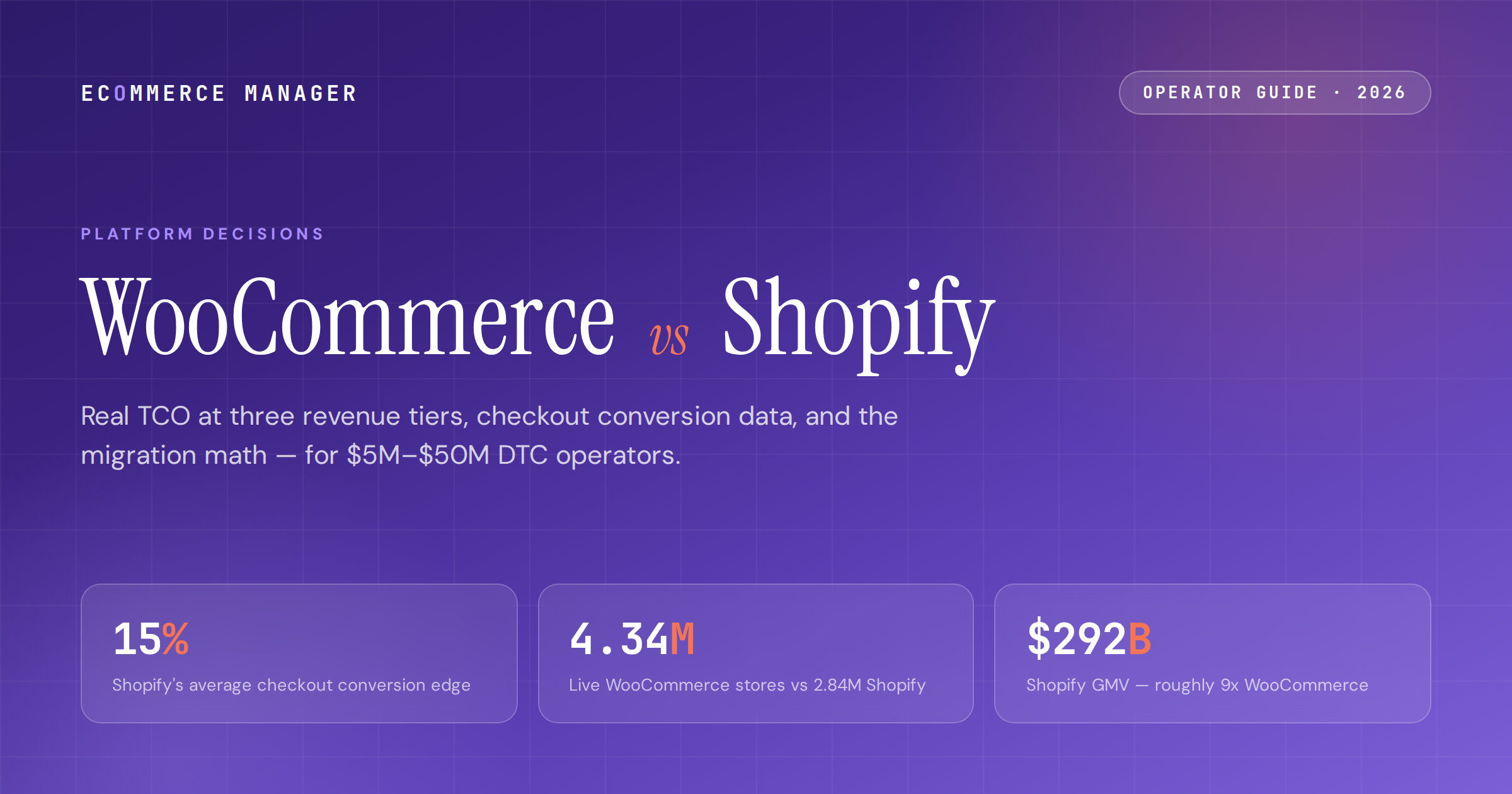
The short version: WooCommerce still wins raw store count (4.34M live stores vs Shopify's 2.84M, per StoreLeads May 2026 data) and it still wins content-led SEO. But Shopify now processes roughly 9x the GMV, holds a 15% average checkout conversion advantage backed by independent study data, and since April 2026 ships B2B features on every plan. Meanwhile WooCommerce's live-store count sits 8.6% below its Q4 2024 peak.
This guide runs the actual numbers: total cost of ownership at $1M, $5M, and $20M in annual revenue, the conversion data that matters, and the specific operator profiles where each platform wins. Every figure is sourced and dated.
Who actually runs on what in 2026
Market share numbers get quoted loosely because every tracker uses a different denominator. Here's the honest breakdown, with sources.
-
01WooCommerce leads on store count: 4,341,142 live stores vs Shopify's 2,844,435 in StoreLeads' May 2026 dataset. Count every install and WooCommerce's footprint is even bigger — WordPress.org reports 7M+ active plugin installations.
-
02Shopify leads where the money is. Among the top 1 million ecommerce sites (BuiltWith), Shopify holds 28.8% vs WooCommerce's 18.2%. Higher-traffic, higher-revenue stores skew Shopify — the segment most platform decisions at your scale actually compete in.
-
03The GMV gap is roughly 9x. Shopify processed $292B in GMV in 2024 and was pacing past $350B in 2025. WooCommerce's ecosystem generates an estimated $30–35B annually. Store count and merchant value are different games.
-
04WooCommerce has plateaued. Live stores peaked at 4,748,170 in Q4 2024 and now sit about 8.6% below that peak. It's a mature, replacement-and-optimization market — not a dying one, but no longer hyper-growth. Track the platform race month to month in ECM Insights.
-
05Shopify Plus now counts roughly 76,600 stores, adding 300+ new merchants weekly. Gymshark, Red Bull, and LVMH brands run on it, which is why Shopify dominates the top-traffic tiers.
-
06The WordPress gravity well is real. WordPress powers about 43% of all websites, and W3Techs puts WooCommerce at 49% of known ecommerce systems in its sample. If your brand is content-heavy, this ecosystem is the pull.
-
07Migration flow runs one direction. In Cart2Cart's March 2026 tracking, WooCommerce→Shopify was the single largest migration path (56 of 241 tracked migrations), and Shopify captured 8,993 WooCommerce stores in one recent 90-day window per Swell's analysis.
The real cost math at three revenue tiers
"WooCommerce is free" and "Shopify is $39/month" are both marketing. Here's what each platform costs to operate in 2026 once you include processing, apps, hosting, and the developer hours nobody budgets for.
The 2026 price sheet
-
→Shopify plans: Basic $39/mo ($29 annual), Grow $105/mo ($79 annual), Advanced $399/mo ($299 annual), Plus from $2,500/mo on a 1-year term ($2,300 on 3-year). Plus converts to a 0.25% variable fee above $1M in monthly GMV.
-
→Shopify Payments rates: 2.9% + 30¢ (Basic), 2.7% (Grow), 2.5% (Advanced), 2.15% (Plus, negotiable). Use a third-party gateway and Shopify adds a 2% / 1% / 0.6% / 0.2% surcharge by plan — the hidden fee that quietly reprices the whole comparison.
-
→Shopify app spend is the real line item: the average merchant runs $120–300/mo in apps; a growing store typically pays $400–1,200/mo across email, reviews, subscriptions, and analytics. Roughly 4.5% of revenue flowing to the Shopify ecosystem is typical for a $200–500K/mo store.
-
→WooCommerce core is $0, the stack isn't: managed hosting runs $50–700/mo at scale (Kinsta, WP Engine, Cloudways), essential extensions $500–2,500/yr, and professional maintenance retainers $500–3,000/mo. US developer rates average around $120/hr freelance.
-
→WooCommerce charges zero platform transaction fees. You pay only your gateway's rate (Stripe: 2.9% + 30¢). That neutrality matters most in markets where Shopify Payments isn't available — Indian merchants, for example, permanently eat a 0.6–2% surcharge on Shopify.
TCO at $1M / $5M / $20M annual revenue
-
→At ~$1M/yr ($83K/mo): Shopify Grow with Shopify Payments lands around $105 + ~$2,250 processing + $300–600 apps ≈ $2,700–3,000/mo. A comparable WooCommerce build: $150–300 hosting + ~$2,450 Stripe processing + $200–400 plugins/maintenance ≈ $2,800–3,200/mo. Near-parity — the tiebreaker is who maintains it.
-
→At ~$5M/yr ($417K/mo): Shopify Advanced: $399 + ~$10,400 processing (2.5%) + $600–1,200 apps ≈ $11,400–12,000/mo. WooCommerce with serious managed hosting and a maintenance retainer: $400–700 hosting + ~$12,100 processing + $1,000–2,500 dev/retainer ≈ $13,500–15,300/mo. Shopify's negotiated rates and bundled infrastructure start pulling ahead — IWD Agency's 2026 analysis reaches the same conclusion for sub-$500K/mo GMV stores.
-
→At ~$20M/yr ($1.67M/mo): Shopify Plus: ~$2,500 base converting to variable fees + ~$35,900 processing (2.15%) + $1,500–3,000 apps. WooCommerce at this scale demands dedicated DevOps, Redis/CDN architecture, and enterprise hosting — plenty of $10M+ GMV brands run it, but per IWD, above $10M GMV Shopify Plus or Adobe Commerce typically delivers better TCO unless your workflows genuinely can't live inside Shopify.
-
→The crossover pattern: WooCommerce is cheaper when you have in-house WordPress capacity and stable requirements. Shopify gets cheaper as revenue grows, because infrastructure, security, PCI compliance, and peak-traffic scaling are bundled. Run your own numbers in the ECM platform calculator before you trust anyone's blog math, including ours.
What would your stack actually cost?
Plug your revenue, AOV, and order volume into the ECM Platform Calculator and get a side-by-side TCO for WooCommerce, Shopify, and three other platforms in under two minutes.
The conversion data that decides most migrations
Platform costs are visible on an invoice. Conversion deltas are invisible until you measure them — and at $5M+ in revenue, a single point of checkout completion is worth more than every hosting bill combined. Benchmark your own funnel against the ECM KPI Library before reading on.
-
01Shopify's checkout converts 15% better on average than competing platforms, up to 36% in like-for-like samples, per an independent study by a Big Three consulting firm. It measures checkout completion specifically, not overall store conversion — but checkout is exactly where paid traffic dies.
-
02Shop Pay lifts conversion up to 50% vs guest checkout and outperforms other accelerated checkouts by at least 10%. Shopify's internal 2025 data shows Shop Pay converting 1.72x standard checkout overall and 1.91x on mobile.
-
03150M+ registered Shop Pay users mean a meaningful share of your first-time visitors arrive with payment credentials already saved. There is no WooCommerce equivalent to this identity network — express wallets like Apple Pay and PayPal help, but don't recognize shoppers across millions of stores.
-
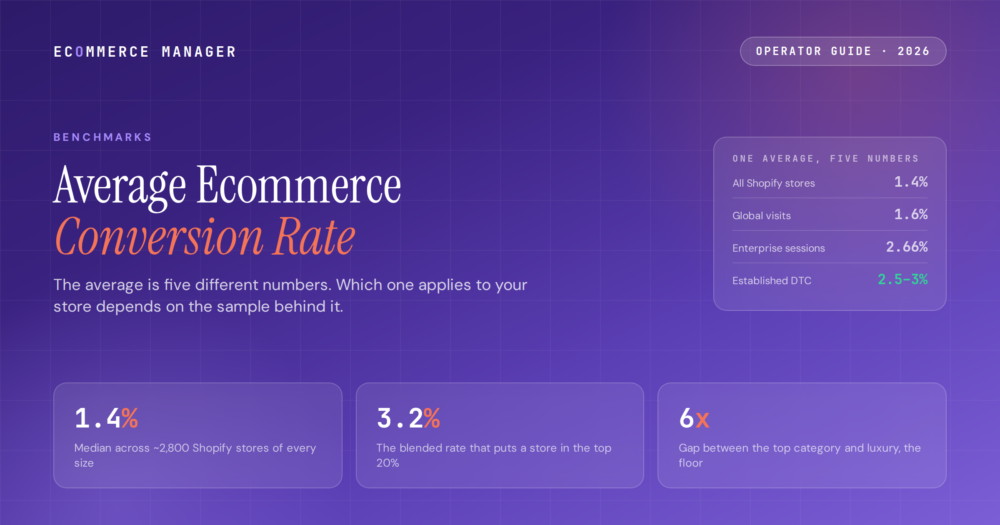
04Baseline benchmarks for context: the average Shopify store converts at 1.4%; the top 20% clear 3.2% and the top 10% clear 4.7% (Littledata). Cart abandonment averages 70.19% across retail. Platform choice moves the needle, but CRO execution moves it further.
-
05WooCommerce's checkout is fully customizable — which cuts both ways. An actively optimized WooCommerce checkout with express wallets can be excellent. An unmaintained one is a liability. Shopify's one-page checkout (default, converting ~7.5% better than multi-page) means the floor is high even with zero optimization effort.
-
06Speed gap out of the box: Shopify stores average a 1.8-second page load with no tuning, while only 51% of WooCommerce stores hit sub-second speeds even after optimization work, per tech-insider.org's 2026 platform testing. Every 100ms of latency taxes conversion; on WooCommerce you pay engineers to buy that speed back.
Where the engineering hours actually go
The line item that never appears in platform comparisons is your team's time. It's also the one operators feel most.
The WooCommerce operational load
-
→You own the full stack: PHP versioning, MySQL performance, plugin compatibility, security patching, and backups. Professional maintenance runs $500–3,000/mo, or it comes out of your own team's sprint capacity.
-
→Plugin sprawl is the recurring failure mode. A typical mid-market WooCommerce store runs 20–40 plugins; every WordPress core update is a compatibility roll of the dice, and the 2023 WooCommerce Payments vulnerability showed what an unpatched stack costs.
-
→Peak-traffic scaling is on you. Black Friday capacity means load testing, object caching (Redis/Memcached), CDN configuration, and database tuning — solvable, but it's real architecture work, not a checkbox. An honest tech stack audit before Q4 is non-negotiable on Woo.
The Shopify operational trade
-
→Infrastructure, 99.99% uptime, PCI DSS Level 1 compliance, and traffic-spike handling are bundled into the plan fee. Your team's hours shift from keeping the store alive to growing it — the "focus leak" argument migration agencies keep winning with.
-
→The trade is control: /products/ and /collections/ URL structures are locked, checkout customization below Plus is limited, and product architecture caps at 3 options and 100 variants (a genuine blocker for configurable catalogs).
-
→Since April 2026, foundational B2B (company profiles, price lists, net terms) ships on every Shopify plan — wholesale is no longer a Plus-only argument. Advanced B2B (unlimited catalogs, partial payments, deposits) still is.
-
→Shopify Magic bundles AI product descriptions, segmentation, and content generation at no extra cost; matching that on WooCommerce means $30–150/mo in third-party AI plugins plus configuration time.
SEO: WooCommerce for content, Shopify for product visibility
This is the one category where WooCommerce still holds a structural edge — but the gap narrowed meaningfully in 2025–2026.
-
01WooCommerce inherits WordPress's full CMS. Yoast/Rank Math give granular control of meta, schema, canonicals, and URL structure with zero platform-imposed paths. For brands where organic content drives a meaningful revenue share, this is still the stronger foundation.
-
02Shopify closed most of the technical gap: its 2026 updates added native JSON-LD for Product, Review, FAQ, and Breadcrumb schema without apps. What it hasn't fixed: hard-coded /products/ and /collections/ URL paths, which complicate large-catalog migrations from established URL structures.
-
03The AI-search wrinkle favors Shopify's defaults. Agencies like Shero report Shopify product pages increasingly surfacing in Google AI Overviews and Perplexity carousels with no merchant-side optimization, a function of default product schema. WooCommerce can match it, but most stores haven't done the configuration.
-
04Migration doesn't have to torch your rankings. Shero's Gen Y Hitch case (WooCommerce→Shopify, Dec 2025) saw organic sessions recover and grow 10.7% within three months of launch. The typical pattern in documented cases: a ~15% traffic dip in month one, full recovery by month three — if every redirect is mapped. If organic is your primary channel, get a specialist SEO partner on the redirect map before launch, not after.
When each platform actually wins
Strip the tribalism and the profiles are clean. Score yourself honestly against these.
WooCommerce wins when
-
→You have a strong in-house WordPress/PHP team or a trusted dev partner, and workflows that don't fit Shopify's plans without justifying Plus.
-
→Content is your growth engine — editorial SEO, resource hubs, communities — and commerce sits inside a WordPress property that already ranks. Compare notes on the ECM WooCommerce review.
-
→You operate in a market without Shopify Payments and refuse to hand over a permanent 0.6–2% surcharge, or you need custom checkout logic, unlimited variants, or ownership of the full codebase.
Shopify wins when
-
→Ecommerce is the business, not a feature of it. Paid traffic efficiency, checkout conversion, and peak reliability outweigh URL control and codebase ownership. Full breakdown in the ECM Shopify review.
-
→Your team is lean and operational hours are your scarcest resource — the bundled infrastructure trade is exactly the point at $5M–$50M with a 2–6 person ecomm team.
-
→You're scaling past $500K/mo GMV, where negotiated Plus rates, Shop Pay's conversion lift, and bundled compliance flip the TCO math — and where an omnichannel or B2B motion benefits from features now included on every plan.
Migrating? Don't run the redirect map alone.
The ECM directory lists vetted migration and platform specialists with verified client reviews — filtered by platform, budget, and vertical.
If you're switching: the numbers to budget
Replatforming is worth it when the cost of staying exceeds the cost of moving. The problem is that the cost of staying hides in developer hours and lost peak revenue, so most merchants move later than they should.
-
01Budget $10,000–$100,000+ for a proper mid-market migration covering development, data mapping, redirects, and SEO recovery work. A documented $5M-revenue, 2,000-SKU WooCommerce→Shopify Plus move cost $18K plus ~$2K/mo in platform fees — and cut hosting costs 40%.
-
02Timeline: 4–12 weeks for a proper migration, not the "one week" stories. Products, customers, and orders come over (orders need LitExtension or Matrixify); customer passwords don't — plan the reset-comms email. Reviews need a third-party app and CSV export.
-
03Watch the variant ceiling. Shopify caps products at 3 options and 100 variants. WooCommerce variable products with 4+ attributes must be restructured before migration or they lose options silently.
-
04Migration savings claims run 20–30% in operational overhead for merchants leaving self-hosted stacks — credible if you're currently paying managed hosting plus a retainer, inflated if a founder was doing maintenance for free. Model your own three-year numbers before signing anything, and pressure-test the ROI against your core KPIs, not the agency's deck.
-
05The single biggest failure mode is launching before redirects are validated. APPWRK's post-mortem across 110 migrations: unvalidated 301s produce hundreds of indexed 404s and a 2–6 month recovery. Verify every redirect, then launch.
What a smart operator does with this
Below roughly $1M in annual revenue with in-house WordPress skills, WooCommerce and Shopify cost about the same to run; pick whichever your team can maintain without stealing growth hours. Past $500K/mo GMV, Shopify's bundled infrastructure, negotiated processing rates, and 15% average checkout conversion edge usually win the three-year math.
Keep WooCommerce if content-led SEO is your primary acquisition channel, if Shopify Payments isn't available in your market, or if your product architecture breaks Shopify's 100-variant ceiling. Those are the three durable reasons in 2026 — everything else on the WooCommerce side of the ledger has narrowed.
If you migrate, treat it as an SEO project with a commerce payload: full URL inventory, validated 301s, schema parity, and a three-month traffic-dip budget. The documented recoveries (traffic back and growing within 90 days) all share one trait — nobody launched before the redirect map was verified.
Frequently asked questions
Is WooCommerce or Shopify cheaper in 2026?
It depends on revenue and who maintains the store. At roughly $1M/year the total cost of ownership is near-identical ($2,700–3,200/month all-in for both). Past $5M/year, Shopify's bundled infrastructure and lower negotiated processing rates typically make it cheaper than a properly hosted and maintained WooCommerce stack, which needs $400–700/month hosting plus a $500–3,000/month maintenance retainer at that scale.
Does Shopify really convert better than WooCommerce?
At the checkout step, yes, on average. An independent study by a Big Three consulting firm found Shopify's checkout converts 15% better on average than competing platforms (up to 36% in like-for-like samples), and Shop Pay lifts conversion up to 50% versus guest checkout. A heavily optimized WooCommerce checkout can compete, but Shopify's floor with zero optimization effort is much higher.
Which platform is better for SEO in 2026?
WooCommerce still leads for content-led SEO because it inherits WordPress's full CMS, flexible URL structures, and tools like Yoast and Rank Math. Shopify closed most of the technical gap in 2025–2026 with native product schema and now surfaces well in Google AI Overviews by default, but its hard-coded /products/ and /collections/ URL paths remain a limitation for large established catalogs.
How much does it cost to migrate from WooCommerce to Shopify?
Budget $10,000 to $100,000+ depending on catalog size, custom functionality, and SEO complexity. A documented mid-market example (2,000 SKUs, $5M revenue) cost $18,000 plus ongoing Shopify Plus fees. Expect 4–12 weeks of work, a temporary organic traffic dip of around 15% in month one, and full recovery by month three if every 301 redirect is mapped and validated before launch.
Is WooCommerce dying in 2026?
No, but it has plateaued. StoreLeads tracks 4.34 million live WooCommerce stores in May 2026, about 8.6% below its Q4 2024 peak of 4.75 million. It remains the largest platform by store count and dominant inside the WordPress ecosystem. What has changed is momentum: WooCommerce-to-Shopify is now the single largest migration path in tracked replatforming data, driven mostly by mid-market brands trading control for lower operational overhead.
The playbook top eComm operators actually read
One weekly brief. Five stories that matter. Zero fluff. Written for managers at $5M–$50M DTC brands who want to sound sharper than everyone else in the meeting.
References
- 01 WooCommerce vs Shopify: Market Share Insights for 2026 — mobiloud.com
- 02 WooCommerce Statistics 2026: Market Share — purethemes.net
- 03 66 WooCommerce Statistics Every Store Owner Should Know (2026) — wiserreview.com
- 04 WooCommerce Market Share 2026: Global Stats & Analysis — redstagfulfillment.com
- 05 Shopify Pricing & Fees 2026: Plans, Rates, and Costs — firstpier.com
- 06 Shopify Fees in 2026: A Complete Breakdown — connectbooks.com
- 07 Shopify Plus Pricing 2026 Guide — arslanemre.com
- 08 WooCommerce Pricing: The Real Cost of a WooCommerce Store — iwdagency.com
- 09 WooCommerce Development Costs: Complete 2026 Budget Guide — codeable.io
- 10 Shopify Checkout Is the Best-Converting in the World — shopify.com
- 11 Shopify Shop Pay Guide 2026: Setup & Conversion — easyappsecom.com
- 12 eCommerce Conversion Rate Benchmarks 2026 — blendcommerce.com
- 13 Shopify vs WooCommerce 2026: Pricing, Benchmarks, SEO, Security, and TCO Data — tech-insider.org
- 14 WooCommerce vs Shopify: Honest Comparison for 2026 — sherocommerce.com
- 15 E-commerce Migration Momentum: March 2026 Report — shopping-cart-migration.com
- 16 WooCommerce to Shopify Migration: Gains, Losses & Real Cost — appwrk.com
Make your platform decision data-backed
Join 12,000+ ecommerce managers reading the ECM newsletter every Wednesday — or browse the directory to find vetted migration, CRO, and platform specialists.