


Last Updated on July 15, 2026
The 18 best ecommerce affiliate program platforms for DTC operators in 2026 — and which one fits your stage
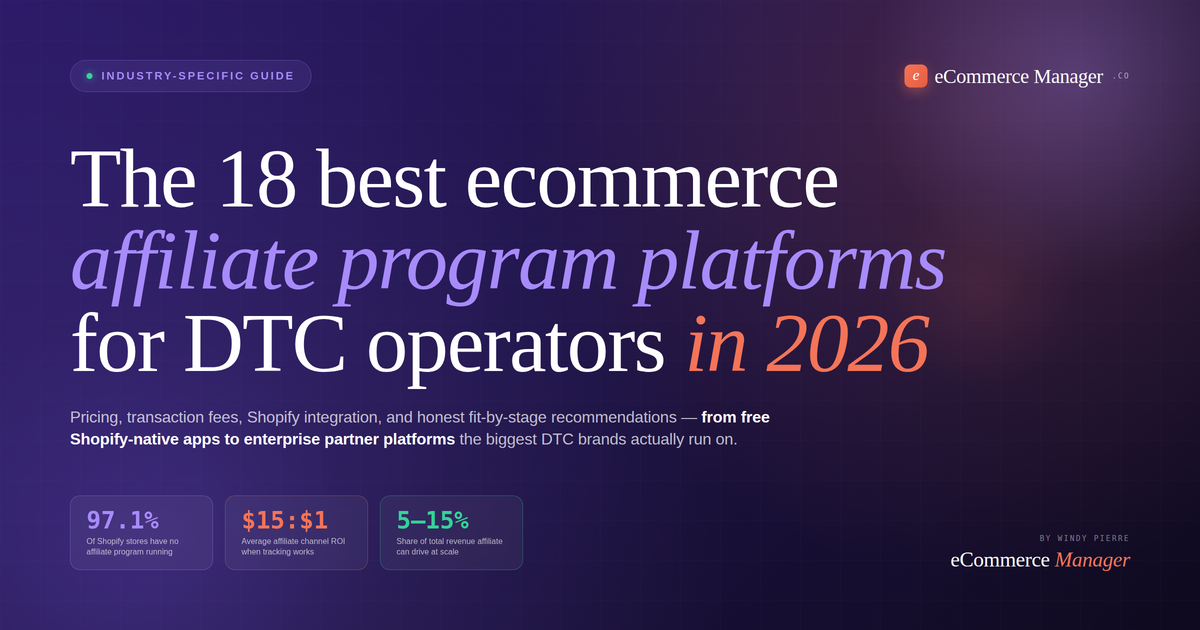
97% of Shopify stores have no affiliate program running in 2026. That's the largest unclaimed acquisition channel sitting on top of the biggest DTC platform on the internet. This guide breaks down the 18 platforms actually worth evaluating — with real pricing, transaction fee structures, honest fit-by-stage recommendations, and the operator take on where each one goes sideways.
- Why platform choice matters more than commission rates
- The full comparison table
- Shopify-native starters
- Creator-first & influencer platforms
- Mid-market SaaS platforms
- Affiliate networks with built-in publishers
- Enterprise partner platforms
- 5 filters before you pick a platform
- Stack recommendations by revenue stage
- FAQ
Why platform choice matters more than commission rates
Most DTC operators spend a week debating whether to pay affiliates 15% or 20%, then pick their platform in an afternoon. That's the wrong ratio.
Here's what actually determines whether an affiliate program becomes a real acquisition channel or an expensive line item that never scales. The commission rate matters, but not as much as most people think. What matters more: whether your tracking survives Safari's ITP, whether attribution disputes with your top affiliates get resolved in hours or weeks, whether payouts happen automatically or eat a full day of your operations team's month, and whether the platform's transaction fees stay proportional to the revenue you actually attribute versus scaling linearly with success.
The 18 platforms below span five categories that solve genuinely different problems. Shopify-native starters (GoAffPro, UpPromote, LeadDyno) exist to test whether affiliate marketing works for your specific product without financial risk. Creator-first tools (Social Snowball, Aspire, Grin) exist because the affiliate channel has shifted from coupon-blog referrals to customer-and-creator programs, and traditional trackers are the wrong architecture for that motion. Mid-market SaaS platforms (Tapfiliate, Refersion, Post Affiliate Pro, iDevAffiliate) exist for the crossover point where you need real reporting depth but aren't ready for enterprise complexity. Affiliate networks (ShareASale/Awin, CJ, Rakuten) exist so you don't have to recruit affiliates from cold — the marketplace comes with the tool. Enterprise partner platforms (Impact.com, Everflow, Partnerize, Rakuten Advertising) exist for brands running hundreds of active partners across multiple channels with fraud detection and governance requirements that only apply above $5M in attributed revenue.
Picking the right tier isn't about ambition — it's about what your program actually looks like today plus 12 months out. Everything else is noise.
The full comparison table
All 18 platforms grouped by tier, with entry pricing, transaction fee structure, Shopify integration, and best-fit revenue stage. Full write-ups follow below.
| Platform | Tier | Entry price / Fees | Best-fit stage |
|---|---|---|---|
| GoAffPro | Starter | Free / $49/mo, no fee | Under $500K |
| UpPromote | Starter | Free / $29.99/mo + 2% | Under $1M |
| LeadDyno | Starter | $49/mo + fees | $100K–$3M |
| BixGrow | Starter | $7.99/mo flat | Under $500K |
| Social Snowball | Creator | $249/mo + 3% | $1M–$20M |
| Aspire | Creator | Custom / demo | $5M–$50M |
| Grin | Creator | Custom / demo | $5M–$50M |
| Tapfiliate | Mid-market | $89/mo flat, no fee | $500K–$10M |
| Refersion | Mid-market | $39/mo + 3% | $1M–$20M |
| Post Affiliate Pro | Mid-market | $129/mo flat | $500K–$10M |
| iDevAffiliate | Mid-market | $39/mo flat | $500K–$5M |
| PartnerStack | Mid-market | $1,000/mo (B2B SaaS) | B2B $5M+ |
| ShareASale (Awin) | Network | $625 setup + 20% override | $2M–$50M |
| CJ Affiliate | Network | Custom + override | $5M–$100M+ |
| Awin (network) | Network | Custom / tiered | $5M–$100M+ |
| Impact.com | Enterprise | $500–$2,500+/mo + 2.5% | $5M–$500M+ |
| Everflow | Enterprise | $750/mo starting | $5M–$100M+ |
| Rakuten Advertising | Enterprise | Custom / high volume | $10M–$500M+ |
Shopify-native starters ($0–$99/month)
These four apps install through the Shopify App Store, live in under an hour, and let you validate whether affiliate marketing works for your specific product without meaningful financial risk. Two of them are genuinely free forever. The right pick depends on whether you want to stay free indefinitely or expect to graduate to paid features within 6-12 months.
01GoAffPro
GoAffPro is the strongest free-tier affiliate app on Shopify and serves over 50,000 merchants across Shopify, WooCommerce, BigCommerce, Wix, and Squarespace. The free plan is genuinely usable, not a demo in disguise — unlimited affiliates, unlimited orders, no revenue share, branded affiliate portal, and automated sales attribution all come at zero cost. Setup ease scores 9.4/10 in third-party comparison studies against Refersion's 5.2/10, which reflects how much of the tool is genuinely plug-and-play.
The tradeoffs are real. Reporting depth lags Refersion and Impact meaningfully. There's zero Amazon Attribution support. The tracking primarily uses Shopify cart attributes which can lose attribution on multi-day buying cycles when Safari's ITP interferes. And the UI has been around since 2017, which shows. But for brands testing affiliate marketing for the first time, GoAffPro removes all financial risk while leaving room to upgrade to Premium ($49/month flat, no revenue share) as the program scales.
Start here if you're under $500K annual revenue and testing whether affiliate works for your product. If the answer turns out to be yes, you'll graduate to Refersion or Tapfiliate around $1M in revenue when reporting depth becomes the bottleneck. If the answer turns out to be no, you spent $0 finding out — which is the correct outcome.
UpPromote is the closest direct competitor to GoAffPro in the Shopify affiliate app category and has become the most-installed affiliate app on the Shopify App Store, with over 3,300 reviews. The Shopify admin integration is meaningfully more polished than GoAffPro's, with a built-in affiliate marketplace, a post-purchase referral popup that converts customers into affiliates automatically, and PayPal Auto-pay on Pro tiers.
The tradeoff on UpPromote is its free tier is significantly more restrictive than GoAffPro's — referral order caps trigger upgrade pressure quickly, which is fine if you plan to be a paying customer within 90 days but frustrating if you wanted to stay free indefinitely. Paid plans start at $29.99/month with a 2% performance fee, scaling to $199.99/month with 1%. That's cheaper than Refersion's Launch tier at typical revenue levels but more expensive than GoAffPro Premium.
Choose UpPromote over GoAffPro if you specifically want the post-purchase referral popup (the "convert my customers into affiliates automatically" motion) and are comfortable paying $30-$200/month. Choose GoAffPro if you want to stay free forever or want zero performance fees at scale.
03LeadDyno
LeadDyno has been the go-to starter platform for first-time DTC affiliate programs for years. The setup experience is genuinely easy — most brands launch in under an hour without developer involvement. The tool handles the basics well: link tracking, PayPal payouts, tiered commissions, an affiliate portal with promotional assets, and email automation for onboarding.
Where LeadDyno hits its ceiling is in reporting depth and integrations. Brands that grow past $3M in annual revenue typically outgrow the reporting granularity, particularly around multi-touch attribution and cross-channel conversion tracking. That's not a knock — it's what the tool was designed for. LeadDyno is a launch platform, not a scale platform, and it does the launch job cleanly.
Pick LeadDyno if you want a paid tool from day one (no free plan) with cleaner UI than GoAffPro and simpler pricing than UpPromote. It's the safe middle-of-the-road starter that never becomes your favorite tool but never becomes a problem either. Fine for what it is.
04BixGrow
BixGrow is the sleeper pick in the starter tier. At $7.99/month flat with zero revenue share, it's the cheapest paid Shopify affiliate app that isn't trying to trick you into upgrades. The feature set is genuinely competitive with LeadDyno's $49/month plan — tracking, payouts, affiliate portals, and a clean UI — for one-sixth the price.
The tradeoff is discoverability rather than product quality. BixGrow has meaningfully fewer app store reviews than UpPromote or GoAffPro, which makes some operators nervous about ecosystem stability. For a brand that just wants a functional affiliate tool at the lowest possible cost and doesn't need extensive third-party integrations, it holds up well.
If you're an operator who reads pricing pages carefully and hates the "flat fee + percentage" model that most affiliate tools use, BixGrow is worth a hard look. The one-time-effort math wins at any real revenue scale.
Launching your first affiliate program? The platform is the easy part — the recruiting playbook is where most brands stall.
Browse our directory of vetted DTC affiliate management agencies who've built programs from zero to $10M+ attributed revenue.
Creator-first & influencer platforms
The affiliate channel has genuinely shifted in the last five years. Coupon blogs and cashback sites still exist, but the majority of DTC affiliate revenue now comes from creators (Instagram, TikTok, YouTube) and customers-turned-affiliates through post-purchase enrollment. Traditional trackers are the wrong architecture for that motion. These three platforms are purpose-built for it.
06Aspire
Aspire (formerly AspireIQ) is one of the most established creator marketing platforms and covers the full lifecycle: discovery, outreach, contracting, product gifting, campaign management, payment, and performance measurement. It's used by brands like BarkBox, Samsung, and dozens of DTC operators who've moved past "we work with a few influencers" into "we run a real creator program with 200+ active partners."
The trade-off is complexity and cost. Aspire is enterprise-priced (custom quotes, typically $1,500-$5,000/month at DTC scale) and requires meaningful team investment to operate — this isn't a set-it-and-forget-it tool. For brands with dedicated influencer managers or agencies handling creator relationships, the ROI justifies it. For brands with one part-time person managing affiliates, it's overkill.
Aspire is a creator operations platform first and an affiliate tracker second. If you already have a dedicated influencer marketing budget and just want affiliate tracking on top, it's overpriced. If you're building creator marketing as a genuine channel with team headcount, it's the right infrastructure.
07Grin
Grin is Aspire's biggest competitor in the enterprise creator management category and is heavily used by DTC brands including SKIMS, Allbirds, MVMT, and dozens of DTC beauty and apparel brands. The pitch is functionally similar to Aspire's — creator discovery, relationship management, product gifting, contracting, payment, and performance tracking in one platform — with a slightly different tooling emphasis on relationship-first workflows versus Aspire's more campaign-first approach.
Grin doesn't publish pricing publicly. Reports in operator communities put entry deals in the $1,200-$3,000/month range for mid-market DTC brands, scaling to $5,000+/month for larger operations. Like Aspire, this is real operational infrastructure — the tool doesn't make sense until you have team headcount to run the creator program it enables.
Aspire vs. Grin is largely a preference call at this point. Both do the same job well. Ask the sales rep for a demo of your specific creator recruiting workflow (not their canned demo) — whichever tool feels more natural for how your team actually works is the right pick.
Mid-market SaaS platforms
Between Shopify-native starters and enterprise partner platforms sits the mid-market SaaS tier. These platforms serve brands generating $500K to $10M in annual revenue with real reporting depth, cross-platform compatibility, and pricing that doesn't require enterprise-level commitments. Five platforms worth serious evaluation.
Tapfiliate is the flat-fee mid-market platform that wins the pricing math for any brand generating meaningful affiliate revenue. Starting at $89/month with no revenue share, the total cost stays predictable as your program scales — a brand doing $100K/month in affiliate revenue pays the same $89 that a brand doing $10K/month pays. Compare that to Refersion's 2-3% override and Impact.com's 2.5% network fee and the flat-fee model becomes the clear winner once you cross about $50K in monthly attributed revenue.
The platform integrates with Shopify, WooCommerce, BigCommerce, Stripe, and 30+ other tools via pre-built connectors. It handles affiliate, referral, and influencer programs from one dashboard. Recurring commission support makes it particularly strong for SaaS and subscription DTC products (subscription pet food, monthly supplement boxes, subscription beauty). The setup is genuinely under 30 minutes with no developer involvement required.
If you plan to cross $50K/month in affiliate revenue within a year, Tapfiliate's flat-fee math beats Refersion by five figures annually. Model both platforms at your projected 12-month attributed revenue before signing — the pricing gap is often the deciding factor.
Refersion has been the default Shopify DTC affiliate platform for years and remains one of the easiest to launch across Shopify, BigCommerce, WooCommerce, and Magento. Real customers include Instant Pot, OSEA Malibu, Dermalogica, Amika, and dozens of DTC beauty and food brands. The free Marketplace listing gets your program in front of opt-in affiliates without paid recruitment — one of the underrated features that meaningfully shortens the "cold start" period.
The catch is Refersion recently restructured its pricing to add a percentage-based fee on top of monthly subscriptions. Launch at $39/month adds 3% of affiliate-driven sales. Growth at $199/month adds 2%. Scale at $599/month adds 1%. Custom annual contracts can eliminate the fee for stores under $1M GMV. This makes Refersion the "path of least resistance" pick — easy to launch, wide platform support, marketplace access — but expensive at scale relative to flat-fee alternatives.
Refersion is the right pick for brands that value the built-in Marketplace listing (opt-in affiliate recruitment without cold outreach) more than they mind the transaction fees. If you don't need the marketplace and can recruit affiliates through email or creator outreach, Tapfiliate's flat-fee model saves meaningful money.
Post Affiliate Pro is the mid-market platform for brands that want deep configurability and cross-platform compatibility. It works via API and JavaScript, which means it runs on any ecommerce platform — Shopify, WooCommerce, BigCommerce, Magento, or custom builds. Multi-tier affiliate structures, recurring commissions, and configurable commission conditions are all first-class features, not upgrade-tier gates.
The tradeoff is complexity. Post Affiliate Pro's configurability comes with a steeper learning curve than Refersion or Tapfiliate — the interface is dense, the documentation is technical, and initial setup benefits from someone comfortable with JavaScript pixel implementation. For brands that need the flexibility, it's worth the setup investment. For brands that just want to run a basic Shopify affiliate program, it's overkill.
Post Affiliate Pro shines for brands with unusual commission structures — multi-tiered MLM-style programs, recurring subscription commissions with complex conditions, or affiliate programs running alongside a custom-built ecommerce platform. If your program is standard Shopify affiliate mechanics, simpler tools save time.
iDevAffiliate is the veteran mid-market platform that most operators forget about because it's not marketed aggressively. At $39/month for Standard and $149/month for Enterprise, it's meaningfully cheaper than Refersion or Post Affiliate Pro at comparable feature parity. The tool supports Shopify, WooCommerce, BigCommerce, and any custom platform via API, handles multi-tier commission structures, and offers both cloud-hosted and self-hosted deployment options.
The tradeoff is polish. The UI feels older than competitors', the reporting isn't as sophisticated as Refersion's, and the ecosystem of integrations is smaller. But for a brand focused on affiliate management fundamentals — tracking, payouts, tiered commissions, affiliate portals — at the lowest defensible price point, iDevAffiliate delivers.
iDevAffiliate is the value pick that budget-conscious operators consistently rediscover. If pricing is the primary constraint and you don't need marketplace-based affiliate recruitment, it does the job at half the cost of the more famous alternatives.
PartnerStack sits in the mid-market tier by pricing but serves an entirely different customer: B2B SaaS companies. If you run a physical DTC ecommerce brand, this isn't the tool — the recurring commission engine, deal registration workflows, and 115,000-partner marketplace are all optimized for software companies running reseller and affiliate programs.
That said, ECM's audience includes B2B SaaS operators (marketing tech companies, ecommerce platform tools, Shopify apps) where PartnerStack is genuinely the default choice. Pricing starts at $1,000/month billed annually, scales to $1,520/month for Growth, and jumps to custom Enterprise tiers. The trade-off Reddit users flag: PartnerStack doesn't actively recruit partners on your behalf — the marketplace grants exposure, but you still run the recruitment motion.
PartnerStack included here for completeness because Shopify app makers and ecommerce SaaS founders in the ECM audience will need it. If you're a physical-goods DTC brand, skip PartnerStack entirely — it's the wrong architecture for what you're building.
Affiliate networks with built-in publisher access
These three platforms are structurally different from everything above them. Instead of just providing tracking software, they bring an existing marketplace of thousands of pre-vetted affiliates — coupon sites, cashback platforms, content publishers, and media companies — to your program on day one. That's the trade for higher fees and less control over partner relationships.
CJ (formerly Commission Junction) is the enterprise-tier affiliate network with the deepest bench of premium content publishers. Where ShareASale brings coupon and cashback publishers, CJ brings big-media affiliates — sites like The Verge, Business Insider, CNN Underscored, plus category-specific publishers with genuine editorial authority. That's meaningful for premium DTC brands where affiliate credibility matters more than volume.
CJ doesn't publish pricing, which is standard for enterprise platforms and appropriate: your fees depend on your volume, your program complexity, and what services you need beyond the platform itself. Realistic entry pricing for a mid-sized DTC brand runs $2,000-$5,000/month plus commission overrides. This isn't a first-affiliate-platform choice — it's a scale platform for brands with existing programs looking to add publisher volume.
CJ makes sense for premium DTC brands (skincare, wellness, fashion) at $5M+ annual revenue who benefit from big-media affiliate credibility. If your affiliate strategy is creator-first or customer-referral-first, CJ's publisher network doesn't add much value — pick a creator-first tool instead.
Awin is the largest global affiliate network with over one million active publishers across 180 countries. If your DTC brand ships internationally — Europe, UK, LATAM, APAC — Awin's geographic reach becomes a genuine differentiator versus US-centric alternatives. For US-only DTC brands, the value is meaningful but overlaps significantly with ShareASale (which is now part of Awin) and CJ.
The trade-off with Awin (and networks generally): less control over partner relationships than platforms like Tapfiliate or Refersion, higher fees, and enterprise-tier pricing that's custom-quoted rather than transparent. The recent ShareASale migration has also created some interface confusion for existing SMB users, though that should stabilize through 2026.
Awin is worth the network fees for brands with genuine international expansion plans. For US-only DTC operators, ShareASale (Awin's SMB tier) usually covers what you need without justifying the main network's higher fees.
Enterprise partner platforms
Enterprise platforms sit at the top of the market for a reason: they solve genuinely different problems than everything else on this list. Fraud detection at scale, multi-tiered partner governance, deal registration for complex B2B partnerships, server-to-server tracking that survives mobile privacy updates, and reporting depth that finance teams can actually reconcile. Below $5M in attributed affiliate revenue, none of this matters. Above it, some of it becomes non-negotiable.
Impact.com is the enterprise partner platform Fortune 500 brands run affiliate, influencer, B2B partner, and referral programs on. The feature depth is genuinely enterprise-grade: server-to-server tracking that bypasses browser cookies entirely (a critical advantage as Safari and Firefox continue tightening privacy), pre-vetted publisher database with tens of thousands of active partners, fraud detection at scale, and legal contract management for complex partnership tiers.
Two honest downsides operators consistently flag. First, the learning curve is brutal — deployment cycles typically run 3-6 months to fully integrate tracking pixels, CRM pipelines, and reporting infrastructure. Second, the 2.5% network override fee applies to every commission you successfully generate, which punishes your program as it scales. A brand generating $1M/month in affiliate revenue is paying $25,000/month in override fees on top of platform costs.
Impact.com is the right platform for brands running $5M+ in attributed affiliate revenue with dedicated affiliate team headcount and complex multi-channel governance needs. Below that scale, it's an expensive over-solution — you pay for infrastructure you won't actually use for years. Most DTC brands under $10M annual revenue should run Tapfiliate or Refersion instead.
17Everflow
Everflow is the primary choice for professional affiliate networks, performance agencies, and DTC brands running massive partner inventories across multiple channels. It centralizes media buying attribution, influencer tracking, and traditional affiliate management into a single, technical hub with granular visibility from click to commission. Native deep-linking capabilities ensure mobile attribution works even when users click on social ads and complete purchases days later on desktop.
Entry pricing starts at $750/month, which is meaningfully lower than Impact.com's typical enterprise entry point, but the platform is genuinely technical — this isn't a tool a first-time affiliate manager can operate without training. Setting up multi-tiered commission structures often requires a technical specialist, and the reporting depth is designed for performance-marketing teams comfortable with campaign-level attribution windows and pixel-based measurement.
Everflow shines for DTC brands where the affiliate manager comes from a performance marketing background (paid social, media buying) and thinks in campaign attribution terms rather than partner relationship terms. If your team is relationship-first, Impact.com's interface will feel more natural despite the higher price.
Rakuten Advertising rounds out the enterprise tier as the platform with the strongest emphasis on conversion attribution and campaign reporting rather than simple link tracking. The publisher network skews toward premium content sites (established media brands, high-authority editorial publishers) rather than coupon or cashback affiliates, which fits well for premium DTC brands prioritizing brand-safe affiliate placements over pure conversion volume.
Like other enterprise platforms, Rakuten is custom-priced with entry deals typically in the four-figure monthly range plus commission overrides. The platform's DNA is built for global brands with sophisticated attribution needs — this is the tier where you're not just running an affiliate program, you're running a multi-channel partner ecosystem with attribution modeling that finance teams need to reconcile against paid social, SEO, and direct channels.
Rakuten is the right fit for premium DTC brands at $10M+ annual revenue where brand-safe placement matters more than affiliate volume. If you're a value-priced brand where coupon sites drive genuine incremental revenue, ShareASale or CJ deliver better ROI at the same price tier.
Ready to model the true cost of your affiliate platform choice at your target attributed revenue?
Run our Platform Calculator to sketch total-cost math across flat-fee, revenue-share, and network-override pricing models.
5 filters before you pick a platform
Every platform on this list can either be the smartest infrastructure decision you make in 2026 or an expensive line item that never pays back. The difference is fit. Run your shortlist through these five filters before signing anything.
Model total cost at 12-month revenue
Never compare subscription prices alone. A $39/month tool with 3% override at $500K attributed revenue costs $1,289/month. A $199/month flat-fee tool at the same volume costs $199. Model both.
Match partner type to platform architecture
Creator-driven programs need Social Snowball, Aspire, or Grin. Coupon/cashback publisher programs need networks like ShareASale or CJ. Mixing architectures and use cases wastes tool spend and confuses reporting.
Verify tracking survives Safari ITP
Cookie-based attribution is dying fast. Platforms with first-party or server-to-server tracking (Impact, Everflow, some Tapfiliate configurations) retain 20-40% more attributed conversions than legacy cookie-based tools.
Check the platform lock-in risk
Your affiliate list is your most valuable acquisition asset. Some platforms make it easy to export; others make it functionally impossible. Verify export options before you commit — you'll want them eventually.
Plan for 6-month deployment reality
Enterprise platforms take 3-6 months to fully deploy. Below $5M attributed revenue you rarely need what they offer. Choosing enterprise too early buys infrastructure you won't use for years.
The single most common mistake DTC brands make with affiliate platforms: over-buying. A brand doing $2M in annual revenue signs a $2,000/month Impact.com contract because they saw the enterprise pitch, then spends 6 months in implementation before the first affiliate sale gets tracked. Meanwhile a comparable brand launches on GoAffPro in an afternoon and validates whether affiliate works at all. Match the tool to your current program, not your ambition. You can always upgrade — but the six months you spend deploying enterprise infrastructure you don't need is time you can't get back.
Stack recommendations by revenue stage
Here's the honest, stage-by-stage recommendation most operators want: what platform actually fits your business right now, and when you should think about upgrading.
Validate the channel
- Primary: GoAffPro (free, no revenue share)
- Alternative: UpPromote free plan
- Focus: Test whether affiliate works for your product
- Skip: Every paid tool until you have proof
Build the real channel
- Primary: Tapfiliate ($89/mo flat) or Refersion
- Creator-first alt: Social Snowball ($249/mo + 3%)
- Network access: Add ShareASale for coupon/cashback
- Focus: Reporting depth, tracking reliability, marketplace access
Scale & govern
- Primary: Impact.com or Everflow
- Creator ops: Aspire or Grin as complement
- International: Awin main network
- Focus: Fraud detection, S2S tracking, governance
The right platform for your program in 2026 is the one that matches your current stage, not your target stage. If you're at $1.5M annual revenue and want to be at $15M, the answer isn't Impact.com — it's Tapfiliate or Refersion with a clear plan to graduate to enterprise when your attributed affiliate revenue justifies the deployment cost. The 97% of Shopify stores running no program at all aren't losing to competitors with better platforms; they're losing to competitors who launched with any platform and iterated. Ship on GoAffPro this week beats waiting three months to implement Impact.com.
FAQ
For most Shopify DTC brands, the right platform depends on stage. Under $1M annual revenue: GoAffPro (free forever, no revenue share) or UpPromote (free plan with paid upgrades) let you test whether affiliate marketing works for your product without committing capital. Between $1M and $10M: Refersion is the mid-market standard — used by Instant Pot, OSEA Malibu, Dermalogica, and Amika — with strong Shopify-native attribution and a marketplace of opt-in affiliates. Between $10M and $50M+: Impact.com or Everflow if you need enterprise-grade fraud detection and multi-partner governance, though most brands under $5M in attributed affiliate revenue don't need that complexity yet. For creator-first programs specifically, Social Snowball or Aspire are purpose-built for turning customers into affiliates automatically after purchase.
Pricing runs across three broad tiers. Shopify-native starter apps range from $0/month (GoAffPro free, UpPromote free) to around $99/month (LeadDyno, Refersion Launch). Mid-market SaaS platforms sit between $89 and $599/month, often with 1-3% transaction fees on affiliate-driven revenue (Tapfiliate, Refersion Growth, Post Affiliate Pro). Enterprise partner platforms like Impact.com, PartnerStack, and Everflow start around $500-$1,500/month with custom pricing and typically add a 2-2.5% network override fee on all commissions. The true cost depends heavily on transaction fee structure — a $39/month plan with 3% override on $1M in affiliate revenue costs $30,039/month, while a $199/month flat-fee tool at the same volume costs $2,388/month. Always model total cost at your target attributed revenue, not just the subscription price.
Shopify-native apps (GoAffPro, UpPromote, LeadDyno, Social Snowball) install directly through the Shopify App Store, use Shopify's cart attributes and order data for tracking, and require no developer involvement to set up — typically live in an hour. Standalone SaaS platforms (Tapfiliate, Post Affiliate Pro, iDevAffiliate) work across Shopify, WooCommerce, BigCommerce, Wix, and custom platforms via JavaScript pixels or API integrations, which makes them the right choice for multi-platform DTC brands or brands not on Shopify at all. The trade-off: standalone SaaS platforms have more sophisticated recurring commission handling and cross-platform reporting, but require more setup effort and lose some of the native attribution advantages Shopify-app tools get for free.
The move from a starter tool (GoAffPro, UpPromote) to a mid-market SaaS platform (Refersion, Tapfiliate) typically happens around $1M in annual revenue when reporting depth becomes a real bottleneck. The move from mid-market to enterprise (Impact.com, PartnerStack, Everflow) typically doesn't make sense until you're generating $5M+ in attributed affiliate revenue AND you have a dedicated affiliate manager who can absorb the 3-6 month deployment cycle enterprise platforms require. Signs you're ready to upgrade: your current tool caps tracked orders and you're bumping the ceiling monthly; you need multi-tiered commission structures your current platform can't handle; you're managing 100+ active partners with complex payment terms; or attribution disputes with major partners are eating hours of your week.
Commission rates vary meaningfully by category and are one of the most misunderstood levers in affiliate program design. Beauty brands typically pay 15-25% commission, fashion sits at 10-15%, electronics stays at 3-8%, and supplements can run up to 40% because customer lifetime value on subscription justifies the higher payout. Beyond the headline rate, structure matters more than most operators realize: tiered commissions (10% base, 15% for top performers) drive dramatically better program engagement than flat rates; recurring commissions on subscription categories retain top affiliates for years; and cookie duration (30-90 days is standard) directly impacts what percentage of assisted sales get attributed to the affiliate versus your direct channels. Start slightly higher than category average during launch, then optimize down based on data after 6 months.

Ready to launch or scale your affiliate program?
Run our Platform Calculator to model total cost at your target attributed revenue, or browse vetted DTC affiliate management agencies who've scaled programs from zero to $10M+.
05Social Snowball
Social Snowball's core mechanic is turning every customer into a potential affiliate at the moment of purchase. Customer buys your product, sees a popup offering them 15% commission on their unique code, shares that code on social media — and the whole affiliate acquisition cycle happens in the 30 seconds after checkout when purchase excitement is highest. Triquetra Health has generated $350K+ in affiliate sales through this motion; Cowboy Colostrum reportedly reaches $130K/month in Social Snowball-attributed revenue.
The pricing is premium and honest about it. Snow Day at $249/month plus 3% of affiliate revenue is designed for brands generating $50K+/month through the channel. Blizzard at $899/month with no commission fee makes sense for programs at $100K+/month in attributed revenue where the flat fee wins the math. Below those revenue thresholds, the tool is overpriced. Above them, it's dramatically cheaper than the alternatives.
Social Snowball wins for DTC brands with high organic engagement, strong repeat-purchase rates, and a customer base that already talks about the product on social. It loses for brands trying to run traditional coupon-blog affiliate programs — the tool isn't designed for that partner mix.