

Last Updated on July 7, 2026
BigCommerce vs Shopify Plus in 2026: A Cost & B2B Breakdown for Enterprise Operators
Two enterprise SaaS platforms, two very different operating models. Here is the head-to-head on price, transaction fees, B2B depth, and the architecture decisions that actually decide the contract.
On this page
The only question that matters
If you are weighing these two, you have already outgrown the easy part of the decision. Both are fully hosted, both scale to nine figures, both have real B2B stories. The honest question is not "which platform is better." It is "which operating model do I want to run for the next three years," because that is the length of the contract you are about to sign.
The two platforms answer that question differently. Shopify Plus optimizes for speed, ecosystem, and a managed path where the platform makes the hard calls for you. BigCommerce Enterprise optimizes for control, open architecture, and native B2B depth. Neither is wrong. They are built for different teams.
This breakdown compares them on the numbers that decide the contract: entry price and pricing model, transaction fees, B2B and multi-storefront depth, the app and API story, and where each sits in the market. Every figure is current as of July 2026, including BigCommerce's June 1 rename and new payment fee, and Shopify's April 2026 move to open core B2B on every plan. For the wider field, see our guide to Shopify alternatives in 2026.
How the pricing models actually differ
This is where most comparison guides go wrong. They line up two monthly numbers and call it a day. The models are structurally different, and that difference matters more than the sticker.
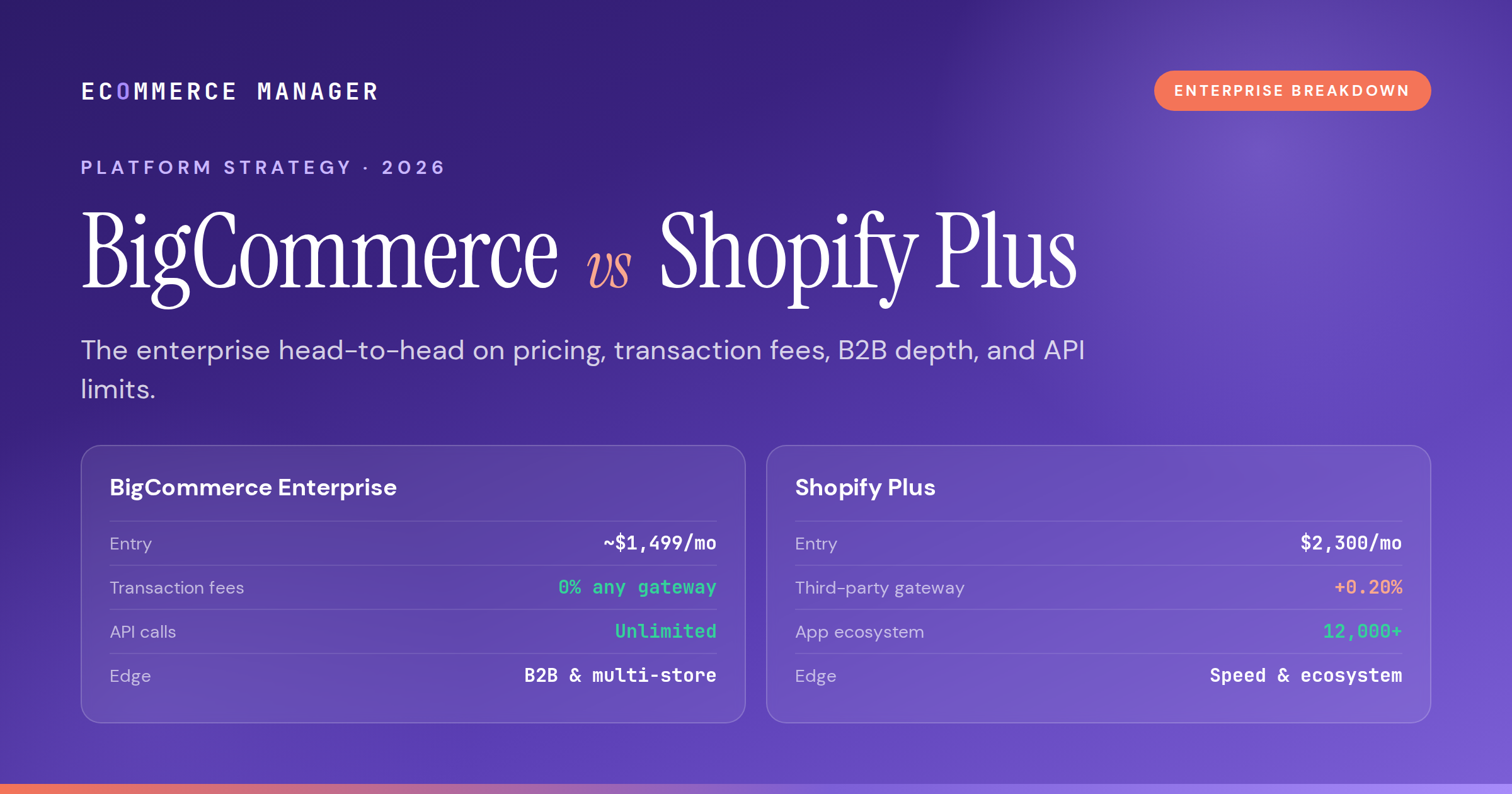
Shopify Plus is a flat fee that becomes a revenue share. You start at $2,300/month on a three-year term (or $2,500 on a one-year term), and that flat rate holds until your monthly GMV crosses roughly $800,000. Past that point you pay 0.25% of monthly GMV, whichever is higher, capped at $40,000/month once you hit about $16M in monthly sales. So a brand doing $2M a month pays around $5,000; a brand doing $5M a month pays about $12,500. The bill scales with you, cleanly and predictably.
BigCommerce Enterprise throws out the revenue share entirely. Pricing is quote-based, negotiated on GMV, catalog size, and storefront count, and typically lands between $1,000 and $3,000/month at entry (the published Performance-tier floor is $1,499/month). There is no percentage of your sales flowing back to the platform as you grow. For a fast-scaling brand, that structural difference can be worth more than the headline gap.
Then there is the fee that used to end every argument. BigCommerce charges no transaction fees on Enterprise, on any payment gateway. Shopify Plus is 0% only with Shopify Payments; a third-party gateway like Adyen or Stripe adds a 0.20% platform fee. On $50M in annual GMV routed through an external processor, that 0.20% is $100,000 a year. If you are contractually tied to a specific processor, price that line before anything else.
BigCommerce Enterprise vs Shopify Plus, head to head
Eleven dimensions that decide the contract, priced and specced as of July 2026. Enterprise pricing on both sides is quote-based, so the ranges reflect what merchants and partners actually report, not a public rate card.
| Dimension | Shopify Plus | BigCommerce Enterprise |
|---|---|---|
| Entry price | $2,300/mo (3-yr) / $2,500/mo (1-yr) | Custom quote; ~$1,000–$3,000/mo; Performance from $1,499/mo |
| Pricing model | Flat, then 0.25% revenue share above ~$800K/mo GMV (cap $40K/mo) | GMV & complexity-based quote; no revenue share |
| Transaction fees | 0% with Shopify Payments; +0.20% on third-party gateways | 0% on Enterprise, any gateway |
| Payment processing | ~2.15%+30¢ via Shopify Payments (US) | Bring your own gateway; no platform cut |
| B2B | Native, strong for unified B2C+B2B; enterprise B2B (unlimited catalogs, terms, deposits) on Plus | B2B Edition bundled: price lists, quotes, POs, credit limits, buyer portals — B2B-first |
| Multi-storefront | 9 expansion stores; separate instances; ERP/PIM as source of truth | Native multi-storefront, single backend, one contract |
| Checkout customization | Checkout Extensibility (sandboxed, upgrade-safe) | Open Checkout SDK on all plans (raw access, you own maintenance) |
| API limits | Rate-limited (contract-based; ~40 req/s GraphQL) | Unlimited API calls |
| App ecosystem | 12,000+ apps (largest in commerce) | Smaller marketplace; more native features out of the box |
| Performance / uptime | Global CDN, 99.99% uptime, 10K+ checkouts/min | 99.99% uptime; open SaaS architecture |
| Analyst position (2025) | Gartner Leader (3rd yr), top Ability to Execute | Gartner Challenger (6th yr); Forrester Strong Performer in B2B |
| Best fit | Unified B2C+B2B, fast launch, app-driven growth, brand trust | Wholesale-first, multi-brand, API-heavy, zero-fee priority |
Sources: Shopify Plus and BigCommerce pricing references, 2026 enterprise comparisons (Folio3, Fyresite, Codup, OroCommerce, Elogic), and Gartner/Forrester 2025 positioning. BigCommerce plan names reflect the June 1, 2026 rename (Enterprise→Performance). Both platforms negotiate enterprise pricing per contract; treat dollar figures as directional, not quotes.
Run your GMV through both models
A flat-plus-revenue-share and a quote-based fee behave very differently as you scale. Model three-year TCO for your actual sales volume before you take either sales call.
B2B and multi-storefront: BigCommerce's home turf
If wholesale is a meaningful slice of your revenue, this section probably decides the whole thing. It is the clearest point of divergence between the two.
BigCommerce is B2B-first. Its B2B Edition, bundled with Enterprise, ships with customer groups, custom price lists, quote management, purchase orders, credit limits, and buyer portals out of the box. No apps, no glue code. Forrester named it a Strong Performer in B2B commerce, specifically citing the architecture. For a distributor or manufacturer with tiered pricing and organizational buyer hierarchies, that native depth is a real cost and complexity advantage.
Shopify Plus has closed a lot of ground, fast. B2B GMV on the platform grew 96% in 2025, and in April 2026 Shopify opened core B2B features to every paid plan, with the enterprise-grade pieces (unlimited catalogs, partial payments, deposits, payment terms) staying on Plus. It is genuinely strong now for running B2C and B2B from one store. The ceiling shows up in advanced workflows: complex approval chains, punchout catalogs, and deep company hierarchies still lean on apps like SparkLayer or custom Hydrogen builds.
Multi-storefront splits the same way. BigCommerce runs native multi-storefront from a single backend under one contract, so multi-brand and multi-region operators manage catalogs and pricing centrally. Shopify Plus uses expansion stores that behave as separate instances, which is why most Plus brands run an ERP or PIM as the source of truth and sync across stores. One model centralizes; the other federates. Match it to how your business is actually structured, and pull in a retention or lifecycle partner early if your B2B accounts drive repeat revenue.
Apps, checkout, and the API story
Here the advantage flips back toward Shopify on two of three fronts. This is where "control" and "convenience" stop being marketing words and start being engineering decisions.
App ecosystem: Shopify, decisively
Shopify's app store passed 12,000+ apps in 2026, the largest in commerce. For subscriptions, loyalty, reviews, personalization, and CRM connectivity, the odds that a mature, well-supported app already exists are high. That speed has a cost: a typical Plus store spends $500 to $1,000+ a month on apps, and a tech stack audit usually finds redundancy in there. BigCommerce's marketplace is smaller, which it offsets by shipping more features natively, so you buy fewer apps to reach the same place.
Checkout: freedom vs upgrade-safety
BigCommerce gives you open Checkout SDK access on every plan. You can rebuild the flow, add steps and fields, and write custom logic. More raw freedom, but it is a heavier engineering lift and you own that maintenance forever. Shopify routes checkout customization through Checkout Extensibility, where changes run in an approved sandbox. Less raw access, but your edits survive platform updates and do not put PCI compliance at risk. For most brands, upgrade-safe and maintainable beats unlimited but fragile.
API: BigCommerce's quiet win
BigCommerce Enterprise includes unlimited API calls. Shopify Plus is rate-limited, contract-dependent, around 40 requests per second on GraphQL. For standard operations that ceiling rarely bites. But if you are syncing inventory across warehouses in real time, repricing against competitors, or wiring in multiple ERPs, unlimited calls remove a whole class of workarounds (batching, caching, polling windows) that Shopify-heavy integrations have to engineer around.
A replatform is won or lost in the migration
Data transfer is routine. Preserving rankings through redirects and a tested cutover is not. Find agencies that specialize in enterprise migrations and post-launch SEO recovery.
Performance, support, and where each sits in the market
Both promise 99.99% uptime and both deliver it at scale. The soft factors are where the two brands genuinely differ, and they matter more than most spec sheets admit.
Shopify carries the market. It runs roughly 4.8 million stores worldwide, holds close to 30% of the US market, and has been a Gartner Magic Quadrant Leader for three straight years with the highest Ability to Execute in the field. Its global CDN gives storefronts a real speed edge, and that market position translates into easier hiring, a deeper agency bench, and customer trust signals at checkout. There are about 67,000 Plus domains live in 2026.
BigCommerce is the smaller, more specialized player. It powers around 40,000 live stores, a Gartner Challenger for six consecutive years, and its live store count was down roughly 8% year over year heading into 2026. That contraction is worth weighing honestly. It reflects a platform that has narrowed toward mid-market and enterprise merchants with real B2B and multi-store needs, but a smaller ecosystem also means a shallower talent pool and fewer off-the-shelf integrations.
One more thing changed the story this year. "No transaction fees, ever" was BigCommerce's sharpest line against Shopify. The June 2026 Open Payment Provider Fee (which does not touch Enterprise) blunted it on the self-serve tiers and made the platform read as slightly less differentiated than it did a month earlier. At the enterprise level the zero-fee advantage still stands, but the marketing halo around it is dimmer. If neither fits, the enterprise B2B crown still belongs to Adobe Commerce, and control-first teams keep an eye on open-source options.
How to actually decide
Skip the feature-count scoreboards. Four questions settle it, and they are about your business, not the platforms.
-
01How much of your revenue is B2B or wholesale? If it is substantial and the workflows are complex, BigCommerce's bundled B2B Edition saves you an app stack and custom work. If B2B is a growing side channel to a DTC core, Shopify Plus's unified model is cleaner.
-
02Are you locked to a non-Shopify payment gateway? If yes, Shopify's 0.20% third-party fee is a recurring tax. On $50M GMV that is $100K a year. BigCommerce Enterprise charges nothing on any gateway. Do this math first, because it is the largest single line most teams overlook.
-
03Do you run one brand or several? Multiple brands or regions managed centrally point to BigCommerce's native multi-storefront under one contract. A single flagship with a few international expansions fits Shopify's expansion-store model, especially if you already run an ERP or PIM.
-
04What is your team optimized for: speed or control? A lean team that wants to ship fast and buy functionality off the shelf is a Shopify team. An engineering-heavy team that wants open APIs, raw checkout access, and no revenue share is a BigCommerce team. Watch CLV and LTV:CAC through any migration, because a conversion dip during cutover can erase years of platform savings.
What a smart operator does with this
The pricing models are different, not just the prices. Shopify Plus is flat then revenue-share (0.25% above ~$800K/mo GMV, capped at $40K/mo). BigCommerce Enterprise is a flat quote with no revenue share and no transaction fees on any gateway. For fast-scaling brands, the absence of a revenue share can matter more than the entry number.
BigCommerce wins B2B and multi-store; Shopify wins ecosystem and speed. Bundled B2B Edition, native multi-storefront, and unlimited API calls are BigCommerce's real edges. A 12,000-plus app store, upgrade-safe checkout, a faster CDN, and Gartner Leader status are Shopify's. Pick the edge that maps to your operating model.
Price the gateway fee before anything else. If you are tied to a third-party processor, Shopify's 0.20% surcharge can run into six figures at enterprise GMV. BigCommerce charges zero. That single line has flipped more of these decisions than any feature comparison.
Weigh BigCommerce's contraction honestly. A roughly 8% year-over-year drop in live stores means a smaller talent pool and thinner integration ecosystem, even as the platform sharpens its enterprise and B2B focus. Fewer partners is a real operating cost, not a footnote. Protect conversion through the switch with a CRO specialist and rehearsed cutover.
Frequently asked questions
Is BigCommerce cheaper than Shopify Plus?
Usually at the platform-fee line, yes. Shopify Plus starts at $2,300/month on a three-year term and adds a 0.25% revenue share once you pass roughly $800K in monthly GMV. BigCommerce Enterprise is quote-based, commonly $1,000 to $3,000/month, with no revenue share and no transaction fees on any gateway. But platform fee is not total cost. Shopify's larger native feature set and app ecosystem can close or reverse the gap depending on how many paid apps you would otherwise stack.
Does BigCommerce still have no transaction fees in 2026?
On the Enterprise (Performance) tier, yes: 0% regardless of payment gateway. That is unchanged. The nuance is that BigCommerce's June 1, 2026 update added an Open Payment Provider Fee of 0.6% to 2% on its self-serve tiers for orders not run through an embedded provider. Enterprise contracts are exempt, so the zero-fee pitch still holds at the top of the range, just not lower down.
Which is better for B2B, BigCommerce or Shopify Plus?
BigCommerce Enterprise is the stronger out-of-the-box choice for wholesale-first businesses. Its bundled B2B Edition includes price lists, quote management, purchase orders, credit limits, and buyer portals with no extra apps. Shopify Plus has closed much of the gap and is better for unified B2C and B2B from one store, but advanced workflows like complex approval chains or punchout still lean on apps or custom work.
Can both platforms run multiple storefronts?
Both can, differently. BigCommerce offers native multi-storefront from a single backend under one contract, which suits multi-brand or multi-region operations. Shopify Plus uses expansion stores (nine included) that behave as separate instances, so most brands run an ERP or PIM as the source of truth and sync across stores. If centralized multi-brand management is core to your model, BigCommerce's architecture is the cleaner fit.
When should an enterprise choose Shopify Plus over BigCommerce?
Choose Shopify Plus when time-to-market, ecosystem breadth, and unified B2C plus B2B matter more than raw architectural control. Its 12,000-plus app store, upgrade-safe checkout extensibility, faster storefront CDN, and Gartner Leader position make it the safer default for most DTC-led brands. Lean toward BigCommerce when you are wholesale-first, run multiple brands, need unlimited API calls, or want to avoid transaction fees on a non-Shopify gateway.
The playbook top eComm operators actually read
One weekly brief. Five stories that matter. Zero fluff. Written for managers at $5M–$50M DTC brands who want to sound sharper than everyone else in the meeting.
References
- 01Shopify Plus Pricing 2026: Costs, Fees & Real Total — ringly.io
- 02Shopify Plus vs Enterprise: 2026 Pricing & Features — arslanemre.com
- 03Shopify Plus Complete Guide 2026 — zipchat.ai
- 04Shopify Plus vs BigCommerce Enterprise: Full Comparison — folio3.com
- 05Shopify Plus vs BigCommerce Enterprise: Which Is Better? — fyresite.com
- 06BigCommerce vs Shopify Plus for B2B — oroinc.com
- 07BigCommerce vs Shopify in 2026: What the New Fees Mean — commerce-ui.com
- 08Shopify Plus Alternatives in 2026: Enterprise Buyer Guide — elogic.co
- 09Shopify Plus vs BigCommerce Enterprise (Codup) — codup.co
- 10BigCommerce 2026 Pricing & Plan Updates — bigcommerce.com
Make the platform call with data, not vibes
Join 12,000+ ecommerce managers reading the ECM newsletter every Wednesday — or browse the directory to find vetted migration, B2B, and CRO partners.