

Last Updated on October 27, 2026
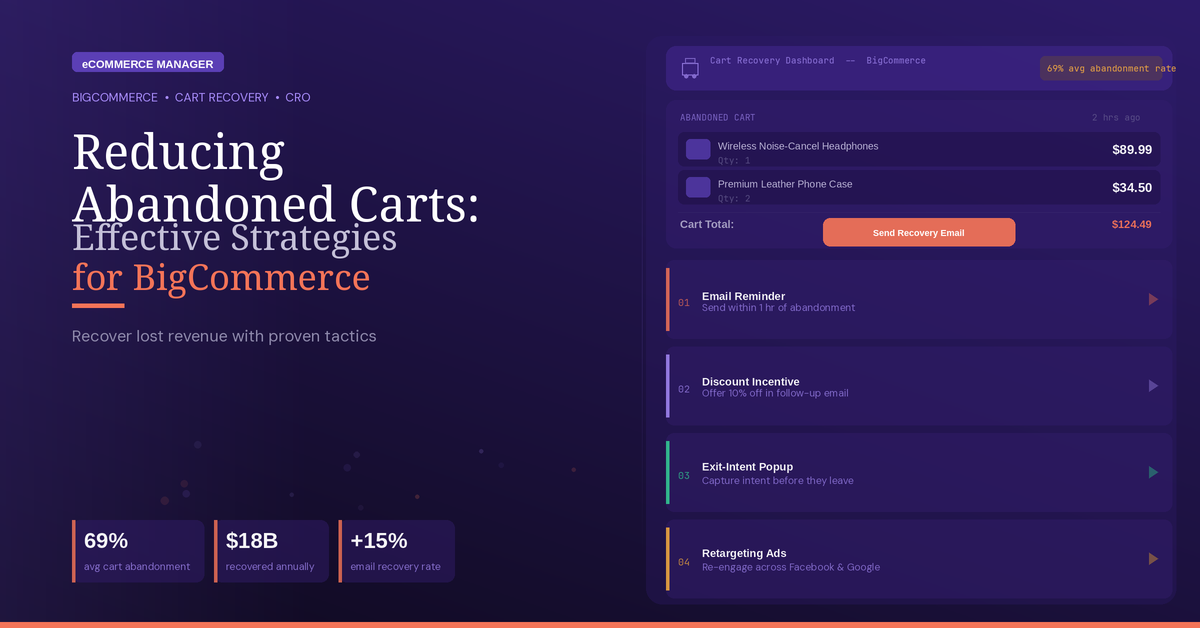
Reducing Abandoned Carts: Effective Strategies for BigCommerce Stores
Abandoned carts can quietly drain sales from any BigCommerce store. Small changes to checkout, messaging, timing, and customer support can bring more shoppers back. This article shares practical strategies, including insights from experts in the field, to help recover more lost orders.
- Assign a Purpose to Each Email
- Customize Journeys From Store Data
- Ease Skincare Doubts Before Offers
- Reserve Coupons for Final Follow-Ups
- Answer Hesitation With Human Support
- Build Confidence With Customer Proof
- Send Conversational WhatsApp Nudges
- Fix Checkout Breaks Before Outreach
- Target Every Add-to-Cart Visitor
- Show Landed Costs Up Front
- Align Outreach With Quiet Trading Windows
The State of eCommerce in 2026
Assign a Purpose to Each Email
We built a three-email sequence with the abandoned cart feature already inside BigCommerce. What changed our results was giving each email a job instead of simply offering a larger discount.
The first email is sent one hour after the cart is abandoned. It has no offer at all. It shows the items left behind and the simple line “Still thinking it over? Your cart is saved.” The second email arrives after twenty-four hours. It addresses the hesitation, shipping and returns and includes two short customer reviews of that exact product. Only the third email, sent at seventy-two hours carries a ten percent code. That code expires after forty-eight hours.
Over eleven weeks the sequence got back fourteen point two percent of abandoned carts up from six point eight percent, with our single email. Two thirds of those recoveries happened before the discount email appeared so we stopped giving margin away to customers who would have bought anyway.
The Complete 2025 E-commerce Manager Career Guide: From Entry-Level to Executive
Each email needs one job, not three jobs.
 Fahad Khan, Digital Marketing Manager, Ubuy Qatar
Customize Journeys From Store Data
We don’t use one standard abandoned cart sequence, because what works for one brand often doesn’t work for another. Every sequence we build is personalised to the brand.
We start with the store’s own data: where in the journey shoppers tend to drop off, what they leave behind, how much they spend and how often they come back. That tells us how many messages to send, how quickly, and whether a discount makes sense at all. A brand with loyal repeat buyers may not need an incentive. A first-time buyer looking at a higher-priced product may need more reassurance, such as reviews, returns information or answers to common questions.
We also keep abandoned cart and abandoned checkout as separate flows, because someone who reached checkout is much closer to buying. Email and SMS work together, but each brand’s mix is decided by its own customers, not a template. The sequence then keeps improving as we test and learn from each brand’s results.
 Stoyan Vlahovski, Founder & CEO, ecom2win
Ease Skincare Doubts Before Offers
My abandoned cart sequence is three emails spread across 48 hours, and the opening one doesn’t mention the cart at all. It asks a question about what they were shopping for, something like, “Still deciding on the right kit for your skin type?” with a link to a comparison guide. That email pulls people back into the decision process without feeling like a sales push.
The next email, about 24 hours later, shows the cart contents with a short customer review underneath each item. I found that a review sitting right next to the product image does more for me than any discount code, because the customers who left my carts were unsure, and a review from someone with a similar concern closes that gap.
The last email goes out at 48 hours with a small incentive, usually free shipping rather than a percentage off. When I ran percentage discounts, I watched customers abandon on purpose to wait for the deal. Free shipping reads as a removed obstacle instead of a bargain. I built the whole sequence to reduce hesitation at each stage rather than just remind people their cart exists.
 Dan McElwee, Head of Retail, Tress Wellness
Reserve Coupons for Final Follow-Ups
The strategy I’d defend is a three email sequence where the discount waits until the last email. On BigCommerce, that means checking whether the default abandoned cart settings fire a coupon at the first reminder, and building the flow yourself if they do. You can use the built-in abandoned cart saver or a Klaviyo flow tied to the store.The State of eCommerce in 2025!
Email one goes out about an hour after the cart is abandoned. It shows the exact cart with images, says the cart is saved, and links straight back to checkout. I keep it plain text styled, because a stripped down message reads like a person sent it. Email two goes out the next day and answers what actually stops a purchase: shipping cost and delivery time, plus the return policy. Give a reply address that reaches a human. Still no code.
Email three goes out around day three. That’s where a small incentive or a low stock note belongs, and only if the stock is truly low.
The reason I hold the code back is that shoppers learn quickly. Put a coupon in email one and some of them start abandoning carts on purpose to get it, and margin leaks out of every order.
I’d also split the flow by cart value. A big cart gets a longer wait and a personal note from a real inbox. A small cart just gets the automated sequence.
 Victor Smushkevich, Founder, Tested Media
Answer Hesitation With Human Support
On our BigCommerce store, I treat abandoned carts as customer service conversations rather than immediate sales pitches. I set up a three step email sequence that focuses on removing purchase friction. The first email sends two hours after abandonment, asking simply whether the shopper encountered checkout errors or needs product assistance. Twenty four hours later, the second reminder highlights key product features, everyday customer feedback, and our straightforward return policy to resolve doubts about fit or quality. Two days after that, a final message offers direct support from our team before cart reservation expires. This approach works because it gives shoppers space while answering common hesitation points, turning interrupted visits into completed purchases without eroding brand trust.
 RUTAO XU, Founder & COO, TAOAPEX LTD
Build Confidence With Customer Proof
The strategy I recommend is to treat an abandoned cart as a confidence problem, not a reminder problem.
Most abandoned cart sequences assume the shopper forgot. Some did. But many people leave because the product page didn’t answer a question. Will it fit? What does it look like in person? Is it worth the price? A generic “You left something behind!” email repeats the same information that failed to convert them the first time.
So I build the sequence around proof instead of pressure.
The first email goes out about an hour after abandonment and acts as a helpful nudge. Keep it short. Show the product, add a clear button back to the cart, and invite them to reply with questions. No discount yet, so you don’t train shoppers to wait for a coupon.
The second email, sent around 24 hours later, does the heavy lifting by showing instead of telling. Feature a 15 to 30 second video of a real customer using the exact product in the cart, whether that’s unboxing it, wearing it, or using it at home. Add one or two reviews that address the most common objection for that product. Link the video back to the product page where the same content lives.
The third email, sent around 72 hours later, focuses on reducing risk. Highlight your return policy, shipping timeline, or guarantee. If margins allow, this is where a modest incentive belongs, because the shopper has already seen the proof.
Three things make it work. Match the video to the product in the cart, not a generic brand video. Keep clips vertical and unpolished, since shoppers trust content that looks like it came from another customer. And make sure the product page backs up the email, so the momentum carries through to checkout.
Your abandoned cart flow is only as good as the content inside it.
 Mark Yeramian, Co-Founder, CEO, Moast.io
Send Conversational WhatsApp Nudges
Abandoned Cart Recovery Message
One strategy I find useful for abandoned carts on a BigCommerce store is sending WhatsApp reminders instead of relying entirely on email. People tend to check WhatsApp more frequently, so it gives us a better opportunity to reconnect with shoppers while they’re still considering a purchase.
I’d send the first reminder an hour or two after abandonment, including the product they left behind and a direct checkout link. If they haven’t completed the purchase, a second message the next day can address common concerns, such as delivery, payment options, or return policies.
What matters is keeping these reminders helpful rather than making them feel like repeated sales pitches. I prefer short conversational messages that make it easy for someone to pick up where they left off. I’d also track recovered orders and revenue to understand how many purchases the reminders actually bring back.
WhatsApp isn’t automatically better for every audience, but when customers actively use it, it can be a practical way to recover lost sales without immediately resorting to discounts.
 Jitender Kumar, Digital Marketing Specialist, SkillWaala
Fix Checkout Breaks Before Outreach
So, most of the abandoned carts aren’t really abandoned. They are broken in checkout. Before I even think about writing a few reminder emails, I have to check if the checkout process itself didn’t fail for some reason. A significant proportion of the “hesitation” on the checkout process at TradingFXVPS were actual card declines, 3D Secure fails, etc. People whose banks were flagging overseas online transactions. None of these issues can be fixed with a series of emails.
For those that truly abandon their carts, we have found that a 3 email sequence with no discounts performs best.
Email 1: Sent 1 hour after cart abandonment. This is sent from a real person not from a logo. This email contains ONE line of text and that is: “Saw you didn’t finish setting up your VPS. Did something break, or did you have a question?” Replies to this email are GOLD because you can see exactly where the friction is in the checkout process for each individual cart abandonment.
Email 2: 24 hours after the 1st email – set up to tackle the biggest objection we hear “Will it be like my broker’s server?”. Include a link to where you have listed the locations of your data centers and offer assistance with choosing a location. The people who buy from us are traders. They want to be convinced with data, not flimflam.
Email 3: “The 7 day money back guarantee still applies and I would be more than happy to do a 30min call to set up the VPS for you.”
No discounts on cart abandonment emails. Teaching a customer to abandon his shopping cart in hopes of a future sale with a deeper discount than normally offered on site is not wise. Eliminate the doubt and convert the customer instead.
 Ace Zhuo, CEO | Sales and Marketing, Tech & Finance Expert, TradingFXVPS
Target Every Add-to-Cart Visitor
Open the floodgates on abandoned carts.
The first thing I do is separate “added to cart” from “started checkout”. Many BigCommerce stores have an automation that they call “abandoned cart”, but it’s actually “abandoned checkout”. That means that anyone who adds a product to their cart, but never clicks through to the checkout page, is never emailed at all.
It’s not a copy-writing thing, it’s a trigger thing.
In BigCommerce (or using an ESP), I create an email flow based on “added to cart” and another for “started checkout”. If someone clicks through from the “added to cart” email, then they’re removed from that flow and added to the “started checkout” flow. Of course, you need to make sure that the email template contains a dynamic product link so that they click through to the product page, not just the home page.
We don’t discount.
My abandonment email series is a conversation, not a negotiation. The first email goes out 45 minutes after abandonment (I’m testing 2 hours), with the subject line “did you have an issue?”
In this email we ask them to click through to purchase, or reply to the email with questions about sizing, shipping, or anything else.
The second email goes out 24 hours later, which is the same time of day that they were shopping when they abandoned. In this email we address the main objection that we discovered when we surveyed recent customers: “what was nearly the reason that you didn’t buy?”
If the reason is price, then we broach the topic of cost of ownership. If it’s efficacy, then we include a story by a customer who had that same concern.
We then follow up with a text-only email from the founder, two days later. We only offer a coupon to those who reply with a relevant objection, which helps us to keep our conversion rate high without sacrificing margin.
 John Mac, Founder, Exit Evidence
Show Landed Costs Up Front
The mistake is treating every abandoned cart as one behaviour and sending everyone the same discount.
BigCommerce’s built in Abandoned Cart Saver gives you up to three scheduled emails on Plus and above, and each one carries a unique recovery link that rebuilds the exact cart. We use those three slots to test a cause, not to escalate an offer.
Email one goes at about one hour and contains no offer at all. It is a plain rebuild link with the line items and the shipping cost already shown. A large share of abandonment is not price resistance, it is someone who got interrupted, or who bounced at the shipping step because the real landed cost only appeared at checkout. Showing that cost in the email recovers those people without paying for them.
Email two goes at roughly 24 hours and answers objections instead of cutting price: delivery estimate, returns window, two or three review snippets for that specific SKU.
Email three, at around 72 hours, is the only one carrying an incentive, and we make it free shipping rather than a percentage off. Free shipping protects unit margin and it reads as removing the friction the customer actually hit, rather than admitting the price was wrong all along.
One operational note that catches people out: check your cart abandonment window against the Saver’s send timing, or the first email will fire at customers who already completed the order. Nothing erases trust faster than being chased for a purchase you just made.
Jimi Patel, Director, eStore Factory LLC
 Jimi Patel, Director, eStore Factory LLC
Align Outreach With Quiet Trading Windows
Abandoned carts should be treated with the same respect as a buyer who walked around a showflat. They liked it enough to view it, so follow up should be a conversation with them and not harassment. The biggest lift for us was timing of the email and not the copy itself. We are a retailer of services for traders and the biggest reason for them abandoning a cart is because a market session opens and they have to go and trade. We send our reminders based on their local time and try to avoid sending them during major trading sessions.
The best performing sequence for us is a three email sequence.
Email 1: A few hours later with “Your cart is saved and ready when you are”. This is sent out a few hours later and is time-gated to make sure it reaches the customer at the quietest part of their day. The email includes the plan that they have left in their cart and a single link back to the showflat for them to return to.
Email 2: Social proof. Email is sent the following day and contains a short note from another trader in a similar location as to why he/she decided to switch to CheapForexVPS and how they found their setup after switching.
Email 3: Abandoned Carts – A Small Offer three days later to first time visitors to CheapForexVPS only. Returning customers are already loyal to you and do not need to wait for a sale. It is first home buyers that need extra reassurance to purchase from you. New customers need a little encouragement to take a risk and purchase from someone unknown to them.
The main thing to note about this segmentation is that new customers need a little push to buy from someone unknown to them, whereas existing customers just need to be reminded.
 Corina Tham, Sales, Marketing and Business Development Director, CheapForexVPS
Related Articles
- Recovering Abandoned Carts: 5 Effective Strategies from E-Commerce Businesses
- Creating a Winning Abandoned Cart Email Sequence on Shopify: Tips & Examples
- WooCommerce Abandoned Cart Emails: Strategies for Recovering Lost Sales