

Last Updated on June 25, 2026
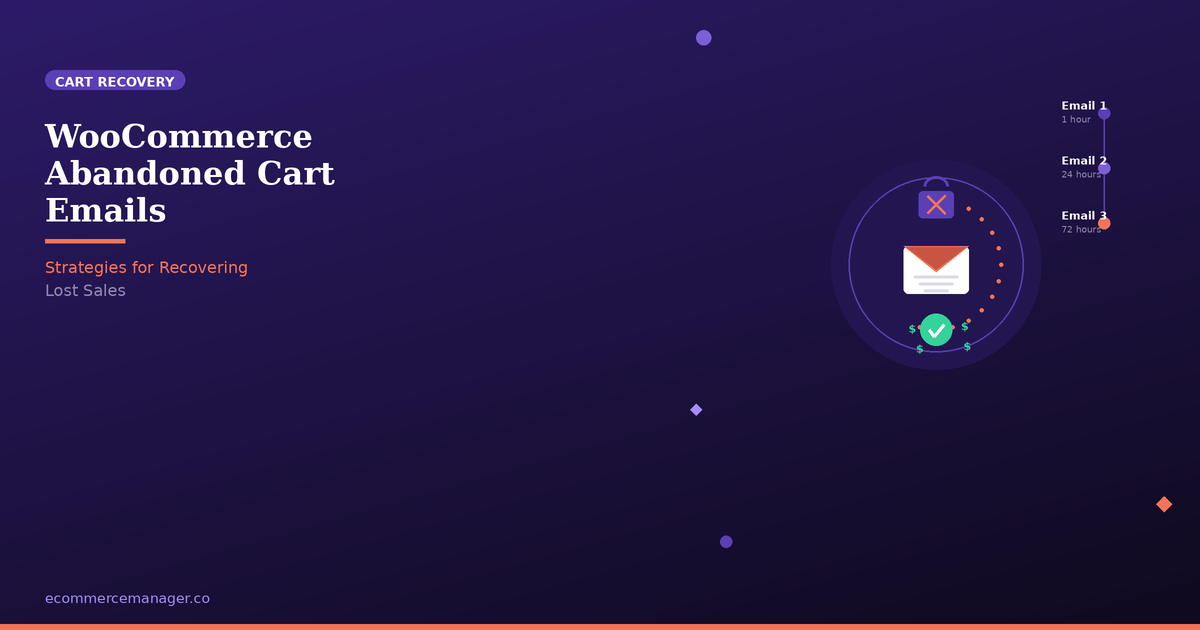
WooCommerce Abandoned Cart Emails: Strategies for Recovering Lost Sales
Cart abandonment costs online retailers billions in lost revenue each year, yet a well-crafted email sequence can win back a significant portion of those sales. This guide presents seven proven strategies for recovering abandoned WooCommerce carts, backed by insights from ecommerce conversion experts and store owners who have tested these approaches at scale. From timing your outreach to crafting messages that address specific customer hesitations, these tactics will help turn abandoned carts into completed purchases.
- Tag Behavior To Drive Tailored Journeys
- Address Hesitation With Decision Support
- Capture Emails Early Then Tackle Objections
- Expose Shipping Costs Upfront
- Segment Time And Lead With Helpfulness
- Send One Plain-Text Personal Note
- Highlight Product Stories Over Discounts
Tag Behavior To Drive Tailored Journeys
I’ve spent over a decade building sales and marketing systems, and at RewardLion we work with WooCommerce as part of our e-commerce stack. I don’t treat abandoned cart as “send one reminder,” I treat it as a tracked customer journey.
The best strategy: tag the behavior before writing the email. Added to cart, checkout started, opted in but didn’t buy, returning customer, product category — each one should trigger a different message.
Example: if someone opts in but doesn’t purchase, we tag that inside the CRM and send a cart-specific email that removes friction: “Still deciding? Here’s what happens after you order,” plus a direct return-to-cart button. No generic “you forgot something” copy.
The hidden win is syncing WooCommerce with email/SMS automation and your all-in-one inbox, so if they reply with a question, your team or AI assistant can respond fast. A lot of “abandoned carts” are really unanswered objections.

Address Hesitation With Decision Support
One strategy that’s worked surprisingly well for abandoned cart recovery is treating hesitation differently from abandonment.
I noticed this while looking at purchase data for a WooCommerce store. Many customers who eventually bought didn’t purchase on their first visit. They came back days later after comparing options, reading reviews, or discussing the purchase with someone else. Yet our abandoned cart emails were acting as if every customer had simply forgotten to check out.
So we changed the first follow-up email. Instead of sending a reminder or discount, we focused on helping customers make a decision. We answered common questions, addressed concerns we heard from buyers, and explained what to expect after ordering.
That change recovered more sales than our standard reminder emails. The biggest lesson was that many abandoned carts aren’t abandoned at all. People often leave because they’re still deciding, and the emails that help them move forward tend to outperform the ones that simply ask them to come back.

Capture Emails Early Then Tackle Objections
I run APMZEE on Shopify rather than WooCommerce, but the recovery logic is the same whatever the platform, and Woo handles it well through Klaviyo, Omnisend or AutomateWoo.
What worked for us was framing the sequence as three separate problems rather than one nagging email. The first message goes out within the hour and assumes a distraction, not a decision, so it just brings the cart back with a clear button and no discount. The second, the next day, handles doubt by answering the real objection, which for us is whether the product is worth it, so we lead with reviews and our money-back promise rather than money off. Only the third, a couple of days later, carries a modest incentive, because discounting too early trains people to abandon on purpose.
That sequence recovers around 12% of abandoned carts for us. The bigger lever though is capturing the email earlier in checkout, because you cannot email a cart you have no address for. Adding an email field before the long shipping form recovered more revenue than any clever copy we wrote.

Expose Shipping Costs Upfront
Abandoned cart recovery in WooCommerce really comes down to a well-timed email sequence. Here’s what works:
Email 1: 1 hour after abandonment
Just a simple reminder with the cart link. No discount needed yet. Many users abandon just because they got distracted, and this alone brings a good number back.
Email 2: 24 hours later
Add some social proof, a review or two for the product they left. Builds trust without pushing a discount right away.
Email 3: 72 hours later
Now drop a small discount (10% with a 48-hour expiry works well). Keep it short and direct.
For WooCommerce, plugins like FunnelKit Automations handle this sequence well, with native integration and no complicated setup.
But before setting up any email sequence, it’s worth looking at why customers are abandoning in the first place. In most cases, unexpected shipping costs at the final checkout step are the biggest culprit. Customers go through the whole process, see a shipping cost they weren’t expecting, and just leave.
A simple fix is making sure shipping costs are visible early, ideally on the cart page itself. When customers know what they’re paying for shipping before they start checkout, there’s no surprise, and drop-offs reduce naturally. Most carriers like FedEx, UPS, and USPS provide live rate APIs specifically for this reason, so the customer sees the actual calculated rate based on their location and order, not a flat guess.
Fix the transparency first, and then the email sequence becomes a much smaller safety net rather than your main recovery tool.

Segment Time And Lead With Helpfulness
Abandoned cart recovery is something I’ve dealt with extensively managing e-commerce across platforms like Amazon, eBay, and Walmart — the psychology of re-engagement is universal regardless of where the cart lives.
The single most effective WooCommerce strategy I’ve seen is timing segmentation. Your first recovery email should fire within the hour, framed around helpfulness — “did something go wrong?” not “you forgot this.” That tone shift alone meaningfully changes open and click behavior.
The second email, sent around 24 hours later, is where you introduce urgency around inventory rather than discounts. “Only a few left” performs better long-term than burning margin on coupon codes, which trains customers to abandon on purpose.
For clients I’ve worked with integrating CRM and email marketing systems, the real leverage comes from syncing cart data with customer purchase history. If someone abandoned a product they’ve bought a variant of before, that context belongs in the email — it feels personal, not automated, and that distinction is what actually closes the loop.

Send One Plain-Text Personal Note
We ran the standard three-email abandoned cart sequence for about a year before looking carefully at which emails were actually doing the work.
The first email, sent about an hour after abandonment, recovered most of what the sequence recovered. The second and third emails were generating unsubscribes at a rate that probably cost us more in list quality than they recovered in revenue. We’d built a sequence because the advice said to do so, not because we’d tested whether three emails outperformed one.
Simplified to a single email, sent roughly 90 minutes after abandonment, written in plain text rather than heavily designed HTML.
The WooCommerce plugin we were using was AutomateWoo, which let us pull the specific abandoned product into the email body with enough context to make the message feel personal rather than automated. Not just the product name but a line about what made that specific item worth coming back for, written once per product category rather than generated dynamically.
Recovery rate on that single plain text email was higher than the three-email sequence had been, which still surprises me when I say it out loud.
The honest caveat is that our abandonment reasons skewed toward distraction rather than price sensitivity, which probably explains why the discount in email three didn’t do much. Stores with more price-sensitive customers might see different results from a sequence that introduces an offer later.
We’ve left it as one email for about eight months now and haven’t felt compelled to change it.

Highlight Product Stories Over Discounts
I’ve found that most abandoned carts aren’t really about price. More often, people get distracted, want a bit more time to think, or simply aren’t ready to make a decision in that moment. Because of that, we’ve had much better results with reminder emails that continue the conversation rather than immediately offering a discount. If someone was interested enough to build a cart, there’s usually a reason they were considering those wines in the first place.
One approach that has worked particularly well for us is sending a follow-up email that focuses on what’s in the basket rather than the basket itself. Instead of saying, “You left something behind,” we’ll highlight the producer, the region, or what makes one of the wines interesting. We tested discount-driven emails against these more story-led reminders and were surprised by the results. The story-led emails often recovered just as many orders while protecting margins and avoiding the habit of customers waiting for a discount before completing a purchase.

Related Articles
- Recovering Abandoned Carts: 5 Effective Strategies from E-Commerce Businesses
- Reducing Cart Abandonment: 10 Strategies for WooCommerce Stores
- Combatting Cart Abandonment: 4 Ecommerce Strategies that Work eCommerce Manager