

Last Updated on June 25, 2026
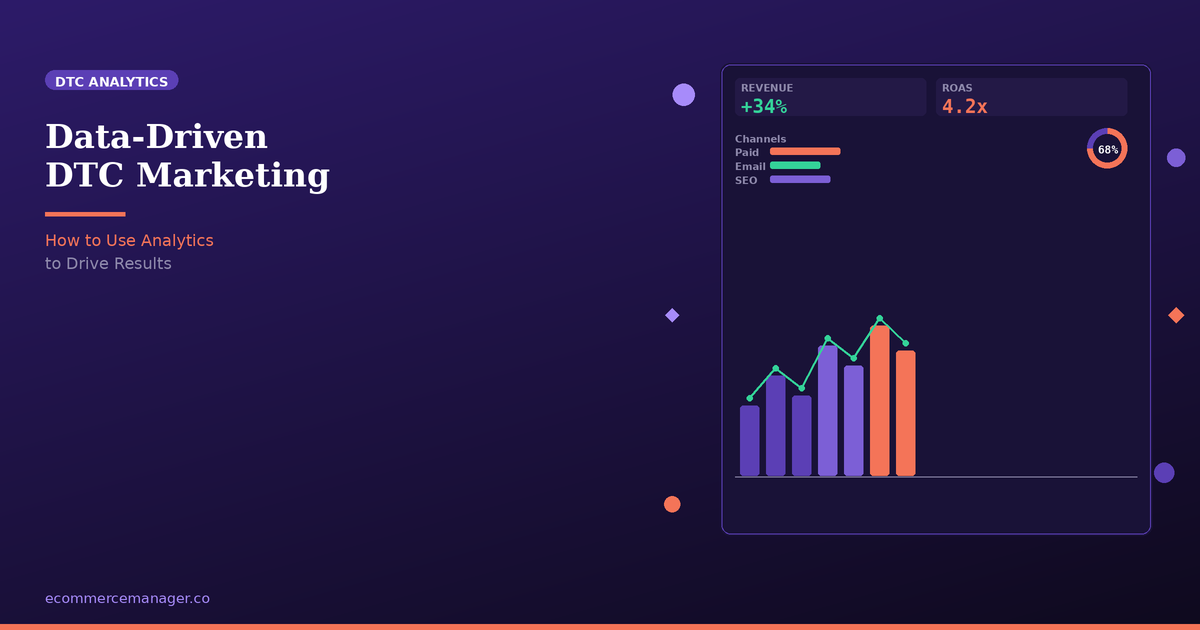
Data-Driven DTC Marketing: How to Use Analytics to Drive Results
Direct-to-consumer brands that ignore their data leave money on the table every day. This article breaks down 25 practical ways to turn analytics into measurable growth, backed by insights from marketing experts who have implemented these strategies across multiple DTC brands. Each tactic addresses a specific conversion barrier or revenue opportunity that can be tested and scaled immediately.
- Boost Repeat Purchases With Basics
- Fund Instagram To Lift Starter Kits
- Show Transformations To Drive Activation
- Align Acquisition With Margin And Cohorts
- Stock What On-Site Searches Reveal
- Back Channels That Expand Lifetime Value
- Answer Buyer Objections First
- Segment Performance By Location Immediately
- Trigger Campaigns From Weather And Cycles
- Market Extended Hours From Booking Data
- Raise Attach Rate With Workflow Fix
- Shorten Gaps To Reduce No-Shows
- Surface Essentials Above The Fold
- Target Harmful Queries With Credible Content
- Expose Shipping Costs Before Checkout
- Match Messages To Prospect Intent
- Elevate Post-Order Profit Over ROAS
- Favor Near-Me Terms And Reviews
- Monitor Daily And Cut Waste Fast
- Use Geo Automation To Improve Efficiency
- Clarify Service Questions Upfront
- Compare Price Points And Upsells
- Speed Up Mobile To Convert
- Anticipate Seasonal Needs And Nurture
- Replace Blasts With Localized Personal Contact
Boost Repeat Purchases With Basics
For a direct-to-consumer menswear brand, the data I trust most is not the campaign dashboard, it is what happens after the first order. The number we watch is the gap between the first and second purchase, because that gap predicts lifetime value long before a cohort fully matures.
A concrete example: our analytics showed that customers whose first order was a basic, a plain tee or briefs, came back far sooner than those who started with a statement piece. The data led to a specific action. We reworked our acquisition ads and post-purchase flow to lead new buyers toward the basics as the entry product, then introduced the rest once they trusted the fit. Second-purchase rate inside ninety days climbed, and our blended acquisition cost fell because we stopped paying to acquire one-time buyers of the flashy item.
The principle I would give any DTC team: pick the one metric that sits upstream of revenue, in our case repeat-purchase timing, and let it drive a real decision. Analytics that only describe what happened are a report. Analytics that change what you sell first, and to whom, are a strategy.

Fund Instagram To Lift Starter Kits
We use first-party data, purchase history, site behaviour, and email engagement to create predictive customer segments and allocate budget to the highest-ROI channels. Our analytics stack (GA4, Klaviyo, Meta CAPI, and a CDP) feeds real-time dashboards keeping track of CAC, LTV, ROAS, and cohort retention.
The post-purchase data showed that customers who bought our starter kit in just 30 days had 3.2x more LTV compared to one-time buyers. We also noticed that Instagram ads increased 22% more starter kit purchases compared to Google Ads for new users. Acting on this, we shifted 35% of our Google budget to Instagram, launched a “Starter Kit – Subscription” email flow, and created personalised upsell offers based on usage frequency.
The starter kit conversions have increased by 47%, subscription attach rate rose from 18% to 34%, and overall CAC dropped 29% while LTV grew 38% over two quarters. Data didn’t just inform the campaign—it rewrote our entire go-to-market strategy.

Show Transformations To Drive Activation
I’m Runbo Li, Co-founder & CEO at Magic Hour.
Every marketing decision we make starts with one question: what does the data say people actually want, not what we think they want? At a two-person company serving millions of users, we don’t have the luxury of gut-feel campaigns. Every dollar and every hour has to be backed by signal.
Here’s a concrete example. Early on, we noticed something in our analytics that surprised us. Users who came in through short-form video content on social media had 3x higher activation rates than users from any other channel. But the deeper insight was in the content type. Videos where we showed a transformation, like a regular selfie turning into a cinematic AI portrait, outperformed educational or explainer content by a massive margin. The data was screaming: people don’t want to be told what AI can do, they want to see the before and after with their own eyes.
So we doubled down. We built our entire organic content strategy around transformation hooks. Every post follows the same data-informed structure: show the input, show the output, make the gap feel like magic. That single insight, pulled from retention and activation cohort data, drove us to reach over 200 million people organically. No ad spend. Just pattern recognition applied to content.
The other thing we track obsessively is template performance inside the product. We monitor which templates get completed versus abandoned, which ones get shared, and which ones bring users back the next day. When we saw that our face swap template had a completion rate 4x higher than anything else, we didn’t just promote it more. We built adjacent templates that replicated the same user psychology: low input effort, high output wow-factor. That data loop, from product analytics back into marketing and content strategy, is what lets two people operate like a team of fifty.
The lesson is simple. Data doesn’t just validate your ideas. It kills the bad ones fast enough that you only spend time on what actually works.

Align Acquisition With Margin And Cohorts
About 70–80% of the useful signal in DTC comes from three places: contribution margin by product, first-order customer acquisition cost, and 60–90-day repeat purchase rate. When those three are tied back to channel and creative, it gets much easier to see where growth is healthy and where it only looks good in-platform. A high ROAS ad can still lose money if it brings in low-margin products or one-time buyers.
The setup usually combines Shopify data, GA4, Meta and Google Ads, then pushes it into a simple dashboard by SKU, channel, new vs returning customer, and cohort. I also watch landing page conversion rate, average order value, and refund rate, because those often explain why one campaign scales and another stalls. The useful part isn’t the dashboard itself; it’s being able to spot a pattern early enough to change spend, offer, or merchandising.
One example was a skincare brand where paid social was showing about a 2.8x ROAS, so on the surface it looked fine. Once cohort and product-level data were pulled apart, the ads were bringing in a large share of first-time buyers on a low-margin cleanser, and only about 18% came back within 60 days, compared with roughly 31% for customers whose first order included a serum bundle. The action was to change creative and landing pages away from the single product, promote the bundle as the entry offer, and cap spend on ad sets that over-indexed on the cleanser. Within about six weeks, blended CAC dropped from around $54 to $41, AOV rose by about 22%, and new-customer payback improved by roughly two weeks.

Stock What On-Site Searches Reveal
At EV Cable Hub I lean hardest on the data that shows what people wanted and could not find, because that is where the next decision usually hides. The most useful source has turned out to be the search box on our own site. Every term a visitor types into it is a person telling you, in their own words, exactly what they came for, and when the results come back empty you are watching demand walk out the door.
The clearest example was a string of internal searches for a longer cable in a specific connector type that we did not stock at the time. The general analytics looked healthy, traffic and sales were steady, so nothing flagged a problem. But the on-site search log showed the same unmet query coming up again and again, with people landing on a no-results page and leaving. That was not a marketing problem, it was a range gap the headline numbers were hiding.
So we acted on it directly. We brought in that product, built a page answering the question those searches were pointing at, and aimed a small email and a few posts at the customers most likely to need it. That single line went on to account for around 8% of orders within its first season, off a decision that came entirely from reading what people typed rather than guessing.
The lesson I keep relearning is that the loudest data is often the quietest signal. Sales reports tell you what worked. The empty searches, the dead-end pages, the questions that recur in the inbox, those tell you what to do next. I would point any DTC founder at the misses before the wins.

Back Channels That Expand Lifetime Value
The data I trust most in DTC isn’t the dashboard everyone stares at, it’s the post-purchase survey question “How did you first hear about us?” Platform attribution tells you which ad got the last click. That one survey line tells you what moved someone in the first place, and the two often disagree sharply.
A concrete example from APMZEE. Our ad reporting was crediting paid social with most of our new customers, so on paper that’s where the budget belonged. But when we cross-referenced the post-purchase survey against lifetime value by source, the people who said they’d found us through a podcast mention or a friend were worth noticeably more over 6 months than the average paid-social buyer, even though there were fewer of them. The channel that looked small on a cost-per-acquisition basis was producing the customers who stayed.
So the action was to stop judging channels on first-order acquisition cost alone and start funding the ones that brought repeat buyers, even where the upfront number looked worse. We shifted spend toward seeding the product with relevant voices and built a proper referral mechanic, and the blended retention of new cohorts improved by about 20% over the following two quarters. Nothing clever happened to the ads themselves. We just changed which signal we let decide the budget.
The thing I keep coming back to is that most DTC teams optimise for the cheapest customer when they should be optimising for the one who comes back. Survey data and cohort LTV catch what click-attribution misses, and that gap is usually where the real money is hiding.

Answer Buyer Objections First
At Santa Cruz Properties, data drives almost every marketing call I make, even though we’re a land company in South Texas and not a traditional DTC brand. The principle is the same: listen to what the numbers are telling you about your buyer, then move fast.
Here’s a concrete example. We sell residential lots and acreage tracts across Edinburg, Robstown, Falfurrias, Hidalgo County, Cameron County, Starr County, and parts of East Texas, and our main differentiator is owner-financing with no credit check. When I started tracking inbound leads by source and message, I noticed a huge spike in engagement every time we led with “no credit check” and “low down payment” instead of leading with the property photos. People weren’t searching for the prettiest lot first, they were searching for a path to ownership. That single insight changed our creative direction.
So we built a campaign around it. We pulled the top-performing phrases from our form submissions and call logs, matched them against the regions where we had the most available inventory, and ran geo-targeted social ads in those specific South Texas markets with messaging like “Own your land in Starr County, no bank, no credit check.” Cost per lead dropped, and the leads that came in were already pre-qualified mentally because the ad answered their biggest objection upfront.
The lesson I’d pass to any DTC marketer: your analytics aren’t just dashboards, they’re a transcript of what your customer is actually worried about. When you align the campaign to the objection, not the product, conversions follow.
We also use data internally to explain tradeoffs to our sales and loan servicing teams. If a region’s lead quality is dipping, we adjust spend instead of pushing harder on a channel that’s tired. Discipline beats volume every time, especially when budgets are tight.

Segment Performance By Location Immediately
Running franchise campaigns across dozens of locations means your data has to do more than tell you what happened — it has to tell you *where* it happened and *why*.
The clearest example I can share: we had a franchise client where overall Meta campaign numbers looked fine at the top level, but when we filtered reporting by location, a handful of franchisees were quietly burning budget with zero conversions. The issue wasn’t the creative — it was overlapping geo-targeting. Multiple locations were bidding against each other in the same ZIP codes. Once we assigned exclusive territories and restructured the targeting, wasted spend dropped and lead volume improved across the board.
The tool that made that visible was a standardized dashboard built in Looker Studio with UTM tags per location and Meta Pixel event tracking tied back to the CRM. Without that setup, those overlapping locations would have stayed invisible inside blended account-level numbers.
The bigger lesson for DTC brands: aggregate data lies to you. The moment you segment by channel, location, or audience and compare performance side by side, that’s when the real decisions become obvious.

Trigger Campaigns From Weather And Cycles
Data drives almost every marketing call we make at Accurate Home and Commercial Services, even though we’re a property services company and not a traditional DTC brand. The principles translate directly: track what customers actually do, then act on it.
Here’s a real example. We noticed in our booking and call data that requests for termite inspections spiked roughly two to three weeks after heavy rain events in the Greater Houston area, Porter, Kingwood, Humble, The Woodlands. Termite swarmers love moisture, and homeowners were Googling after they saw activity, not before. So we built a weather-triggered campaign: when rainfall in our service zip codes crossed a threshold, we pushed targeted ads and email reminders about termite and mosquito inspections to past customers and zip-code-matched prospects. Our cost per booked inspection dropped meaningfully because we were meeting people right when the problem was top of mind.
Another example: we cross-referenced inquiry data and saw that real estate agents who booked one general inspection often came back within 90 days needing IECC energy or TAS/ADA work for a different client. They didn’t know we did all of it under one roof. So we built a simple post-inspection email sequence showing the full service menu, inspections, REScheck and COMcheck reports, accessibility consulting, pest control, handyman work. Repeat bookings from agents went up noticeably.
The lesson I’d share with any DTC marketer: don’t drown in dashboards. Pick two or three signals that actually predict buying behavior, seasonality, weather, repeat-purchase windows, search intent, and build campaigns around those triggers. With 25-plus years serving Houston and Conroe, we know the patterns, but the data confirms them and tells us exactly when to act. That’s how we explain tradeoffs internally too: every dollar spent should tie back to a measurable signal, not a hunch. Test small, read the numbers honestly, then scale what works.

Market Extended Hours From Booking Data
At Davila’s Clinic, data isn’t a buzzword, it’s how we decide where to spend our limited marketing dollars to actually help patients in Weslaco and the Rio Grande Valley find us. Here’s how it works in practice.
We start with appointment data. We track which services patients book most (physical check-ups, chronic disease management, telemedicine) and cross-reference that with the time slots they choose. When we saw a heavy concentration of bookings in our 5:00 PM to 9:00 PM evening window and Saturday mornings, that wasn’t a guess, that was the data telling us working professionals and families couldn’t get care during standard 9-to-5 hours. So we leaned in hard. We built a whole campaign around “Care That Works When You Do,” showing extended hours across our local digital channels and Google Business profile. New patient inquiries during evening slots climbed noticeably within weeks.
Another example: we noticed search and call patterns spiking around back-to-school season for physicals and wellness check-ups. Instead of running generic primary care ads, we shifted budget into a focused preventive care campaign timed to that demand curve: school and sports physicals, family wellness visits, telemedicine for busy parents. Meeting patients where they already were beat trying to create demand from scratch.
The principle I’d share with any DTC marketer: let the data tell you what your audience is already trying to do, then remove friction. We didn’t invent the demand for evening hours, patients showed us with their booking behavior. Our job was to amplify the message.
One tradeoff we’re honest about with our team: data tells you what’s happening, not always why. So we pair the numbers with front-desk feedback and patient conversations. That mix of quantitative signal and qualitative context keeps campaigns grounded in real patient needs instead of vanity metrics. Trust comes from clarity, and clarity comes from listening, to data and to people.

Raise Attach Rate With Workflow Fix
Most operators treat the POS as a cash register. We treat it as our cheapest analytics tool. Square gives us attach rate per session, retail mix, and time-of-day patterns — and for a bootstrapped business, that beats any dashboard we’d build ourselves.
The leading indicator we read weekly is retail attach rate per session. One stretch, session volume climbed but attach rate stayed flat. That wasn’t a marketing problem, it was a workflow problem — guests were checking out before staff had a natural moment to introduce product. We rebuilt the post-session flow around that one insight and grew retail sales 40%. To rule out seasonality, we compared same-weekday cohorts pre and post. No ad spend, no new SKUs.
We triangulate POS data with guest feedback and booking patterns. Not sophisticated. But for a hybrid service-plus-product model, attach rate is the number that moves margin — and most owners aren’t reading it weekly.

Shorten Gaps To Reduce No-Shows
I run a clinical practice rather than a direct-to-consumer brand, so take this as a cross-industry read, but a practice markets directly to the people it serves too, and the data-to-action discipline is the same.
The decision I’m proudest of came out of our no-show data. We’d assumed people skipped appointments because they forgot, so the plan was more reminders. When we looked at the timing, the misses clustered around appointments booked more than three weeks out, not around whether a reminder went out. The problem was the gap between booking and visit, not memory. So instead of piling on reminder volume, we changed the cadence and added a short confirmation step closer to the date, and we cut no-shows by 30% in the first quarter.
The lesson I carry from that is to let the data kill your first explanation before you spend money on it. The obvious story, send more reminders, would have cost us more and moved nothing. The numbers pointed at a different cause. Whatever you’re marketing, the analytics earn their keep when they stop you from running the campaign you’d already decided you wanted.

Surface Essentials Above The Fold
When Wattbike came to us ahead of their Proton and Air product launches, their analytics flagged that product pages were losing potential customers. The pages felt cluttered with no clear path to purchase.
That data directly led us to restructure the page hierarchy: key benefits, pricing, and the add-to-cart button above the fold, with detailed specs moved into a tabbed section below. We also added homepage basket functionality to cut unnecessary steps in the purchase journey.
The data told us exactly where DTC customers were stalling, and we built specifically to fix those points.

Target Harmful Queries With Credible Content
Entity Scoring System Demoted Negative Branded Results
I track brand mentions and search visibility daily because reputation damage compounds fast if you ignore the early signals. For our ORM work, we built a system that scrapes negative articles, extracts entities, and scores how much damage each piece is doing to search results for specific queries. That scoring tells us where to focus first.
One client came to us after a fraud story hit a tier-one publication and started ranking for their name within 48 hours. We pulled their Google Search Console data and found the negative article was already getting 200 impressions per day for branded searches. We also tracked their LinkedIn engagement, which dropped 40% in the same week. That told us two things: the article was visible to their target audience, and people were pulling back from engaging with their content because of it.
Instead of issuing a denial or trying to fight the narrative head-on, we used the data to map what people were actually searching for. Turns out most queries were variations of “company name + fraud” and “company name + controversy.” So we focused on publishing third-party validation content that ranked for those exact queries. We worked with independent industry voices to publish analysis pieces that added context and nuance without sounding defensive.
Within three weeks, the negative article dropped from position two to position seven for the main branded query. LinkedIn engagement recovered to baseline within five weeks. The key was using search and engagement data to understand the actual damage pattern, not just reacting emotionally to the existence of bad press. Data tells you where the fire is burning hottest so you can put water there first.

Expose Shipping Costs Before Checkout
Data and analytics are fundamental to our direct to consumer marketing decisions. We rigorously collect and analyze information from multiple sources, including customer purchase histories, website interaction patterns, social media engagement metrics, and the performance of our email marketing campaigns. This comprehensive approach allows us to develop a deep understanding of our target audience, their preferences, and their buying behaviors. Our primary goal is to identify trends, predict future actions, and pinpoint areas for optimization across the entire customer journey.
For instance, we once observed a significant drop off in conversions for a particular product line after customers added items to their cart but before completing the purchase. By drilling into the data, we identified that customers were consistently abandoning their carts at the shipping information stage. Further analysis revealed that the shipping costs for these specific products were higher than anticipated by customers, especially for international orders. In response, we implemented a dynamic shipping cost calculator on the product page itself, allowing customers to see accurate costs before proceeding to checkout. Additionally, we launched a targeted email campaign offering a small shipping discount to customers who had abandoned carts in that category. This data driven intervention directly led to a measurable decrease in cart abandonment rates and a notable increase in sales for that product line.

Match Messages To Prospect Intent
I’ve run CC&A Strategic Media for 25+ years, and our core process is pairing marketing psychology with CRM, automation, SEO/SEM, and campaign analytics. For DTC, I use data to identify intent: where people came from, what content they engaged with, what they ignored, and what message moved them closer to buying.
One example: a DTC client had organic visitors repeatedly engaging with educational content, but the product messaging was too broad. We used CRM behavior, email interactions, and traffic-source data to separate “researchers” from “ready buyers,” then built different email drips and retargeting messages for each group.
The specific action was changing the campaign from “buy this product” to “here’s the problem this product solves,” supported by blog content, social posts, and search ads around those questions. That’s marketing psychology: meet the customer at the stage they’re actually in, not the stage you wish they were in.
The biggest mistake I see is treating analytics as one dashboard number. The useful insight usually comes from connecting patterns across CRM data, search behavior, email engagement, social relevance, and conversion paths.
Elevate Post-Order Profit Over ROAS
The data point that changes our DTC decisions most is contribution margin after the first order, not ROAS in isolation. A campaign can look great in platform reporting and still bring in customers who buy the wrong SKU, generate high support load, or never reorder.
We look at which products attract the best customers, which landing pages produce cleaner conversion paths, and what happens after the first purchase. That helps us separate cheap traffic from useful traffic. In supplements, that’s huge because the best customer is often the one who understands the product, has the right expectation, and comes back.
One clear example was shifting more traffic toward educational pages and tighter product positioning instead of broad promotional angles. The upfront click cost wasn’t always lower, but the customer quality improved and repeat behavior got stronger. That made the economics healthier.
Analytics should help you spend less time admiring dashboards and more time choosing where to press harder. For us, the right data doesn’t just explain performance. It changes which products, pages, and offers deserve more attention next.

Favor Near-Me Terms And Reviews
My background is in IT and web development before agency work, so I think in systems and metrics by default—that naturally carried over into how I run campaigns for local service businesses.
The most actionable data I watch isn’t conversion rate in the abstract—it’s which specific search terms are actually triggering calls. For one contractor client, we noticed their Google Business Profile was getting impressions for broad terms but calls were coming almost entirely from hyper-local “near me” variations. That told us exactly where to focus our optimization effort rather than spreading across dozens of keywords.
The other thing I lean on hard is review language. When multiple customers use the same unprompted phrase to describe a client’s service, that’s your actual market positioning—and it should drive your ad copy and on-page messaging directly. We’ve built that feedback loop into how we onboard every new client with our review generation system.
Data doesn’t have to mean expensive tools. For most local service businesses, your Google Business Profile Insights and a consistent review process will tell you more about what’s working than most paid platforms ever will.

Monitor Daily And Cut Waste Fast
I had one product running at 200-600% ACoS, and every click was costing more than it returned. I caught it because our PPC spend and margins sync into Google Sheets every day, so the number was already there when I opened the sheet, and I cut the campaigns the same day.
Before that setup I was downloading CSV exports once a week, and by the time I spotted a problem, four or five days of spend had already gone out the door. Having the data current just means you’re not finding out on Friday what went wrong on Monday.

Use Geo Automation To Improve Efficiency
As the Founder of RewardLion and author of five marketing books, I’ve spent over a decade helping businesses turn raw data into predictable revenue. Without analytics, running marketing campaigns is just burning money, which is why we tag and analyze every customer touchpoint from prospect to upsell.
Take our work with ADT Security Systems, for example. We analyzed their multi-market campaign data and integrated RewardLion OS to track lead responses and behavior in real time.
Using this data, we deployed geo-targeted ads and automated appointment scheduling, helping them eliminate waste and achieve an 8x ROAS.

Clarify Service Questions Upfront
One thing I pay close attention to is the questions people ask before requesting a quote. In our storage and removals business, we noticed a recurring pattern around uncertainty about how mobile storage actually works. That insight led us to create more educational content and simplify explanations throughout the website. The result was better-qualified enquiries because customers arrived with a clearer understanding of the service.

Compare Price Points And Upsells
I use platform-level A/B testing and purchase data to guide DTC pricing and offer decisions. Specifically, I run experiments in Kajabi and ThriveCart to compare price points, payment structures, and upsell options while tracking real-time conversion and purchase trends. We segment audiences and compare variants to see which options drive higher engagement and repeat purchases. Analyzing those results lets us refine pricing and promotional tactics to better align offers with customer behavior.

Speed Up Mobile To Convert
At CI Web Group we build data systems for home service brands every day, so I track website engagement metrics like bounce rate and pages per visit to spot where visitors lose interest before they ever convert.
One clear case came from a landing page that pulled strong traffic yet showed visitors leaving after the first scroll. The analytics pointed straight to slow mobile load times, so we rebuilt the page layout and cut the heavy images.
That single change lifted time on site and raised the share of visitors who completed the contact form.
I review the same Google Analytics and Looker Studio dashboards weekly to test small adjustments rather than guessing what the next campaign needs.

Anticipate Seasonal Needs And Nurture
At MacPherson’s Medical Supply, data isn’t a buzzword, it’s how we make sure the right patient gets the right equipment without wasted motion. Serving the Rio Grande Valley for over 80 years means we sit on a goldmine of patterns: what referrals convert, which products families actually keep using six months later, and where our community has gaps in care.
Here’s how we actually use it. We track inquiry sources, insurance mix (Medicare, Medicaid, VA, TriCare), product categories, and repeat-visit data. When we noticed a steady climb in respiratory-related inquiries coming in during late summer, well before flu season hit the headlines, we acted on it. We shifted our outreach budget to highlight that we have a respiratory therapist on staff, repositioned CPAP and oxygen content on our digital channels, and made sure our intake team was ready to answer respiratory questions first. The result was a smoother patient experience during the season when families needed us most.
Another example: data showed us that mobility and complex rehab customers often had follow-up needs for custom orthotics or bracing months later. So instead of running one-and-done campaigns, we built a longer nurture approach, check-in messaging, education about head-to-toe orthotic options, and reminders that we handle insurance verification in-house. That cut friction for caregivers who were already overwhelmed.
My biggest piece of advice for any DTC marketer: don’t chase the dashboard, chase the decision. Every metric we look at has to answer one question, does this help a patient in the Valley get equipment faster, or does it help a family trust us with the next decision? If a number doesn’t move us toward action, we stop tracking it. Data should sharpen judgment, not replace it. That’s how a family-owned shop competes and wins against the big national distributors.

Replace Blasts With Localized Personal Contact
While distribute is a B2B SaaS platform rather than a traditional DTC physical product, we sell directly to individual founders and lean teams, so our early user acquisition relied heavily on direct-to-user analytics. When we first launched, we tried to stretch a tight budget by running a broad broadcast campaign, using AI to mass-translate our standard copy into multiple languages for different regions. After the first month, our dashboard showed decent open rates, but the actual reply and conversion metrics were flatlining near zero. The data made it incredibly obvious that the generic blast approach wasn’t landing. We immediately cut that campaign entirely. We reallocated that time and spend to writing highly personalized, one-to-one outreach for specific local markets instead. When our conversion numbers finally spiked using that localized approach, we realized we had something useful. We packaged up the exact templates that were driving those new conversions and offered them as a free download. Swapping that raw swipe file in for our old generic newsletter opt-in caused our daily signups to jump almost immediately.

Related Articles
- 14 Customer Segmentation Strategies That Drive Results in DTC Marketing
- DTC Marketing: Campaigns That Resonate With Your Audience
- Building Customer Loyalty through DTC Marketing: Approaches & Examples