

Last Updated on October 27, 2026
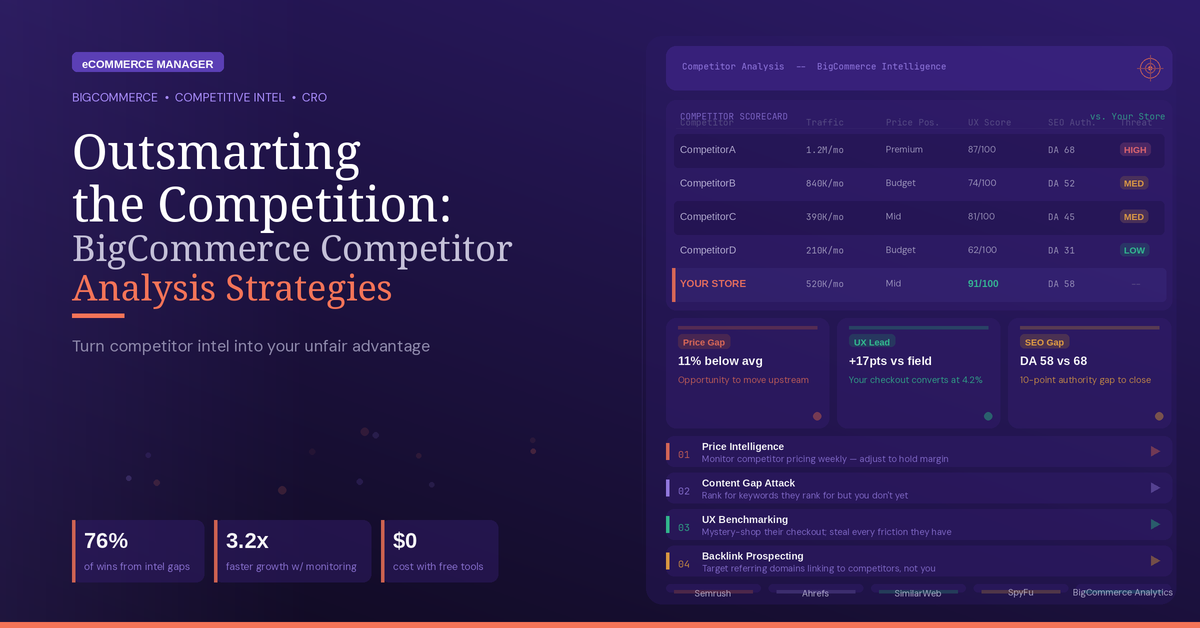
Outsmarting the Competition: BigCommerce Competitor Analysis Strategies
Winning more BigCommerce customers starts with understanding what competing stores do better. This article shares practical strategies for spotting gaps in speed, pricing, shipping, service, search, and customer experience. Insights from industry experts show how to turn those findings into clearer improvements and stronger sales.
- Deploy AI to Close FAQ Gaps
- Provide Details That Reduce Returns
- Elevate Review Counts Near Titles
- Seize Weekend Demand During Stockouts
- Place Test Orders to Expose Friction
- Resolve Unboxing Doubts With Guidance
- Create Midlevel Pages for Search Demand
- Chart Discount Cycles From Schema Data
- Target Overlooked Search Categories
- Anticipate Market Shifts Through Live Signals
- Clarify Final Costs for Buyers
- Answer Plant Buyer Questions Clearly
- Transform Service Gaps Into Referrals
- Benchmark Store Speed Across Markets
- Prove Shipping Thresholds Through Experiments
The State of eCommerce in 2026
Deploy AI to Close FAQ Gaps
I had AI build tools to analyze our competitors: best sellers, pricing, backlinks, content, and rankings.
Some of it has future benefits eg. adjusting our product line plans. Some has paid off quickly eg. seeing a gap in our FAQs for GEO, which has already doubled our AI answer impressions.
When I find a technique that works, I duplicate it between the two websites.
 Daniel Brady, Owner / Founder, Heavenly Hammocks & Swings
Provide Details That Reduce Returns
I track competitors by auditing their storefront end-to-end: product pages, search and category structure, mobile UX, checkout friction, shipping options and on-site content (specs, styling guides, reviews). That reveals where utility or clarity is missing and where we can differentiate.
A concrete insight: many alternative-fashion stores emphasize imagery but skim on functional details and post-purchase clarity, so we doubled down on clear technical descriptions, sizing guidance and streamlined international shipping info to reduce returns and improve conversion.
The Complete 2025 E-commerce Manager Career Guide: From Entry-Level to Executive
 Nicolas Falourd, CEO, Cyber Techwear
Elevate Review Counts Near Titles
We track competitor product page copy and image strategy on BigCommerce stores monthly, specifically focusing on how they present social proof, review counts, UGC photos, and badges, since trust signals tend to shift quietly ahead of broader design trends.
The insight that mattered most: we noticed a leading competitor had moved customer review counts from below the fold to directly beneath the product title, a small change easy to overlook. We tested the same placement on our own top 15 product pages.
Before the change, our average conversion rate on those pages sat at 2.8%. After moving review counts above the fold to match, conversion rose to 3.6%, a 29% relative lift, and average time-to-first-scroll-interaction dropped slightly, suggesting customers trusted the page faster without needing to scroll for proof.
The lesson: competitor analysis doesn’t need to focus on pricing or promotions. Sometimes the most valuable insight is where they choose to place existing trust signals.
 Faizan Khan, PR and Content Marketing Specialist, Ubuy Singapore
Seize Weekend Demand During Stockouts
In my 10 years as a digital marketing manager, one strategy I’ve found useful for analyzing competitors is monitoring their publicly visible pricing, product availability, promotions, and assortment changes over time. Rather than checking competitor sites manually, we used competitive-intelligence tools to track changes in key SKUs and identify recurring patterns.
One valuable insight came from monitoring a regional competitor’s product availability. We noticed that several of their higher-margin products frequently went out of stock on Friday afternoons, creating a predictable gap in availability over the weekend. Instead of competing on price, we adjusted our paid search strategy during those periods and emphasized products that were available for immediate dispatch.
Over the following quarter, weekend acquisition revenue increased by 28%, while paid search delivered a 3.4x ROAS. The experience reinforced an important lesson: competitor analysis is most useful when it identifies a recurring customer opportunity, not simply when it tells you what another business is doing. Availability, timing, pricing, and customer intent can reveal opportunities that aren’t obvious from a standard competitor comparison.
 Fahad Khan, Digital Marketing Manager, Ubuy Kuwait
Place Test Orders to Expose Friction
I pull up my competitors’ product pages and place a test order roughly once a quarter. I’m looking at the full buying experience from the customer’s side, not their storefront design. I count how many clicks it takes to reach checkout.
She documents every upsell that appears in the cart. She also examines what the shipping confirmation email says and how soon it arrives. I track all of that in a simple spreadsheet.
One pattern I caught doing this across several competitors was that most of them buried their shipping timeline deep in an FAQ or didn’t mention it at all. My team added estimated delivery dates directly on every product page and repeated them in the cart. Our return-request volume dropped in the weeks after, and repeat purchase rates went up. Customers weren’t surprised anymore.
The competitor analysis that moved the needle for me wasn’t copying someone’s homepage layout or matching their pricing. I bought from them the way a real customer would and documented every friction point I felt along the way. Where they were slow to confirm an order, I was fast.
The State of eCommerce in 2025!
Where their post-purchase emails were generic, mine got specific. I didn’t need fancy tools for this, just a credit card and a spreadsheet.
 Will Mitchell, Founder, StartupBros
Resolve Unboxing Doubts With Guidance
I read my competitors’ negative reviews before I look at anything else on their storefront. I skip the product pages and the pricing. I go straight to the 2- and 3-star reviews, sorted by most recent, on their best-selling SKU.
In at-home grooming, those reviews are a free list of unsolved problems. The complaints there are specific. Which step confused them, what arrived damaged, what they expected and didn’t get. I keep a running doc of the recurring ones, and anything that shows up three or four times across different competitors I treat as a category-wide gap rather than one brand’s bad batch.
The most valuable thing I found that way had nothing to do with the product itself. Buyers kept describing the same moment of hesitation after opening the box, unsure whether they were about to do it right. So we put the fix in the unboxing and instructions rather than in a new feature. Clearer first-use guidance and fewer decisions for the customer to make alone at the sink.
 Dan McElwee, Head of Retail, Tress Wellness
Create Midlevel Pages for Search Demand
The strategy I rely on is a category and product page teardown of the stores ranking above you. BigCommerce storefronts are easy to read because the URL structure, category tree, and faceted filters sit right out in the open. I pull the top three or four competitors for a core keyword, then map their category hierarchy, title tag patterns, and which filtered pages they let Google index.
The insight that keeps showing up is that the stores winning organic traffic usually own a middle layer of category pages that the losing stores skip. They’ve got a page for “waterproof hiking boots women” while everyone else has a single “Boots” category and a pile of products. Those mid-level pages match how people actually search, so they rank for dozens of long phrases at once.
Once you see that gap, the edge is simple. Build those missing category pages with real copy, a clear heading, internal links from the parent, and a few buying tips above the product grid. Then check your own faceted URLs so you aren’t blocking pages that deserve to rank.
I’d also read competitor reviews and Q&A sections. Shoppers tell you exactly which sizing, shipping, or material questions the product pages fail to answer, and you can answer them on yours.
 Victor Smushkevich, Founder, Tested Media
Chart Discount Cycles From Schema Data
The strategy that actually pays is comparing catalog data over time, not browsing the storefront.
Most competitive analysis stops at opening a rival’s site and noting prices. We pull their structured data instead. A BigCommerce storefront publishes product schema in JSON-LD on every product page, and the store sitemap lists the full product and category set. Capture those on a weekly schedule and you build a time series: each SKU’s price, stock state, review count and review average, week after week. The storefront shows you one moment. The series shows you behaviour.
The most useful thing that falls out of it is discount cadence. Across the accounts we manage, the competitor who looks permanently cheaper on spot checks very often is not. They are running a promotional cycle, and the spot checks happen to land inside it. Their average realised price across a quarter can sit higher than the brand that has been quietly price matching every week and giving away margin on the weeks when nobody else was discounting. You cannot see that from a screenshot. You can only see it from the series.
The second series worth keeping is review velocity. New reviews per week is a rough proxy for unit velocity when you have no access to a competitor’s sales data, and it separates the SKUs that are genuinely moving from the ones that are just merchandised well on the homepage. That is the difference between copying a competitor’s range and copying their mistakes.
 Jimi Patel, Director, eStore Factory LLC
Target Overlooked Search Categories
The big commerce competitive work tool I utilize the most is an internal link crawl that covers all the urls of the top two or three competitors. Then I map which urls each competitor receives the most internal links from their own website. I remove nav, footer, & faceted / sort parameter urls prior to creating this graph so that it represents the editorial routing vs. template noise.
Internal link distribution clearly indicates which pages a competitor has bet on — and therefore which high intent pages they are neglecting. In one project we did a crawl to show where competitors were routing their internal links; there was heavy internal routing into brand and collection pages while almost none to use case and compare categories although both of these categories had actual demand. This informed our build order; we built the categories they ignored and internally linked to them from our highest authority pages first. Within a couple of months those pages ranked for the queries the competitor had not protected since they had structurally told Google those pages weren’t important.
 Roman Sydorenko, CEO, seobro
Anticipate Market Shifts Through Live Signals
The most effective strategy for gaining a competitive edge on BigCommerce is to move beyond static quarterly audits and deploy automated analytics to monitor pricing elasticity and content velocity in real-time. While most brands focus on historical data, the real advantage lies in identifying the exact moment a competitor tests a new market position or prepares for a seasonal surge. By tracking how frequently a competitor updates their product detail pages and adjusts their margins, you can see their strategy unfolding weeks before their marketing campaigns launch.
In my experience leading e-commerce strategies, this approach revealed a pattern of price manipulation by a major industry player. By tracking pricing shifts across their entire catalog, we observed them incrementally raising prices on high-volume items three weeks before a major holiday, only to “discount” them back to the original price during the sale. This insight allowed us to advise our client to maintain steady pricing and lean into “true value” messaging. The result was a significant improvement in conversion rates compared to the competitor, as consumers recognized the transparency.
Monitoring content velocity-specifically how often a competitor refreshes SEO metadata and product descriptions-is equally critical. A sudden increase in update frequency within a specific category is a leading indicator that the competitor is preparing to bid aggressively on those keywords or has secured a better supply chain for those items. Detecting these shifts allows you to adjust your own inventory and ad spend proactively, rather than waiting for market share to dip. The goal is to transition from observing what a competitor has done to predicting what they are about to do next.
 Amit Agrawal, Founder & COO, Developers.dev
Clarify Final Costs for Buyers
I’m Charles Liu, founder and Marketing Director of Cubic Promote, a Sydney-based business employing around 30 people across Australia, the Philippines, Vietnam, and India.
We don’t use BigCommerce for our main website, although we do operate smaller e-commerce stores using Shopify. We’ve been selling promotional merchandise online for more than 20 years, and competitor research has always been an important part of how we approach pricing and customer experience.
One strategy I use is to look at competing websites from the customer’s perspective. I’ll search for products we sell, compare what other suppliers are offering and see how easy it is to find pricing, minimum quantities, branding options and delivery information.
One useful insight from comparing promotional merchandise is that the cheapest advertised price doesn’t always mean the best deal. Two suppliers might sell almost identical drink bottles, but the final cost can depend on order quantities, printing methods, setup charges and delivery requirements.
We’ve put a lot of effort into making those details easier for customers to understand. At Cubic Promote, we offer free artwork mock-ups, competitive quotes within an hour during business hours and a price-matching policy when customers find a better quote from another Australian supplier.
I also pay attention to how competitors present their products. If a website makes it easy to compare colours, sizes and printing options, I’ll look at what makes that experience work. If important information is difficult to find, it’s a reminder to check whether we’re making the same mistake.
I’ve found that competitor research is more useful when you’re looking for ways to improve the buying experience rather than simply copying prices or website designs. Customers usually want a fair price, although they also want to know they’ll receive the right products on time.
Whether you’re using BigCommerce or another platform, I’d focus on understanding why someone would choose a competitor over you. Sometimes the biggest opportunity is making a customer’s decision a little easier.
 Mr Charles Liu, Marketing Director, Cubic Promote
Answer Plant Buyer Questions Clearly
One way to conduct competitor research is to visit competitor websites as a customer would to learn about shopping options. In addition to learning competitor prices and search rankings, other topics to research include competitor responses to customer questions and other uncertainties about purchasing and receiving products. During my research of online nurseries, for instance, I learned that these businesses spend more website space promoting images and information about mature plants than about the products customers will actually receive. Insights like these can help you find business opportunities to differentiate yourself in the nursery industry by providing additional information about plant sizes and other growing topics, such as plant life cycles. Other research options to consider include studying competitors’ most-searched terms and unaddressed customer questions. Key lessons from my experience include avoiding attempts to mimic competitor successes and seeking opportunities to meet unmet customer needs to improve your search rankings and customer confidence in ways other than lower prices.
 Tammy Sons, Founder/CEO, TN Nursery
Transform Service Gaps Into Referrals
I’m a customer first. As Sales, Marketing and Business Development Director at CheapForexVPS, I learn more about a competitor’s checkout process and the follow-up emails that are sent after a purchase has been made within a few weeks than I could ever gather from reviewing pricing tables. I walk around show homes. The brochure makes something look great but when you get inside the ‘corners’ are often of a very poor quality. I also read reviews of competitors’ products. Negative reviews, especially those that are left after a 3-star rating, can be very valuable as they are written by real customers who explain what nearly caused them to leave a negative review. In particular, I read reviews that praise a competitor’s low prices but then list a series of problems that customers have encountered after they have placed an order. For example, I read one competitor’s reviews where customers praised the low price but then complained about being ‘dumped’ after the customer’s credit card had been charged. This led to us developing a warm and very human onboarding process and we have seen a massive decrease in early cancellations and a rise in referrals as customers remember how they were treated after they had paid for a product.
 Corina Tham, Sales, Marketing and Business Development Director, CheapForexVPS
Benchmark Store Speed Across Markets
As a competitor you don’t read their marketing copy but instead you load test their online stores. I run my competitors’ BigCommerce stores through WebPageTest every quarter on 5 different locations around the world. I then pull the script waterfall and with Wappalyzer I fingerprint the online store’s app stack. The network waterfall of online marketing copy is truth!
At TradingFXVPS, we have a bunch of buyers who are traders based in London, Singapore, and Johannesburg. Therefore, when I test a competitor’s marketing, I test it from the perspective of a customer based in those locations, as opposed to a data center in the US. For example, one of the competitors looked very good in terms of their marketing. When I looked under the hood of their product page, it fired 38 third-party scripts: 3 live chat apps, 2 customer review apps, a popup app, and several tracking pixels that hadn’t been disabled. When tested from a throttled mobile connection in Singapore, their product page took over 9 seconds to become interactive. I discovered that they were losing a lot of Asian traffic before anyone worked out that they were losing any traffic at all.
Knowing exactly where to fight from here was crucial. So, I cut our shop down to the barest minimum of scripts required, added some lazy loading to heavy assets, and launched an assault on Asia-Pacific search terms. Today, the mobile version of our checkout page loads in less than 3 seconds from Singapore, and it’s our fastest growing region. No one ever thanks you for speed, but they always punish inaction. Most competitors have no idea this is even a factor and thus it never makes it into their pricing comparison spreadsheets.
Prove Shipping Thresholds Through Experiments
My competitor analysis is not reading their homepage. It is running their best guess as an experiment against my own shop.
Prices, shipping thresholds and trust elements are the levers a competitor most likely believes in, and most of them publish the result somewhere. On BigCommerce it is easy to put a competing price and shipping promise into a live test on my own storefront. Then I get three things a spreadsheet never gives me: how much revenue the change is worth when it actually works, how much it is worth when the competitor is wrong, and what the conversion ceiling looks like for that whole idea on our product mix.
A concrete example. A competitor was pushing free shipping above a threshold. I had never tested a threshold on that account, so I built one, let it run across 5,286 users over 231 days, and measured revenue per user rather than conversion rate. Control 7.22 EUR, variant 8.41 EUR. The published result for that shop is 30 percent more conversions.
The insight was not the 8.41 EUR. It was that on that account the threshold was never under test, so the whole class of pricing and shipping ideas had been decided by whoever set the shipping table last. The second insight was that conversion rate would have hidden this: we could have lifted add-to-cart and looked like winners while revenue per user stayed flat.
So the edge is not knowing what competitors do. It is knowing which of their beliefs survive contact with your own traffic.
 Jörg Dennis Krüger, Author, Expert and Mentor, The Conversion Hacker®
Related Articles
- Effective Shipping Strategies for Your BigCommerce Store
- Scaling Your BigCommerce Business: Expert Advice and Strategies
- Shopify Analytics: 12 Strategies for Data-Driven Decisions