

Last Updated on October 28, 2026
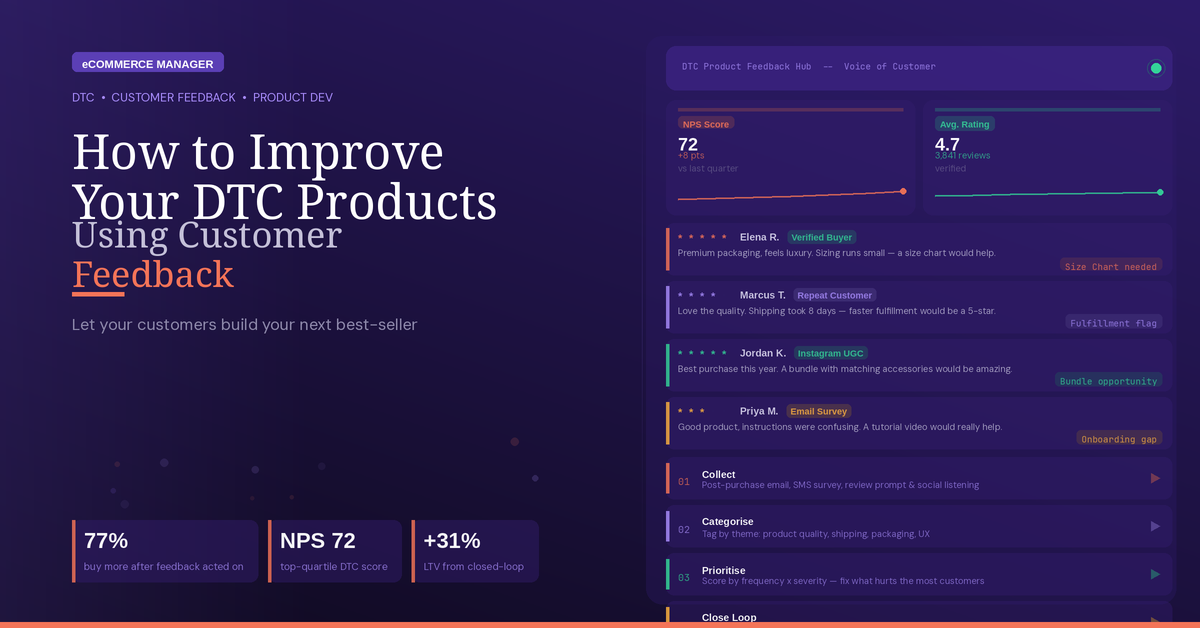
How to Improve Your DTC Products Using Customer Feedback
Customer feedback can reveal exactly where a DTC product, service, or buying experience falls short. Insights from experts in the field show how brands turn complaints, usage data, and refund patterns into practical improvements. From clearer packaging to better support, small changes can create stronger customer experiences and repeat sales.
- Target Educational Content by Buyer Role
- Replace Weak Packaging After Pattern Analysis
- Match Hair Products by Porosity
- Preserve Context Across Team Handoffs
- Refine Formulas Through Specific Taste Tests
- Translate Concerns Into Clearer Guidance
- Photograph Items Beside Familiar Objects
- Standardize Containers to End Transit Leaks
- Increase Snack Portions After Value Complaints
- Route Inquiries to Humans Within Minutes
- Build Human Imperfection Into Handwritten Notes
- Align Ads, Pages, and Jar Claims
- Publish Visit Terms on Booking Pages
- Verify Wig Images Against Actual Pieces
- Train Every Crew Member Equally
- Rewrite Entry Screens From Usage Data
- Rebuild Services Around Weekly Triage
- Put Outcomes Ahead of Strain Science
- Shift Merchandise Discovery to Soak Areas
- Guarantee Results Through Success Windows
- Demystify Quote Steps to Ease Anxiety
- Detail Recovery Requirements at First Contact
- Remove Decision Overload From Customer Journeys
- Read Refunds When Surveys Fail
- Unite Device Assistance Under One Workflow
Target Educational Content by Buyer Role
You don’t just get customer feedback from surveys. Search behavior, questions from prospects, and the reasons people hesitate can reveal the same problems. For one of our clients, Modula, we found that its complex product range made it difficult for potential customers to understand which solutions were relevant to them. In response, we created more educational content and targeted customers by industry and job role. In the end, people saw the information that was relevant to their needs. That helped increase conversions by 37% over 18 months. The lesson was that sometimes customers don’t tell you what needs fixing, but this can be seen in their behavior.

Replace Weak Packaging After Pattern Analysis
Kept a running spreadsheet of every complaint that came in, tagged by what it was actually about, shipping, sizing, packaging, whatever it was. Individual emails get forgotten fast. A spreadsheet does not. Noticed packaging kept coming up over a few months, customers saying boxes arrived a bit crushed or items shifted around inside. No single complaint or feedback felt urgent enough to act on alone.
Switched suppliers for packaging once the pattern was obvious on paper. Damaged-item returns dropped the following quarter, and a few customers brought up the sturdier boxes in reviews without anyone prompting them to.
One complaint alone rarely tells the whole story. Could just be one bad shipping day, nothing systemic. Seeing the same issue show up five or six times over months, tracked somewhere instead of scattered across old emails, is what actually points to something worth fixing.

Match Hair Products by Porosity
Friday ticket review opened with three weekday notes asking which leave-in matched low porosity hair after wash day, and that stack earned a live change. We folded those notes into the Friday queue and rewrote the Hair Analyser prompts so the first reply asked porosity before it pushed a new cream. The public pages then used that same rematch language, so shoppers saw one path on the site and in the inbox. The average UK curl routine used 5.2 products. When a ticket names which of those bottles failed, that is the feedback we ship against.

Preserve Context Across Team Handoffs
We handle feedback by avoiding one large queue for every observation. We separate urgent issues from recurring friction and promising ideas that need stronger evidence. This approach keeps the team responsive without letting the loudest comment shape our priorities. We also document every change and the reason behind it so everyone stays aligned.
One improvement started with feedback from customers who repeated themselves after asking for help. We mapped each handoff and found where important context was being lost. We standardized shared notes so the next teammate had the right information. As a result conversations became smoother customers felt heard earlier and repeat explanations became less common across every meaningful customer interaction.

Refine Formulas Through Specific Taste Tests
My example comes from my earlier food-product work at Julian Bakery, rather than from a claim that EVKII manufactures food. Taste feedback from employees, my wife and friends helped identify formulation problems that a nutrition label could not show.
Pea protein was a particular flavor challenge. Peanut butter or a sacha inchi protein blend helped create a better flavor base. Monk fruit also needed sweetness adjustments across formulas; using an ingredient successfully in one product did not mean the same amount would work in another. The useful feedback was specific enough to change a formulation, rather than simply saying that people liked the idea of a healthy product.
I treat that feedback as a signal to test, not as a substitute for product verification. Nutrition lab checks and stability testing still matter. A formula that tastes better but misses the shelf-life target may need more work.
The lesson I carried into DTC work is that health positioning cannot rescue poor taste. Ask what makes the product difficult to use or enjoy, make a concrete change, and check the changed product again. I also used a four-star-or-better Amazon review goal as an operating heuristic, not a guarantee of future sales or repeat purchase.

Translate Concerns Into Clearer Guidance
At Domepeace, customer feedback changed how we explain our scalp-care routine. We initially used broad language about hydration and healthier skin. Customers were much more specific: they wanted less shine in photographs and relief from that tight feeling after shaving. We used those concerns to make our messaging more practical, emphasizing shine control and post-shave comfort. We also clarified which product to use, when to use it, and what to expect during the first week. That helped customers choose with a clearer understanding of what they were buying, and we saw better reviews and fewer returns. My advice is to listen for the problem in the customer’s own words. Then improve the guidance around the product, rather than assuming every piece of feedback requires a new formula.

Photograph Items Beside Familiar Objects
My rule with customer feedback is to wait for the same complaint to show up from different customers before I act on it, not react to one loud voice. I read reviews, support tickets and any post purchase survey answers together on a regular basis, and I look for the same word or phrase turning up in separate people’s own descriptions. If it is one person having a bad day, I answer them directly and move on. If the same friction keeps repeating, it goes into the next round of changes to the page or the product itself. One ecommerce founder I advised kept getting messages that the product felt fine once it arrived, but customers were confused about sizing before they bought, so returns stayed high and the founder assumed it was a pricing problem. We went back to the exact wording customers used in support tickets and reviews rather than guessing, and it was consistently about scale and fit, not price. We reshot the product page with the item sitting next to everyday objects so people could see how big it was. We also updated the size chart and added the same plain language note to the confirmation email. Returns came down enough that the founder dropped the plan to discount the product and left it alone.

Standardize Containers to End Transit Leaks
At TiffinStash, customer feedback isn’t just routed to support—it actively governs our marketplace operations, packaging standards, and product roadmap across three core pillars:
1. A Direct Escalation & Vendor Governance System
In a fresh food marketplace, customer trust is everything. We categorize issues into strict priority levels. Any severe complaint—like a quality drop or foreign object—is flagged as a Priority 1 issue and directly escalated to myself and my co-founder. We instantly compensate the customer, put the partner kitchen on a formal warning, and enforce a strict three-strikes rule. If a vendor receives three P1 infractions, we disassociate from them completely. We only scale with sellers who share our commitment to quality, and the same standard applies to our drivers to ensure a respectful end-to-end experience.
2. Standardizing Packaging to Eliminate Leakage
Early customer feedback highlighted a massive industry pain point: container leakages during transit. Instead of passing the blame to drivers, we solved it at the source. We established strict, A-grade container guidelines for all partner kitchens and provided them direct sourcing links. Paired with custom insulated TiffinStash thermal bags used by our drivers, standardizing this hardware reduced leakage and container damage complaints by 100% over the last 36 months.
3. Removing Rigid Lock-ins for True Flexibility
Traditional tiffin services often lock customers into rigid plans, offer no pause options, or ship bulk weekly deliveries where food sits in the fridge. Customer frustration with these models shaped our platform design. We built full flexibility into TiffinStash: subscribers can skip, pause, swap delivery addresses, or switch between different local kitchens on the fly without canceling. We also run separate daily lunch and dinner delivery batches so meals arrive fresh. Listening to daily friction points allowed us to transform a traditional service into a truly modern, customer-first marketplace.
— Shruti Shah, Co-Founder at TiffinStash (tiffinstash.com)

Increase Snack Portions After Value Complaints
In our DTC business, customer feedback is our main way of learning what to fix. We read reviews, survey replies, and support messages every week, and we tag similar issues together so patterns become clear. Once we spot a trend, we test a small change, measure the result, and then roll it out to everyone. A good example came from our subscription snack box. Many buyers told us the portions felt too small for the price. We listened, increased the pack size, and kept the price the same for one month as a trial. Sales and positive reviews both rose, so we made the bigger size permanent. We also updated our FAQ to set clearer expectations for new customers. The lesson is simple: listen closely, make one focused change, and show customers their voice matters. That builds trust and keeps people coming back.

Route Inquiries to Humans Within Minutes
I read every piece of feedback that comes through reviews and support tickets, not just the star rating. The complaint I keep seeing across DTC brands is the follow up gap. Someone asks a question through a form or a chat widget and nobody responds for a day or two. By the time an answer shows up, the interest is gone. That pattern kept repeating, so I set up automated email and text follow up sequences that acknowledge a message within minutes and route it to a real person fast. Responding within one minute instead of hours raises conversion by 391 percent, according to Velocify research. Feedback that gets read but never acted on just sits in an inbox doing nothing. Once I started routing that specific complaint into a fix, it stopped showing up in the next round of feedback.

Build Human Imperfection Into Handwritten Notes
Most of our best product changes came from complaints we almost dismissed as one-offs.
The one that mattered: customers kept telling us the handwriting looked “too perfect.” Which felt insane, we’d spent years and 6 patents pending getting the machines to write well. But a few of them explained it the same way, that recipients were squinting at the note wondering if a person actually wrote it, and that hesitation killed the whole effect. Real handwriting is inconsistent. Letters drift, spacing wanders.
So we went back and built variation into the pen strokes on purpose. Slight irregularity, natural slant drift. It made the product technically worse by the original spec and dramatically better in the field. Our envelopes get opened 99% of the time and that only holds up if the thing inside reads as human.
How we catch this stuff now: every support ticket with an emotional word in it gets flagged and read by someone on the product side, not just support. Volume is the wrong filter early on. Three people saying something weird and specific beats fifty people saying “love it.”
Rick Elmore, Founder/CEO, Simply Noted (simplynoted.com)

Align Ads, Pages, and Jar Claims
About 10 support threads a month at APMZEE were eating trust because the ad sounded stronger than the jar.
I am Neill David Watson, founder of the Shopify DTC brand at https://apmzee.com/. We sell Creatine Gummies from $25 and Saffron Sleep X from $31 as 30-day supplies. We did not reformulate first. We built a human claim gate that reviews roughly 6 AI Meta drafts and forces day-3 and day-24 emails to reuse checkout language. Once the page and the pack matched, that complaint type nearly vanished and the 20% subscription invites stopped reading like a bait switch. Feedback fixed the service layer before it touched the formula.

Publish Visit Terms on Booking Pages
Customer feedback that changed our service was a stack of clarification emails asking which visit length was real.
We treated that as product feedback on a clinic book path, not a vibe problem. The fix was locking the 60-minute intro and $47 deposit on The Functional Medicine Process: What to Expect at https://www.interlinkedwellness.com/process, with follow-ups every 6 to 8 weeks and the Texas-during-appointment rule in the same block. Positive change showed up as fewer clarification threads and more completed first visits. Feedback improved the page patients can verify before they book.

Verify Wig Images Against Actual Pieces
I pay the most attention to feedback that comes up more than once, because that usually means there’s something we need to make clearer on the product side.
One example is color and density. With wigs and toppers, customers can have a hard time judging those details from a standard product photo. We’ve taken that feedback and become much more careful about checking product images against the actual piece, especially for color, volume and how the hair looks around the top and parting area.
It’s a small change, but it makes a real difference because customers are making a very visual purchase online. The goal is to reduce the gap between what someone sees on the product page and what they receive.
For me, good customer feedback is useful when it helps us improve the product information before the customer has to ask for clarification.

Train Every Crew Member Equally
I personally evaluate each customer complaint; however, I rarely make changes based on complaints from a single customer. A complaint from one customer is an individual piece of data (a “data point”). However, if three separate customers complain about similar issues, then that indicates there may be a policy issue and at that time I would consider making a change. That is how many complaints it takes for me to take action (to make a “process” change) before I make any changes.
One complaint that has stuck with me (three different customers complained about this): They all said that the foreman gave them good service, but the second and third movers on the crew were not as helpful. These weren’t bad reviews individually. Collectively these three complaints indicated that although I teach team leaders to have vision for their teams, some of the people working under them did not receive that training. Therefore, I made sure every person who works on our crews receives the same three courses we created. I will never know what the financial benefit of doing so is. What I do know is when this particular type of complaint stops coming in, that tells me that the course(s) are helping. In a reputation business, I rely on that type of feedback rather than a numerical figure.

Rewrite Entry Screens From Usage Data
I tag every question before I answer it. Running group consulting for thousands of entrepreneurs, the sheer volume forced that on me. Sourcing, pricing, ads, launch mechanics.
Individually each question feels like one person’s problem. Stacked in one place and counted, the tags stop being conversation and start being a roadmap.
The part I’m careful about is not shipping for whoever shouts loudest. A request that comes in ten times still gets checked against what people do. The tag counts tell me where to look, and usage data tells me whether the behavior matches the complaint. When they disagree, I go ask five people directly rather than guess.
With the no-code AI products I build now, the same tag kept surfacing in the first day of use. People weren’t confused about the feature, they couldn’t get to it. I rewrote the opening screen and left the help docs alone, because the tag was pointing at the entry point, not the product. Then I go back to the exact people who raised it and tell them it changed.

Rebuild Services Around Weekly Triage
The fact that I run SEOBRO and Reddit Services by themselves allows me to receive feedback from my customers before I have to deal with them as a “churn” number. I take repeated customer complaints about the same issue as product R&D rather than just a form of “noise”.
For an example of this, when I first ran my SEO business as a “productized” offering — fixed scope, fixed deliverables, monthly reporting — everything looked great on paper. However, after working with three different clients who all complained of basically the same thing (the report was good but they did not know how to proceed on Monday) they valued execution sequencing over deliverable volume, and I stopped defending the product and decided to disassemble my product.
After scrapping my original template I rebuilt my offering around a weekly triage call followed by a prioritized task list — (indexing, internal linking, intent, and then external). After rebuilding, renewal conversations were easier. I began getting referrals from within existing client accounts.
Lesson learned: One complaint is simply noise; three are flaws in your design. Stop developing features and begin deconstructing your offerings.

Put Outcomes Ahead of Strain Science
Beginning our journey we put out a vaginal probiotic which clearly listed the name of each strain as well as how many Colony-Forming Units (CFU); Clinical – Precise – Invisible to customers. We used support tickets, Post-Purchase Survey Responses and Subscription Cancel Reasons to determine why the shopper did not understand what they purchased nor understood why any particular strain mattered. It was not a matter of shopper distrust of the product – “L. crispatus” meant nothing at the moment of purchase and thus we completely redesigned both the Label and Product Description Page (PDP) to be focused upon an Outcome and shifted the Strain Science one level deeper into the Learning Center where those interested in that type of information could find it.
There were two Guard Rails established for the redesign process. Our Scientific Advisory Board — OB/GYN’s and Microbiome Researchers — agreed that all of the Plain Language claims made would remain consistent with the FDA Structure/Function Rules, therefore we would not drift into Disease Territory. And we prioritized this over other Loud Feature Requests since we found that this had a significant impact upon Repeat Purchase Behavior rather than simply Ticket Volume.
The change has become a Standing Rule within our company: Outcome On Front — Science One Click Away. All launches since have gone through the same Translation Step prior to shipping.

Shift Merchandise Discovery to Soak Areas
We consider each response from all post visit surveys and google reviews to be a real time operational indicator and not a customer satisfaction metric. The positive comments we received in reviews (beer soap, and other items made with hops) did not translate over to our retail attach numbers. Once we began reaching out to our repeat customers to find out why, we found they were telling us the same story; they had just spent 1.5 hours soaking and when they got out of the water they were asked to come to a counter to purchase products before putting their shoes back on. A bad time to ask.
We decided to move product discovery to the soak area and then rebuild the square point-of-sale process so that host’s could sell products at the retail table in the wind down period instead of at checkout. Our retail sales increased by 40%, and Square created a case study for this — again without changing anything regarding our products or price points.
We focus on the signals that repeat across channels and which move both revenue per session as well as guest flow. Usually in an experience based business the useful signal is at the intersection of service and revenue and not within either.

Guarantee Results Through Success Windows
I do not often respond to the most vocal. Most often the voice asking for something that will remove a barrier for all customers going forward, is the voice I listen to. This is what I call “the filter”.
Wolfstone had several new clients in the beginning state the exact same concern: they were interested in seeing evidence that the work would be successful prior to signing with us. On the surface this seemed like only one issue; however the underlying issue was consistent among each client. We created a formal Success Window measured against a week-one baseline and a Client Approved Prompt List – we continue to work until we meet these measures. All subsequent clients benefitted from this – as did the initial client who requested it. The bespoke reporting tweaks are generally parked. A fix that only helps the person yelling at you isn’t a process change, it’s an accommodation.
Adam Woodhead, Co-Founder, Wolfstone Digital

Demystify Quote Steps to Ease Anxiety
I pay closest attention to feedback customers repeat without being prompted. In our storage and removals business, we noticed people kept asking what happened after they requested a quote. Nothing was technically wrong with the process, but the uncertainty was creating unnecessary stress. We made the next steps much clearer in the website and follow-up communication. That was a useful reminder for me: customers do not always ask for the solution directly. Sometimes they keep asking the same question until you realise the experience itself needs fixing.

Detail Recovery Requirements at First Contact
In towing, customers are often calling during a stressful situation, so feedback isn’t just about whether we transported their vehicle safely. It’s also about whether they understood what was happening and felt reassured throughout the process.
At Underground Towing & Salvage, we use customer feedback to identify where communication can be clearer, particularly around arrival times, vehicle accessibility and recovery requirements.
One improvement we’ve focused on is explaining potential recovery complications before dispatch. For example, a vehicle stranded in an underground carpark may require specialist low-clearance equipment rather than a conventional tow truck.
By establishing these details early, we can arrange suitable equipment, communicate expectations and reduce avoidable delays.
My biggest lesson is that good customer service in an emergency begins before the tow truck arrives.
Remove Decision Overload From Customer Journeys
I’ve learned that customer feedback is most valuable when you treat it as information about the customer’s experience, not simply as a list of things they want changed.
When I work with clients, I try to look for patterns rather than react to the loudest individual request. One customer might ask for a specific feature, but several customers describing the same frustration in different ways can reveal the bigger problem underneath it.
I remember a situation where customers were technically able to complete a process, but we kept hearing that it felt confusing and took too long. The initial temptation was to add more instructions and explanations. Instead, we looked at where people were actually getting stuck. The problem wasn’t that customers lacked information. There were simply too many decisions being presented at once.
We simplified the experience, reduced unnecessary steps, and made the most important action more obvious. The interesting part was that we didn’t build a major new feature. We removed friction. Customers found the process easier, and the team also received fewer questions about the same issue.
That experience reinforced something I use when evaluating feedback: “What problem is the customer actually trying to solve?”
For DTC businesses, I think feedback should come from more than surveys. Reviews, support conversations, returns, repeat purchases, cancellations, and even questions customers ask before buying can reveal where expectations and reality don’t match.
I also try to separate preference from friction. A customer saying, “I’d love to have this feature” is useful, but a customer saying, “I almost didn’t buy because I couldn’t figure this out” can point to a much more immediate business problem.
The goal isn’t to implement every suggestion. It’s to identify recurring problems, understand why they happen, and make changes that improve the experience for a meaningful portion of customers. The best feedback loop I’ve seen is simple: listen, identify the underlying problem, make the smallest meaningful change, measure what happens, and then listen again.

Read Refunds When Surveys Fail
Most feedback advice assumes you can ask. We can’t — our customers are going through one of the worst years of their lives, and a “how did we do?” email is tone-deaf. So we read behavior instead. The channel we trust most is refunds: it’s the only feedback where someone paid real money and then said it wasn’t worth it. We read reasons, not just rates. The broader lesson for any sensitive category: silence isn’t satisfaction. Struggling customers don’t complain, they just leave — so your feedback volume is lowest exactly when you need it most.

Unite Device Assistance Under One Workflow
We treat customer feedback as operational data, not just comments. What I see a lot is that recurring support issues usually point to a broken workflow, so we track patterns in helpdesk tickets, provisioning delays and device problems, then adjust the process rather than handling the same issue over and over.
One example is centralized device support. When customers were repeatedly dealing with fragmented support across carriers, internal IT and device vendors, the better approach was to bring triage, repairs, replacements and remote management into one workflow. That kind of change can reduce support load significantly and gives IT teams a much clearer view of where problems are coming from.

Related Articles
- DTC Customer Service: 22 Strategies for Ensuring Customer Satisfaction
- Creating a Seamless Checkout: Ecommerce Tips From The Pros
- DTC Returns & Exchanges: Tips for a Smooth Process