

Last Updated on June 7, 2026
Beyond ABC: The Silent Margin Erosion Your Inventory Strategy Misses at Scale
Inventory management is a cornerstone of operational efficiency. For many businesses, particularly those scaling rapidly, it represents a significant area of potential margin erosion. This often stems from a reliance on outdated or incomplete analysis. Traditional methods can overlook subtle but impactful inefficiencies.
The State of eCommerce in 2026
The complexity of modern supply chains demands more robust approaches. Companies need to move beyond basic stock counts. Understanding the true cost of holding inventory and the implications of stock-outs requires a deeper analytical lens. This is where advanced strategies become critical for maintaining profitability.
This exploration focuses on how organizations identify and address the often-hidden factors impacting inventory performance. It highlights the operational challenges and the strategic insights derived from comprehensive data analysis. The goal is to illuminate the pathways companies take to refine their inventory strategies for sustained growth.The Complete 2025 E-commerce Manager Career Guide: From Entry-Level to Executive
The Limits of Traditional Inventory Analysis
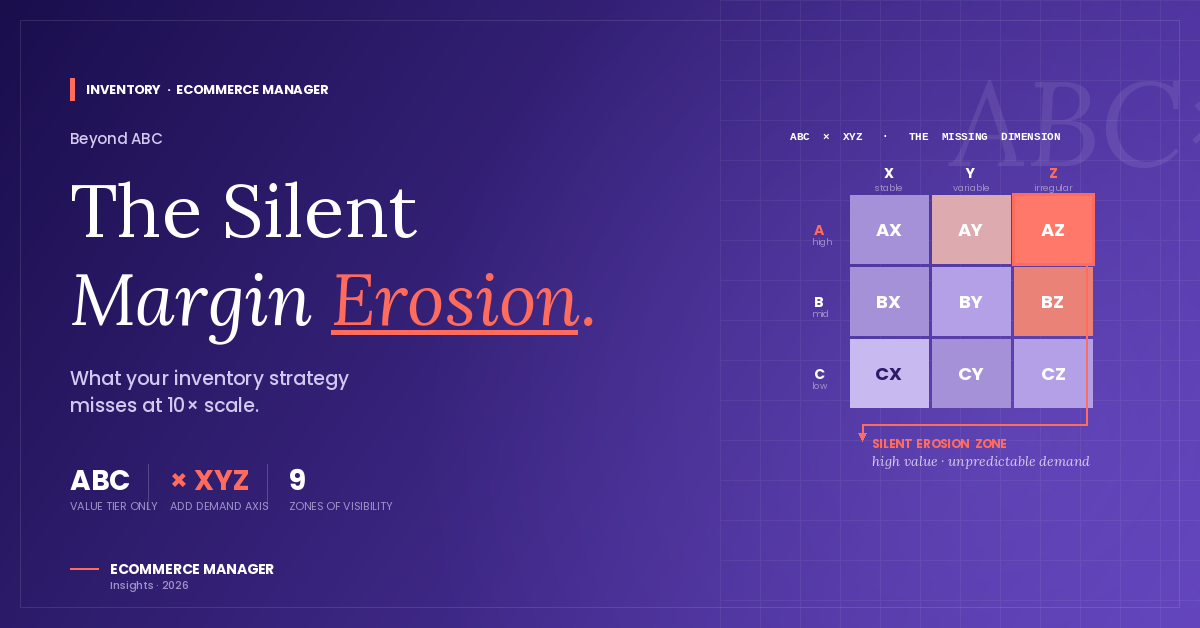
Many businesses begin with foundational inventory management techniques. The ABC analysis, for instance, categorizes items based on their value. This helps prioritize management efforts. However, its static nature can be a significant drawback at scale.
As a business grows, product lines diversify. Demand patterns become more volatile. Relying solely on a fixed ABC classification can lead to misallocation of resources. High-value items might still experience stock-outs if demand spikes unexpectedly. Low-value items could tie up excessive capital if not managed efficiently.Marketing Calendar: A Complete Guide
The inherent challenge lies in the data’s timeliness and granularity. Historical sales data, while useful, may not capture current market dynamics. Without real-time insights, even sophisticated initial strategies can falter. This gap creates an environment where costs accumulate unnoticed.
Operational Data as the Foundation
Effective inventory strategy hinges on accurate and accessible operational data. This includes more than just sales figures. It encompasses stock levels, lead times, supplier performance, and storage costs.
Companies scaling their operations must establish robust data collection workflows. This involves integrating various systems. Point-of-sale systems, warehouse management systems (WMS), and enterprise resource planning (ERP) platforms all contribute vital information.
Automating data processing is also essential. Manual data handling is prone to errors and delays. It creates bottlenecks that prevent timely analysis. Streamlined data pipelines ensure that insights are current and actionable.
Key Performance Indicators for Inventory
Defining and tracking relevant Key Performance Indicators (KPIs) is crucial. These metrics provide a quantitative measure of inventory health. They allow businesses to gauge performance against objectives.
Common KPIs include inventory turnover ratio, days of inventory on hand, and stock-out rate. However, at scale, these may need further segmentation and refinement.
The State of eCommerce in 2025!
For instance, breaking down inventory turnover by product category or by warehouse location offers more targeted insights. Analyzing stock-out rates for specific SKUs can pinpoint recurring supply chain issues.
Beyond Static Classification: Dynamic Inventory Segmentation
While ABC analysis provides a starting point, its static nature proves insufficient for dynamic environments. Companies often evolve towards more sophisticated segmentation models. These models adapt to changing business conditions.
One approach involves incorporating demand variability into segmentation. Items with high value and high variability require the most rigorous oversight. Items with low value and low variability can be managed with simpler, more automated processes.
This dynamic segmentation allows for flexible resource allocation. It ensures that management attention is focused where it is most needed. This prevents over-management of stable items and under-management of volatile ones.
The Role of Technology in Data Handling
Technology plays a pivotal role in enabling dynamic inventory segmentation. Advanced analytics platforms can process vast amounts of data in near real-time. This capability is fundamental for companies operating at scale.
AI-enabled tools can identify patterns and anomalies that human analysts might miss. They can predict demand fluctuations with greater accuracy. This predictive power allows for proactive inventory adjustments.
Such technologies facilitate the automation of data processing. They transform raw operational data into actionable insights. This reduces the manual burden on teams and improves decision-making speed.
Implementing AI-Augmented Inventory Insights
The integration of Artificial Intelligence (AI) into inventory management is transforming how businesses operate. AI-augmented outsourcing, for example, can provide specialized analytical capabilities. This allows companies to leverage expertise without significant internal investment.
AI algorithms can analyze complex datasets to identify optimal reorder points. They can also forecast demand with a high degree of precision. This predictive accuracy directly impacts carrying costs and lost sales.
These tools help in modeling various scenarios. Companies can simulate the impact of different promotional activities or supply chain disruptions. This strategic foresight is invaluable for mitigating risks.
Automating Data Analysis and Reporting
A significant challenge for growing businesses is the sheer volume of data generated. Manual analysis becomes impractical and error-prone. Automation, powered by AI and sophisticated software, becomes a necessity.
Automated systems can continuously monitor inventory levels. They can trigger alerts for low stock or potential overstock situations. This real-time oversight prevents costly errors.
Automated reporting tools consolidate key metrics. They present them in an easily digestible format. This enables management to quickly grasp inventory performance and identify areas for improvement.
Defining and Tracking Advanced Metrics
Beyond standard metrics, companies at scale focus on more nuanced performance indicators. These often relate to the cost of inventory and its impact on the bottom line.
Metrics such as carrying cost of inventory as a percentage of sales, or the cost of obsolescence, become critical. Analyzing the return on investment (ROI) for inventory investments is also paramount.
These advanced metrics provide a clearer picture of inventory efficiency. They highlight the financial impact of operational decisions. This clarity drives strategic adjustments aimed at margin improvement.
The Strategic Value of Predictive Analytics
Predictive analytics offers a significant advantage in inventory management. It moves businesses from reactive to proactive strategies.
By forecasting future demand, companies can optimize stock levels. This reduces the risk of both stock-outs and excess inventory. Proactive management minimizes the financial penalties associated with each.
The application of predictive models extends to supplier performance. AI can identify potential delays or quality issues before they impact the supply chain. This foresight strengthens resilience.
AI in Operational Tooling
AI is increasingly embedded within operational tooling. Warehouse management systems now feature AI-driven optimization for picking and packing. Inventory planning software leverages AI for more accurate forecasting.
These tools enhance the efficiency of daily operations. They provide granular insights into warehouse performance. This data, in turn, feeds back into broader inventory strategy.
The synergy between AI-powered tools and operational processes creates a virtuous cycle. Improved operational execution leads to better data. Better data fuels more accurate AI analysis, driving further operational gains.
Continuous Improvement in Supply Chain and Warehouse Operations
Inventory management is not a static discipline; it requires ongoing refinement. Companies that excel at scale embrace a culture of continuous improvement.
This involves regular reviews of inventory policies and procedures. It also includes staying abreast of technological advancements. The goal is to consistently optimize for efficiency and cost-effectiveness.
Feedback loops are essential. Data from warehouse operations and sales performance should inform inventory strategy adjustments.
Benchmarking and Performance Analysis
To understand true performance, companies often benchmark their inventory metrics. Comparing key KPIs against industry standards or best-in-class performers provides valuable context.
This analysis helps identify specific areas of underperformance. It can reveal opportunities for adopting new strategies or technologies.
Performance analysis is not just about identifying problems. It is also about recognizing successes. Understanding what works well allows for replication and scaling of those best practices.
Adapting to Market Volatility
The modern business environment is characterized by constant change. Market volatility, shifts in consumer behavior, and geopolitical events all impact supply chains.
Inventory strategies must be agile enough to adapt. This means building flexibility into forecasting models. It also involves developing contingency plans for supply chain disruptions.
The ability to quickly re-evaluate and adjust inventory levels is a competitive advantage. It ensures that businesses can maintain service levels and profitability amidst uncertainty.
The Integration of AI-Augmented Outsourcing
AI-augmented outsourcing offers a strategic pathway for companies to enhance their inventory analysis capabilities. Specialized providers can offer advanced analytics and data science expertise.
This allows businesses to tap into cutting-edge AI technologies. They can gain deeper insights without the overhead of building an in-house team. This is particularly beneficial for companies looking to scale rapidly.
Such outsourcing models can focus on specific aspects of inventory management. This might include demand forecasting, optimization of safety stock levels, or anomaly detection.
Driving Better Inventory Insights and Cost Savings
The ultimate objective of refining inventory strategy is to drive better insights and achieve significant cost savings. By leveraging advanced analytics and operational tooling, companies can reduce carrying costs.
Minimizing stock-outs prevents lost sales and preserves customer loyalty. Optimizing lead times and supplier relationships further enhances efficiency.
These improvements contribute directly to the bottom line. They free up capital that can be reinvested in growth initiatives. A well-managed inventory is a powerful enabler of business expansion.
The Enduring Challenge of Inventory Optimization
The pursuit of optimal inventory levels is an ongoing journey. It requires a blend of strategic planning, robust data analysis, and technological adoption.
Businesses that recognize the silent margin erosion caused by suboptimal inventory strategies are better positioned for success. They invest in the processes and tools necessary to gain deeper insights.
The focus remains on operational excellence and intelligent resource allocation. This approach underpins sustainable growth and long-term profitability in competitive markets.
“Effective inventory management is less about counting what you have and more about understanding what you need, when you need it, and at what cost, to fuel growth without sacrificing profitability.”