

Last Updated on June 7, 2026
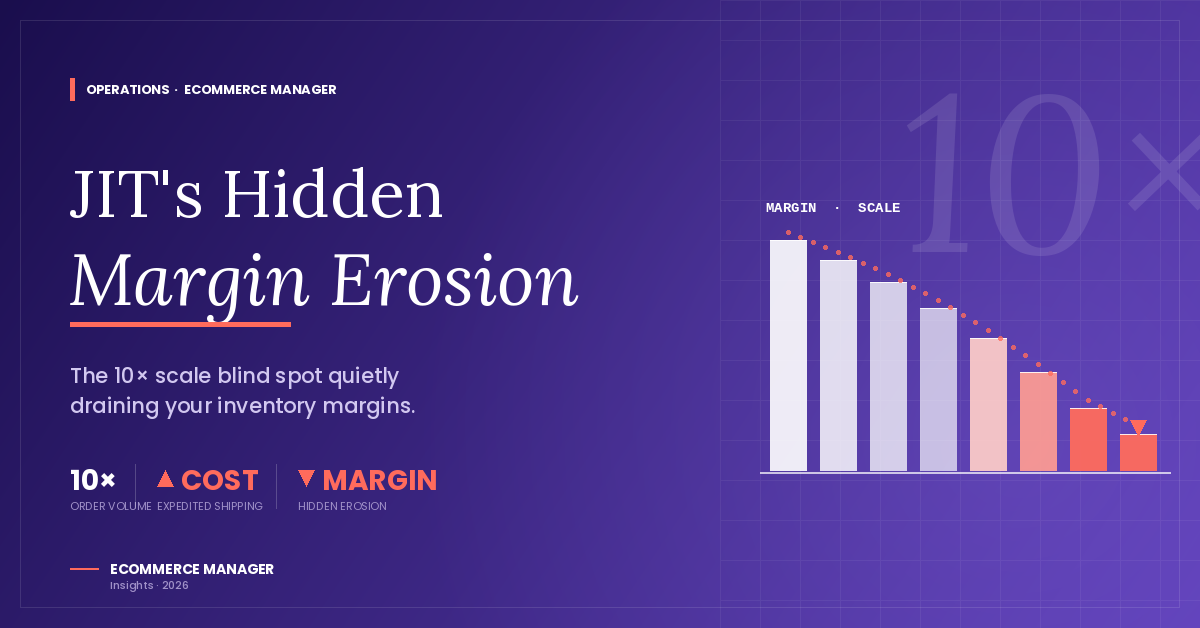
JIT’s Hidden Margin Erosion: The 10x Scale Blind Spot Affecting Your Inventory Costs
The pursuit of efficiency is a constant in modern business. Just-In-Time (JIT) inventory management stands as a testament to this drive. It promises reduced waste and leaner operations. Companies adopt JIT to minimize holding costs and storage needs. This strategy aligns perfectly with lean manufacturing principles.
However, scaling JIT introduces complexities. The transition from small-scale success to 10x growth often reveals unforeseen challenges. These issues can silently erode profit margins. They stem from operational blind spots that emerge under significant scale. Understanding these blind spots is crucial for sustained profitability.
The State of eCommerce in 2026
The Illusion of Simplicity in Scaling JIT
JIT’s core appeal lies in its apparent simplicity. Receive goods only when needed. Produce only what is ordered. This minimizes the need for large warehouses. It reduces the capital tied up in inventory. For small businesses, this can be a game-changer.
The challenge intensifies with growth. A tenfold increase in order volume strains every aspect of the supply chain. The number of suppliers increases. Order frequencies multiply. Delivery windows become tighter. Managing this intricate web of transactions demands robust systems.
Without the right infrastructure, JIT’s benefits can reverse. Increased expedited shipping costs emerge. Stockouts become more frequent. Customer satisfaction declines. These are direct impacts on profitability.
The Complete 2025 E-commerce Manager Career Guide: From Entry-Level to Executive
Systemic Vulnerabilities at Scale
At a larger scale, manual processes falter. Relying on spreadsheets or disparate software is unsustainable. Coordination across departments becomes chaotic. Each touchpoint represents a potential failure point.
This is where enterprise resource planning (ERP) systems become indispensable. They provide a unified platform for managing core business processes. An integrated system ensures data consistency. It allows for real-time visibility across operations.
For JIT, this integration is non-negotiable. It connects procurement, production, and logistics seamlessly. Without it, the risk of error grows exponentially with scale. The system must handle increased transaction volumes reliably.
Demand Forecasting Accuracy
JIT relies heavily on accurate demand forecasting. Small fluctuations are manageable. However, at 10x scale, even minor forecasting errors can lead to significant inventory issues.
Marketing Calendar: A Complete Guide
Overestimating demand results in excess inventory. This directly contradicts JIT principles and increases holding costs. Underestimating demand leads to stockouts. This impacts sales and customer loyalty.
Advanced forecasting tools are essential. These tools use historical data, market trends, and predictive analytics. Integration with an ERP system allows these forecasts to drive procurement and production schedules automatically.
The Role of AI in Predictive Analytics
Artificial intelligence (AI) is transforming demand forecasting. Machine learning algorithms can identify complex patterns. They adapt to changing market dynamics more effectively than traditional methods.
AI-powered forecasting provides a more granular view. It can predict demand at the SKU level. This precision is vital for optimizing inventory for a large, diverse product catalog. The ability to anticipate demand shifts is a significant competitive advantage.
The State of eCommerce in 2025!
Operational Bottlenecks and Their Cost
Scaling JIT amplifies existing operational bottlenecks. Any inefficiency in receiving, put-away, picking, or shipping becomes a major drag on performance.
Warehouse management is a prime example. At scale, manual tracking of inventory becomes impossible. Misplaced items lead to delays. Lost items result in unfulfilled orders. This directly impacts the bottom line through lost revenue and increased administrative overhead.
Optimizing warehouse operations is therefore critical for JIT success at scale. This involves efficient layout, clear processes, and accurate tracking.
Real-Time Inventory Tracking
Real-time inventory visibility is non-negotiable for scaled JIT. Knowing exactly what you have, where it is, and its status is paramount.
Barcoding systems, RFID technology, and warehouse management modules within an ERP are key. These technologies enable instant updates as inventory moves. This eliminates manual data entry errors. It provides accurate stock levels for sales and planning.
This level of accuracy is foundational for making timely purchasing decisions. It prevents over-ordering or under-ordering.
Warehouse Management Integration
An integrated warehouse management system (WMS) is essential. It works in tandem with the ERP. The WMS directs warehouse activities. It optimizes put-away and picking routes. It manages labor and equipment usage efficiently.
For a business operating on JIT principles, this ensures goods are ready precisely when needed. It minimizes transit times within the facility. This speed and accuracy directly contribute to reduced lead times and better customer service.
The benefits extend to optimizing space utilization. Efficient put-away strategies prevent congestion. This is vital when dealing with a 10x increase in throughput.
Supplier Coordination Challenges
The reliance on suppliers for timely deliveries intensifies with scale. A single supplier delay can disrupt the entire production or fulfillment process.
Managing a larger supplier base requires sophisticated tools. Traditional methods of communication are insufficient. Electronic data interchange (EDI) and supplier portals streamline order placement and tracking.
These systems facilitate real-time updates on order status. They allow for proactive identification of potential issues. This communication bridge is vital for maintaining JIT’s delicate balance.
Automating the Purchase Order Process
The sheer volume of purchase orders at 10x scale necessitates automation. Manual creation and tracking are prone to errors and delays.
An ERP system can automate the creation of purchase orders. It bases these on reorder points and demand forecasts. This ensures that replenishment orders are generated precisely when needed, avoiding stockouts or excess inventory.
This automation extends to approving and sending orders to suppliers. It reduces the administrative burden significantly. It also speeds up the procurement cycle, which is critical for JIT.
For instance, an integrated purchase order management ERP software can automatically trigger orders when inventory levels fall below a predetermined threshold. This is based on real-time data, ensuring the correct quantity is ordered from the appropriate supplier.
The Cost of Expedited Shipping
When JIT breaks down due to unforeseen issues or poor planning, the default solution is often expedited shipping. This is a costly fix.
Increased frequency of expedited shipments eats directly into profit margins. It signals a reactive rather than proactive operational state. The higher fees for faster delivery negate the savings expected from JIT.
The goal must be to prevent the need for expedited shipping through robust planning and execution. This requires systems that provide end-to-end visibility and control.
The Impact on Overall Profitability
The erosion of margins at scale is often subtle. It’s not a single catastrophic event but a series of small inefficiencies. Increased expedited shipping, lost sales due to stockouts, and higher administrative costs all contribute.
The initial savings from reduced inventory holding might be dwarfed by these new costs. This is the 10x scale blind spot. It highlights that what works at a smaller scale does not always translate linearly.
A comprehensive crm management erp software can help mitigate these issues. By integrating sales data with inventory and procurement, it provides a holistic view of demand and supply. This allows for better decision-making to avoid costly disruptions.
Leveraging Technology for Scaled JIT Success
Achieving JIT at 10x scale requires a fundamental shift in operational strategy. It demands reliance on technology for precision, speed, and coordination.
The core of this technological foundation is an integrated ERP system. This platform acts as the central nervous system for the business. It connects all operational facets.
Beyond the core ERP, specialized modules enhance JIT capabilities. Warehouse management, advanced forecasting, and supplier integration tools are vital.
System Integration for Data Accuracy
Data accuracy is the bedrock of any JIT system. Inaccurate data leads to flawed decisions. This is especially true at scale.
Integrating different systems ensures data consistency. When sales, inventory, purchasing, and finance data are all flowing from a single source of truth, errors are minimized.
This integration prevents discrepancies. It ensures that demand signals accurately reflect actual sales. It guarantees that inventory counts are up-to-date. This accuracy is what allows JIT to function effectively at high volumes.
The Importance of Real-Time Data Flows
JIT thrives on immediacy. Decisions must be made based on current information. Real-time data flows are therefore critical.
When a sale occurs, inventory levels should update instantly. When a supplier confirms a shipment, this should be reflected immediately in the expected arrival. This seamless flow of information allows for agile responses to changing conditions.
Without this real-time capability, businesses operate with outdated information. This leads to missed opportunities and costly mistakes. It undermines the very principles of JIT.
Workflow Automation for Efficiency
Workflow automation is key to handling the increased transaction volume. It streamlines repetitive tasks and reduces manual intervention.
Automating order processing, approval workflows, and replenishment triggers frees up valuable human resources. These resources can then focus on strategic initiatives rather than transactional duties.
This automation also enforces process discipline. It ensures that tasks are completed in the correct sequence. It provides audit trails for accountability.
Streamlining Document-Centric Processes
Many operational processes involve documents. Purchase orders, invoices, shipping manifests, and compliance forms are ubiquitous.
Solutions like e-signature and advanced document workflow management integrate with ERP systems. They digitize and automate these processes. This speeds up approvals. It improves compliance. It reduces paper-based errors.
For JIT, this means faster turnaround times for critical documents. It ensures that approvals for materials or shipments are not delayed by manual routing.
Conclusion: The Strategic Imperative of Integrated Systems
The allure of Just-In-Time inventory management is its promise of peak efficiency. However, scaling this strategy from modest beginnings to significant growth reveals critical vulnerabilities. The 10x scale blind spot is real. It manifests as hidden margin erosion through increased costs and lost revenue.
Successfully navigating this transition hinges on a strategic embrace of technology. Robust ERP systems, coupled with specialized modules for warehouse management, demand forecasting, and supplier coordination, are not merely beneficial; they are essential. These integrated systems provide the real-time visibility, data accuracy, and workflow automation required to maintain JIT’s delicate balance under pressure.
By proactively addressing the systemic challenges of scale through intelligent system design and automation, businesses can transform JIT from a potentially fragile tactic into a sustainable, profit-driving strategy. This ensures that efficiency gains are not only achieved but amplified as the business grows.
“Scaling JIT effectively requires moving beyond manual processes to embrace integrated technology that provides real-time visibility and automates critical workflows, ensuring efficiency gains translate into sustained profitability.”