

Last Updated on June 7, 2026
How small ecommerce teams can use JIT inventory without hurting customer experience
I like Just in Time inventory, but I do not treat it as a shortcut. For a small ecommerce team, JIT can lower inventory costs, free up cash, and reduce the amount of dead stock sitting in storage. It can also create late shipments, angry customers, refund requests, and support tickets if the team cuts inventory before fixing the process behind it.
That is the part many ecommerce operators miss. JIT is not only an inventory decision. It affects product pages, supplier timing, fulfillment, customer communication, cash flow, and delivery promises. When those pieces are not connected, the store may look lean on paper while customers deal with delays.
For small teams, the goal should not be to hold the lowest possible inventory. The goal should be to hold the right amount of inventory for each product type. Bestsellers need protection. Slow movers may not. Custom products can often work with longer lead times. Imported products with long supplier timelines need more caution. That is how I think about JIT in ecommerce.
What JIT inventory means in ecommerce
Just in Time inventory means a business receives products, parts, or materials close to the time they are needed. In ecommerce, that can take several forms. A store may order smaller batches more often. A brand may restock based on live sales velocity instead of a large quarterly purchase order. A custom product seller may buy materials only after orders come in. A seasonal business may delay larger buys until demand becomes clearer.
NetSuite describes JIT as an inventory model where materials arrive when production is scheduled to begin, with the goal of keeping only the inventory needed to meet demand. That definition works well for manufacturing, but ecommerce teams need to add one more layer. The customer still sees a product page, a delivery estimate, and an order confirmation before the backend process happens. If that promise is wrong, the inventory model has already damaged trust.
That is why I see JIT as a customer experience strategy as much as an inventory strategy. It can make a business more efficient, but only when product availability, supplier lead times, and customer messaging are managed together.
Why small ecommerce teams use JIT inventory
Small ecommerce teams usually work with limited cash, limited storage, and a small staff. Every box sitting in storage has a cost. Inventory ties up money that could be used for ads, product testing, packaging, photography, email campaigns, or supplier deposits. When products do not move, the business does not just lose shelf space. It loses flexibility.
Finale Inventory reports that ecommerce holding costs often range from 20% to 25% of inventory value per year. That means $100,000 in inventory can create roughly $20,000 to $25,000 in annual carrying costs before the business even counts markdowns, damage, or obsolete products.
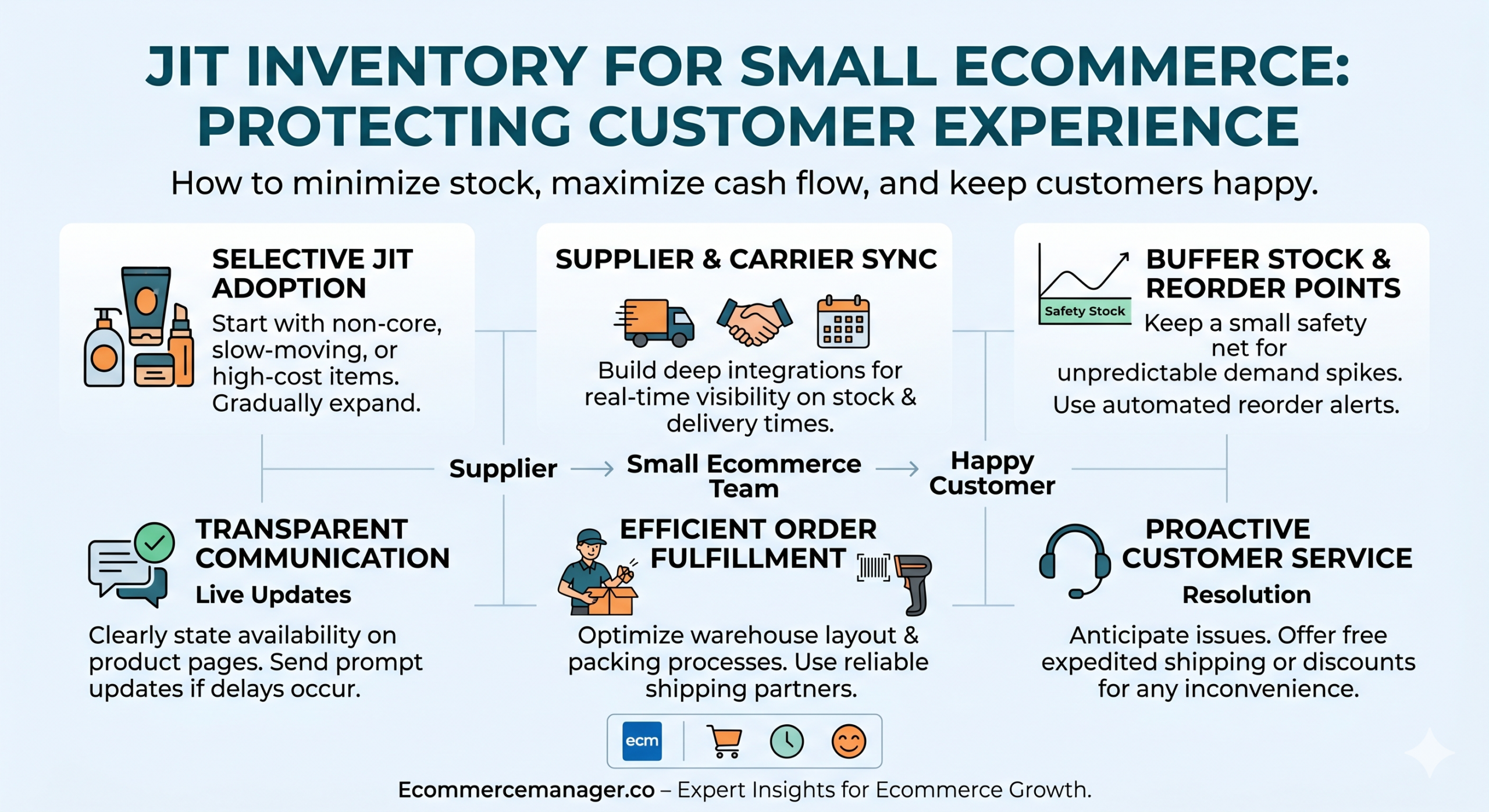
This is where JIT becomes useful. It helps a small team buy closer to actual demand instead of guessing too far ahead. That can reduce waste, improve cash flow, and make product testing less risky. Still, I would not apply JIT across the whole catalog. I would use it where the risk is controlled and keep stronger buffers where the customer impact would be high.
Inventory problem
How JIT can help
Risk if handled poorly
Too much slow moving stock
Less cash stuck in unsold products
Product range may feel too thin
Seasonal overbuying
Smaller buys before demand is clear
Late stock during peak demand
Limited storage space
Fewer units stored at one time
Higher risk of stockouts
New product testing
Smaller batches reduce testing risk
Launch momentum can stall
Cash flow pressure
More cash stays available for growth
Delays can create refunds
Too many stale SKUs
Cleaner catalog and better buying focus
Customers may lose favorite items
The main benefit is control. JIT gives a small ecommerce team more room to adjust. The main risk is fragility. If the supplier, forecast, or communication process breaks, the customer feels it fast.
Where JIT can hurt customer experience
JIT usually fails for small ecommerce teams when inventory is reduced faster than the operating process improves. A store cuts stock levels, but the product page still shows vague shipping language. The supplier lead time is not tracked by SKU. The team has no backup vendor for bestsellers. Support does not know what to say when an order is delayed. That is when a lean inventory plan becomes a customer service problem.
The issue is not always slow delivery. Customers can accept waiting when the delivery promise is clear. McKinsey found that 90% of US consumers are willing to wait two or three days for ecommerce deliveries, especially when that helps them avoid shipping costs. The key point is that customers care about reliability and clear expectations, not just speed.
That changes how I would manage JIT. I would not hide longer lead times. I would explain them before checkout. If an item is made to order, say that. If a product ships in seven business days, say that. If a product is available for preorder, label it clearly. A customer who agrees to a clear delay is different from a customer who discovers the delay after payment.
Products that fit JIT and products that do not
The best JIT decisions happen at the product level. A small ecommerce team should not ask, “Should we use JIT?” The better question is, “Which products can safely use JIT, and which products need inventory protection?”
Custom products are usually a better fit because customers expect some production time. Slow moving accessories may also work well because holding too much stock creates waste. Bestsellers are more sensitive. They may support a lighter inventory model, but only with strong reorder points, safety stock, and reliable supplier timelines.
Product type
JIT fit
Why it works or fails
Custom products
High
Customers expect a clear lead time
Made to order products
High
Production starts after purchase
Slow moving accessories
High
Deep stock often creates dead inventory
Seasonal products
Medium
JIT can reduce leftovers, but timing must be tight
Bestsellers
Medium
Works only with reliable reorder rules
Perishable goods
Medium
Reduces waste, but delays hurt fast
Viral trend products
Low
Demand can spike before suppliers react
Imported products with long lead times
Low
Delays can miss the sales window
Urgent need products
Low
Customers may not tolerate waiting
This table is where I would start before changing inventory levels. I would mark every SKU by risk. If a product drives repeat purchases, paid search conversions, or customer trust, I would be careful with deep cuts. If a product sells slowly and has predictable demand, I would be more open to JIT.
The setup I would build before cutting stock
Before reducing inventory, I would build a simple operating system around demand, suppliers, and customer communication. It does not need to be complex. It does need to be consistent.
First, I would track sales velocity by SKU. Monthly sales are not enough. A product that sells 90 units evenly across 30 days is different from a product that sells 90 units after one email campaign. The first product is predictable. The second may need campaign based planning.
Second, I would track supplier lead time by SKU, not only by vendor. A supplier may ship one item in three days and another in twelve. JIT depends on real timing. A general vendor estimate is not good enough when inventory is tight.
Third, I would create reorder points. A basic formula works for many small teams:
Reorder point = average daily sales x supplier lead time in days + safety stock
If a product sells 5 units per day and the supplier takes 7 days, the base reorder point is 35 units. If the store keeps 15 units as safety stock, the reorder point becomes 50 units. That gives the team a trigger before the product becomes a customer problem.
Fourth, I would create customer messaging rules before delays happen. This includes product page copy, checkout delivery dates, order confirmation text, backorder language, support scripts, and refund options. JIT works better when the team knows what to say before customers start asking.
JIT inventory KPIs ecommerce teams should track
A small ecommerce team does not need a large reporting setup to manage JIT. It needs a small group of metrics that show whether lean inventory is helping or hurting. I would review these numbers weekly for bestsellers and monthly for the rest of the catalog.
KPI
What it shows
Why it matters
Inventory turnover
How fast stock sells
Shows whether inventory is moving well
Stockout rate
How often products are unavailable
Shows if JIT is too aggressive
Supplier lead time
How long replenishment takes
Shows if vendors can support JIT
Backorder rate
How often orders cannot ship on time
Shows customer facing inventory risk
On time delivery rate
Whether orders arrive as promised
Connects inventory to customer experience
Carrying cost
Cost of holding inventory
Shows cash tied up in stock
Refund rate
How often customers cancel after buying
Shows if delays are hurting trust
Delivery related support tickets
How often customers ask about timing
Shows if communication is unclear
I would not judge JIT by inventory reduction alone. Lower stock is not a win if refunds, support tickets, and missed delivery promises increase. That only moves the cost from the warehouse to the customer service team.
How to protect customer experience when stock gets tight
The customer experience plan should start before checkout. Product pages should show clear availability, realistic shipping dates, and honest lead times. Baymard Institute found that 41% of ecommerce sites do not show delivery dates and instead use shipping speed language, which can create uncertainty for shoppers. That matters even more when inventory is lean because there is less room for timing mistakes.
I would rather write “ships by May 28” than “standard shipping.” I would rather write “made to order, ships in 7 to 10 business days” than let the customer find out later. Clear language reduces support pressure and helps customers decide if the timeline works for them.
After the order, updates matter just as much. If a supplier is delayed, the customer should hear it from the business before they ask. If the delivery date changes, give the new date. If the product is backordered, give the customer a clear choice to wait, switch products, or get a refund.
This is where a good small business CRM can help. Smarfle CRM, built in Orlando, FL, is a useful example because it brings customer messages, scheduling, invoices, and follow ups into one place. For a small ecommerce or service based team, that kind of setup can stop inventory delays from turning into missed replies and confused customers.
A safer hybrid JIT model for small ecommerce brands
For most small ecommerce brands, I would not recommend strict JIT across the whole business. A hybrid model is safer. Keep safety stock for the products that drive the most revenue. Use JIT for slower moving SKUs, custom products, replacement parts, and products with predictable supplier timing.
I would also create a “do not cut too deep” list. These are the products that matter most to customer trust. They may be bestsellers, repeat purchase items, high margin products, or products used in paid ad campaigns. If these products go out of stock, the business loses more than one sale. It may lose ad efficiency, repeat customers, and review quality.
Smarfle CRM can fit into this workflow when small teams need better follow up around delayed orders, payment timing, invoices, or customer updates. It should not replace inventory software, but it can support the communication layer that keeps customers informed when stock is tight.
Final takeaway
JIT inventory can help small ecommerce teams reduce waste, lower carrying costs, and free up cash. It can also create stockouts, delays, refunds, and bad reviews when the customer experience is not protected.
I would not start with a simple inventory cut. I would start with sales velocity, supplier lead times, reorder points, safety stock, and clear customer messaging. Then I would reduce stock only where the data supports it.
That is the practical way to use JIT inventory in ecommerce. Keep the business lean where it makes sense, but never make customers pay for weak planning.