

Last Updated on March 29, 2026
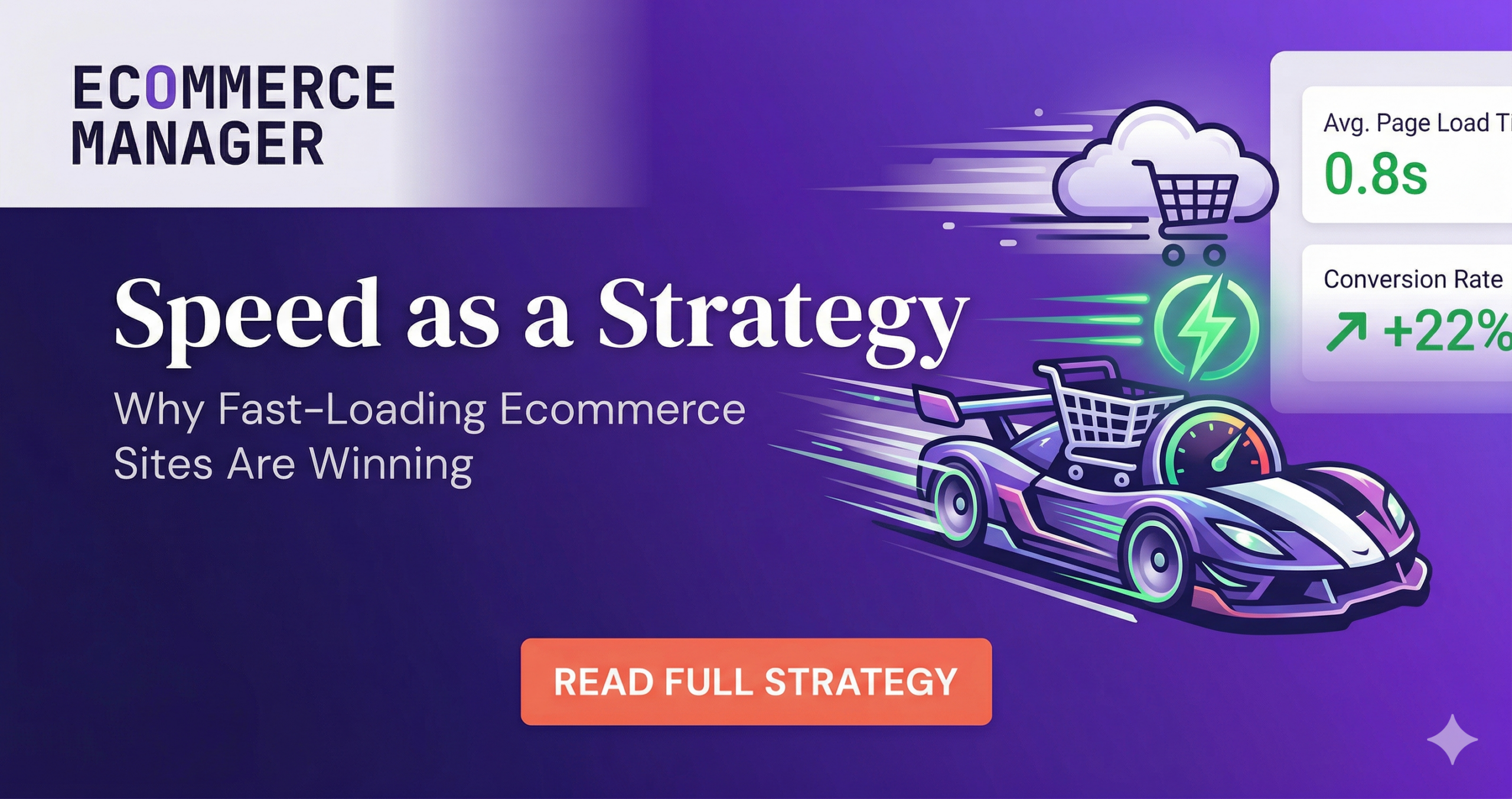
Some competitive advantages in ecommerce are hard to replicate: a unique product, a strong brand, a supply chain built over years. Site speed isn’t one of those. It’s available to any brand willing to do the work. But most brands treat it as maintenance rather than strategy, and that’s why the gap between fast and slow sites keeps growing.
The brands that have invested in performance are seeing compounding returns across SEO, paid media efficiency, and conversion rate. The ones that haven’t are slowly falling behind without a clear explanation for why.
The SEO Dimension
Google’s Core Web Vitals have been an official ranking factor since 2021. The three metrics (Largest Contentful Paint, Interaction to Next Paint, and Cumulative Layout Shift) measure loading speed, responsiveness, and visual stability. Sites that consistently meet Google’s “Good” thresholds for these metrics hold an advantage in competitive search results over comparable sites that don’t.
For ecommerce, this matters across the full funnel. Category pages that rank higher drive more top-of-funnel traffic. Product pages that perform better in search capture more purchase-intent queries. Strong Core Web Vitals scores across a site’s pages produce a cumulative organic traffic advantage that grows over time.
The Paid Media Dimension
Every dollar you spend on paid search or social advertising is only as effective as the page it sends traffic to. A slow landing page means a higher percentage of paid clicks result in bounces before the offer loads. You’ve already paid for those clicks.
Google Ads Quality Score also partially reflects landing page experience, including speed. A lower Quality Score means a higher cost per click for the same position. Fast landing pages reduce effective acquisition costs without requiring any changes to targeting, creative, or bid strategy.
The Conversion Dimension
Portent’s data shows up to a 17 percent conversion rate lift for B2C ecommerce per second of load time improvement. Deloitte research found a 0.1-second improvement in mobile speed correlated with an 8.4 percent increase in retail conversion rates. The mechanism is simple: slow pages give visitors more time and reason to reconsider. Fast pages keep them focused on the purchase decision.
This compounds with traffic quality. A site that earns more organic traffic because of better performance also converts that traffic at a higher rate. The two effects reinforce each other.
The Mobile Dimension
Mobile accounts for more than half of ecommerce visits in most markets. Mobile conversion rates typically lag behind desktop by a significant margin, and a substantial part of that gap is attributable to performance. Pages that load quickly on a desktop over fiber can be slow and unresponsive on a mid-range phone over 4G.
Google measures Core Web Vitals separately for mobile and desktop, and mobile scores are what matter most given the predominance of mobile search. Brands that focus exclusively on desktop performance are optimizing for the smaller portion of their traffic.
Where the Investment Actually Goes
The most common sources of ecommerce site slowness are large unoptimized images, excessive third-party scripts, render-blocking CSS and JavaScript, and inadequate hosting infrastructure.
Image optimization typically delivers the fastest return. Compressing images, converting to WebP, and serving appropriately sized images for different viewports can reduce page weight by 40 to 60 percent on image-heavy product pages. It’s usually the highest-impact change with the lowest risk of breaking anything.
Third-party script auditing is the next priority. Every external script introduces a dependency on another server and adds JavaScript execution time. Review every analytics integration, marketing pixel, chat tool, and review widget. For each one, ask whether the business value justifies the performance cost.
Caching reduces server response times and improves perceived load speed. For WordPress and WooCommerce sites, a well-configured caching layer dramatically reduces Time to First Byte. For Shopify, app scripts still load dynamically even though the platform handles infrastructure caching.
The State of eCommerce in 2026
The State of eCommerce in 2025!
Making Speed a Sustained Advantage
The challenge with speed is that it degrades over time as features, apps, and scripts accumulate. A site that performs well today can become noticeably slower over 18 months of incremental additions without anyone making a deliberate decision to slow it down.
Checking Core Web Vitals scores monthly, running PageSpeed Insights on key pages after significant updates, and reviewing Search Console’s Core Web Vitals report quarterly keeps performance as an ongoing operational metric rather than a periodic cleanup project.
The brands that treat speed as a strategic priority are the ones compounding the advantage. The gap between them and slower competitors only widens over time.
Matt Suffoletto, Founder & CEO, PageSpeed Matters