

Last Updated on March 29, 2026
By Derrek Wiedeman, Founder of WHYZ
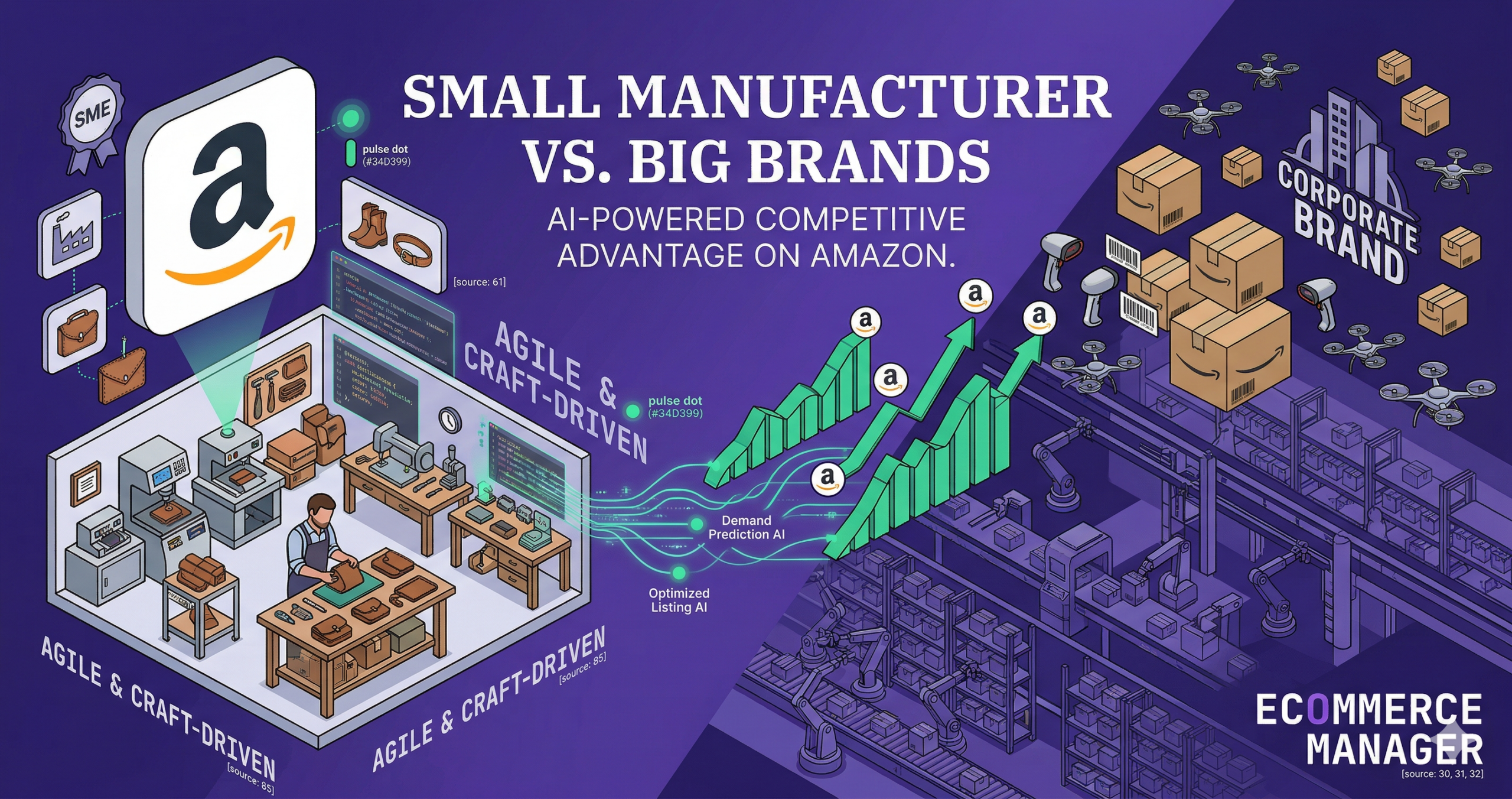
We have 8 people on our team. We ship 50,000+ units a month across 8 brands on Amazon. And we compete directly against companies with 200-person headcounts, nine-figure budgets, and entire departments dedicated to things I handle with a script and a well-crafted prompt.
I’m not going to pretend this is a David vs. Goliath story with some feel-good ending. It’s messier than that. But AI has changed what’s possible for a small manufacturer on Amazon. Not in a theoretical way. In a very concrete, this-saved-us-from-drowning way. Here’s what that actually looks like.
Where We Started
Five years ago, running 8 brands with a small team meant constant triage. Someone was always behind on something. Inventory decisions were made on gut feel and a basic spreadsheet. Supplier quotes sat in inboxes for days before anyone reviewed them. Content on our listings was decent but not great, because great took time we didn’t have.
The big brands didn’t have those problems. They had dedicated inventory planners. Sourcing teams. Copywriters. We had whoever could context-switch fastest on a given Tuesday.
And that gap showed. Our conversion rates were lower than they should’ve been. We’d stock out of fast movers because we miscalculated demand. We’d sit on slow movers because we were too optimistic about sell-through. Each of those problems costs real money. Stockouts tank your BSR ranking and cost you sales you can never recover. Excess inventory eats your margins and your storage fees.
The Supplier Monitoring Problem
One of the first things I used AI to solve was supplier monitoring. We source ingredients and packaging from dozens of suppliers. Prices shift. Availability changes. Minimum order quantities creep up. And if you’re not paying attention, you find out about a 12% price increase the week your raw material runs out.
Now I run automated monitoring across our key suppliers. We pull quote history from our Baserow ERP, compare it against incoming supplier emails, and flag anything that’s changed. The system reads incoming emails, extracts pricing, and logs it to our sourcing database. Without me touching it. If a supplier sends a quote with prices 8% higher than last quarter, I see that in a dashboard update, not buried in an inbox.
That sounds simple, but the actual build took real work. I’m using Claude Code to write and maintain the scripts that power this. Custom Node.js pipelines, Gmail API integration, structured logging. It’s not off-the-shelf software. It’s automation I own, tuned specifically to how our business works.
The payoff: I probably save 6-8 hours per week just on supplier monitoring tasks that used to be manual. More importantly, I catch pricing changes before they become problems instead of after.
Content Creation at Scale
This is where AI has had the most visible impact on revenue. Good Amazon listing content matters enormously. Titles, bullets, A+ content, backend keywords. A 0.5% improvement in conversion rate on a product doing $40,000 per month is $2,400 per year from one listing. We have 8 brands with multiple SKUs each.
Before AI, updating content was a 2-3 day project for one person. You’d research competitors, pull keyword data, rewrite bullets, wait for review, iterate. Now I can generate a strong first draft of a complete listing in under an hour, including keyword-optimized bullets based on real search volume data.
But the bigger content win has been educational content. We built out 70+ research pages for our ingredient categories, covering dosing, mechanisms, sourcing, and the peer-reviewed literature. That content drives organic search traffic and builds trust with buyers who want to understand what they’re purchasing before they click “Add to Cart.” Building that library the old way would’ve taken 18 months and a full-time writer. We did it in a few months with AI doing the heavy lifting on drafts and me reviewing for accuracy.
Big brands have content teams. We have AI and a system. The output quality is comparable. The cost difference is not.
Inventory Forecasting
This one still has room to improve, but we’ve made real progress. Our old process: look at the last 30 days of sales velocity, multiply by lead time in weeks, add a buffer, order. It worked until it didn’t. And it really didn’t work during Q4 or any time demand spiked unexpectedly.
Now I run a forecasting model that pulls 90 days of sales data, weights recent velocity more heavily, accounts for our average lead time by supplier (which varies from 3 weeks to 9 weeks depending on origin), and flags SKUs where current stock will hit zero before the next order could arrive. It runs every morning. I get a short list of items that need attention.
This isn’t cutting-edge machine learning. It’s relatively simple logic applied consistently to clean data. But that’s the thing about AI-assisted automation for small businesses: you don’t need fancy models. You need reliable, accurate data and something that actually runs every day without you babysitting it.
In Q4 last year, we had zero stockouts on our top 10 SKUs. The previous year, we had 3. Each stockout cost us an estimated $8,000-$15,000 in lost sales and ranking recovery time.
Pricing Strategy
Amazon pricing is a game that never stops. Your Buy Box share, your competitive position, your ad spend efficiency. They all tie back to how well you price relative to the market. Big brands have repricing tools and analysts watching this in real time.
We built a lightweight system that checks our prices against the top 5 competitors in each category twice a day and flags any situation where we’re priced more than 7% above or below a competitor for the same product type. It doesn’t auto-reprice. I’ve seen too many businesses get burned by runaway repricing algorithms. But it surfaces the information fast so I can make a deliberate call.
That’s maybe 20 minutes of decision-making where it used to be an hour of manual research that often didn’t happen at all.
What AI Can’t Do
I want to be honest about the limits here. AI doesn’t replace relationships. Our best supplier relationships were built over years of consistent ordering and straightforward communication. No automation changes that.
AI also doesn’t replace knowing your products deeply. You still need someone who understands the category, the customer, and what quality actually means for your specific ingredients. I review every AI-generated draft. I approve every content update. The human judgment layer is still doing real work.
And AI doesn’t fix a bad product or a bad market position. We compete because our products are good and our prices are fair. AI just lets us operate those products and that pricing at a scale and consistency a team our size couldn’t sustain manually.
The State of eCommerce in 2026
The Complete 2025 E-commerce Manager Career Guide: From Entry-Level to Executive
Marketing Calendar: A Complete Guide
The Real Advantage
The gap between a 200-person company and an 8-person company used to be operational capacity. They could just do more things, more consistently. AI narrows that gap because it turns one person into the output of four or five. On the specific tasks where it actually works.
And for an Amazon-native manufacturer like us, those tasks are exactly the ones that move the needle: content, pricing awareness, inventory accuracy, supplier monitoring. We’re not competing on brand awareness spend. We’re competing on execution quality. And AI makes it possible to execute like a much bigger company.
Derrek Wiedeman is the founder of WHYZ, a supplement brand focused on single-ingredient, no-filler powders. He oversees manufacturing of 50,000+ units monthly across 8 consumer brands from Tampa, FL. For peer-reviewed ingredient research, visit whyz.com/learn.