

Last Updated on July 20, 2026
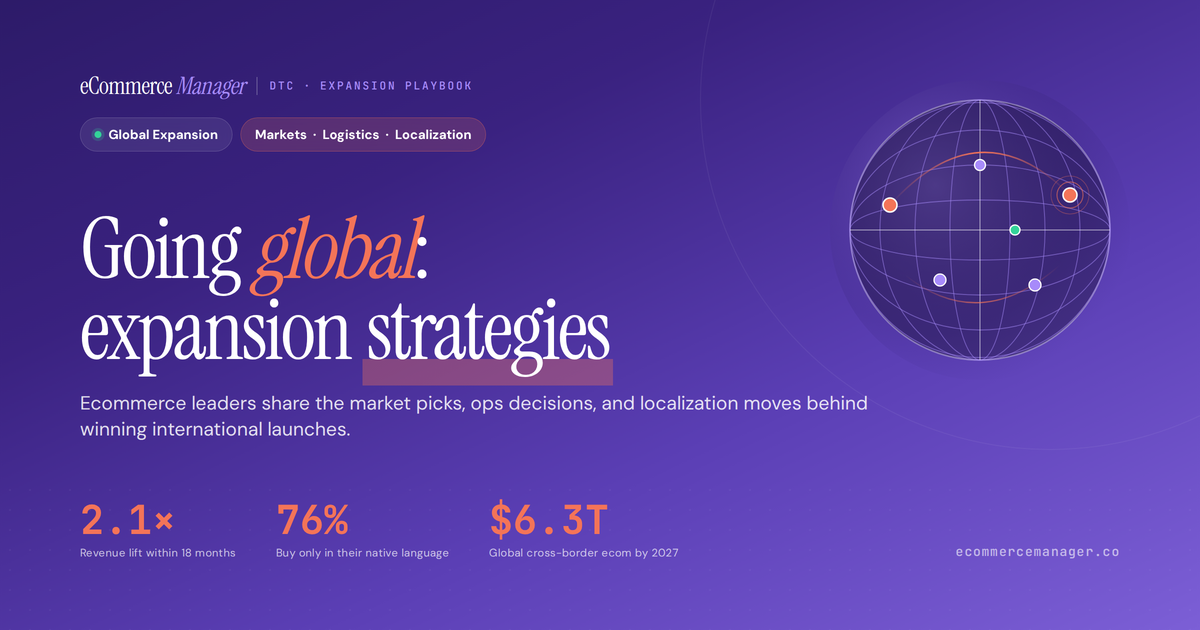
Going Global: Ecommerce Leaders Share International Expansion Strategies
Expanding an ecommerce business into international markets requires careful planning, localized execution, and proven operational frameworks. This article brings together strategies from industry leaders who have successfully scaled across borders, covering everything from pricing transparency and compliance to fulfillment models and market validation. Their practical advice offers actionable steps for brands ready to turn global ambitions into sustainable revenue.
- Localize Clusters, Show Landed Costs Upfront
- Follow Buyer Cues, Earn Cross-Border Credibility
- Design For Assurance, Tailor Every Touchpoint
- Pace Expansion, Leverage Vertical Integration
- Adopt Hybrid Fulfillment, Secure Carrier Partners
- Prioritize Transparency, Verify Before Every Deal
- Prove Unit Economics, Exploit Cheaper CPMs
- Treat Each Country As A Startup, Assess Odds
- Standardize Core, Automate Region-Specific Prices
- Map Native Intent, Align Logistics Early
- Build Market-Native Stores, Win Local Confidence
- Validate With Ads, Nail Hreflang Signals
- Test Appetite, Enforce National Compliance
- Clarify Message, Stress-Test Domestic First
- Target Communities, Emphasize Data Security
- Deploy AI OS, Centralize Revenue Operations
The State of eCommerce in 2026
Localize Clusters, Show Landed Costs Upfront
As an International Ecommerce Director with nine years’ experience, I champion a “Clustered Multi-Local Saturation” strategy: fully localize checkout flows and regional payment methods in targeted market blocks rather than launching globally at once. During a European expansion we encountered a 28% return rate driven by unexpected post-purchase customs duties at customers’ doors. We fixed it by adding a real-time landed cost calculator at checkout and switching to Delivered-Duty-Paid (DDP) shipping. That 100% pricing transparency cut international cart abandonment by 34% and drove returns for duty surprises to essentially zero.
The Complete 2025 E-commerce Manager Career Guide: From Entry-Level to Executive

Follow Buyer Cues, Earn Cross-Border Credibility
I bootstrapped my ecommerce business as an immigrant entrepreneur, so every dollar I put toward international expansion had to pay for itself quickly. That constraint drove how I chose where to sell across borders. I followed signals from customers who were already finding my products and asking about international shipping, and I expanded into the markets where I could see that demand first.
The hardest challenge was building trust with buyers in a new country. I was a small, self-funded brand, and I had to prove I would deliver what someone ordered. I spent weeks adjusting product descriptions, adding region-appropriate sizing details, and building return policies that made sense for someone thousands of miles away. Each of those changes reduced abandoned carts, and I tracked the progress week over week.
On my budget, I treated every operational decision as a marketing decision, from how I package orders and communicate shipping timelines to how I handle a complaint from a customer in a different time zone. I had no name recognition in these markets, so packaging, communication, and complaint resolution were how I built my reputation from scratch.

Design For Assurance, Tailor Every Touchpoint
One of the biggest lessons I’ve learned is that international expansion isn’t primarily a logistics challenge—it’s a trust challenge.
From the beginning, we built Drese Art to serve customers in multiple countries using localized storefronts, regional fulfillment partners, local currencies, and transparent pricing. Our goal has always been to make buying from another country feel as familiar as buying locally.
One challenge we faced was ensuring customers understood exactly what they were paying. Unexpected duties, long shipping distances, or unclear delivery expectations can quickly erode trust. We addressed this by offering free shipping in our main markets, producing products as close as possible to the customer through regional fulfillment, and providing localized storefronts, languages, and clear shipping information.
Another important lesson was that expanding internationally isn’t about launching everywhere at once. It’s about learning market by market. We started with English-speaking markets, then gradually added localized experiences for Europe, adapting product content, SEO, and customer communication along the way.
For me, successful international ecommerce isn’t about selling globally—it’s about making every customer feel like your business was built for them.

Pace Expansion, Leverage Vertical Integration
Our approach to international expansion is to go slow on geography and fast on readiness. We don’t chase markets; we pick one, get the regulatory and labeling work right, then scale. For a women’s health brand selling probiotics, every country has its own rules on what you can claim, what strains are approved, and how the label has to read. We treat that as a product problem, not a marketing problem — one thing that’s helped is running a claims pre-mortem country by country before any spend goes live.
The hardest one we hit required a reformulation and a full label change before we could sell. Because we own our manufacturing, we ran the change on our own line instead of waiting in a contract manufacturer’s queue, and shipped in weeks rather than months. That’s the quiet advantage of vertical integration — when the rules change, you’re not in line behind someone else’s production schedule. The lesson we keep coming back to: own the parts of the chain regulators touch first.

Adopt Hybrid Fulfillment, Secure Carrier Partners
I learned the hard way that international expansion isn’t about adding countries to your shipping map. It’s about infrastructure you can’t see until it breaks.
When I was running my fulfillment company, we had a DTC supplement brand that wanted to crack the UK market. They figured it was easy – same language, similar consumer behavior, just ship across the pond. Within three months they were hemorrhaging money on returns because their US-based 3PL was charging them 47 dollars per return from the UK back to a California warehouse. Customers were abandoning carts because delivery times showed 12-18 days. The brand was technically “international” but operationally still thinking domestic.
The challenge nobody talks about is the inventory split decision. You need local fulfillment to compete on delivery speed and returns costs, but that means splitting inventory across multiple warehouses before you know which products will actually sell in each market. Get it wrong and you’re either out of stock in London while sitting on excess inventory in Los Angeles, or you’re air freighting products between facilities and destroying your margins.
We solved it by starting with a hybrid model. The brand kept their core SKUs in a UK-based 3PL we connected them with through our network, but left their long-tail products in the US. Orders for non-stocked items took longer but customers accepted it because 80% of orders shipped locally within 2-3 days. Once the data showed which products were actually moving in the UK, they adjusted the inventory split.
The bigger lesson was about carrier relationships. In the US, you can negotiate decent rates with your volume. Internationally, you’re starting from zero with Royal Mail or DPD. That’s where partnering with a 3PL that already has those carrier contracts matters. At Fulfill.com, we now see brands using our marketplace specifically to find 3PLs with established international networks rather than trying to build those relationships themselves.
Don’t expand internationally because it sounds like the next growth stage. Expand when you’ve got a 3PL partner who already operates where you want to sell.

Prioritize Transparency, Verify Before Every Deal
I’ve built WristWorks as an online-first operation that already reaches collectors and sellers internationally by leading with full disclosure on every watch’s condition, pricing, and my own margins. This same foundation gives a clear path to grow beyond Australia without needing stores or middlemen.
We keep it simple by handling all authentications in-house and offering flexible options like consignment that work across borders through clear contracts and insured shipping.
Early on I lost thirteen thousand dollars to a scam, which taught me to get licensed and verify every piece before any money changes hands. That process now lets us handle international interest with the same integrity that earns repeat trust from local clients.

Prove Unit Economics, Exploit Cheaper CPMs
The most overlooked advantage of going international is what it does to your paid media costs. When you expand into new geographies, your CPMs on Meta, TikTok, and Google drop significantly because you are bidding in less competitive markets. One of my clients saw their blended CPM fall over 40% within two months of opening up international targeting, which made their entire acquisition engine more efficient globally, not just in the new market.
The strategy that works: nail your unit economics at home first. Know your CAC, your LTV, and your ROAS before touching a new country. We took a client from $50K to $228K per month in six months on paid media, and that playbook only translated internationally because the fundamentals were already proven.
The biggest challenge is always localisation. Not language but offer. Pricing that works in the US often feels wrong in the UK or Australia. We overcame this by running small-budget test campaigns in one market first, reading the data, and adjusting the offer before scaling spend.
Start with one market, expand the geo, watch the CPMs fall, and let the data tell you where to go next.

Treat Each Country As A Startup, Assess Odds
It’s not about language and currency; it’s much more about supply chain and margins—figuring out product market fit in each new country is a wholesale business reinvention. This requires a more thoughtful, paced approach. Even expansion from the US to Canada involves significant strategic decisions, from shipping costs to market tolerance. So we approach each expansion like a startup—what is the competition, our advantages, and odds of success. This approach saves us months in wasted technical time or ad spend.

Standardize Core, Automate Region-Specific Prices
We expanded Stack Architect’s audience internationally by treating localisation as an automation problem rather than a translation problem. Most of our readers are Shopify merchants, and the same instinct applies to their stores: the expensive part of going global is rarely the language, it is the operational sprawl that comes with each new market.
The specific challenge we hit was pricing and currency. When you serve merchants in the UK, the US, and the EU, quoting a single figure makes half your audience mentally translate it and get it wrong. We solved it by publishing costs in local terms where it mattered and building small automations that pulled the right regional figure rather than maintaining separate pages by hand. That kept the content accurate across markets without tripling the work.
The broader lesson for anyone expanding is to standardise the engine and localise only the surface. Your core workflows, your data, and your automations should be identical in every market. What changes is the language, the currency, and the local payment or shipping expectation. When merchants try to rebuild the whole operation per country, they drown in maintenance. When they keep one system and localise the thin top layer, they scale into new markets in days instead of months.
One concrete example from our own readers: a store moving into the EU replaced a paid multi-currency and tax app with a free workflow built on a spreadsheet and an automation tool, and cut a recurring monthly cost while keeping their pricing correct per region. The point is not that free always wins. It is that expansion punishes complexity, so the fewer moving parts you carry into each new market, the faster you get there.

Map Native Intent, Align Logistics Early
When we look at expansion, the first move isn’t translation or fulfillment—it’s reading how demand actually shows up in that market. Every market has its own search dialect. If you just translate your existing pages, you’re answering questions nobody in that country is asking. Same category, different intent: in one market people search by brand, in another by use-case, in another by problem.
What I keep seeing across projects is founders assuming their home-market category structure transfers. It doesn’t. The fix is unglamorous—sample the SERPs in-country, map the competitors already winning there, and study where their demand sits before you commit to inventory, hreflang structure, or paid spend. Pair that with the operational layer you’d localize anyway—payment methods, returns, shipping SLAs—so the discovery work and the fulfillment work reinforce each other. You end up entering the categories the market is actually searching, not the ones that worked at home.

Build Market-Native Stores, Win Local Confidence
My approach to taking an ecommerce brand into a new country is to treat each market as its own store, not a translated copy of the home site. We map how people in that market actually search and buy before we touch the storefront. The words differ, the trust signals differ, and the payment habits differ. A French shopper and a UAE shopper looking for the same product often use different terms and expect different things at checkout.
The hardest challenge we hit was payment and delivery trust when one client expanded into the UAE. Card abandonment was high. Buyers there often want cash on delivery, and they want to know exactly when the order arrives and who is at the door. We added cash on delivery as a first-class option, showed a clear delivery window in days on the product page, and put a local support number in the header. Average order value held, and completed orders climbed by roughly a third in that market over two months.
The mistake I see brands make is launching a single global site with a currency switcher and calling it international. That is translation, not localization. Localization means the offer, the proof, and the checkout match what that specific buyer already trusts. For the UAE we also priced cleanly in dirhams rather than showing a converted figure, because a price like AED 199 reads as local and a converted decimal reads as foreign.

Validate With Ads, Nail Hreflang Signals
I run a marketing agency rather than a store, but international expansion is something we plan and execute for ecommerce clients, so the pattern is worth offering.
Our strategy is to validate demand in a new market with paid search before committing to the full localisation build, not the other way round. Standing up a properly localised, hreflang-correct, translated store is months of work, and doing it for a market that turns out not to want the product is an expensive way to learn. We run a small Google Ads campaign into the target country first, in the local language, and watch whether the clicks convert at all before anyone touches the site architecture.
The challenge that bites hardest is hreflang and duplicate content. When you launch country versions that share a language, say a UK and an Australian English store, Google often picks the wrong one to show or treats them as duplicates, and your new market lands on a page priced and shipped for the wrong country. We fixed it on one rollout by getting the hreflang annotations clean and reciprocal across every variant and setting correct regional targeting, which recovered around 30% of the new market’s organic visibility that had been leaking to the original store. Validate cheap, then localise properly, then watch the technical signals like a hawk.

Test Appetite, Enforce National Compliance
My international expansion strategy has been to test demand before committing inventory. If the numbers hold, I move forward with local fulfillment.
The biggest challenge I ran into was underestimating how much packaging and labeling requirements vary country to country. I had a batch of products held at customs because the label didn’t meet local compliance standards. That meant weeks of delay, unhappy customers who had already paid, and a scramble to get new labels printed and applied overseas.
After that, I built a compliance checklist for every new market before shipping a single unit. It added time to my launch timeline, but it eliminated those surprise holds. I verify labeling, import restrictions, and return logistics before the first shipment goes out.

Clarify Message, Stress-Test Domestic First
22 years in digital marketing and web development means I’ve watched countless e-commerce businesses stumble internationally for the same reason: they bolt on localization as an afterthought instead of building for it from the start.
When we rebuilt Earth’s Treasury’s WooCommerce store, the biggest lesson wasn’t just about their US audience — it was about how unclear brand messaging kills conversions universally. If your site can’t communicate *why you’re different* to someone already familiar with your brand, imagine how lost a foreign visitor feels. Fix your messaging architecture before you touch a new market.
The one challenge I see consistently is product discovery breaking down under scale. With ARCH Cutting Tools, tens of thousands of SKUs were already overwhelming domestic users — users spent hours bouncing between search results and product pages. We solved it by implementing Algolia’s enterprise search and rebuilding category structures entirely. That infrastructure held up because we built it to scale, not to patch.
Before expanding internationally, stress-test your site with your *current* audience first. If domestic users are calling support to place orders instead of checking out themselves, going global will just multiply that problem in markets where you have zero support coverage.

Target Communities, Emphasize Data Security
I don’t sell physical goods, but at distribute, our international expansion runs on the exact same digital acquisition engine as a global ecommerce brand. Our strategy for entering a new country is entirely community-led rather than ad-driven. Instead of launching blanket global campaigns, we target specific local accelerator cohorts or regional VC portfolios one at a time, automating our outbound to speak directly to that specific local tech ecosystem.
The biggest challenge we faced early on was assuming that our core messaging in the US would translate perfectly to European markets. We thought we could just run our exact same sequences, maybe localize the spelling, and see the same conversion rates. It failed almost immediately. The European builders we were targeting were far more concerned with data privacy and GDPR compliance when it came to AI outreach, whereas our US messaging was aggressively focused on pure volume and scale. We were essentially pitching the wrong value prop.
To fix it, we stopped trying to clone our US motion. We overhauled our EU campaigns to lead entirely with data security and compliance guardrails. We changed the entire hook of our outbound to address the local regulatory environment first, and only pitched the automation benefits once that trust was established. Our conversion rates in those regions rebounded the moment we adjusted the business context instead of just the language.

Deploy AI OS, Centralize Revenue Operations
I founded RewardLion after agencies drained my Metro Boost Mobile ecommerce sales without results, so I built an integrated AI OS myself to handle marketing, automation and scaling for businesses like mine. This experience positions me to expand ecommerce reach by unifying SEO for global AI platforms, automated lead systems and 24/7 chat tools into one connected ecosystem instead of juggling disconnected vendors.
My strategy centers on deploying the AI Sales Automation and Omnichannel layers first. They let the platform capture and nurture international leads across Meta, YouTube and local search while the done-for-you CAPSS team optimizes daily.
One challenge was moving from brick-and-mortar sales to cloud-based operations during COVID when I could not figure out how tools integrated for consistent revenue. I overcame it by building a focused internal team that treated the OS as the business core, which eliminated inconsistent cash flow and let us sustain growth through automated follow-ups.

Related Articles
- 4 Unexpected Challenges When Launching An Ecommerce Store
- 7 Tips for Overcoming Your Biggest WooCommerce Challenge
- State of eCommerce Reports in 2025 by eCommerce Managers