

Last Updated on September 4, 2026
10 Best Dropshipping Software for Sellers in 2026
I have run a steel distribution business in South-East NSW since 2000. Over those years we built branches at Queanbeyan, Nowra and Moss Vale. And we learned something the hard way. When the system says one thing and the rack says another, the customer finds out first.
So when people ask me about dropshipping, I do not think about marketing. Instead I think about lead times, supplier accountability and the phone call you make when a delivery slips.
Dropshipping is distribution. The only real difference is that somebody else holds the stock. But you still carry the customer, the promise and the refund. And in 2026 that gap matters far more than it did three years ago. Because the cheap end of the model has come apart.
What I check before I look at a single feature
Every platform sells the same promise. No warehouse, no capital tied up, no risk. Fine. Then ask the second question: how often does inventory sync?
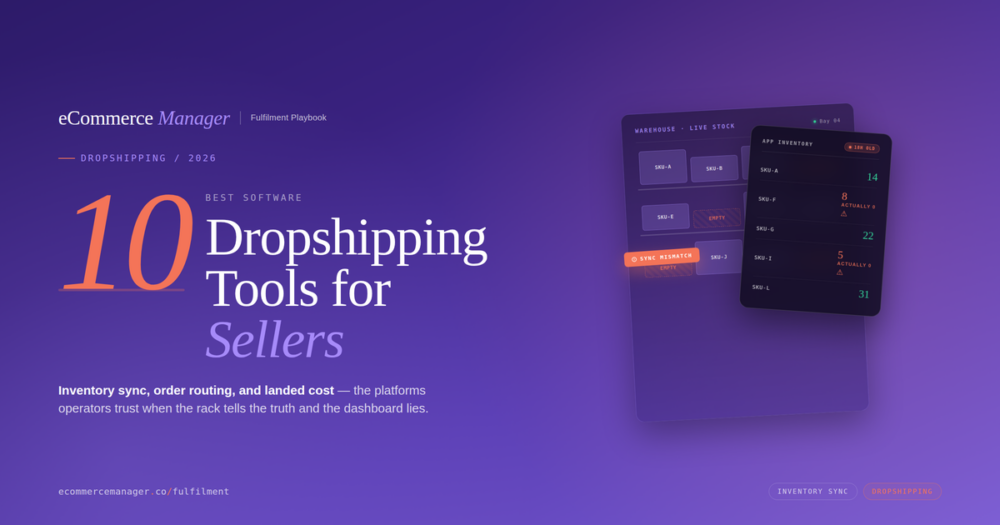
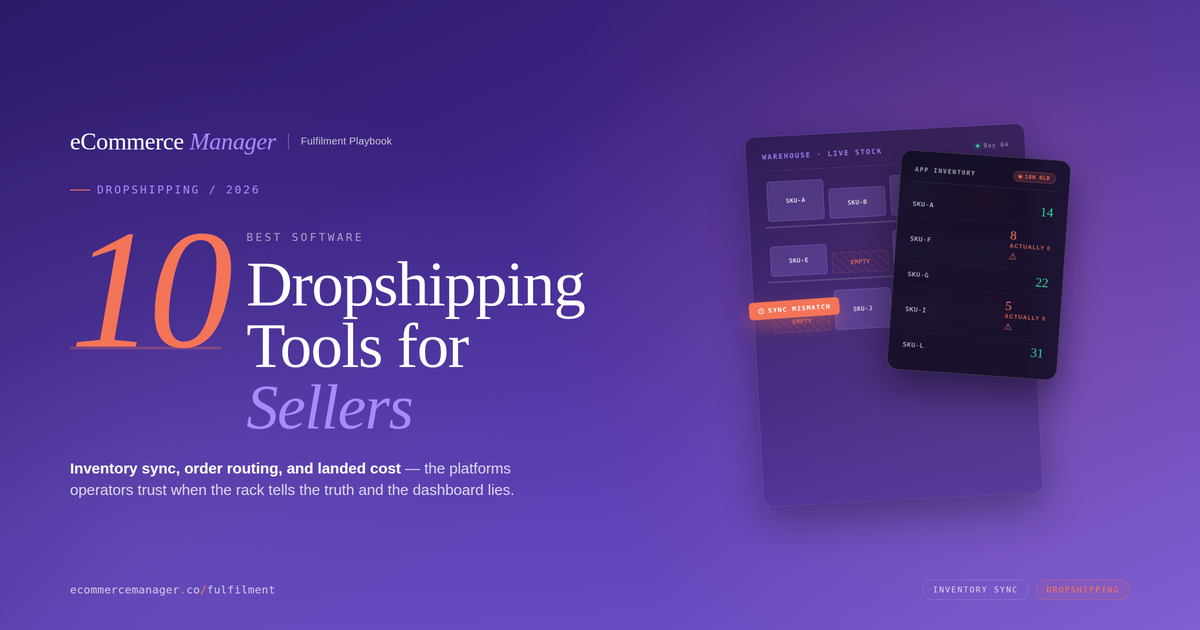
If the answer is once a day, you will oversell. If it is a spreadsheet you download on Monday, you will oversell twice by Wednesday. In our trade a stock figure that is six hours old is a guess. Then that guess becomes a complaint.
After sync I look at routing. What happens when supplier A runs dry and supplier B has the item on the shelf? Good systems reroute the order themselves. Weak ones send you an email at midnight and wait. Then I look at returns, because reverse logistics is where thin margins go to die. Finally I look at landed cost, which is the number most sellers never calculate until the duty invoice lands.
Now to the platforms.
- Flxpoint
Flxpoint is the closest thing in this market to proper distribution software. It routes orders across multiple suppliers, so you can rank sources by cost, speed or proximity. It also onboards suppliers through API, CSV, EDI or a self-serve vendor portal. So you can bring your own suppliers instead of renting somebody else’s catalogue.
Pricing sits near USD 499 to 599 a month depending on which source you read. Onboarding costs extra, from around USD 800. That is real money. But think about what it replaces. If you run five suppliers and drown in spreadsheets, it costs less than the person you would hire. Reviews run strong on Capterra and weak on the Shopify App Store. Though that second sample is tiny, and the product never suited self-serve setup.
- Rithum
Rithum is the engine behind dropship programs at Home Depot, QVC and Nordstrom. And it moves more than USD 50 billion a year. Most sellers have never heard of it. It came together from CommerceHub, ChannelAdvisor and DSCO. And it runs on the same EDI documents our steel suppliers have used for decades. Those are the purchase order, the advance ship notice, the invoice and the inventory advice.
That last one matters. Vendors on this network refresh stock in under fifteen minutes. Meanwhile most dropshipping apps refresh once or twice a day and call it real time. Rithum is not for a solo seller. Users report bills past USD 2,000 a month, plus GMV fees and two-year contracts. Still, it shows you what disciplined dropship infrastructure looks like.
- Pipe17
Pipe17 raised USD 15.5 million in January 2025 to build out its AI tooling. And the money went into order orchestration rather than product research. You set routing rules through point-and-click filters. Then the system splits orders, holds them, applies inventory buffers and flags exceptions. It also ships an AI agent that handles routing admin on its own.
Published tiers run roughly USD 120 to 500 a month. Then the top plan covers 5,000 orders before overage kicks in. Above 10,000 orders you get a custom quote. One customer cut twenty hours of manual work a week. For a mid-sized operation juggling a storefront, a marketplace and a warehouse, that is a return I understand.
- Dropshipzone
Here is the one most Australian sellers should look at first. Dropshipzone launched in 2012 and sits under New Aim, a large private logistics group. It carries more than 100,000 products across appliances, furniture, home, garden and tools.
There is no subscription, no joining fee and no minimum order. You pay wholesale cost plus freight. Better yet, orders ship from Australian warehouses. Dispatch usually runs one to two business days, with delivery inside roughly three to eight. Compare that with three weeks from overseas and the argument makes itself. The Shopify app currently rates around 4.7 across a small review base. Earlier sync complaints appear to have been addressed.
- iDropship
iDropship works the high-ticket end from Melbourne, covering furniture, appliances and home goods for Australia and New Zealand only. The team has two decades behind it, and there are no monthly or setup fees.
Two things stand out to me. First, they inspect goods before dispatch, which is quality control rather than hope. Second, they ship in neutral packaging. So your customer opens a box with your brand on it and not the supplier’s. Dispatch runs two to seven business days. Be aware that sources disagree on integration. Some describe a private API. Others describe manual imports with no live stock sync. Ask them directly before you commit, because that single answer decides whether you oversell.
- Syncee
Syncee has run since 2016. Now it lists more than 12,000 vetted suppliers across the United States, Canada, the United Kingdom, Europe and Australia. Suppliers must hold real stock and show a shipping record before they get in. Now that is closer to how we vet a mill than how most marketplaces operate.
Stock and prices sync several times a day, and no plan charges transaction fees. Paid tiers run about USD 40 to 100 a month. The genuinely useful piece is the DataFeed Manager. It lets you automate any supplier outside the marketplace through a CSV or XML feed. So if you already have supplier relationships, you can bring them in rather than starting over. You can also switch a proven product from dropship to wholesale, which is exactly how a distributor thinks.
- BigBuy
BigBuy is a European wholesaler that owns its warehouse in Valencia and stocks over 400,000 products. Because it holds the goods itself, it can promise 24 to 48 hour shipping across Europe. So your order does not pass down a chain.
There is no minimum order, and it ships anonymously under your brand. The catalogue runs in 24 languages and connects to more than 200 marketplaces. Sellers do report connector problems and slow support when things break. Therefore test one paid order per product line before you scale. For Australian sellers the freight leg is long. But for anyone selling into Europe this is a serious option.
- Gelato
Gelato solves the print-on-demand freight problem by producing near the buyer. It runs more than 140 production partners across 32 countries. And it delivers around 90 percent of orders within five business days. Australia sits inside that network, which most centralised print operations cannot match.
The free plan covers every product. Meanwhile Gelato+ costs USD 19.99 a month on annual billing, and it unlocks product discounts and branded packaging. Base costs undercut the better-known names. But watch the shipping rates. Sellers have reported increases near 70 percent on some framed items. You also get limited control over which partner fulfils your order. Quality therefore varies by region.
- Inventory Source
Inventory Source connects you to roughly 230 pre-integrated suppliers, weighted heavily towards United States furniture, marine, automotive and sporting goods. The directory itself is free. Then inventory automation starts at USD 199 a month, and full automation with order routing starts at USD 299.
Be careful here. Trustpilot sits near two out of five, with complaints about support, integration problems and catalogue accuracy. Catalogue accuracy is no minor gripe in this trade. Because it is the difference between a sale and an apology. The company now steers larger accounts towards Flxpoint, which tells you something about where the product is heading.
- Zendrop
Zendrop is the AI-forward option, offering built stores, automated fulfilment and workflow tooling, plus warehouses in the United States. Goods held there ship in two to five days. But China-sourced items run ten to twelve days, and they stretch further in the fourth quarter.
Plans run from USD 29 to 79 a month depending on how many products you link. Trustpilot scores well across a very large review base. However there are recurring complaints about billing after cancellation and double charges on plan changes. Also the WooCommerce integration disappeared back in 2023. So read the terms properly, and keep your own record of what you signed up to.
The tariff change that broke the old arithmetic
Anyone still pricing on 2023 assumptions needs to stop. The United States ended duty-free treatment for low-value parcels from every country on 29 August 2025. And Congress then made the change permanent by statute. Customs had been processing over 1.36 billion of those parcels a year. Since the phase-out began, it has collected more than USD 1 billion in duties.
What does that mean at ground level? A fifteen dollar product can now carry twenty dollars of duty. Worse, those duties do not come back when the customer returns the item. As a result the model is shifting towards bulk import, local warehousing and domestic fulfilment. In other words, dropshipping is quietly turning back into distribution, with working capital and stock risk attached.
What Australian sellers keep getting wrong
Consumer guarantees under Australian Consumer Law survive whatever your terms and conditions say. Not a policy page, not a checkout tick box. The ACCC has said plainly that customers may ask whether you hold stock or dropship, since that determines delivery time.
Here is the part that catches people. You are liable, not your overseas supplier. Telling a customer to chase the manufacturer is not an option. If a delay is unreasonable, it can amount to a major failure. Then the customer chooses between a refund and a replacement. The ACCC has already made consumer guarantees and delivery timeframes an enforcement priority. Meanwhile its 2025 sweep of online returns policies produced warning letters. Sourcing locally is therefore a compliance decision as much as a logistics one.
How I would choose
Start with the question nobody in this industry likes. What happens on a bad day? Because the good days need no software at all.
Selling into Australia? Then start with local supply through Dropshipzone or iDropship. Accept the thinner margin as the cost of a delivery promise you can keep. Running several suppliers already? Now you need real order routing, so look at Flxpoint or Pipe17 instead of patching spreadsheets together. And if you want international breadth, Syncee gives you vetted suppliers plus the ability to plug in your own.
Above all, test one paid order per supplier before you list anything. Order it yourself, time it, open the box and look at the packaging. That is what we do with a new mill. And it is the only test that has ever told me the truth.