

Last Updated on October 26, 2026
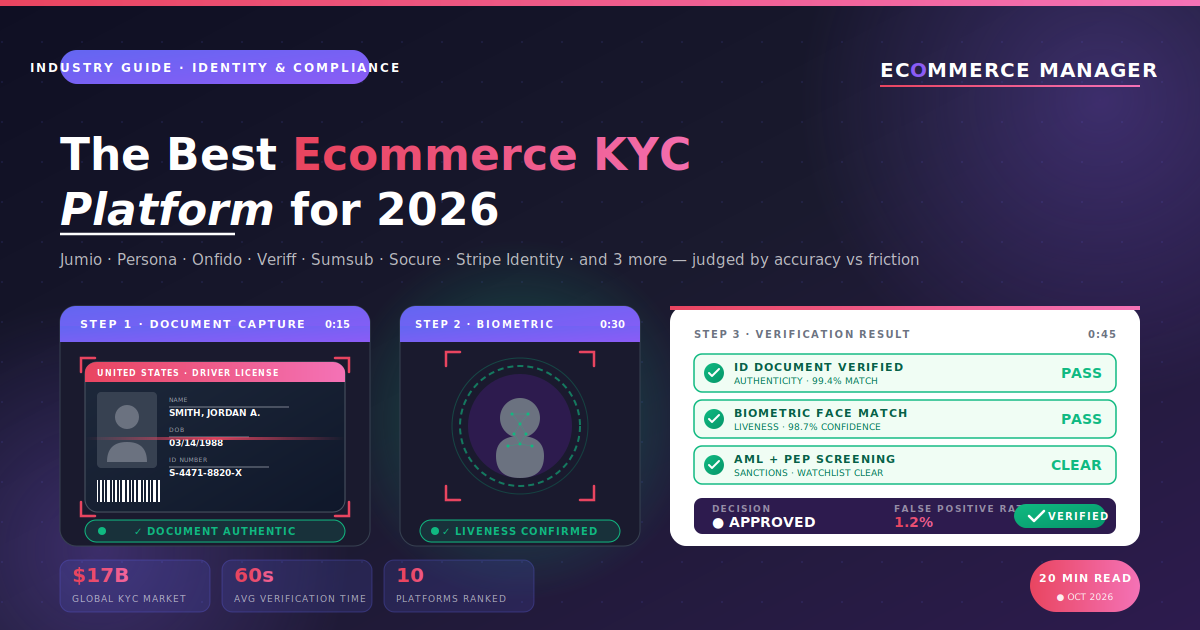
The Best Ecommerce KYC Platform for 2026
The honest ranking of identity verification platforms built for ecommerce — judged by the tension nobody writes about: accuracy versus friction, compliance versus conversion, and the per-verification cost that quietly eats margin at scale.
Here's the operator reality nobody wants to spell out: KYC (Know Your Customer) is quietly becoming a line item every serious ecommerce business over $5M needs to understand, and the vendors in this space have gotten very good at making their pricing pages look reasonable while the real cost silently balloons at scale. State-by-state age verification laws for alcohol, vape, and cannabis. Marketplace due diligence requirements for seller onboarding. Chargeback and friendly-fraud defense on high-value transactions. B2B legitimacy verification for wholesale. BNPL and fintech-adjacent integrations that trigger full KYC obligations. If you're selling anything regulated, operating a marketplace, or doing meaningful volume in high-ticket categories, you're going to buy one of these platforms within 12 months. This guide ranks 10 of them by what actually matters for ecommerce: verification accuracy at the lowest friction, geographic coverage that matches your market, and per-verification pricing that doesn't explode at scale.
Why KYC Became an Ecommerce Problem (And It's Only Getting Bigger)
A decade ago, KYC was a financial services problem. Banks, broker-dealers, insurance companies, and the occasional crypto exchange were the only businesses that cared because they were the only businesses regulated to care. Ecommerce operators didn't think about it — the credit card processor handled fraud, chargebacks were a cost of doing business, and nobody was asking you to verify who your customers actually were. Those days are over, and most ecommerce operators haven't fully registered the shift yet.
The shift has four parts. First: regulated verticals. Alcohol delivery, cannabis, vaping, firearms, nutraceuticals, adult content, and prescription-adjacent products now operate under a patchwork of state and federal verification requirements that didn't exist five years ago. Second: marketplace due diligence. If you run a marketplace with third-party sellers, the INFORM Consumers Act and similar state laws require you to verify high-volume sellers — and the fines for failing to do so are not symbolic. Third: chargeback and friendly-fraud defense. Identity verification at checkout for high-value transactions has moved from "nice to have" to "necessary to defend disputes." Fourth: B2B legitimacy. Any wholesale, net-30 terms, or business customer onboarding now requires verifying that the entity on the other end is actually a legitimate business — not a shell set up to run away with inventory.
What ties these together is that every one of them pushes the ecommerce operator toward an identity verification platform. And every one of those platforms will quote you a pricing model that looks reasonable at demo volume and expensive at real volume. Understanding this market is no longer optional for serious operators.
The Five KYC Buyer Types (Which One Are You?)
KYC buyers in ecommerce fall into five clear types with meaningfully different needs. Match yours before you compare vendors — the right platform for a marketplace is the wrong platform for a high-risk DTC brand, and vice versa.
Marketplace Seller Verification
You run a marketplace (Etsy-style, B2B directory, service marketplace) and need to verify sellers before they list. INFORM Act compliance for high-volume sellers is a hard requirement. Best fits: Jumio, Persona, Veriff, Sumsub.
High-Risk Vertical Buyer Verification
You sell age-restricted, regulated, or compliance-sensitive products (alcohol, vape, cannabis, firearms, nutraceuticals, delta-8). Age verification at checkout plus ID verification on delivery/pickup is table stakes. Best fits: Veriff, Sumsub, Shufti Pro, Jumio.
Fintech / BNPL / Financial Ecommerce
You sell financial products or integrate BNPL/lending/crypto. Full KYC + AML + PEP + sanctions screening required. Compliance stakes are highest in this bucket. Best fits: Alloy, Socure, Sumsub, Trulioo.
Luxury / High-Value Anti-Fraud
You sell high-ticket items ($500+ AOV) where chargeback and friendly fraud defense matters. Identity verification at checkout tied to transaction decisioning. Best fits: Socure, Alloy, Stripe Identity (if on Stripe), Persona.
Standard Ecommerce Adding Light Verification
You run a mainstream ecommerce business ($5M-$50M DTC) and want selective verification for suspicious orders, high-value transactions, B2B accounts, or international customers. You don't need enterprise-grade AML, just reliable ID verification at reasonable cost. Best fits: Stripe Identity (if on Stripe), Persona, Veriff, Shufti Pro.
The Four Evaluation Criteria That Decide the Winner
1. Verification method and accuracy
Document-only verification (checking a driver's license or passport) is the cheapest and lowest-friction option — but it's also the easiest to spoof with a decent photo editor. Document + biometric (face match to the ID photo, with liveness detection) is the modern standard for serious verification. Data-based verification (checking the submitted name/DOB against credit bureau and public records) is useful as a secondary signal. The best platforms combine all three and adjust the mix based on risk level. Accuracy matters more than any marketing claim — ask every vendor for their published false positive rate (legitimate users rejected) and false negative rate (fraudsters approved).
2. Geographic coverage
If you sell internationally, geographic coverage is often the dealbreaker. US-focused platforms struggle with international documents, non-Latin alphabets, and country-specific ID formats. Global platforms (Jumio, Onfido, Veriff, Sumsub, Trulioo) cover 190+ countries but may be weaker on US-specific requirements like state age verification. Match the platform's coverage sweet spot to your actual customer geography — paying for global coverage you don't need is wasteful; paying for US-only when half your buyers are international is a dealbreaker.
3. Integration depth
Modern KYC platforms offer SDKs for iOS, Android, and web, pre-built UI components, and REST APIs. Developer-friendly platforms (Persona, Stripe Identity) make integration a weekend project. Enterprise platforms (Jumio, Socure) require a longer integration but deliver more flexibility. No-code integrations exist (Zapier connectors, direct Shopify apps) but are usually last-resort. The right integration depth matches your engineering resources — don't buy enterprise if you can't dedicate an engineer to the integration.
4. Per-verification pricing and volume breaks
Every KYC platform prices per verification, usually in the $0.40-$5 range depending on checks included. The honest math: at 10,000 verifications/month and $2 per verification, you're paying $240K/year on KYC alone. Volume discounts are negotiable above 50K/month in most cases, but you need to ask. Beware of "additional check" fees — some platforms quote a low base price then charge extra for liveness detection, PEP screening, AML monitoring, or ongoing verification. Get the all-in per-verification price in writing before signing.
Complete Comparison: 10 Ecommerce KYC Platforms
Ranked by overall ecommerce fit — verification accuracy, geographic coverage, integration quality, and real-world pricing. "Starting Price" is per-verification cost at base volume; enterprise pricing is almost always negotiable above 50K/month. "Coverage" is the platform's documented strong markets.
| KYC Platform | Best For | Verification Methods | Starting Price | Coverage |
|---|---|---|---|---|
JU Jumio |
Enterprise | Doc + Biometric + Data | $0.75-$3/verification | GLOBAL 200+ |
PR Persona |
Dev-Friendly | Doc + Biometric + Data | $1-$2/verification | GLOBAL 200+ |
ON Onfido (Entrust) |
Enterprise | Doc + Biometric | $1.50-$4/verification | GLOBAL 195+ |
VF Veriff |
UX Leader | Doc + Biometric | $1-$3/verification | GLOBAL 230+ |
SM Sumsub |
KYC+AML | Doc + Biometric + AML | $1-$2.50/verification | GLOBAL 220+ |
SO Socure |
Fintech | Data + Doc + Biometric | Custom (enterprise) | US STRONG |
ST Stripe Identity |
Stripe-Native | Doc + Biometric | $1.50/verification | 120+ COUNTRIES |
TR Trulioo |
Global Data | Data + Doc + Biometric | $1-$3/verification | GLOBAL 195+ |
AL Alloy |
Decisioning | Multi-vendor orchestration | Custom (enterprise) | US + CAN STRONG |
SH Shufti Pro |
Budget | Doc + Biometric + Data | $0.40-$1/verification | GLOBAL 240+ |
The "Starting Price" column shows per-verification cost at base volume — the real number you'll pay at 10K+/month is almost always lower after negotiation. The spread between $0.40 (Shufti Pro) and $4+ (Onfido at full checks) is enormous: at 50K verifications/month, that's $20K vs $200K annually. Cheap doesn't automatically mean worse — Shufti Pro has 240+ country coverage and legitimate accuracy for most use cases. Expensive doesn't automatically mean better — Onfido's premium pricing reflects enterprise sales motions as much as technical superiority. The honest move is getting multiple vendors to quote your specific volume before deciding anything, and asking each one for their published false positive rate.
1. Jumio — The Enterprise Identity Verification Leader
Jumio
Jumio is the deep-stack enterprise leader in identity verification, with a 15-year track record and the most comprehensive document support in the category (3,500+ ID types from 200+ countries). The platform combines document verification, biometric liveness detection, data-based identity checks, AML screening, and ongoing monitoring in a modular suite. For marketplaces, high-risk ecommerce, and any serious operator who needs comprehensive verification with real audit trails — Jumio is almost always in the final shortlist.
The honest trade-offs are the ones you'd expect from an enterprise leader. Pricing is premium ($0.75-$3 per verification depending on check depth), the sales process is high-touch (expect multiple calls before pricing, custom contracts, legal review), and the integration is more involved than Persona or Stripe Identity. The platform punishes operators who buy without doing their own volume math. Best fit: $20M+ ecommerce operators and marketplaces where comprehensive verification matters more than developer convenience.
2. Persona — The Developer-Friendly Modern KYC
Persona
Persona is the KYC platform that modern engineering teams actually enjoy using. The documentation is clear, the SDKs are well-maintained, the no-code flow builder lets non-engineers configure verification journeys, and the UI/UX for end users is the best in the category. The platform is positioned perfectly for mid-market ecommerce ($5M-$50M) where you need serious KYC capabilities but don't have the engineering budget for a Jumio or Socure integration. Pricing at $1-$2 per verification is honest, with a legitimate free tier for testing.
The trade-offs are modest. Persona is newer than Jumio (founded 2018 vs 2010), so the enterprise feature depth is slightly thinner — Jumio's AML and ongoing monitoring tooling is more comprehensive. For most ecommerce use cases outside strict fintech, that gap doesn't matter. Verification accuracy is competitive with the top enterprise players, geographic coverage is strong, and the pricing predictability is a legitimate relief after dealing with enterprise sales processes elsewhere.
3. Onfido (Entrust Verified) — Document + Biometric Veteran
Onfido (Entrust Verified)
Onfido was a top-3 pure-play identity verification platform until Entrust acquired it in 2024, and the integration has strengthened the platform's enterprise security position. The core product remains strong: document verification across 2,500+ ID types, biometric face match with liveness detection, and solid API/SDK quality. For enterprises already in the Entrust security ecosystem, the integration synergies are real. For standalone evaluations, Onfido's premium pricing requires justification against Jumio and Persona.
Honest take: Onfido's current pricing ($1.50-$4 per verification) is on the higher end of the market without clearly superior accuracy over Jumio or Veriff. The platform competes on brand reputation, enterprise sales relationships, and the Entrust integration — all legitimate advantages, but ones that disproportionately favor larger buyers. Mid-market ecommerce ($5M-$20M) will usually find better value in Persona or Veriff.
4. Veriff — The UX-Led Fast-Growing Challenger
Veriff
Veriff has quietly become one of the most important KYC platforms by focusing on something others underweight: the end-user verification experience. The completion rate (percentage of users who finish the verification once they start) regularly measures 95-98%, which is 10-15 points higher than category averages. In ecommerce terms, higher completion means fewer legitimate customers abandoning the verification flow — directly protecting conversion. Document coverage is deep (11,000+ ID types across 230+ countries), and the integration is cleaner than most enterprise platforms.
Best fit: ecommerce operators where completion rate matters most — age verification at checkout for alcohol/vape/cannabis, marketplace seller onboarding where friction kills signups, and international ecommerce where document variety matters. Pricing is competitive with Persona and better than Onfido. The platform has aggressively invested in US market expansion over the past two years and now matches US-focused platforms on domestic ID coverage.
5. Sumsub — KYC + AML All-in-One for Compliance-Heavy Operators
Sumsub
Sumsub is the KYC+AML all-in-one platform that's quietly dominated crypto, BNPL, and fintech-adjacent ecommerce verification over the past five years. The platform combines identity verification, AML screening, PEP checks, transaction monitoring, and compliance workflow management in a single stack — meaning you buy one platform instead of stitching KYC + AML + fraud prevention from three vendors. For ecommerce operators in regulated verticals or integrating financial services, Sumsub's compliance depth is a legitimate advantage.
Best fit: BNPL integrations, crypto-adjacent ecommerce, high-risk verticals requiring real AML (not just KYC), B2B platforms needing beneficial ownership verification. Not the right pick for simple age verification or marketplace seller onboarding where you don't need AML — the extra features add cost without benefit. Pricing is competitive with Veriff and Persona for base verification, but climbs when you add AML modules.
6. Socure — The US Digital Identity + Fraud Specialist
Socure
Socure is the US digital identity leader with a different approach to KYC: data-first verification using 400+ data sources rather than document-first. For US-focused ecommerce — luxury DTC, high-ticket, BNPL, financial services — Socure's identity match rate (99%+) and fraud detection are category-leading. The platform is used by nine of the top ten US banks, which gives you a sense of the enterprise rigor level. For US ecommerce operators above $50M who need the best possible fraud detection: Socure is in the conversation.
The honest trade-offs: Socure is enterprise-only (custom pricing, long sales cycles, no self-serve), US-strong but weaker internationally (though Canada and UK coverage is solid), and expensive — expect $3-$8 per verification equivalent at full feature deployment. Not the right pick for international ecommerce, SMB, or buyers who need document-first verification. The right pick for US DTC above $50M where identity-driven fraud is eating meaningful margin.
7. Stripe Identity — The Stripe-Native Verification
Stripe Identity
Stripe Identity is the obvious right answer if you're already running Stripe for payments and need basic-to-moderate KYC. The integration lives inside your existing Stripe account, pricing is flat at $1.50 per verification (no sales process), and the data flows into your existing Stripe customer records without a second CRM. For ecommerce operators who want to add verification without introducing a second compliance vendor, the convenience is real and the pricing is honest.
The trade-offs are what you'd expect from a native product. Verification depth is good but not best-in-class — Jumio, Veriff, and Sumsub each win on specific dimensions. No AML or PEP screening — this is identity verification only, not a compliance platform. Geographic coverage (120+ countries) is good but narrower than Jumio or Sumsub (200+). Best fit: Stripe-powered ecommerce doing basic identity verification for marketplace sellers, high-value transactions, or age verification. Not the right pick for regulated verticals needing AML or operators doing high international volume outside Stripe's coverage sweet spots.
8. Trulioo — The Global Identity Data Network
Trulioo
Trulioo takes a data-first approach similar to Socure but with better international coverage. The platform aggregates 450+ data sources across 195+ countries, giving you identity verification coverage in markets where document-based verification struggles (emerging markets, countries with inconsistent ID formats, or any customer whose documents don't photograph well). For cross-border ecommerce, international marketplaces, and businesses verifying customers across multiple regions, Trulioo's data breadth is a legitimate advantage.
Trade-offs: data-first means Trulioo is less visible to the end user — the verification often happens in the background with no UI, which is great for conversion but less reassuring for high-risk transactions where you want visible verification. Pricing is enterprise-tier ($1-$3 per verification depending on data checks included), and the integration process is more involved than Persona or Stripe Identity. Best fit: cross-border ecommerce, international marketplace onboarding, and B2B verification across multiple jurisdictions.
9. Alloy — The Identity Decisioning Orchestration Platform
Alloy
Alloy is different from everything else on this list — rather than being a KYC platform itself, Alloy is a decisioning platform that orchestrates verification across 190+ underlying vendors (including several on this list). You define risk rules and verification waterfalls, Alloy routes each verification to the right combination of vendors based on risk level, geography, and transaction value. For sophisticated fintech-adjacent ecommerce needing dynamic verification logic, Alloy's orchestration is uniquely powerful.
Honest take: Alloy is overkill for most ecommerce. The platform shines when you have complex verification requirements (different checks for different customer segments, risk-based waterfalls, A/B testing verification flows) and the engineering resources to configure it. For straightforward age verification or marketplace onboarding: skip Alloy, buy a direct KYC platform. For fintech-adjacent ecommerce with real compliance complexity: Alloy's flexibility is genuinely differentiating. Pricing is custom enterprise and expensive, but the TCO can be lower than running multiple KYC vendors in parallel.
10. Shufti Pro — The Budget Global KYC Option
Shufti Pro
Shufti Pro is the honest budget option in a market where most vendors assume you're a bank with a bank's budget. Starting at $0.40 per verification (half or less of Jumio, Persona, or Veriff), with legitimate global coverage (240+ countries, 10,000+ ID types), the platform delivers 70-80% of the enterprise feature set at 30-40% of the enterprise cost. For cost-sensitive ecommerce operators under $20M who need serious KYC but can't justify Jumio pricing, Shufti Pro is a legitimate consideration — not just a cheap trap.
The trade-offs: Shufti Pro's end-user UX is competent but less polished than Veriff or Persona (completion rates typically run 2-5 points lower). The sales/support experience is less white-glove than enterprise alternatives. Documentation is adequate but not exceptional. For high-volume cost-sensitive operations where the per-verification cost matters more than premium UX: legitimate. For brand-sensitive ecommerce where every interaction represents the brand: pay for Veriff or Persona.
The Per-Verification Cost Reality at Scale
KYC pricing looks reasonable at demo volume and expensive at real volume. Here's what verification costs actually look like at common ecommerce scales — the numbers that should be driving your vendor decision:
The False Positive Trap That Eats More Than You Think
Every KYC vendor's marketing emphasizes their fraud detection rate — the percentage of bad actors they catch. The number that quietly matters more for ecommerce is the false positive rate: legitimate customers rejected or forced through additional friction who then abandon. At a 3% false positive rate on 10K monthly verifications, that's 300 legitimate customers rejected monthly. If your average customer LTV is $200, you're losing $720K/year to over-aggressive verification — which absolutely dwarfs any chargebacks you avoided. Ask every vendor for their published false positive rate alongside their fraud detection rate. Vendors who won't share either number are telling you something.
Red Flags When Evaluating KYC Vendors
- Won't publish false positive rate. If a vendor's sales rep can't give you a documented false positive rate, they're hiding something. The number varies 5-10x across vendors and dramatically affects your real cost of use.
- "Additional check" fees not disclosed upfront. Some vendors quote a low base per-verification price, then add fees for liveness detection, biometric match, PEP screening, ongoing monitoring. Get the all-in price for your actual configuration in writing.
- Minimum monthly commitments that don't flex. If a vendor forces you into a $5K/month minimum commitment at 1K verifications, you're paying $5 per verification — three times market rate. Volume breaks should scale naturally.
- No SOC 2 Type II report available. Any serious KYC vendor has a current SOC 2 report. If they can't produce one, they don't belong on a shortlist for compliance-sensitive verification.
- Verification data stored indefinitely by default. You want control over data retention policies. Vendors that keep verification data forever by default create compliance risk under GDPR, CCPA, and emerging state privacy laws.
- No sandbox environment. Any vendor who won't give you a legitimate sandbox for testing before signing a contract is signaling that their actual integration experience is worse than their demo.
- Multi-year contracts required for standard pricing. KYC is a maturing market — pricing should come down. Multi-year contracts lock you into today's prices while competitors drop theirs. Negotiate annual terms with price-protection clauses.
How to Actually Choose Your Ecommerce KYC Platform
1. Which buyer type are you?
🏪 Marketplace seller verification
Jumio (enterprise) · Persona (mid-market) · Veriff (UX-sensitive)
🔞 High-risk vertical buyer verification
Veriff (completion rate) · Shufti Pro (budget) · Jumio (comprehensive)
💳 Fintech / BNPL / financial ecommerce
Alloy (orchestration) · Socure (US fraud) · Sumsub (KYC+AML)
💎 Luxury / high-value anti-fraud
Socure (identity fraud) · Stripe Identity (if on Stripe) · Persona
2. What's your realistic 12-month verification volume?
Under 1K/month: Stripe Identity (if on Stripe) or Persona self-serve — don't overthink it. 1K-10K/month: Persona or Veriff with annual contracts. 10K-50K/month: negotiate hard with 2-3 vendors; Veriff, Persona, and Shufti Pro all willing to flex significantly. 50K-200K/month: full enterprise RFP with Jumio, Veriff, Sumsub, and one specialist (Socure for US-fraud, Trulioo for global). 200K+/month: Alloy orchestration starts to make sense; otherwise consolidate with Jumio or Sumsub.
3. What's your geographic customer mix?
US-only: Socure, Stripe Identity, Persona all legitimate. US + Canada + UK: Persona, Veriff, Stripe Identity. Primarily international: Jumio, Veriff, Sumsub, Trulioo. Emerging markets focus: Trulioo's data breadth or Jumio's document support. Match coverage to actual customer geography — pay for the countries where you have real customers, not aspirational coverage.
4. What's your engineering integration bandwidth?
Weekend project (small eng team): Persona, Stripe Identity, Shufti Pro. 2-4 week integration: Veriff, Sumsub. Multi-month enterprise integration: Jumio, Socure, Alloy. The engineering cost of integration is real — a cheap vendor that takes 3 months to integrate can be more expensive than a premium vendor that takes 2 weeks. Factor engineering time into TCO.
The Honest Bottom Line
Across 10 serious ecommerce KYC platforms, the pattern is clearer than vendor marketing suggests. For most mid-market ecommerce operators ($5M-$50M DTC), Persona delivers the best combination of modern integration experience, honest pricing, and legitimate verification quality — it's the pragmatic right answer for a majority of buyers in this list. For Stripe-powered operations needing light verification, Stripe Identity is the obvious add-rather-than-swap choice. For high-risk verticals and age verification where completion rate directly protects conversion, Veriff is the UX-driven winner. For marketplace seller onboarding at scale and comprehensive enterprise verification, Jumio remains the deep-stack leader worth the premium.
Everything below the top four is situational: Sumsub for fintech-adjacent KYC+AML, Socure for US-focused fraud defense, Trulioo for global data-first verification, Alloy for sophisticated orchestration, Onfido for Entrust-ecosystem buyers, Shufti Pro for cost-sensitive global coverage. None are bad products — they're just better matched to specific buyer profiles than the top four.
The expensive mistake isn't picking the wrong vendor from this list. It's buying any of them without running the per-verification math at your realistic 12-month volume, asking for documented false positive rates, and negotiating pricing with at least two competing quotes. Vendors in this market have gotten very comfortable with buyers who sign the first number they see. Don't be that buyer. The $120K-$1.2M annual difference between a well-negotiated and a poorly-negotiated contract is real money.
Running a KYC Vendor Evaluation?
The eCommerce Manager helps operators pressure-test KYC platforms with real volume math, false positive rate validation, and competing-quote negotiation support — no vendor affiliate incentives.
Get an Unbiased KYC Review →