

Last Updated on September 7, 2026
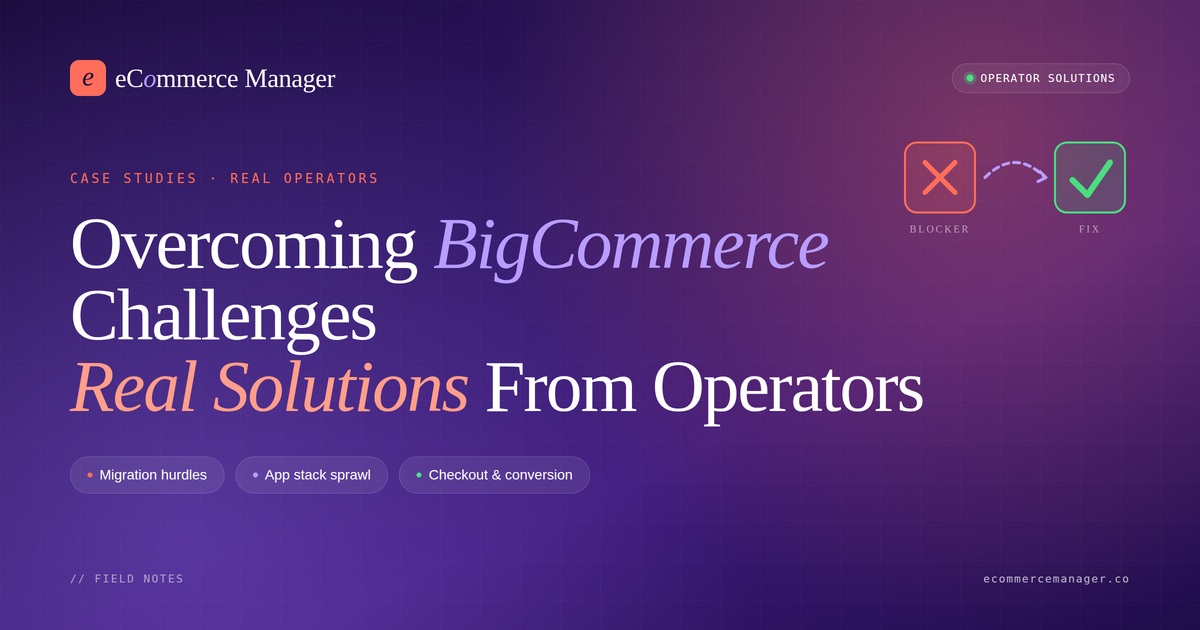
Overcoming BigCommerce Challenges: Real Solutions From Ecommerce Businesses
BigCommerce offers powerful features, but scaling an online store on the platform comes with technical hurdles that can slow growth and drain resources. This article breaks down nine practical strategies that successful ecommerce businesses have used to solve common BigCommerce limitations, with insights from developers and store owners who have implemented these solutions. From API integrations to SEO optimization, these real-world approaches provide actionable blueprints for overcoming the platform’s most frustrating obstacles.
- Prune Facets to Restore Crawl Budget
- Centralize Inventory With Webhooks
- Move Content to WordPress
- Queue Events to Prevent Rate Limits
- Validate Feeds Daily to Cut Waste
- Redirect Ads Toward Available Products
- Build Custom Functions Via APIs
- Lift Rankings Through Targeted SEO
- Simplify Variants Through Sales Data
The State of eCommerce in 2026
Prune Facets to Restore Crawl Budget
One major issue faced by many BigCommerce stores with large product catalogs is how “facets” can quietly consume all your crawl budget. By default, BigCommerce allows filter options to create URLs that are crawlable as well. On a site with a moderately sized catalog, this creates thousands of similar pages. All of these pages compete for ranking against each other and the actual category pages that drive conversions.
For example, I recently worked on a project where the organic positions for key category terms began to drop off. At first, my client thought this might be an issue with the quality of their content. Following our normal process (indexing > internal linking > intent), however, it became clear what was going on: Googlebot was crawling almost exclusively filter permutations rather than the pages that should have been ranking. This isn’t because the store was generating bad content—it simply generated near-identical filter URLs that the search engine crawled in lieu of the pages we were trying to get ranked.
To correct this, we did a type of “pruning.” We created parameter handling rules to stop the low-value filter URLs from being indexed. Then, we added canonical tags to point all of those URLs back to the clean category page they belonged to. Lastly, we rebuilt the site’s internal linking to send authority to the category pages that were driving commercial activity. Once again, category pages regained their position and crawl stats reflected the fact that crawl budget was once again being spent on the URLs earning it.
The Complete 2025 E-commerce Manager Career Guide: From Entry-Level to Executive

Centralize Inventory With Webhooks
Scaling from a single storefront to BigCommerce, marketplaces, and a physical location, our inventory counts kept drifting apart — a sale on one channel wouldn’t reflect fast enough on another, leading to oversells and cancelled orders. My first instinct was to resist manual patching — spreadsheets and manual counts don’t scale and just add human error. So I mapped the actual data flow to find where the real gap was: every channel treated itself as the authoritative source, guaranteeing conflicts.
We connected BigCommerce via API to a middleware inventory tool, with our warehouse system as the single source of truth. Every channel became a subscriber to one feed, not an independent record. We also moved from scheduled syncing to webhook-triggered updates, so stock changed the moment a sale happened.
BigCommerce gave us the flexibility to solve it — it didn’t solve it by itself. Now I ask, “What’s the single source of truth?” before asking what features a tool has.

Move Content to WordPress
Our biggest issue with BigCommerce was its built-in blog feature. It was just too basic for our content strategy. We could not easily add custom layouts, author bios, or related product widgets. We rely heavily on articles to drive traffic, so this was a massive roadblock. I started by looking into hiring a developer to custom code the blog pages. However, the quotes we received were way over our budget. I then researched alternative ways to host content. My solution was to set up a separate WordPress site on a subdomain. We linked it directly from our main shop navigation menu. We used a matching colour scheme and logo so customers hardly notice they are switching sites. This gave us the powerful writing tools of WordPress while keeping our shop secure on BigCommerce. It took some effort to set up, but our search engine traffic has doubled since then.

Queue Events to Prevent Rate Limits
The technical difficulty I often face in complex BigCommerce projects is dealing with API rate limit congestion when performing large-scale catalog synchronizations with other ERP systems. As soon as the scale of a business rises to thousands of SKUs and real-time inventory and pricing on different storefronts are needed, we find that the regular REST API limits become restrictive. I have seen synchronization processes crash as a result of integration logic trying to push too much data at once.
To overcome this issue, I provide guidance to my engineering teams on switching from point-to-point synchronous integration to an asynchronous, event-driven setup. Instead of the ERP sending full catalog updates according to a fixed schedule, we use a middleware layer with the help of a message queue. This allows the system to see all the changes in the ERP, store them, and then transfer them to the BigCommerce API at the highest speed without violating the platform’s rate limits.
The next step in optimizing the solution is to move away from polling logic and use webhooks instead. By responding to specific changes instead of asking the system for the complete data, we manage to decrease the number of API calls dramatically. This is a smart approach that transforms the processes from error-prone to stable. The main lesson learned is that the scalability of the platform depends on the quality of the API.

Validate Feeds Daily to Cut Waste
A BigCommerce client of ours in the UAE had a feed sync problem that quietly drained about $3,200 (AED 11,800) a month in wasted ad spend before we caught it. Their product feed was pushing variants—each color and size as a separate SKU—into Google Merchant Center, but half of those variant IDs weren’t matching what the storefront actually had in stock. Google kept serving ads for sizes that were sold out; shoppers clicked, hit a dead end, and bounced.
We fixed it by setting up a daily feed validation check instead of relying on BigCommerce’s default weekly refresh, catching mismatches within 24 hours instead of finding out from a frustrated customer email. We also split the feed rules so low-stock variants dropped out of Shopping ads automatically once inventory hit zero, rather than waiting for a manual pause.
My recommendation to other shops running paid ads on BigCommerce: don’t trust the platform’s default sync cadence for anything with size or color variants. Build in a same-day check, because a stale feed doesn’t just cost you the sale; it costs you the ad spend that sent the shopper there in the first place.

Redirect Ads Toward Available Products
Over 15 years of scaling eCommerce brands from $1 million to over $200 million in revenue, a recurring challenge I’ve tackled with BigCommerce stores is managing ad spend efficiency during unexpected inventory delays. Basic product-level feeds often keep pushing ad spend toward out-of-stock items, burning budget on clicks that can’t convert.
My problem-solving process focused on auditing our data flow to cut wasted spend without halting sales momentum. Instead of running campaigns tied strictly to individual product variants that were delayed, we restructured the strategy around broader category campaigns and targeted high-intent audience segments.
We optimized ad copy and dynamic assets around available product lines while shifting to smart bidding to capture high-converting shoppers. This minimized wasted ad spend, maintained strong conversion momentum, and delivered online sales at a much lower cost per click.

Build Custom Functions Via APIs
BigCommerce trips people up because its theme system, Stencil, is less flexible for deep custom work than clients often expect. An unusual design or feature can be harder to build than on a more open platform.
On one project, a client wanted a bespoke feature the platform didn’t handle neatly. Forcing it through the theme would have meant fragile, hard-to-maintain code.
We got there by working with the platform instead of against it, using its API to build the function properly as a clean, separate piece rather than hacking the theme apart. The build stayed stable and easy to maintain.
What I took away was to stop bending a platform into doing something it resists, and find the route it genuinely supports instead. Playing to a platform’s real strengths beats fighting it every time.

Lift Rankings Through Targeted SEO
One challenge we tackled for an ecommerce client using BigCommerce was poor organic visibility on their product pages despite solid site speed. Their rankings for key terms like “eco-friendly home goods” stayed buried on page two, limiting traffic and sales growth.
First, we ran a full site audit to pinpoint issues like thin meta descriptions, duplicate content from auto-generated variants, and weak internal linking. We explained the tradeoffs to the stakeholder right away: investing in content would pull resources from their paid campaigns short-term but deliver compounding organic wins. They bought in because we built trust through clear communication and shared data-backed projections.
Next, we prioritized work when resources felt tight by focusing on high-impact pages first. We created 150 targeted blog posts over six months that wove in product links naturally, optimized on-site elements with technical SEO tweaks, and built 200 authoritative backlinks from relevant industry sites. We monitored everything weekly, adjusting based on performance data to stay on track.
The result? Their main category pages climbed to position three within four months, driving a 45% lift in organic sessions and converting that traffic into measurable revenue.
Simplify Variants Through Sales Data
The hardest thing I ran into on BigCommerce was product variants. We had a catalog where a single item existed in a dozen configurations, and the option sets we’d built didn’t map cleanly to how inventory moved. Customers would order combinations we couldn’t reliably ship, and my support inbox turned into a manual reconciliation job.
My fix started with pulling every order from a 60-day window and sorting by which variant combinations sold. Most of the SKU sprawl never got bought. So I cut the option tree down to what people were ordering, made the low-volume configurations quote-only, and rebuilt the remaining variants as discrete SKUs with their own inventory counts.
Cancellations from unfulfillable orders basically stopped, and the product pages got simpler, which helped conversion more than any design change I made that quarter.
Across both of the e-commerce companies I built and eventually sold, the pattern held. When a platform limitation felt like a wall, the actual problem was usually that we were asking it to support complexity our customers had never asked for. I learned to look at what’s selling before I looked at what’s broken, and the order data would show me which half of the catalog I could delete.

Related Articles
- 7 Tips for Overcoming Your Biggest WooCommerce Challenge
- Effective Shipping Strategies for Your BigCommerce Store
- 4 Unexpected Challenges When Launching An Ecommerce Store