

Last Updated on August 26, 2026
The SEO Impact of Replatforming in 2026: The Operator's Guide
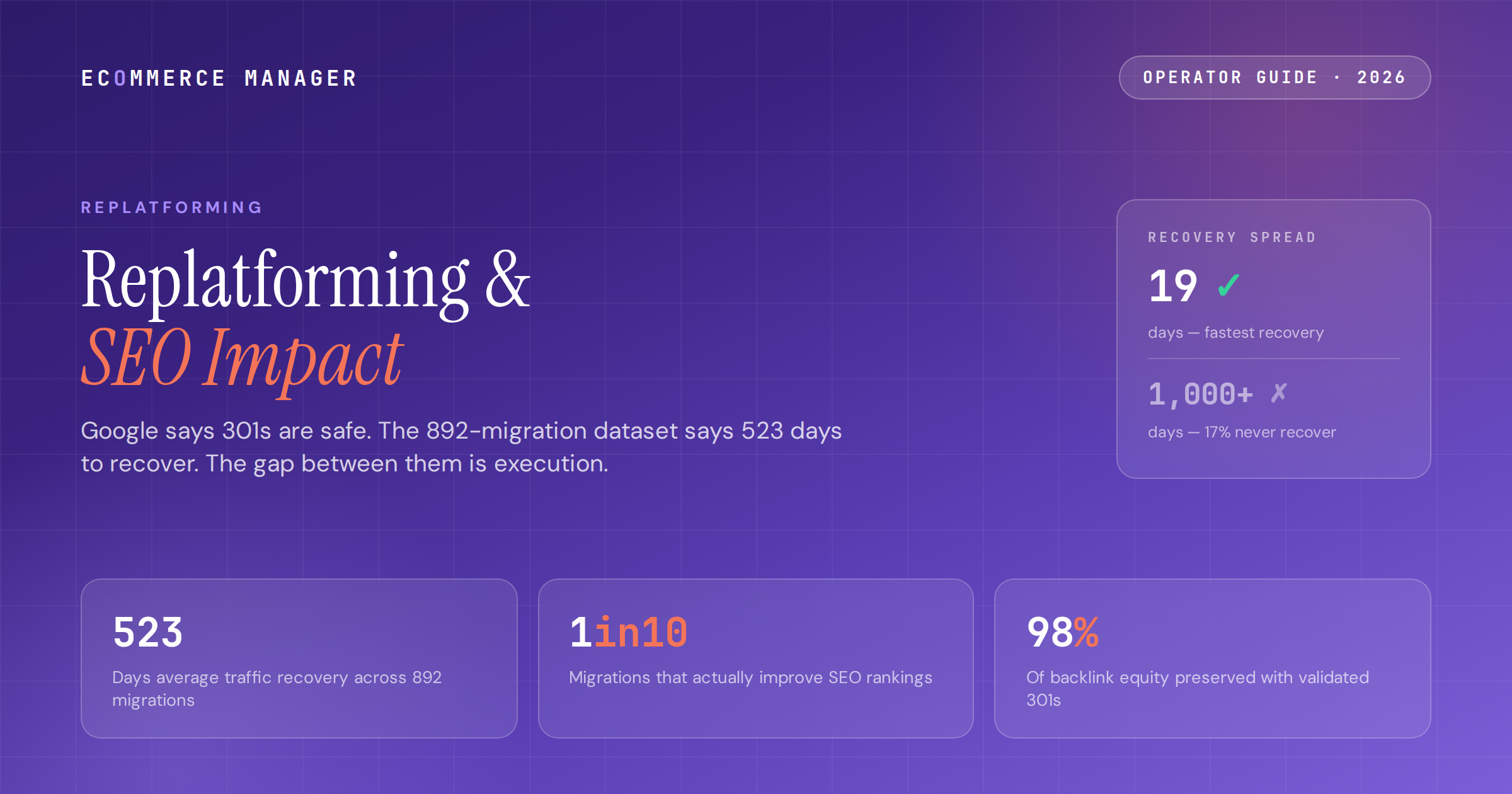
Google says 301s don't lose PageRank. The largest migration dataset says the average site takes 523 days to recover. Both are true, and the gap between them is this guide.
On this page
Two true statements that seem to contradict each other
Statement one comes from Google's own site-move documentation, updated June 17, 2026: "301 and other permanent redirects don't cause a loss in PageRank." John Mueller has said ranking stabilization after a well-executed migration typically takes 4–12 weeks. By Google's account, replatforming is a routine, temporary adjustment.
Statement two comes from the largest available dataset. Search Engine Journal's analysis of 892 domain migrations found the average site took 523 days — about 17 months — to recover its organic traffic, and 17% never recovered even after 1,000 days. An earlier study of 171 migrations put the never-recovered figure at 42%. Only about 1 in 10 migrations end with improved rankings.
Both are true because they measure different things. Google describes what happens when the redirect signal is complete and clean. The dataset describes what teams actually ship. The same 892-migration study recorded recoveries in 19, 22, and 23 days — proof the 4–12 week outcome is available to anyone who does the work. This guide covers what the data says actually happens to traffic, the specific mechanisms that leak equity, the new AI-citation stakes that didn't exist two years ago, and how to read your own numbers after launch.
What actually happens to organic traffic
Strip the anecdotes and the distribution looks like this. It's wider — in both directions — than most operators assume.
-
01The full distribution from the 892-migration dataset: average recovery 523 days, fastest recoveries 19–23 days, 17% never recovered after 1,000 days. Industry syntheses put 60–80% of migrations at some measurable traffic loss, and only about 1 in 10 improving rankings. Nearly the entire spread is explained by execution, not platform choice.
-
02The normal, healthy pattern: a 10–30% organic dip that stabilizes within 2–6 weeks, with recovery to 95–100% of baseline by weeks 8–12 for well-executed migrations. Ecommerce-specific cases cluster around a 15% dip in month one, recovered by month three. Enterprise sites past 50,000 pages run longer; 3–6 months is typical.
-
03The unhealthy pattern has a name in agency practice: the migration hangover. A drop of 50% or more with no recovery after four weeks. It marks a structural failure (missing redirects, a shipped noindex tag, broken canonicals), not normal recrawl volatility, and it requires diagnosis rather than patience.
-
04The downside cases are expensive and specific. One large retailer lost roughly $5M in a single month after its IT consultants rejected URL redirect recommendations during a redesign. Another documented case dropped 63% overnight after redirecting HTML pages but forgetting linked assets — images, PDFs, videos — then spent 11 days fixing redirects and four months recovering.
-
05The upside cases are just as documented. An ecommerce migration handled as an SEO project produced a 126% organic traffic increase; another recovered rankings a botched earlier migration had destroyed and added 139,000 monthly organic sessions plus 22,000 new keywords. Migration done well is an optimization event, not a survival event.
-
06Ahrefs adds the number that should shape your caution: 60% of pages that lose rankings in a migration never fully recover them. Traffic recovers in aggregate before it recovers page by page, which is why the protection work in this guide happens per-URL, ranked by value, and why the ECM migration checklist treats the crawl as Phase 1, not a launch-week task.
Planning the move behind the SEO question?
Plug your revenue, AOV, and platform costs into the ECM Platform Calculator for a three-year TCO comparison across five platforms — the commercial half of the replatforming decision.
Where the equity actually leaks
Google doesn't penalize platform changes. Traffic leaks through a short list of specific, preventable mechanisms — and knowing them by name is most of the defense.
The redirect-layer leaks
-
→Incomplete maps. The classic version in ecommerce: platform URL structures change wholesale (Shopify's /products/ and /collections/ paths never match Magento's or WooCommerce's — the route-specific traps are in the ECM Magento and Shopify migration guides), and any URL without an explicit 301 to its closest equivalent becomes a 404. Bulk-redirecting everything to the homepage doesn't count — Google treats it as a soft 404 and the equity evaporates anyway.
-
→Redirect chains and 302s. Chains leak link equity and slow crawling; temporary redirects tell Google the move isn't permanent. The standard is one clean server-side 301 per URL: not JavaScript redirects, not meta-refresh, no intermediate hops.
-
→Forgotten non-HTML assets. The 63%-overnight-drop case above came from exactly this: images, PDFs, and downloadable resources carry backlinks and rankings too. A two-year-old whitepaper with 40 backlinks ranking #3 for a valuable keyword loses all of it if deleted without a redirect.
The on-page and technical leaks
-
→Metadata that doesn't survive the transfer. Custom title tags and meta descriptions (often stored in platform-specific attributes) arrive lost, truncated, or replaced with defaults. Migration tools treat SEO fields as premium add-ons and silently skip them on basic plans. Verify top pages against the pre-migration export.
-
→Launch-day technical landmines: the staging noindex tag that ships to production, canonicals still pointing at the staging hostname, and an outdated XML sitemap. Each one is a five-minute check in staging and a multi-week recovery in production.
-
→Core Web Vitals regression. If the new platform loads slower than the old one, rankings decline even with perfect redirects — one documented case tied a 44% organic decrease to a rushed launch. Post-launch targets: LCP under 2.5 seconds, INP under 200ms, CLS under 0.1. Speed is part of the SEO migration scope, not a separate project — and worth a tech stack audit line item before the theme build starts.
-
→Content changed mid-migration. Redesigns that quietly rewrite headers, thin out body copy, or remove optimized content stack a second variable on top of the platform change — and make the post-launch diagnosis ambiguous. Migrate first, optimize second, or accept that you won't know which change caused what.
The second scoreboard: AI citation equity
A migration in 2026 is judged on two boards. Rankings retained is the old one. Citations retained — across AI Overviews, Perplexity, and ChatGPT — is the new one, and most migration checklists don't mention it.
-
01A botched migration can remove a site from AI answers as fast as from rankings. AI answer engines assemble citations from crawlable, structured, consistently-resolving pages. Broken redirects and lost schema don't just drop positions; they drop the site out of the answer layer entirely, and the operator often doesn't notice because nobody was tracking it.
-
02Schema preservation moved from nice-to-have to launch-day non-negotiable. Product, Review, FAQ, and Breadcrumb markup must render — server-side — on the new platform from day one. Well-structured product pages increasingly surface in Google AI Overviews with no extra optimization, which means the markup is now a traffic asset with a measurable value, not a checkbox.
-
03Add an AI-citation KPI to the migration baseline. Before launch, record where the site appears in AI Overviews and answer-engine citations for the top 20–30 revenue queries alongside classic rank tracking. It's a second before-and-after that catches losses classic rank trackers miss, and it belongs next to the conversion and traffic baselines in your core KPI set.
-
04The upside runs through the same pipe. Platforms with strong default structured data give migrating merchants an AI-visibility bump they never explicitly built — one of the quieter reasons replatformed stores sometimes exceed their old organic baseline instead of merely recovering it. Platform-by-platform schema defaults are covered across the ECM platform reviews.
The protection work, in priority order
Pre-migration work determines 60–70% of the outcome before anything goes live. The playbook below is ordered by traffic value, because engineering hours are finite and URL counts are not.
-
01Export a 12-month baseline you'll defend later: top pages by clicks and impressions, top queries, average positions, and organic sessions from Search Console and analytics. Without this snapshot, the post-launch argument about whether the migration worked is unwinnable in either direction.
-
02Crawl everything, then map by value, not by count. The working rule from migration practice: the top 20% of pages drive roughly 80% of organic traffic, so score URLs by traffic and backlink equity and build the redirect map in that priority order. Every URL still gets a 301, but the pages that pay the bills get mapped, reviewed, and tested first.
-
03Validate in staging like it's the launch. Crawl the redirect map against the staging site, confirm the highest-value pages resolve with single clean 301s, check for the noindex tag and staging-hostname canonicals, and verify schema renders server-side. Errors in URL mapping compound irreversibly after launch; in staging they cost minutes.
-
04Launch with the monitoring already running: real-time crawl monitoring at cutover, the new sitemap submitted, the old sitemap briefly accessible so crawlers process the redirects, and Search Console coverage watched daily for two weeks. A 404 spike caught on day two costs hours; found in week six it costs a quarter.
-
05Keep redirects alive for the long haul: 12 months minimum, longer for domain moves. Redirect maintenance is the most commonly abandoned piece of migration hygiene, and pruning redirects early is how recovered equity leaks a second time. If organic drives meaningful revenue, a migration-experienced SEO specialist owning this playbook end-to-end is the cheapest insurance available against the 523-day outcome.
Don't run the redirect map alone.
The ECM directory lists vetted migration and SEO specialists with verified client reviews — filtered by platform, budget, and vertical, including teams whose entire job is the crawl, the map, and the validation.
Reading your recovery: dip, hangover, or win
The post-launch weeks are a diagnosis exercise. The data gives you clean thresholds for which situation you're in and what each one demands.
-
01Weeks 1–2: volatility is the plan working. Expect 5–15% fluctuation in the first 30 days as the index recrawls; a 10–30% dip is within normal range. The checks that matter now are mechanical (coverage reports, 404 lists, redirect spot-checks on top pages), not rank obsessing.
-
02Weeks 2–6: the fork. Stabilizing toward baseline means you're on the healthy curve; hold your nerve and change nothing. A sustained drop past 30% points to a real technical problem worth diagnosing now. A drop of 50%+ with no recovery after four weeks is the hangover — audit for the structural failures (missing 301s, noindex, canonicals) immediately, because waiting doesn't fix structural causes.
-
03Weeks 8–12: the verdict window. Well-executed migrations sit at 95–100% of baseline here, matching Mueller's 4–12 week stabilization guidance. Run the review against the pre-migration snapshot (traffic, positions on top queries, AI citations, and Core Web Vitals) and score it honestly.
-
04If you're in the bad tail, act like it. The 523-day average exists because teams treated structural failures as volatility and waited. The documented fast fixes (the 63%-drop case recovered in four months once redirects were completed in 11 days) share one trait: someone diagnosed the mechanism instead of watching the graph. ECM tracks how these platform moves keep playing out in weekly Insights.
-
05And if you're at baseline by week 12, you're not done. You're at the starting line. The 1-in-10 migrations that improve SEO treat recovery as the floor: the new platform's speed, schema, and structure become the optimization budget the old stack never allowed. That's the actual return on the whole exercise.
What a smart operator does with this
Hold both true statements at once. Google's documentation is right that 301s preserve ranking signal, and the 892-migration dataset is right that the average site takes 523 days to recover, because the dataset measures what teams actually ship. The 19-day recoveries and the never-recovered 17% ran the same kind of project with different discipline. Plan for the version Google describes; budget monitoring for the version the data describes.
Defend equity by value, not by URL count. The top 20% of pages carrying 80% of organic traffic get mapped first, tested first, and monitored first, including the PDFs and images that carry backlinks nobody remembers. One clean server-side 301 per URL, no chains, validated in staging, and kept alive for at least 12 months.
Track the second scoreboard. A 2026 migration that preserves rankings but loses AI citations has still lost traffic. Record where you appear in AI Overviews and answer engines for your top revenue queries before launch, ship server-rendered schema on day one, and measure both boards at the week-12 review. Recovery to baseline is the floor; the platforms worth migrating to make the ceiling higher.
Frequently asked questions
Does replatforming hurt SEO?
Not inherently, but execution decides everything. Google's own documentation states that 301 redirects don't cause a loss in PageRank, and well-executed migrations typically dip 10–30% and recover to 95–100% of baseline within 8–12 weeks. The observed data is harsher because most teams execute poorly: a study of 892 migrations found an average recovery of 523 days, with 17% of sites never recovering. The gap comes from incomplete redirect maps, redirect chains, lost metadata, and shipped staging tags — all preventable.
How long does SEO recovery take after a platform migration?
For well-executed migrations: a 10–30% dip stabilizing within 2–6 weeks and recovery to 95–100% of baseline by weeks 8–12, matching Google's John Mueller's 4–12 week stabilization guidance. Enterprise sites past 50,000 pages typically take 3–6 months. The fastest documented recoveries in the 892-migration dataset were 19–23 days. Poorly executed migrations average 523 days, and a drop of 50% or more with no recovery after four weeks indicates a structural failure that requires diagnosis, not patience.
How much traffic do sites lose during replatforming?
The distribution is wide. Industry studies suggest 60–80% of migrations see some measurable traffic loss, with a normal healthy dip of 10–30% that recovers. Only about 1 in 10 migrations improve rankings. The tail cases are severe: documented incidents include a 63% overnight drop from unredirected non-HTML assets and a retailer losing roughly $5 million in one month after skipping redirect recommendations. On the other side, migrations run as SEO projects have produced documented gains of 126% in organic traffic.
What causes SEO traffic loss during a migration?
A short list of specific mechanisms: incomplete 301 redirect maps (especially when URL structures change wholesale), redirect chains and 302s that leak equity, forgotten non-HTML assets like PDFs and images that carry backlinks, metadata and schema lost in transfer, staging noindex tags or canonicals shipped to production, Core Web Vitals regression on the new platform, and content quietly changed during the redesign. Google does not penalize platform changes themselves — every major loss traces to one of these execution failures.
How do I protect AI search visibility during a migration?
Treat it as a second scoreboard alongside rankings. Before launch, record where your site appears in Google AI Overviews and answer-engine citations for your top 20–30 revenue queries. Ensure Product, Review, FAQ, and Breadcrumb schema renders server-side on the new platform from day one — AI answer engines assemble citations from crawlable, structured, consistently-resolving pages, so broken redirects and lost markup remove you from AI answers as fast as from rankings. Measure both boards at the week-12 review.
The playbook top eComm operators actually read
One weekly brief. Five stories that matter. Zero fluff. Written for managers at $5M–$50M DTC brands who want to sound sharper than everyone else in the meeting.
References
- 01 SEO Site Migration in 2026: Zero-Traffic-Loss Playbook — digitalapplied.com
- 02 Ecommerce Migration SEO: Will You Lose Your Rankings? — mercuryminds.com
- 03 Website Migration SEO: Avoid 50% Traffic Loss — numentechnology.co.uk
- 04 Site Migration Checklist: SEO Tasks Prioritized by Traffic Impact (2026) — o8.agency
- 05 Website Migration Checklist SEO: The 2026 Guide — webtonic.io
- 06 SEO Migration Checklist: Protect Traffic and Rankings — heygenyl.com
- 07 Website Redesign SEO Migration Checklist (2026) — seolevelup.com
- 08 SEO Site Migration: Migrate Without Losing Traffic — seobeni.com
- 09 Magento to Shopify Migration Case Study: 63% Organic Growth — eastsideco.com
- 10 eCommerce SEO Migration Case Study: 126% Increase in Traffic — goinflow.com
- 11 5 Costly eCommerce Replatforming Mistakes 2026 — edgebound.xyz
- 12 Ecommerce Platform Migration: How to Replatform Without Losing Revenue — conception-labs.com
- 13 WooCommerce to Shopify Migration: Gains, Losses & Real Cost — appwrk.com
- 14 WooCommerce vs Shopify: Honest Comparison for 2026 — sherocommerce.com
- 15 27 Ecommerce Migration Statistics That Guide Successful Platform Transitions — swell.is
Make your platform decision data-backed
Join 12,000+ ecommerce managers reading the ECM newsletter every Wednesday — or browse the directory to find vetted migration, CRO, and platform specialists.