


Last Updated on June 16, 2026
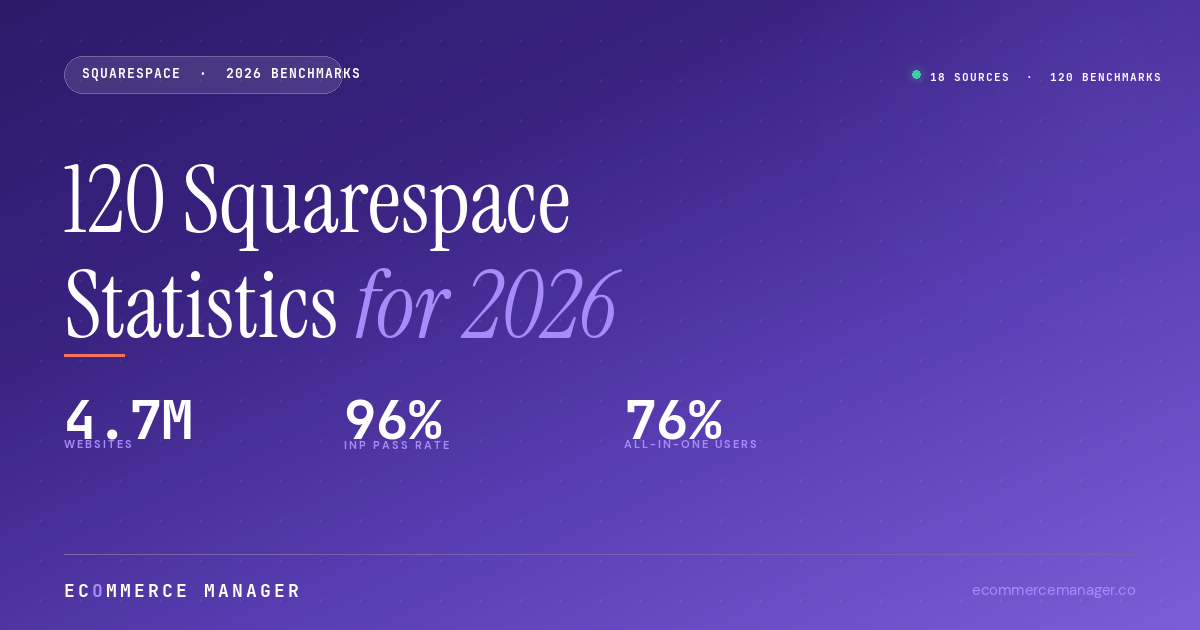
120 Squarespace Statistics for 2026
Squarespace powers 4.7M sites and the best responsiveness scores among major builders — but the lowest SEO scores. 120 numbers from 18 sources on where Squarespace wins (service businesses, content brands), where it loses (technical SEO, ecommerce depth), and when operators migrate.
On this page
Why Squarespace deserves a closer look — and where its limits show
Squarespace gets pigeonholed as the "designer-friendly Wix" — and for some of its 4.7M sites, that's accurate. But the 2026 numbers reveal a more specific identity: Squarespace dominates among service businesses (consultants, designers, photographers, wellness, agencies) and is quietly growing in ecommerce — store count grew 24% YoY in Q1 2026, and 28.5% of platform revenue now comes from commerce features.
The platform's real story is performance: 96% INP responsiveness pass rate, the best among major builders. Sites feel instant. But the catch is brutal — Squarespace also posts the lowest average SEO score (40.5/100) in the same benchmark. The performance advantage means little if organic traffic doesn't reach it.
For $5M–$50M DTC operators, Squarespace shows up in two places: as a starting platform brands migrate off when ecommerce depth or B2B requirements outgrow native capabilities, and as a legitimate option for content-heavy or service-led businesses where design control, booking integration, and brand consistency matter more than checkout flexibility. This guide pulls 120 statistics from 18 sources, organized to inform both decisions.
1. The Squarespace ecosystem — service businesses lead, ecommerce is catching up
4.7M sites, $1B+ revenue, 24% YoY ecommerce store growth. The standout segment is service businesses: 93% say Squarespace makes them feel more professional, and 1 in 3 customers report revenue lift after migrating in.
-
01Squarespace powers about 2.5% of all websites and 3.5% of sites using a known CMS as of March 2026, with roughly 4.7 million websites built on the platform.
-
02Squarespace generated $1B+ in annual revenue in 2024, with about 16.8% year-over-year revenue growth, showing strong platform demand.
-
03Around 71.5% of Squarespace revenue comes from presence (websites) and 28.5% from commerce, meaning a large user base is adding ecommerce and bookings on top of content sites.
-
04Squarespace earns over 71% of revenue from US customers, with the remaining ~29% from international markets, highlighting a strong but expanding global footprint.
-
05Earlier data show Squarespace powering about 14–15% of online stores in some ecommerce samples, making it one of the most popular hosted ecommerce platforms.
-
06Squarespace's GMV was around $5.78 billion in 2021 and has continued to grow as more sites add ecommerce and bookings.
-
07StoreLeads reports Squarespace stores grew 24% year-over-year in Q1 2026, even though store count dipped 5.3% quarter-over-quarter, reflecting consolidation but strong annual growth.
-
08Squarespace manages 10+ million domains, making it a major registrar and a key part of many small business brand stacks.
-
09Squarespace has a 96% INP responsiveness pass rate, the highest responsiveness score among major platforms, which matters for perceived speed and user satisfaction.
-
10Despite good responsiveness, the average SEO score of Squarespace sites is 40.5/100, the lowest among major builders in one benchmark, suggesting large optimization upside.
-
11Google Trends data show Squarespace's highest popularity in Australia, followed by New Zealand, the US, Canada, and the UK, signaling strong adoption in English-speaking markets.
-
12Squarespace's service-business survey of 500+ businesses found 82% of service businesses say clients increasingly expect a clear and professional online experience before committing.
-
1378% of service businesses agree that clients hesitate when services are unclear online, and 67% say clients are less likely to book if they can't do it online, underscoring the importance of clear digital journeys.
-
1493% of Squarespace customers agree that their Squarespace website and client experience make their business feel more professional and credible.
-
1575% of Squarespace customers say clearly organized services on their site have increased inquiries and bookings.
-
16Among Squarespace service-selling customers, 65% use three tools or fewer to run their business, showing consolidation around an all-in-one stack.
-
17By contrast, 52% of non-Squarespace service businesses rely on four or more tools, and about 25% spend over 16 hours per week on admin, indicating a fragmentation disadvantage.
-
1843% of Squarespace service customers spend less than five hours per week on admin tasks, freeing more time for billable work and marketing.
-
191 in 3 Squarespace customers report increased revenue after moving to Squarespace, attributable to clearer online experiences and integrated tools.
-
20Overall 2026 consumer trends show shoppers want trust-first, seamless journeys across discovery, booking, and payment, which Squarespace positions itself to support end-to-end.
Outgrowing native Squarespace email?
Squarespace email plus Beacon AI works well at low list sizes. At scale (25k+ subscribers) most brands move to Klaviyo or Omnisend for deeper segmentation, lifecycle flows, and proper revenue attribution. The directory lists vetted partners who've migrated brands without losing list health.
3. Email and CRM — built-in, AI-assisted, and good enough until it isn't
Native Squarespace email plus Beacon AI handles welcome, nurture, and post-purchase flows without third-party tools. 76% of customers manage discovery, booking, and payment in one place. The trade-off: limited at scale vs Klaviyo's depth.
-
01Squarespace offers a full suite of built-in email campaigns, with templates that automatically match the site's design, simplifying brand-consistent email marketing.
-
02Squarespace's Beacon AI provides AI-assisted email copy, enabling users to generate and tweak campaigns faster.
-
03Marketing automations in Squarespace map out customer journeys, including welcome, nurture, and post-purchase flows, without third-party tools.
-
04Squarespace analytics includes revenue, conversion, and cart abandonment data so merchants can directly tie email campaigns and flows to sales.
-
05Squarespace's service-business survey found 46% of service businesses say marketing is their most time-consuming weekly task, reinforcing the value of automation.
-
06Consolidation around Squarespace allows 65% of customers to run their business on three tools or fewer, reducing friction between website, email, and scheduling.
-
07Squarespace email and scheduling support the full client journey: 76% of customers say Squarespace lets them manage discovery, booking, and payment in one place.
-
08Email addresses are published on 54% of Squarespace stores, indicating that over half of merchants present direct contact channels in addition to forms.
-
09Around 36% of Squarespace stores list a phone number, offering another trust-building contact method alongside email.
-
10Industry data Squarespace cites align with common benchmarks: email remains one of the highest-ROI channels, often returning $36–$40 per $1 spent for ecommerce brands.
-
11Email is central to building first-party data as third-party cookies fade, something Squarespace explicitly highlights in its SEO and marketing content.
-
12Squarespace customers commonly use email to re-engage visitors who filled out forms or started cart/booking flows, relying on built-in analytics for timing and segmentation.
-
13Squarespace analytics dashboards show pageviews, referrers, sales, and conversion, enabling data-driven email segmentation based on behavior.
-
14Many Squarespace guides recommend pairing email campaigns with blog content and lead magnets to convert organic and social traffic.
-
15Squarespace's integration with payment, booking, and membership features enables behavior-based email triggers, giving SMBs sophisticated lifecycle tools without code.
-
16As AI search and Overviews pull answers directly into SERPs, Squarespace suggests email and owned channels will become even more important to maintain relationships beyond search clicks.
-
17Internal surveys highlight that businesses want seamless end-to-end experiences; 80% of non-Squarespace businesses agree a more unified client experience would help them grow, which includes email.
-
1879% of non-Squarespace respondents say having the client experience in one place would give them more time for actual work vs managing multiple tools, underscoring the appeal of integrated Squarespace email.
-
19Squarespace markets email automation as a way to scale marketing without hiring additional staff, crucial for solopreneurs and micro-teams.
-
20Squarespace's AI roadmap includes deeper AI-driven recommendations for email content, subject lines, and send-time optimization, following broader marketing AI trends.
4. Mobile commerce and UX — Squarespace leads on responsiveness, lags on SEO
96% INP pass rate is best-in-class — Squarespace sites feel instantly responsive. The catch: 40.5/100 average SEO score is the lowest among major builders. The performance win means little if you can't get organic traffic to it.
-
01Squarespace's 96% INP responsiveness pass rate signals top-tier interactive responsiveness, important for mobile shoppers who expect sites to feel instant.
-
02Web performance benchmarks show Squarespace scoring best-in-class on responsiveness compared to other major site builders, though not necessarily on SEO.
-
03Squarespace analytics provides device-level insights (mobile vs desktop) so merchants can track how mobile visitors behave and convert.
-
042026 web-design trend guides highlight mobile-first design and card-based layouts as standard, with Squarespace templates adopting these patterns broadly.
-
05Squarespace's commerce features (including checkout and product pages) are fully responsive by default, reducing the risk of poorly adapted mobile pages.
-
06Modern design trends like motion narrative and "card play" help structure content in digestible blocks for small screens.
-
07Tiny Coast's 2026 trends note that AI will quietly update stores via chat, iterate CSS, and serve different paths to different people, many of which improve mobile experiences behind the scenes.
-
08Squarespace encourages strong visual clarity, generous whitespace, and readable typography — all critical for mobile UX and accessibility.
-
09Service-based Squarespace businesses increasingly rely on online booking and payment; 67% of businesses say clients are less likely to book if they can't do so online, often from mobile.
-
1082% of service businesses agree that clients expect a professional online experience before committing, which includes smooth mobile pages and clear flows.
-
11Squarespace sites commonly incorporate clean navigation, pinned headers, and prominent CTAs to simplify mobile journeys.
-
12Squarespace Analytics tracks conversion, cart abandonment, and sales so merchants can identify mobile bottlenecks and test fixes.
-
13Industry-wide, shoppers increasingly research and buy on mobile, especially for visual categories; Squarespace templates target creatives and stores in these niches.
-
14Many Squarespace themes support full-bleed imagery and vertical scrolling experiences, optimized for mobile storytelling.
-
15As AI search rises (expected to handle 25% of global queries by 2026), Squarespace suggests structuring content for quick answers and good UX to win AI citations that drive mobile traffic.
-
16Squarespace's SEO and design guidance encourages structured content blocks, FAQ sections, and question-answer formats, which also read well on mobile.
-
17Payment integrations support mobile-friendly methods (cards, wallets), aligning with B2C expectations for easy checkout on phones.
-
18Squarespace's INP performance advantage can lower bounce rates for mobile shoppers who are sensitive to delays and jank.
-
19Tiny Coast notes that AI-infused workflows will increasingly serve different messaging and paths to different people based on who they are, likely including device context.
-
20Overall, Squarespace positions responsive design + fast interactions + AI tuning as key to converting mobile traffic into revenue in 2026.
Best responsiveness, lowest SEO scores — does the platform math work for you?
The Platform Calculator runs Squarespace against Shopify, BigCommerce, WooCommerce, and Wix on real 3-year TCO including the SEO and ecommerce-depth trade-offs that decide whether you stay or migrate.
5. Personalization — AI-aware content beats traditional recommendation widgets
Squarespace's 2026 personalization story isn't recommendation carousels — it's structuring content so AI assistants cite it. 25% of global queries are expected to go through AI by 2026. Question-and-answer formats win in that environment.
-
01Squarespace's SEO and AI search trends report says AI assistants like ChatGPT are expected to handle 25% of global queries by 2026, meaning customers often arrive with AI-shaped expectations and queries.
-
02Squarespace advises structuring content as direct question-and-answer pairs to win placements in AI Overviews and AI assistants, effectively personalizing for "questions people ask."
-
03Salsify's 2026 consumer research shows 22% of shoppers use AI tools for product research, so brands must present clear, deep content that AI can ingest and summarize accurately.
-
04Squarespace's design and UX trend content emphasizes AI-driven personalization, with sites increasingly serving different messaging and flows to different types of visitors.
-
05Tiny Coast notes AI will "serve different messaging and paths to different people based on who they are and what they actually need," which is the essence of personalization.
-
06Squarespace's analytics stack provides visitor and behavior data (pageviews, referrers, conversion, cart abandonment) to fuel personalized experiences and content testing.
-
0782% of service businesses say clients expect a clear, professional online experience before committing; personalization of services, packages, and messaging helps meet that expectation.
-
0878% say clients hesitate when services are unclear; tailoring service descriptions, FAQs, and onboarding content by audience can reduce that friction.
-
0976% of Squarespace customers agree the platform allows them to manage the full client journey in one place, enabling consistent personalized experiences from discovery through payment.
-
10Squarespace customers condensing tools (65% using three tools or fewer) can unify data more easily, improving the quality of personalization and segmentation.
-
11Email and automation features let Squarespace users send targeted campaigns based on behaviors such as form submissions, product purchases, or bookings.
-
12Squarespace's design system encourages modular content blocks that can be swapped for different segments or campaigns, supporting simple personalization patterns.
-
13Squarespace recommends focusing on topics that require depth and expertise, giving brands a chance to stand out in AI and search with unique, personalized value.
-
14Consumer trend reports show shoppers want brands that align with their values and identity, making story-driven, niche-specific personalization particularly effective.
-
15AI-mediated search and content consumption push brands to create content that an AI can not only summarize but preferentially cite, effectively personalizing at the "answer engine" level.
-
16Squarespace's Beacon AI builds on-brand copy variations in seconds, allowing A/B tests and audience-specific content without heavy manual writing.
-
17Integrated analytics + AI make it easier to identify high-value audience segments and tailor offers, packages, and content flows accordingly.
-
18Salsify notes shoppers often webroom (research online) and showroom (research in-store), so digital personalization must be consistent with any offline touchpoints.
-
19For service businesses, 93% believe their Squarespace presence enhances professionalism and credibility, which supports personalized premium pricing and higher-value services.
-
20Overall, Squarespace encourages brands to treat personalization as a mix of AI-aware content structure, tailored UX, and integrated data, rather than just recommendation widgets.
6. AI and Beacon — the quiet workflow assistant approach
Beacon AI handles email copy, content variations, and on-brand templates. The Squarespace AI thesis: AI as workflow infrastructure that helps small teams compete, not flashy front-end gimmicks. AI search reshaping discovery is the real 2026 shift.
-
01Squarespace's SEO/AI trends article states that AI is expected to handle about 25% of global search queries by 2026, dramatically reshaping discovery.
-
02AI assistants like ChatGPT are changing how people search; Squarespace urges brands to create content more informative than AI summaries so they are still worth visiting.
-
03Squarespace recommends question-and-answer content structures and strong off-page authority to increase the odds of being cited by AI engines.
-
04Tiny Coast's 2026 design guide says "AI will be everywhere in 2026, but in workflows" — updating ecommerce via chat, iterating CSS, and generating copy versions — rather than just in flashy front-end features.
-
05AI will also serve different paths to different people based on their needs, making AI-driven personalization a quiet but pervasive force in site experiences.
-
06Squarespace's product updates highlight Beacon AI and other AI-driven marketing tools as a core part of its value proposition in 2026.
-
07Beacon AI supports AI-assisted email copy, reducing creative bottlenecks and allowing more experimentation.
-
08Squarespace's AI tools aim to simplify marketing and site management for non-technical users, so they can compete with larger brands despite small teams.
-
09Squarespace Analytics plus AI insights help users understand which pages, campaigns, and channels drive conversions, guiding optimization.
-
10AI search and Overviews mean that brands relying solely on ranking blue links risk losing visibility; Squarespace advises focusing on entity-level authority and rich content.
-
11Ecom platform comparisons show Squarespace expanding AI features (content, email, design) to stay competitive with Shopify and Wix in 2026.
-
12AI is expected to become the default backend assistant "updating products, managing content, and testing variants" with minimal human intervention.
-
13Squarespace integrates with external analytics and ad platforms, allowing AI-driven optimization across ads, email, and site when paired with third-party tools.
-
14SEO experts on Squarespace stress that AI search will reward brands that offer depth, uniqueness, and expertise, which AI cannot fully replicate.
-
15With AI involved in more queries, businesses must proactively monitor brand mentions and citations in AI outputs to protect and grow visibility.
-
16Squarespace promotes AI as a way to reduce fragmentation — replacing multiple disconnected tools with a more unified, AI-enhanced platform.
-
17Consumer trend reports foresee AI becoming embedded, invisible infrastructure shaping personalized experiences at scale, not just a buzzword feature.
-
18Service businesses using Squarespace already see the benefit of streamlined workflows; AI is the next layer, automating more of that operational work.
-
19Squarespace's 2026 marketing content positions AI as central to SEO, content, email, and design, not an isolated add-on.
-
20Overall, AI + Squarespace in 2026 = AI-aware SEO, AI-assisted content, and quietly personalized experiences, helping small brands punch above their weight.
What a smart operator does with these 120 numbers
Fix the SEO gap first if you're staying on Squarespace. 40.5/100 average SEO score is the lowest among major builders — that's where the biggest unlocked revenue is. Schema markup, meta tag control, page-speed cleanup, and proper heading hierarchy can usually move that score 20+ points with focused work.
If you're a service business, the all-in-one stack is the real value prop. 65% of Squarespace customers run on three tools or fewer. That consolidation around website, scheduling, payment, and email is the actual product — not the templates. Most "should I use Squarespace?" decisions get answered better by counting tools than by comparing themes.
Lean into Beacon AI for content and email production. It's free, built-in, and matches site design. The output quality is comparable to mid-tier AI writing tools that brands pay for separately. Use it before adding a Jasper or Copy.ai subscription.
Structure content for AI search, not just Google. 25% of queries will route through AI by 2026. Question-and-answer formats, depth, and entity-level authority are how you stay visible when blue links lose share. This work compounds — it's also the same work that improves traditional SEO.
Migration triggers cluster around three things. Custom checkout (subscriptions, BNPL flows, B2B quoting), deep PIM or ERP integrations, and headless requirements. None matter under $1M GMV. All start to matter somewhere between $5M and $10M, which is roughly when Squarespace brands move to Shopify Plus or BigCommerce.
Frequently asked questions
Is Squarespace a serious ecommerce platform in 2026?
More serious than the design-builder reputation suggests, but with caveats. Squarespace powers roughly 14–15% of online stores in some ecommerce samples, GMV crossed $5.78B back in 2021 and has continued growing, and store count grew 24% YoY in Q1 2026. 28.5% of platform revenue now comes from commerce features. That said, Squarespace ecommerce tends to peak in content-driven and service-led categories rather than high-SKU or B2B-heavy ones. For a content brand or service business at sub-$10M GMV, it's a credible choice. For a 5,000-SKU DTC operation with complex inventory, Shopify or BigCommerce wins.
How does Squarespace compare to Shopify for ecommerce?
Shopify wins on ecommerce depth — app ecosystem, checkout flexibility, subscription handling, B2B features, and inventory management at scale. Squarespace wins on design quality out of the box, consolidated workflow (site + email + scheduling + payments in one place), and lower total cost for smaller catalog sizes. Squarespace also leads on raw site performance (96% INP pass rate is best-in-class). The honest assessment: if you're a content-led or service-led brand under $5M GMV, Squarespace can absolutely work. Above that, Shopify Plus typically pays for itself in conversion optimization and operational depth.
Why does Squarespace have such a low average SEO score?
Squarespace's average SEO score in one major benchmark is 40.5/100 — the lowest among major builders. The reasons cluster around three areas: limited control over technical SEO (URL structures, schema markup, robots.txt, XML sitemaps), heavier templates that hurt Core Web Vitals despite excellent INP responsiveness, and meta tag handling that lags more mature platforms. Most of this is fixable with focused work — schema, meta optimization, structured content, image compression — but it's not handled automatically. Brands that prioritize organic traffic typically need a SEO specialist familiar with Squarespace's specific limitations.
What is Beacon AI and is it worth using?
Beacon AI is Squarespace's native AI suite, focused on content generation: email copy, A/B test variations, on-brand copy that matches site templates, and increasingly product descriptions and SEO content. For Squarespace customers, it's worth using before adding a separate AI writing tool. The output quality matches mid-tier external tools (Jasper, Copy.ai), it's free with the platform, and crucially it's brand-aware — it generates copy that matches site templates and tone rather than starting from scratch each time. The honest limitation: it doesn't replace strategic editorial judgment, just speeds up production.
When does a brand outgrow Squarespace?
Three triggers show up consistently. First, ecommerce depth — when subscription billing, complex tax/shipping rules, B2B quoting, or multi-store requirements expose native limits. Second, SEO ambitions — when organic search is the primary growth channel and Squarespace's technical SEO ceiling becomes the bottleneck. Third, integration depth — when ERP, PIM, or warehouse systems need stable APIs and reliable webhooks that Squarespace doesn't expose. None of these matter under $1M GMV. All start to matter between $5M and $10M, which is when many Squarespace brands migrate — usually to Shopify Plus for ecommerce-led growth or BigCommerce for B2B-heavy needs.
The playbook top eComm operators actually read
One weekly brief. Five stories that matter. Zero fluff. Written for managers at $5M–$50M DTC brands who want to sound sharper than everyone else in the meeting.
References
- 01 Squarespace Statistics — Colorlib — colorlib.com
- 02 Squarespace CMS Usage Statistics — W3Techs — w3techs.com
- 03 Squarespace Statistics — Magecomp — magecomp.com
- 04 Squarespace Statistics — Meetanshi — meetanshi.com
- 05 Squarespace Store Reports — StoreLeads — storeleads.app
- 06 Service Business Growth Survey — Squarespace — squarespace.com
- 07 Top 10 Consumer Trends to Watch — Salsify — salsify.com
- 08 Watch — youtube.com — youtube.com
- 09 2026 Marketing Goals — Squarespace — squarespace.com
- 10 Squarespace Product Updates — March 2026 — squarespace.com
- 11 2026 Web Design Trends — Squarespace — squarespace.com
- 12 Web Design Trends 2026 — Tiny Coast — tinycoastdigital.com
- 13 2026 Marketing Trends — Wix — wix.com
- 14 Watch — youtube.com — youtube.com
- 15 Squarespace Analytics — Support Docs — support.squarespace.com
- 16 Watch — youtube.com — youtube.com
- 17 Email Marketing ROI Benchmarks — VentureHarbour — ventureharbour.com
- 18 SEO and AI Search Trends — Squarespace — squarespace.com
Make every platform decision data-backed
Join 12,000+ ecommerce managers reading the ECM newsletter every Tuesday — or browse the directory to find vetted CRO, email, retention, and AI partners with Squarespace experience.

2. Social media — Squarespace owns the design-forward content brand niche
Instagram dominates (68% adoption among Squarespace stores), and the platform's identity is built around visually distinctive content brands. Beacon AI and Unfold templates extend that brand consistency from site into social.