

Last Updated on June 1, 2026
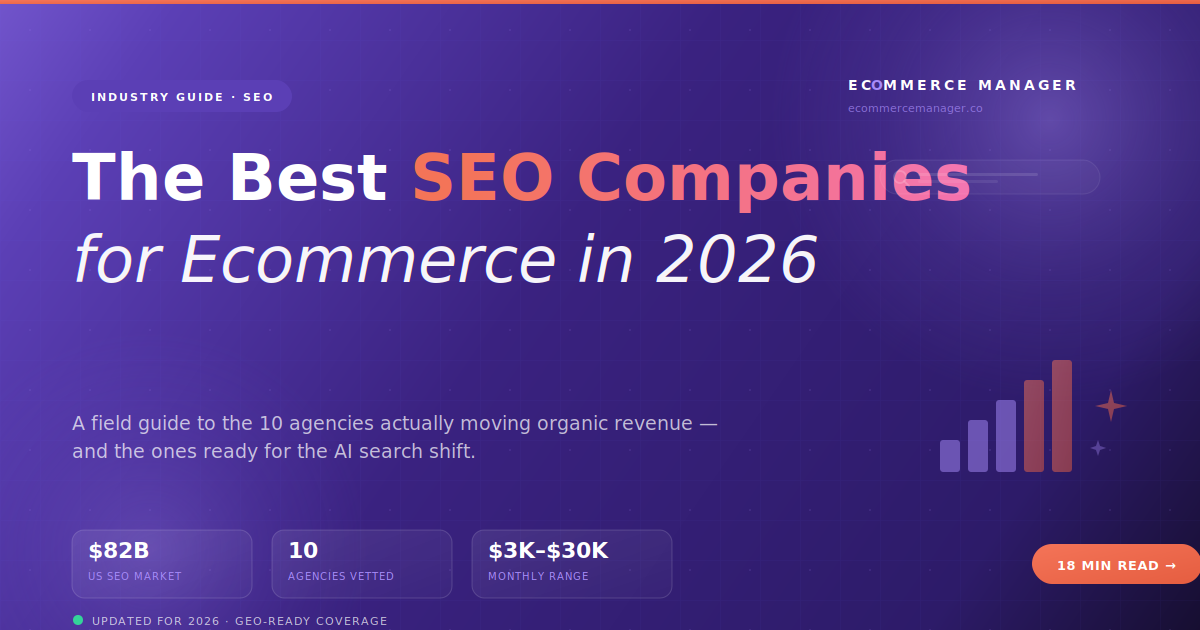
The Best SEO Companies for Ecommerce in 2026
A no-bullshit guide to the agencies actually moving the needle for DTC and ecommerce brands — what they cost, what they specialize in, and which ones are ready for the AI search shift that's reshaping organic.
Every ecommerce founder has the same story. They hired an SEO agency. The agency sent monthly reports full of keyword movement, traffic curves, and backlink counts that looked great. Revenue didn't move. Six months later the contract ended, and nobody could explain what they'd actually paid for. If you're reading this list, you're trying to skip that chapter.
Why Ecommerce SEO Is a Different Sport
A general SEO agency can rank a service business for "best plumber in Phoenix" all day. Ecommerce SEO is a different animal because the technical problems are different. You're not optimizing five pages — you're optimizing 5,000 product pages and 50 category pages, half of which are duplicates of each other from different filter combinations, and a third of which go out of stock every Tuesday.
Real ecommerce SEO work looks like this: crawl budget management on huge catalogs, faceted navigation canonicalization, Google Shopping feed optimization, structured data for product and review rich results, and site architecture decisions that don't tank revenue when you migrate from Shopify Basic to Shopify Plus. None of that is what a general SEO agency does well, and none of it shows up on the report you'll see in month two.
What Actually Changed in 2026
Two things, and they matter more than most agency websites admit:
One: AI search is now a meaningful traffic source. Google AI Overviews, ChatGPT shopping recommendations, Perplexity, and Gemini are surfacing product pages directly. Most ecommerce brands are getting somewhere between 5% and 15% of their product-related discovery from AI assistants now, and that number is climbing every quarter. The agencies still optimizing only for blue-link Google results are leaving real revenue on the table. The category for this work has a name now: Generative Engine Optimization, or GEO. Most retainers don't include it. The ones that do are pulling ahead.
Two: AI tools dropped agency costs by 20–30% for routine work. Content briefs, technical audits, keyword research, and reporting that used to consume 15–20 hours a month now take 5–8 hours with AI assistance. Some agencies passed savings to clients. Most pocketed the margin and raised prices anyway. Worth asking on a sales call.
How We Judged These Agencies
Most "best SEO agency" lists rank by employee count, review scores, and years in business. Those criteria made sense in 2018. They don't tell you whether an agency can grow organic revenue for a $15M Shopify Plus brand selling cookware. We weighted three things instead:
Ecommerce-Specific Track Record
Verifiable DTC clients, platform-specific expertise (Shopify, BigCommerce, WooCommerce, Magento), and case studies that show revenue, not just rankings.
AI Search Readiness
Does the agency have a stated GEO methodology? Are they optimizing product pages for ChatGPT, Perplexity, and AI Overviews — or pretending it's still 2022?
Revenue Attribution
Can they tie organic work to actual dollars? Reports of keyword movement are nice. Reports showing "this content piece drove $42K in attributed revenue last month" are useful.
Quick Comparison: 10 Top Ecommerce SEO Agencies
Side-by-side, sorted by fit rather than rank order. Specialty column tells you what they actually do best, not what their homepage claims.
| Agency | Specialty | Best For | Starting Price | GEO Native? |
|---|---|---|---|---|
WX WebFX |
Full-service enterprise | $10M+ brands wanting attribution | $3,500/mo+ | Yes |
OB OuterBox |
Ecom-only technical SEO | Large catalogs (5K+ SKUs) | $4,500/mo+ | Yes |
CT Coalition Technologies |
Design + SEO + dev | Replatforms & rebuilds | $3,000/mo+ | Partial |
VC Victorious |
SEO-only specialist | Mid-market growth | $5,000/mo+ | Yes |
FS First Page Sage |
Content + thought leadership | Premium brands w/ GEO needs | $10,000/mo+ | Native |
IN Inflow |
Ecom-only mid-market | $5M–$50M DTC brands | $5,500/mo+ | Yes |
SB Searchbloom |
SEO + PPC hybrid | Multi-channel ROI focus | $3,500/mo+ | Partial |
TH Thrive Internet Marketing |
Full-service value pick | SMB ecom on budget | $2,000/mo+ | Partial |
EP Ecommerce Paradise |
High-ticket DTC | Premium & dropshipping stores | $3,500/mo+ | Partial |
PF Passionfruit |
AI-native challenger | Brands prioritizing AI search | $5,000/mo+ | Native |
Starting prices are exactly that — starting. A typical mid-market DTC engagement runs 1.5–2x the starting rate after you factor in catalog size, content scope, and link building budgets. If an agency quotes you $1,500/month for a "comprehensive" ecommerce program, run. That number doesn't cover a single senior strategist's time.
1. WebFX — The Enterprise Attribution Heavyweight
WebFX
WebFX is the agency the other agencies on this list compete with for enterprise accounts. They claim over $10 billion in client revenue generated, and their proprietary platforms — MarketingCloudFX and RevenueCloudFX — solve the problem most agencies dodge: actually tying organic work to dollars. If you've been burned by an agency that couldn't tell you how much revenue last month's content drove, WebFX's reporting will feel like a different sport. The downside: they're huge, which means your account team rotates and the senior strategist who sold you isn't necessarily the one running your work. Good if you want the system. Less good if you want a single dedicated brain.
2. OuterBox — The Ecommerce Specialist's Specialist
OuterBox
OuterBox has done ecommerce SEO and only ecommerce SEO for over twenty years. That sounds like marketing fluff until you watch them work on a 30,000-SKU catalog. They've seen every Shopify URL structure limitation, every Magento crawl budget challenge, every BigCommerce schema quirk — which means they don't bill you to solve problems they've already solved a hundred times. Their methodology covers crawl budget management for large catalogs, faceted navigation canonicalization, Google Shopping feed optimization, and structured data for product and review rich results. In 2026 they've added Generative Engine Optimization as a first-class service. If you have a complex site that any generalist agency would describe as "interesting," OuterBox is your call.
3. Coalition Technologies — When SEO and Site Build Are One Project
Coalition Technologies
Coalition is the agency you call when your site needs a rebuild and you don't want to hire two separate teams to argue about whose work is breaking the other's. Their LA team specializes in rebuilding underperforming ecommerce stores with SEO baked into the framework rather than bolted on after launch. Deep Shopify and WooCommerce expertise, and their technical team can execute site migrations without revenue bleeding mid-transition. The trade-off: if you don't need design or dev work, you're paying for capabilities you'll never use. Best fit for brands at the "we need a new site" moment, not the "we just need better rankings" moment.
4. Victorious — Mid-Market's Most-Awarded Choice
Victorious
Victorious has won over 180 industry awards including Best Large Agency of the Year, and they're an SEO-only shop — no PPC, no design, no dev. That focus matters. It means their senior strategists actually know SEO instead of being generalists who can do six things badly. Their work is transparent and data-driven, with case studies that show specific numbers (the Lychee the Label engagement showed 1,122% growth in page-one keywords and 214% revenue growth). For mid-market DTC brands that want a serious SEO partner without buying a full-service agency, Victorious is the safest bet on this list.
5. First Page Sage — Premium Content + Native GEO
First Page Sage
First Page Sage is the agency that bet early and bet right on AI search. All their campaigns now include GEO optimization as standard, ensuring clients show up in AI-generated search responses, not just blue links. With 15+ years of ecommerce and B2B experience and client logos including Logitech, Wix, Brooks Brothers, OSEA Malibu, and CPAP.com, they have the credibility most challengers don't. The work is content-heavy and thought-leadership focused, which means the ramp is slower than aggressive technical agencies, but the moats they build are deeper. Premium pricing, premium outcomes, premium expectations.
6. Inflow — Mid-Market DTC's Quietly Excellent Choice
Inflow
Inflow doesn't market itself nearly as hard as the agencies above it on this list, which is partly why their clients are so loyal. They focus exclusively on ecommerce, exclusively on mid-market brands, and they staff senior strategists who actually stay on accounts. The methodology covers technical SEO, content marketing, link building, and conversion optimization, with case studies that read more like operator post-mortems than agency brag sheets. The downside: smaller team means longer waitlists, and they're notoriously selective about who they take on. The upside: if they take you, you get senior attention you couldn't pay double for at a bigger shop.
7. Searchbloom — The SEO + PPC Hybrid Bet
Searchbloom
Searchbloom refuses to separate "organic" and "paid" into silos, and the math behind that choice is sound. The keywords that convert in Google Ads are usually the same ones worth ranking organically. The landing page changes that lift paid ROAS usually lift organic too. By running both channels under one team, Searchbloom catches efficiencies that two separate agencies leave on the table. They're also strong at diagnosing site architecture issues that throttle both crawl efficiency and conversion flow, especially for product-heavy stores. Not the right pick if you already have a great PPC team you love — but if you don't, the hybrid model saves real money.
8. Thrive Internet Marketing — The Value Pick
Thrive Internet Marketing Agency
Thrive's pitch is straightforward: full-service digital marketing for ecommerce — SEO, PPC, social, content — at price points where smaller brands can actually afford it. They're not the agency that'll get you to $50M. They're the agency that helps you get to $5M without sinking your operating budget. Worth knowing: the lower price point comes from leveraging a larger team with more junior execution and senior oversight. That works fine for standard SEO programs. It can break down if your situation needs senior-strategist creative thinking on day one. Honest answer about what stage they fit.
9. Ecommerce Paradise — High-Ticket DTC Specialists
Ecommerce Paradise
Ecommerce Paradise is one of the few agencies that genuinely understands the high-ticket end of DTC — the brands selling $1,500 fire pits, $4,000 outdoor saunas, or $8,000 e-bikes. The SEO playbook for those stores is different. You're not chasing volume keywords with low intent; you're chasing a smaller number of very high-intent buyers and building product pages that justify the price. Their team has deep Shopify expertise and conversion-focused SEO that prioritizes revenue per page over raw traffic. Less useful for $40 t-shirt brands. Very useful if your AOV starts at four figures.
10. Passionfruit — The AI-Native Challenger
Passionfruit
Passionfruit is the youngest agency on this list, and the bet is interesting. They claim ranking number one for ecommerce SEO in 2026 based on AI search readiness, revenue attribution capability, and ecommerce platform expertise — and their pitch is that traditional SEO agencies are solving yesterday's problem. Their AI-native approach to Generative Engine Optimization, combined with MCP integration for Shopify and revenue-per-keyword reporting, is a different methodology than what the incumbents offer. The risk: they're new, so the track record is shorter. The opportunity: if AI search is where you think the puck is going, an agency built for that future is worth a serious conversation.
What This Actually Costs
Ecommerce SEO pricing in 2026 has settled into a clearer pattern than it had even two years ago. Here's the honest breakdown:
🏪 Small catalog (under 500 SKUs)
$3,000 – $8,000/mo
🏬 Mid-size catalog (500 – 5K SKUs)
$8,000 – $15,000/mo
🏢 Large catalog (5K – 50K SKUs)
$15,000 – $30,000/mo
🏭 Enterprise (50K+ SKUs)
$30,000+/mo custom
The 2026 wrinkle: AI tooling has reduced agency costs for routine work by 20–30%, which means starting prices on smaller engagements have softened. Some agencies passed the savings on. Others kept the margin. It's a fair question to ask in a sales call: "How has AI changed your delivery model and pricing?" The answer tells you whether you're working with a 2026 agency or a 2022 one that updated its homepage copy.
The 6-Month Rule
Ecommerce SEO is a six-month bet at minimum. Anyone promising results in 90 days is either lying or planning to buy backlinks that'll tank your domain by month nine. Budget for six months before you judge an agency's work, and stop comparing month-one rankings to month-three rankings. The right comparison is month-one revenue to month-twelve revenue.
How to Actually Pick One
Most founders pick the wrong agency because they evaluate the wrong things. Here's the operator's version of the decision process:
Step 1: Define your stage and your blocker
An agency that's great for $2M brands will fail for $30M ones. An agency great at content won't fix your technical debt. Before you even take a meeting, write down two things: what stage are you in, and what's the single biggest blocker on organic right now? Hand that to every agency you talk to and watch what they do with it.
Step 2: Ask the GEO question early
Just ask: "What's your methodology for getting our products surfaced in AI Overviews, ChatGPT shopping recommendations, and Perplexity?" If the answer is vague, generic, or "we're still figuring that out" — pass. The agencies on this list with "Native" in the GEO column have real, articulated methodologies you can pressure-test in 15 minutes.
Step 3: Demand revenue attribution
Don't sign a contract that doesn't include a clear method for tying organic work to attributed revenue. "Keyword rankings improved" is what the last agency told you, and you didn't know what to do with it. "This product cluster drove $34K in attributable organic revenue last quarter" is the standard now. If the agency can't explain how they'll measure that, move on.
Step 4: Talk to a real client at your stage
Not the agency's case study. An actual client, ideally one at your revenue size and on your platform. Five minutes on the phone with a real operator will tell you more than five hours on the agency's website. Any agency that won't connect you to a reference is hiding something.
- Guaranteed rankings in 30/60/90 days. Algorithm is too volatile for guarantees. Anyone promising them is either uninformed or about to commit a violation that gets you penalized.
- "Comprehensive" packages under $1,500/month. The math doesn't work. You're getting a junior person and a templated checklist.
- No platform-specific expertise. If they can't immediately tell you the Shopify URL structure limitations or BigCommerce schema quirks, they don't actually know ecommerce.
- Locked-in 12-month contracts. Good agencies offer 3- or 6-month options because they trust their results. Bad ones lock you in because they don't.
- No answer for AI search. In 2026, "we're still evaluating that" is a polite way of saying "we don't have a strategy."
The Honest Bottom Line
Every agency on this list is genuinely good at what they do. Every one of them will also fail spectacularly if you put them on the wrong job. The best agency for an enterprise replatform isn't the best agency for a $3M Shopify store. The best one for AI search isn't necessarily the best one for technical debt.
Pick the stage and problem you're actually solving for, not the brand name with the prettiest case studies. Ask the GEO question. Demand revenue attribution. And whatever you do, don't sign a 12-month contract with anyone you couldn't fire after 90 days if the work wasn't moving.
Not Sure Which Agency Fits?
The eCommerce Manager helps brand owners shortlist the right SEO partner for their stage and platform. Honest matchmaking, no kickbacks, no agency bias.
Get Matched →