

Last Updated on June 7, 2026
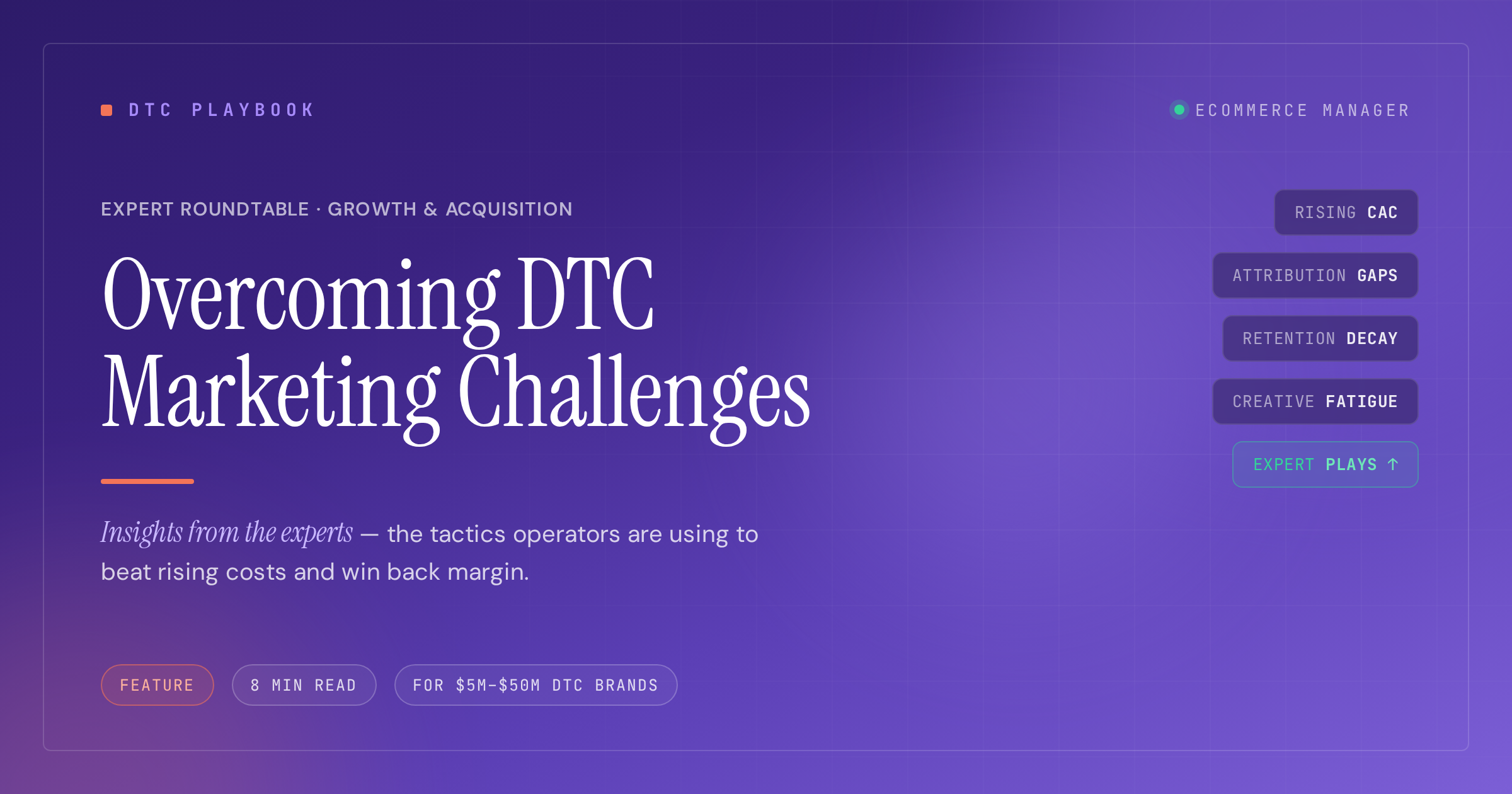
Overcoming DTC Marketing Challenges: Insights from the Experts
Direct-to-consumer brands face mounting pressure to acquire customers profitably while building lasting relationships in an increasingly competitive market. This article brings together proven strategies from industry experts who have successfully tackled the most pressing DTC marketing challenges. From leveraging first-party data to creating smarter acquisition channels, these insights offer practical solutions that drive real results.
- Adapt Plans To Real Time Demand
- Remove Sensory Uncertainty With Samples And Specs
- Solve Fit To Protect Margin
- Use Customer Words And Preserve Rigor
- Let The Product Prove Itself Fast
- Humanize Messages Around Local Pain Points
- Show Benefits Not The Business Model
- Teach The Category Before You Sell
- Match Urgency With Concrete Assurances
- Separate Brand And Performance Budgets
- Prioritize First Party Data And LTV
- Narrow Focus To Your True Edge
- Raise Prices To Signal Quality
- Intercept Comparisons With Superior Answer Pages
- Publish Original Research For Information Gain
- Build Community And Diversify Acquisition
- Align Promises So Back End Converts
- Bridge Offline And Online With Smart QR
- Gauge True Intent Before You Scale
- Lead With Trust And Value
- Integrate Support To Close The Gap
Adapt Plans To Real Time Demand
One of the hardest parts of DTC marketing for us was planning around extreme demand swings. Traffic does not rise in a straight line for a seasonal business. It compresses quickly and buyer intent changes every week. Campaigns that looked efficient in September can lose relevance by mid October. We rebuilt our calendar around customer behavior instead of fixed media plans.
We now shift creative, bidding, landing page focus, and email timing based on live signals from search patterns, conversion rate, and inventory confidence. This gives our team faster feedback and fewer wasted impressions. The lesson is simple: we do not treat demand as static, and we build systems that react before the market forces change.

Remove Sensory Uncertainty With Samples And Specs
The biggest DTC marketing challenge I’ve faced running PerfumeM (perfumem.com), an independent fragrance retailer on Shopify since 2017, has nothing to do with channels. It’s that customers can’t smell the product before buying. Every paid ad in the world doesn’t fix that gap. So conversion looks bad, returns look bad, and the obvious response (spend more on acquisition) just throws more buyers at the same wall.
How we overcame it. Two moves, both unglamorous.
One. We rebuilt every product page to include a spec block sourced from real customer reviews. Longevity in hours, projection level, climate suitability, occasion fit, demographic skew. Not marketing copy. Numbers and short phrases pulled from buyers who actually wore the fragrance. Underneath the manufacturer’s description we now show what the people who bought it said it actually performs like. That changes a blind purchase into an informed one.
Two. A progressive sample box. Customer picks 3 samples, low commitment, low price. If they love one, that sample credits back toward the full bottle. The mechanic turns “I might love this” into a $9 test, not a $90 gamble.
Together those two moves did more for conversion than any paid channel work we tried. Return rate dropped. AOV held. Lifetime value improved because the first purchase was no longer a roll of the dice.
Advice for other DTC operators. Identify the specific hesitation that kills your buyer’s confidence, then solve that hesitation on the page. Don’t push more traffic at a page that hasn’t answered the question buyers are silently asking.

Solve Fit To Protect Margin
The biggest DTC challenge we faced in the last 18 months was a return rate that quietly ate 24 percent of gross margin on every order. Industry average is around 10 percent; we were running 18 to 21 percent across sizes M and L. Easy to ignore because revenue looked healthy.
What we found when we audited: 73 percent of returns were size-related, not quality-related, and the majority were “fits too small” complaints on customers in the Anglo market who had ordered to standard EU sizing. Our M was their S.
What we did:
Rewrote every product page with a sizing widget that asked four questions: height, weight, a tight or loose preference, and a primary use case (work, sport, or daily). Backend matched the answer to a real size, not a chart conversion. Returns on widget-confirmed orders dropped 41 percent in eight weeks.
Added an 8 second video of a body type matching the customer’s size code. We filmed 4 fit models across body shapes, each wearing all 5 sizes in our most-returned style. The customer sees what M actually looks like on a body like theirs before ordering.
Sent post-purchase SMS at order day 2 with care instructions and a “still unsure on fit? reply here for a 1:1 fit check before you wear it” line. 11 percent of customers replied, and we converted 60 percent of those messages from a likely return into a confirmed-fit keep.
Rebuilt the returns landing page to ask a fit-reason dropdown before processing, so future page updates target the most-cited specific complaint.
Net result over 11 months: return rate dropped from 18 to 21 percent down to 9.8 percent. Recovered margin equivalent to roughly 14 percent of revenue. The interesting side effect: customer survey LTV scores went up 28 percent because customers who got the fit right on the first order kept ordering across the line.
Advice for other DTC brands: do not chase cart conversion rate if it bleeds back through returns. The win is the keep rate, not the buy rate. Most brands measure the wrong end of the funnel.

Use Customer Words And Preserve Rigor
The biggest DTC marketing challenge we hit early was that we were writing our labels and PDPs in clinician language. Our first vaginal probiotic led with strain names, CFU counts, and clinical-trial references—everything an OB/GYN on our advisory board would trust—and it barely converted. The product was right; the language was wrong. Women shopping for vaginal health weren’t searching “Lactobacillus crispatus”; they were searching what they were actually feeling. We weren’t meeting them at their question.
What we changed: we rebuilt the front of the funnel around customer-language education—Learning Center articles answering the questions women actually type into Google—and reserved the clinical detail for the supplement facts panel and the deeper science pages. Every claim still gets routed through the scientific advisory board against FDA/FTC structure-function rules before it ships, so nothing softens into a medical promise. The advice for other founders in regulated categories: write two layers. A consumer layer in the words customers use, and a clinical layer underneath for the people who want proof. Don’t collapse them. Keep both visible and trust compounds.

Let The Product Prove Itself Fast
I’m Runbo Li, Co-founder & CEO at Magic Hour.
The biggest challenge in DTC marketing is that attention is free but trust is expensive. Anyone can get eyeballs. The hard part is converting a stranger into someone who pulls out their credit card in under 60 seconds. We solved this by killing the funnel entirely.
Here’s what I mean. Early on, we tried the traditional playbook: run ads, send people to a landing page, explain the product, hope they sign up. Conversion rates were brutal. Then I remembered something from my days helping my parents market their restaurant and real estate business on social media. People don’t buy from explanations. They buy from demonstrations.
So we flipped the model. Instead of showing people what Magic Hour does, we let them use it immediately. No sign-up wall. No onboarding tutorial. You land on the site, you pick a template, you see your video rendered in minutes. The product IS the marketing. We saw conversion rates jump dramatically once we removed every layer of friction between “curious” and “convinced.”
The second thing we did was treat organic content as our primary acquisition channel, not paid ads. I posted AI-generated videos daily across platforms and reached over 200 million people organically. One NBA edit went viral enough that Mark Cuban followed me and became a paying customer. The Dallas Mavericks reached out on their own. That didn’t come from a media buy. It came from making content so good that people couldn’t ignore it.
My advice: stop thinking about marketing as a department or a budget line. Think about it as a product decision. If your product can’t sell itself in the first 30 seconds of someone touching it, no amount of ad spend will fix that. Remove every gate between curiosity and experience. Let people feel the value before you ever ask for money. The companies winning DTC right now aren’t the ones with the best funnels. They’re the ones where the first interaction IS the product.

Humanize Messages Around Local Pain Points
One of the biggest challenges I’ve faced with DTC marketing at The Family Doctor Primary Care was cutting through the noise in our saturated local healthcare market. When I started here, we were spending money on Facebook ads and Google campaigns, but we weren’t seeing the patient acquisition numbers we needed. People would click, but they weren’t converting into actual appointments.
The problem was that our messaging was too generic. We were saying things like “quality healthcare for your family,” the same thing every other clinic in town was saying. It wasn’t resonating because it didn’t feel personal or urgent.
I decided to completely rethink our approach. Instead of broad campaigns, I focused on specific pain points our community actually cared about. We created targeted content around things like same-day sick visits, managing diabetes without feeling overwhelmed, and navigating insurance confusion. I also started featuring our actual doctors and staff in our ads instead of stock photos. Patients told us they chose us because they felt like they already knew Dr. Martinez before walking through the door.
We also shifted budget toward patient testimonials and community involvement. When we sponsored a local health fair and shared that content online, engagement skyrocketed compared to our traditional ads.
My advice to others facing similar challenges? Stop trying to appeal to everyone. Get specific about who you’re trying to reach and what problems they’re actually losing sleep over. Generic healthcare messaging doesn’t work anymore. People want to see real faces and hear genuine stories from their neighbors.
Also, don’t be afraid to show personality. Medical marketing doesn’t have to be stiff and clinical. We’ve found that our most successful campaigns are the ones where we let our team’s genuine care and humor shine through.
Track everything, but give campaigns time to work. We almost pulled the plug on our community-focused strategy after three weeks. Six weeks in, it became our best-performing approach.

Show Benefits Not The Business Model
One of the biggest marketing challenges we’ve faced at RGV Direct Care Family Clinic is explaining what “direct care” actually means to potential patients. Most people don’t understand the difference between our model and traditional insurance-based practices. When we first started, we’d run ads about our membership model and affordable monthly fees, but people were confused. They’d call asking if we took their insurance, not grasping that our approach was entirely different.
We overcame this by shifting our messaging completely. Instead of leading with “direct care” terminology, we started showing the benefits patients actually care about. Same-day appointments. Longer visit times. A doctor who knows your name. Direct communication with your physician. We began using patient testimonials and real stories instead of clinical explanations of our business model.
Social media became our best tool. We created short videos showing what a visit looks like at our clinic versus a traditional practice. We showed the lack of waiting time, the relaxed conversations, the follow-up texts patients receive. Visual storytelling worked so much better than any brochure ever could.
My advice to others is simple. Stop trying to educate people about your business model and start showing them how their life improves. Patients don’t care about the mechanics of direct care. They care that they can see a doctor when they’re sick without waiting weeks. They care about texting their physician when their child has a fever at night.
Don’t try to market to everyone. We wasted months trying to reach the general population when our ideal patients were already frustrated with traditional healthcare. Target people who have had bad experiences with rushed appointments, long waits, and impersonal care. Those are your people.
Be patient with the process too. Direct care is still unfamiliar to many, and educating a market takes time. We didn’t see real traction until about eight months in, but once word of mouth started, growth became much more organic and sustainable.

Teach The Category Before You Sell
Our biggest DTC challenge wasn’t CAC or conversion — it was that nobody was searching for a beer spa. The category didn’t exist in the US when we opened in February 2021. You can’t optimize a funnel that nobody enters. So we spent the first chapter of our marketing not selling Oakwell, but selling the concept of a beer spa at all. We killed paid search, leaned into earned media and visual storytelling on Instagram and TikTok, partnered with local breweries who already had audiences, and intentionally let partners and journalists be the primary explainer channel — our own booking page was the last stop, not the first.
The lesson: if you’re creating a category, your top-of-funnel job is education, not conversion. De-emphasize your booking CTA early. Spend on PR and content that teaches what you are before you spend a dollar trying to close a booking. Demand capture only works after demand exists.

Match Urgency With Concrete Assurances
One overlooked DTC challenge was seasonality distorting both urgency and customer judgment. During peak weather swings, shoppers rushed decisions and often skipped important details. That behavior inflated sales temporarily, then generated support strain and preventable dissatisfaction later. Marketing looked successful externally while operations absorbed the consequences internally.
The response centered on pacing urgency with reassurance throughout the buying journey. We paired timely offers with decision tools, delivery expectations, and installation reminders. That balance preserved momentum while protecting customers from rushed, costly mistakes. Others should resist urgency tactics that overpower product understanding during peak periods. Strong DTC marketing does more than accelerate demand, it safeguards decision quality.

Separate Brand And Performance Budgets
One of the toughest DTC challenges was balancing brand building with relentless pressure for immediate return. Short-term tactics delivered quick wins, but they slowly narrowed audience quality and weakened future demand. The way through was separating budgets by objective, then measuring each against the right commercial horizon. I protected a portion for upper-funnel storytelling while keeping performance campaigns accountable to profitable acquisition.
That structure stopped every decision from being judged by last-click efficiency alone. Over several months, branded search, direct traffic, and conversion rates improved because awareness work had room to compound. My advice is to define what each dollar must accomplish before launching another campaign. DTC brands grow stronger when leadership values demand creation and demand capture as connected parts of one system.

Prioritize First Party Data And LTV
One challenge I faced was rising acquisition costs while conversion quality stayed inconsistent, which forced me to rethink our paid-heavy approach. I would say this was especially hard because competition was intense, audiences were fragmented, and customers expected more personal experiences across channels.
I overcame it by shifting budget toward first-party data, owned-community building, and sharper message testing. We rebuilt landing pages around a clearer value story, improved segmentation, and used retention tactics so repeat purchase helped offset acquisition pressure. I also aligned paid, email, and organic content into one funnel, which made our spend more efficient and reduced waste.
My advice is to stop treating paid media as the entire growth engine. Start measuring lifetime value against acquisition cost, then invest in content, community, and customer experience that compounds over time. Also, test one variable at a time, because small creative and audience changes often reveal the fastest wins.

Narrow Focus To Your True Edge
One of the biggest challenges we’ve faced with DTC marketing at Equipoise Coffee was standing out in an incredibly crowded specialty coffee market. When we launched our e-commerce store, we thought great coffee would sell itself. We’d pour our hearts into sourcing and roasting, but we were competing against hundreds of other brands saying the exact same things about quality and freshness.
Our customer acquisition costs were through the roof, and we were burning through ad spend without seeing sustainable returns. People just weren’t converting because they couldn’t distinguish us from every other small-batch roaster claiming to be special.
The turning point came when we stopped trying to market to everyone and got laser-focused on our actual differentiator. For us, that was our approach to balance in roasting. We literally named ourselves Equipoise because we believe the best coffee finds harmony between brightness and sweetness, between origin character and roast development. Once we started telling that specific story instead of generic specialty coffee messaging, everything changed.
We revamped our email marketing to educate customers about what balance in coffee actually means. We created content showing our roasting process and how we make decisions during cupping. We got vulnerable about batches that didn’t meet our standards and why we wouldn’t release them. This transparency built trust.
My advice to others facing similar challenges is to stop trying to appeal to the widest possible audience. Get uncomfortably specific about what makes your product different, even if that means some people won’t be interested. The ones who connect with your actual story become loyal customers who don’t just buy once but subscribe and tell their friends.
Don’t chase trends or try to outshout bigger brands with larger budgets. You can’t win that game. Instead, lean into what genuinely makes your small batch production special and let that authenticity drive your marketing. We’ve found that honesty and specificity beat flashy campaigns every time.

Raise Prices To Signal Quality
Early in my career as a fractional CMO (that included quite a lot of DTC work), I faced a conversion plateau that defied my logic.
One client assumed lowering their cost would lower the barrier to entry. Instead, I suspected their cheap price created a massive psychological barrier we all know: DOUBT. They sold brilliant, objectively better products (one major one, in particular) for average prices, but people didn’t buy. Why?
And that’s when it hit me: Pricing isn’t just a financial metric, it is the loudest marketing signal.
So, we tested a counterintuitive approach inspired by the “Chivas Regal Effect”. In the 1950s, the then struggling Scotch brand doubled its price without changing their recipe even a bit. But sales miraculously exploded.
When consumers can’t easily judge quality, they’re stuck using the price tag as the measuring stick. So, we just raised prices by 20% across the board. 20 percent!
The result? An IMMEDIATE lift in sales, because the higher cost promised a premium experience. Though the impact on sales wasn’t as “game-changing” as it was for Chivas, it did turn a failed product line into a profitable one… by simply changing some numbers.
This is why nowadays I always say: “Sell the prestige, not just the product.”
So, my advice to any DTC founder is to test a premium tier immediately. If your conversions are inexplicably low, you might not be too expensive. You might actually be too cheap to be trusted.

Intercept Comparisons With Superior Answer Pages
In projects I’ve led with DTC brands in saturated categories, the problem usually isn’t traffic — it’s that paid CPCs keep climbing on the exact commercial queries that convert. Bidding harder is a losing game.
The move: competitor-gap mapping on “alternative to” and comparison queries. I pull SERPs where competitors rank with thin, stale, or misaligned content — pages ranking by default, not merit — and build dedicated landing pages that actually answer the comparison. Then internal links from existing category pages route authority into them, so they index and climb. I treat internal linking as a distribution layer, not navigation — deciding which pages receive demand.
One rule I hold: don’t build an “alternative to” page unless you can genuinely out-answer the incumbent. A weak gap page just adds another thin URL to the pile. Audit where competitors rank weakly on decision-stage queries before scaling spend — organic intercepts work because the buyer is already evaluating. You’re not creating demand, you’re routing it.

Publish Original Research For Information Gain
Navigating the transition to zero-click search results has presented an obstacle for organic (unpaid) visibility. I have overcome this challenge by focusing on “information gain” – in other words, making sure all of my content presents new, useful data and/or personal insight that can’t be easily replicated with artificial intelligence. I recommend developing strong brand authority through conducting and publishing original research rather than simply paraphrasing information already available on-line.

Build Community And Diversify Acquisition
High customer acquisition costs often erode margins. The way I solved this was to focus on creating quality content that offers users an additional layer of information (thus increasing organic authority and retention), as opposed to focusing solely on the click-through rate. Focusing on developing a community can be far more beneficial than simply trying to generate as many clicks as possible. In order to avoid relying too heavily upon one single source’s evolving algorithms, diversifying your potential traffic streams in the beginning stages is essential. Your greatest asset will always remain authenticity.

Align Promises So Back End Converts
The biggest challenge I see consistently in DTC is that brands are so focused on getting the front end to convert that they never stop to ask whether what they are promising actually matches what they are delivering. A black hat VSL might get someone to buy a single bottle. But the moment that customer picks up the phone with your back end sales team, they are not sold on the product anymore. They are skeptical. More friction, and now your agents are not upselling. They are reselling. And that is an entirely different and much harder conversation.
It all starts with the front end. If your lead magnet is weak or your anchor product doesn’t have a strong enough value proposition, your AOV on the front end might show as if it’s winning, but once it’s time for fulfillment or nurturing to begin, it all falls apart. Refunds and chargebacks start flooding in. It’s impossible to “call center your way” out of a broken offer. What you can do is build the front end with enough honesty and clarity that by the time a customer hears from your team, they are already bought in. That’s when cart recovery calls close. That’s when welcome call/upsells work, and finally when high ticket coaching becomes a natural next step in the conversation, instead of a hard pitch.
My advice to anyone facing this is simple. Audit your VSL the same way your best customer would. If the promise on the front end is something your product cannot deliver, your call center will spend every shift doing damage control instead of driving revenue. Fix the front end first. Then add the phone team. In that order, the results are transformational. We have seen clients unlock an entirely new revenue channel on the back end simply because the front end finally told the truth. Absolute game changer.

Bridge Offline And Online With Smart QR
One of the biggest challenges I’ve faced with DTC marketing is bridging the gap between offline and online customer touchpoints. When we first launched Free QR Code AI, we noticed our customers were running traditional campaigns like print ads, direct mail, and product packaging, but they had no clean way to track whether those efforts actually drove online engagement or sales.
The disconnect was frustrating. Marketing teams would spend thousands on beautiful print collateral, but when it came time to measure ROI, everything went dark. UTM parameters work great for digital, but you can’t exactly ask someone to type out a long URL with tracking codes from a billboard.
So we doubled down on making QR codes not just functional, but trackable and intelligent. I’m talking about codes that could dynamically redirect based on time of day, location, or even the device scanning them. We built analytics directly into our platform so marketers could see real-time data: scans over time, geographic distribution, peak engagement windows, and conversion rates post-scan.
The results spoke for themselves. One of our early DTC brand partners saw a 340% increase in measurable offline-to-online conversions within the first quarter. They went from guessing to knowing.
My advice to others facing this challenge? Stop treating offline and online as separate ecosystems. They’re the same customer journey, just different chapters. Here’s what specifically helped us:
First, make the bridge effortless. If someone has to work to move from your physical touchpoint to your digital one, you’ve already lost them.
Second, demand data from everything. If a marketing activity can’t be measured, question whether you should be doing it at all. We’ve found that even small DTC brands can access enterprise-level attribution when they use the right tools.
Third, test and iterate fast. We ran dozens of QR code variations before landing on designs that actually drove scans. Color, placement, and context all matter more than you’d think.
Don’t let offline marketing be a black box anymore. The technology exists to close that loop.

Gauge True Intent Before You Scale
A common obstacle faced by DTC marketers is that while a potential customer may claim they want the product, their actions often demonstrate otherwise. For example, a learner may click on an ad simply because they are stressed about a looming exam. This customer will have more of a need for seeing evidence that the tool (such as a practice exam) will prepare them for the academic challenge at hand, clearly explain any errors they made, and improve their utilization of study time once they get the actual reality of taking the exam at the completed conclusion of their testing experience.
The solution to this dilemma is to provide a path leading toward readiness prior to presenting a final purchase/sale offer (practice quiz, estimate of total number of questions answered correctly on the practice exam, weak-topic identification list, etc.). I recommend that you attempt to identify intent before you invest in additional traffic to your website. Examples of indicators you should be tracking include, but are not limited to: numbers of completed practice quizzes, number of practice tests taken, numbers of emails replied to and number of returning visitors, and many more – rather than just number of clicks. Note: A potential customer who begins an online timed practice test for their upcoming examination will likely have more intent than the individual who merely viewed the landing page with the option to take an online timed practice exam. After you know which activities demonstrate an individual’s real intent, your DTC marketing will be much more efficient because follow up actions can occur based on actual consumer behaviour rather than on anticipated consumer behaviour.

Lead With Trust And Value
One persistent challenge in DTC marketing involved balancing lead generation with maintaining trust and credibility in a highly competitive digital environment. Rising acquisition costs and declining engagement rates made traditional performance campaigns less effective over time. According to a Deloitte report, nearly 57% of consumers say brand trust influences purchasing decisions more than price, particularly in education and professional development sectors. The most effective shift came through focusing on value-first marketing strategies such as educational content, learner success stories, and skill-based insights that addressed real career challenges instead of relying heavily on promotional messaging. Data-driven personalization also helped improve engagement by aligning communication with learner intent and professional goals. A key lesson for brands facing similar challenges is that sustainable DTC growth rarely comes from aggressive advertising alone. Long-term success is more often driven by authenticity, relevance, and consistently delivering meaningful experiences that build trust over time.

Integrate Support To Close The Gap
Look, the biggest headache in DTC marketing isn’t the ads themselves. It’s the disconnect between the promise you make in the ad and what actually happens when the customer tries to buy. You see it constantly—brands obsess over the click, but they completely ignore the “messy middle” of the buyer’s journey.
Say a customer has a simple question about shipping or whether the product fits their needs. If they hit a wall and get some generic, automated response three hours later? Forget it. You’ve just set all that ad spend on fire. The conversion doesn’t fail because the product is bad; it fails because you broke the path to purchase.
The way we solved this was by putting real human expertise right into the discovery phase. We stopped treating customer service like a cost center—that’s a huge mistake. Instead, we started looking at it as the final, high-intent stage of our marketing funnel. We gave our support team the same product context our marketing team uses. When a customer asks a question, they aren’t getting a script; they’re getting an answer that actually fulfills the brand promise we made in the ad. It’s the ultimate bridge between getting someone through the door and actually keeping them.
If I’m talking to other ecommerce leaders, my advice is simple: stop treating support and marketing like they’re separate worlds. If you’re pouring money into ads but your conversion rates are stuck, go look at your post-click experience. Audit it. You need to treat your support interactions with the same data-driven rigor you apply to your ad campaigns. At the end of the day, a customer who gets a quick, smart answer from a real human is going to be a way more loyal, high-value customer than someone left wandering around an FAQ page alone.

Related Articles
- DTC Marketing: Campaigns That Resonate With Your Audience
- Building Customer Loyalty through DTC Marketing: Approaches & Examples
- Effective DTC Marketing Channels: Insights from Top Brands