

Last Updated on August 19, 2026
The Best Ecommerce Platforms for Developers in 2026
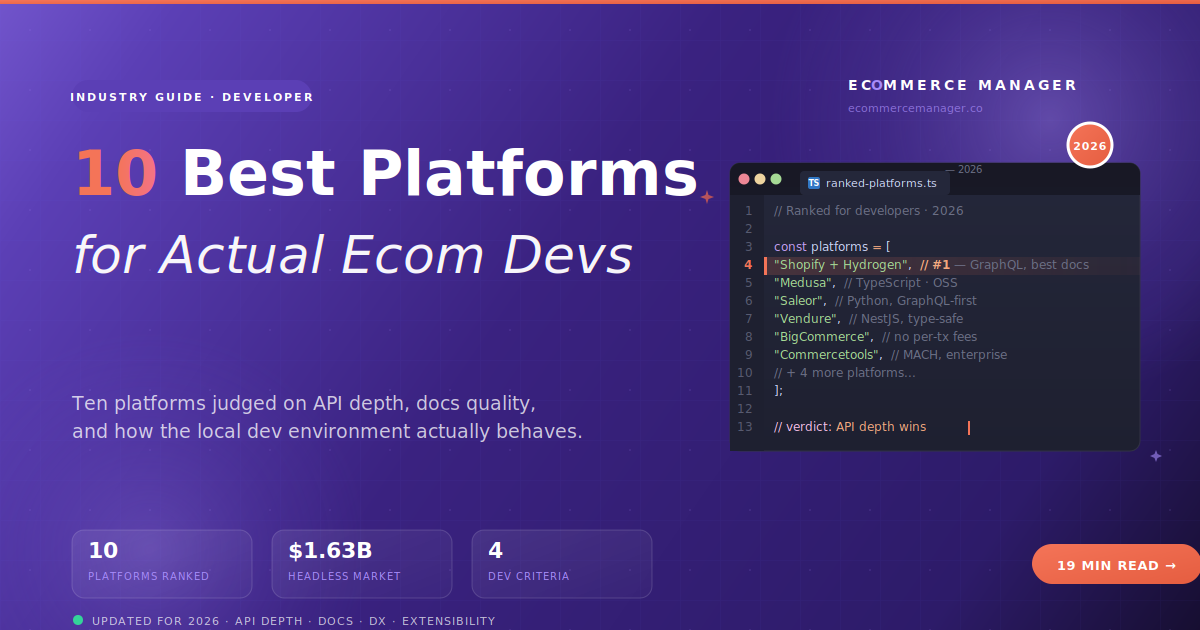
Most "best platform" articles are written for merchants. This one is for the engineers actually shipping the code — where API depth, docs quality, and how the local dev environment behaves matter more than the marketing site.
Search "best ecommerce platform" and you get a dozen articles ranking the same vendors in a different order — usually with the author's affiliate link at the top. That's fine if you're a merchant picking a store to run your business on. It's completely useless if you're the developer who's going to spend the next two years actually building on it. This guide flips the criteria. Below are the 10 platforms judged on API depth, docs quality, local development experience, and extensibility — the things that decide whether your Monday morning is spent shipping features or fighting the framework.
Why Merchant-Focused Rankings Are Useless to Developers
Here's the split that most comparison articles miss. Merchants care about what the storefront looks like out of the box, how easy the admin is, and what apps they can install without a developer. Developers care about none of that. What matters to devs: whether the API returns what the docs say it returns, whether webhooks fire reliably, whether the SDK is maintained by real people or a marketing team, and whether you can spin up a local environment without a two-day onboarding call.
Those criteria produce a completely different ranking. Shopify, which merchants love, is genuinely excellent for developers too — but for very different reasons than the merchant reviews suggest. Medusa, which most merchant lists ignore, is one of the best developer experiences in the entire category. Adobe Commerce, which enterprise reviews still praise, has a developer experience most engineers would describe as archaeological. The winners are different when you change the question.
The headless ecommerce market hit $1.63 billion in 2026 and is projected to reach $4.08 billion by 2035. That growth is driven almost entirely by developer preference — the shift away from monolithic platforms toward composable stacks is a developer-led movement, not a merchant one. Gartner projects 60% of enterprise retailers will operate composable commerce stacks by 2028, up from under 20% in 2024. If you're picking a platform now, that trajectory should influence the decision.
The Three Categories of Ecommerce Platforms
Before comparing individual platforms, understand which category each one falls into. The lines used to be clean; they're not anymore, because SaaS platforms have all bolted on "headless" modes and open source platforms have all launched hosted offerings. But structurally there are still three distinct approaches, and each fits a different type of dev team.
Managed Platforms with Headless Options
Shopify, BigCommerce, Swell. You get the admin, checkout, payments, and infrastructure managed. You build a custom storefront against their APIs. Fastest to ship, least backend control.
Open Source Composable
Medusa, Saleor, Vendure, WooCommerce. You self-host, customize the backend, and own the whole stack. Maximum control, maximum responsibility.
Enterprise Composable
Commercetools, Elastic Path, Adobe Commerce. MACH-architecture platforms built for large teams with dedicated ops, integration budgets, and complex catalogs. Powerful, expensive, and not for one-person teams.
Traditional-with-API
WooCommerce (again), Adobe Commerce (again). Started as monoliths, now expose APIs. Massive plugin ecosystems, some technical debt in the core, best for teams already in the WordPress/PHP world.
The Four Criteria That Actually Matter
Every developer-facing platform will claim they have great APIs, excellent docs, and vibrant communities. Almost none of them do all three. Here's what to actually test before committing:
1. API depth (not just "we have an API")
Every platform in this list has an API. What matters is whether that API can express the things you need to build. Can you create a custom cart type without hacking the checkout? Can you subscribe to inventory changes via webhook without polling? Does the GraphQL schema include the fields your storefront actually needs, or do you have to make three requests to render a product page? The gap between "has an API" and "has an API you can build production commerce on" is enormous. The only way to know is to build a small prototype before you commit.
2. Documentation you can actually use
Docs quality is inversely correlated with how much marketing you see about the docs. Platforms that shout about their "developer-first documentation" often have exactly the kind of docs that describe every endpoint at the reference level but have zero cohesive guides for building an actual feature. The docs you want have working example code you can copy, cover the edge cases (rate limits, retry behavior, error responses), and get updated when the API changes. Shopify's docs, Medusa's docs, and Stripe's docs are the industry benchmarks. Some enterprise platforms' docs are 300-page PDFs from 2019.
3. Local development experience
How long does it take to go from git clone to a working local environment with seed data? Under 10 minutes is excellent (Medusa, Vendure). Under an hour is acceptable (Shopify with Hydrogen, BigCommerce). More than a day means the platform will hurt you every time a new engineer joins. Test this before you commit — it's the single best proxy for how the whole platform will feel to work with.
4. Extensibility without patching core
Every serious commerce project needs custom behavior somewhere — a pricing rule, an inventory sync, a payment method your platform doesn't support natively. The question is whether the platform gives you clean extension points (plugins, hooks, middleware, custom apps) or whether you end up forking the core to make it work. Platforms that require core modifications to do anything non-standard are debt machines. Platforms with real extensibility (Medusa's modules, Vendure's plugins, Shopify's app extensions, Saleor's apps) let you build without breaking your upgrade path.
Quick Comparison: 10 Platforms for Developers
Side-by-side. "Stack" is what the platform is built in. "License" tells you the commercial model. "API" indicates the primary API style. Comparison order is by developer experience, not brand recognition.
| Platform | Stack | License | API | Best For |
|---|---|---|---|---|
SH Shopify + Hydrogen |
Ruby / React | SaaS | GraphQL | Fast-shipping teams |
MD Medusa |
TypeScript / Node | Open Source | REST + GraphQL | Modern JS teams |
SL Saleor |
Python / Django | Open Source | GraphQL | GraphQL-native builds |
VN Vendure |
TypeScript / NestJS | Open Source | GraphQL | Type-safe backends |
BC BigCommerce |
PHP / Any Frontend | SaaS | REST + GraphQL | API-first SaaS teams |
CT Commercetools |
Java / Any Frontend | Enterprise | REST + GraphQL | MACH enterprise stacks |
SW Swell |
Node / Any Frontend | SaaS + OSS SDK | REST + GraphQL | Subscription commerce |
AC Adobe Commerce |
PHP / Magento | Enterprise | REST + GraphQL | Complex PHP stacks |
WC WooCommerce |
PHP / WordPress | Open Source | REST | WordPress-native devs |
EP Elastic Path |
Java / Any Frontend | Enterprise | REST + GraphQL | Complex B2B enterprise |
Every platform in 2026 claims to be "API-first" or "composable-ready." Most of them mean "we have a JSON endpoint and a press release." Actual API-first means you can run the whole platform headless in production, with no admin UI dependencies, without any of the docs saying "this feature is only available via the admin." Test that claim before you commit — it's usually optimistic.
1. Shopify + Hydrogen — The Ecosystem That Actually Delivers
Shopify + Hydrogen
Shopify's developer experience is genuinely one of the best in the entire commerce category, and it's easy to miss that because the merchant-facing marketing is so loud. The Storefront API is GraphQL, comprehensive, and well-versioned. Hydrogen (Shopify's React framework) plus Oxygen (their edge hosting) give you a full modern storefront stack with sensible defaults. The Shopify CLI, local dev tooling, and Polaris design system for admin extensions are all above the industry standard. The docs — shopify.dev — are the closest thing to Stripe-level docs in the commerce space.
The trade-off is philosophical, not technical. You're building on a managed platform, which means you don't control the backend. Custom checkout logic is limited (though 2024's Checkout Extensibility improved this significantly), you pay Shopify's platform fees on every transaction, and you're subject to their API rate limits. For most teams, this is the right trade-off. If your business model or catalog demands unusual backend behavior, look at Medusa or Commercetools instead.
2. Medusa — The Modern Open Source Standard
Medusa
Medusa is the platform most developers reach for when they want an open-source Shopify. It's Node.js, TypeScript throughout, uses PostgreSQL, and has an admin UI built in React. The Medusa 2.0 release in 2024 introduced modules and workflows that fundamentally improved the extensibility model — you can now compose custom commerce logic without patching the core, which is what killed developer adoption of most legacy open-source platforms. The local dev experience is excellent: npx create-medusa-app and you're running in under 10 minutes with seed data.
The ecosystem is smaller than Shopify's (fewer prebuilt integrations, smaller plugin marketplace), but the code quality is high and the community is genuinely active. For teams that want full backend control, a modern stack, and can invest in the ops of self-hosting, Medusa is the strongest open source option in the category. There's also Medusa Cloud for managed hosting if you want the OSS platform without the ops overhead.
3. Saleor — GraphQL-First from the Ground Up
Saleor
Saleor is unusual in that it was designed as a headless, GraphQL-first commerce platform from the beginning — not as a monolith that later added an API layer. The API is comprehensive and well-designed, the Django backend is stable, and the platform genuinely scales for global brands (Lush, Wilson, Butternut Box all run production on Saleor). If your team is Python-heavy or you want a GraphQL-native platform without the enterprise pricing of Commercetools, Saleor is the natural choice. The Apps framework introduced in 2023 provides clean extension points that don't require core patches.
The trade-off: the platform is opinionated in ways some teams love and others don't. The admin UI (Saleor Dashboard) is React-based and modern, but if you want to modify the admin heavily you're in for meaningful custom work. Saleor Cloud provides managed hosting if you don't want to self-host the Django stack.
4. Vendure — Type-Safe Backends and Real Extensibility
Vendure
Vendure is the platform for teams that value type safety and clean architecture above almost everything else. Built on NestJS (the TypeScript-first Node framework used by enterprise backends), Vendure has one of the best-designed plugin systems in open-source commerce. Plugins are TypeScript modules that hook into a clean extension API — you can add custom fields, entities, and business logic without ever forking core. The GraphQL API is comprehensive, the admin UI is Angular-based and functional, and the docs are legitimately good.
The trade-off: smaller ecosystem than Medusa or Saleor, less brand recognition, so hiring engineers with Vendure experience is harder. But if you're building for the long term and want a codebase that stays maintainable as it grows, Vendure's architecture rewards patience. Best fit for engineering teams that would rather build things right than build them fast.
5. BigCommerce — The API-First SaaS Alternative
BigCommerce
BigCommerce built its brand on being the "developer-friendly" SaaS alternative to Shopify, and while Shopify has largely caught up in the last three years, BigCommerce still has real advantages for certain teams. No per-transaction platform fees (which for high-volume stores adds up meaningfully vs Shopify). More permissive backend customization. First-party B2B support at reasonable pricing. The Storefront API supports both REST and GraphQL, and the platform genuinely runs in production as headless — BigCommerce's own case studies of headless customers are one of the more mature datasets in the category.
The trade-off: developer ecosystem is smaller than Shopify's. Fewer third-party apps, fewer prebuilt integrations, less community content. If you value ecosystem depth, Shopify wins. If you value not paying platform fees on every transaction and want more backend flexibility, BigCommerce wins.
6. Commercetools — The MACH Enterprise Standard
Commercetools
Commercetools pioneered the MACH acronym (Microservices, API-first, Cloud-native, Headless) that's now the enterprise standard for composable commerce. The platform is purpose-built for large teams building on custom stacks — every commerce capability (cart, checkout, catalog, promotions, subscriptions) is a discrete microservice you can adopt or replace independently. Audi, Bang & Olufsen, Express, and other global brands run on it. The APIs are comprehensive, the docs are legitimately good, and the architecture actually delivers on the composable promise.
The trade-off is cost and complexity. Commercetools is enterprise-priced (typically $80K+/year minimum), requires meaningful integration work, and is genuinely overkill for teams that don't have complex requirements. If your catalog fits in a spreadsheet and your business model is standard DTC, this is more platform than the problem needs. If you have B2B, B2C, multiple channels, complex pricing, and dedicated engineering teams, Commercetools rewards the investment.
7. Swell — Developer-Friendly with Native Subscription Logic
Swell
Swell is one of the more underrated platforms in the developer-focused category. It's a managed SaaS backend with an open-source SDK, native subscription and dunning logic built in (not bolted on), and mixed-cart support (physical + digital + subscriptions in one order) that most platforms handle poorly. For subscription-first brands, subscription boxes, or hybrid product/service models, Swell removes weeks of custom development that you'd otherwise write on Shopify or BigCommerce.
The trade-off: smaller brand recognition, smaller developer community. Fewer third-party integrations than Shopify. But the platform is well-designed, the APIs are clean, and for the specific use cases it targets (subscriptions, hybrid carts, complex commerce logic), it's often a better fit than the bigger names.
8. Adobe Commerce — Powerful, Complex, PHP
Adobe Commerce (Magento)
Adobe Commerce (formerly Magento) is the platform every developer with more than five years in ecommerce has opinions about. On the plus side: unmatched flexibility for complex catalogs, mature B2B feature set, deep customization at every layer, decades of ecosystem depth. On the minus side: PHP legacy patterns from the mid-2010s, notoriously heavy local development environment (Docker-based, memory-hungry), and a learning curve that new engineers describe as "brutal." The GraphQL API introduced in Magento 2.3 is competent but comes on top of a codebase most developers find harder to reason about than modern alternatives.
The trade-off: Adobe Commerce is powerful for the problems it solves — complex enterprise B2B, sophisticated product configurations, deep customization requirements — but it demands PHP expertise and meaningful engineering investment. Most new projects in 2026 are picking Medusa, Saleor, or Commercetools over Adobe Commerce unless they're already deep in the Adobe ecosystem.
9. WooCommerce — The WordPress-Native Option
WooCommerce
WooCommerce is the platform that developers either love or actively avoid, with very little middle ground. The love comes from the massive ecosystem — over 100,000 plugins, decades of WordPress community knowledge, and the fact that any WordPress developer can pick it up in a week. The avoidance comes from PHP legacy patterns, the WordPress plugin architecture (which makes truly clean extensibility harder than modern platforms), and the operational complexity of running WooCommerce at scale (see our managed WooCommerce hosting guide for what that means in practice).
The REST API and newer Store API make WooCommerce viable for headless builds, and the WooCommerce Blocks project has modernized the frontend significantly. For teams already deep in the WordPress ecosystem, WooCommerce is the pragmatic choice — you get commerce functionality on top of the CMS you already know. For teams starting fresh in 2026, most engineers would recommend Medusa or Saleor instead.
10. Elastic Path — The Complex B2B Enterprise Pick
Elastic Path
Elastic Path lives at the hardest end of the enterprise commerce market — complex B2B, configurable products, subscription commerce for large enterprises with sprawling omnichannel operations. Where Commercetools wins on general MACH architecture, Elastic Path wins on Product Experience Manager (PXM) capabilities that handle catalog complexity most platforms can't express. Multi-currency, multi-language, sophisticated pricing rules, deep promotions engine — all first-class citizens.
The trade-off: enterprise pricing, sales-driven procurement (custom quotes only), and significant integration work required. For mid-market teams, it's more platform than the problem needs. For genuinely complex B2B operations — think industrial distributors, configurable manufacturing catalogs, subscription plus one-time hybrid businesses — Elastic Path is one of very few platforms that can actually handle the requirements without heroic custom development.
The Migration Reality Check
Your ecommerce platform choice is one of the least reversible decisions in your stack. Data migration between platforms is technically doable but operationally brutal — orders, customer accounts, subscriptions, scheduled actions, and every custom integration you've built all need to move. Most teams pick a platform they think they'll outgrow, and then take three years to actually migrate off it. Pick something you can grow into for 5+ years. The wrong short-term pick costs vastly more than the right long-term one.
Red Flags to Watch During Evaluation
Every platform in this list will sound great in a sales call. Watch for these signals during actual evaluation:
- "That feature is only available via the admin." If the docs say this about anything material, the platform isn't actually API-first. It's a monolith with an API endpoint.
- Documentation without example code. Reference docs that describe every endpoint without showing you how to actually build a feature. Almost always means the docs were written by tech writers who never used the platform.
- No public status page or changelog. If you can't see the platform's uptime history or track what's changed in recent releases, that's what you'll get: no visibility.
- The "sample app" is 5 years old. Every platform has an example storefront. If it hasn't been updated recently, the platform has stopped investing in developer experience.
- Support responses that take days. During evaluation, submit a real technical question. How long does it take to get an actual answer (not "we've received your ticket")? Multiply that by 10 for what you'll experience in production.
- Community that's just users asking questions with no answers. Healthy communities have active core team engagement. Ghost towns predict what your support experience will be.
- Breaking changes without deprecation. Check the platform's history: do they version their API properly? Do they deprecate before removing? Or do they push breaking changes without notice? Big difference in what your maintenance burden will be.
How to Actually Pick
Skip the sales calls. Answer these four questions honestly and the platform picks itself:
1. What's your team's language and stack?
💚 TypeScript / Node
Medusa or Vendure
🐍 Python
Saleor
🐘 PHP / WordPress
WooCommerce or Adobe Commerce
☕ Any / Managed
Shopify, BigCommerce, Commercetools
2. How much backend control do you need?
If you need custom checkout logic, unusual cart types, or unique commerce models: Medusa, Vendure, or Commercetools. If standard commerce flow is fine: Shopify or BigCommerce will be faster to ship. Don't pick self-hosted OSS if you don't have the ops capacity to run it.
3. What's your ops capacity?
Open source platforms mean you own the ops: hosting, upgrades, security patches, scaling, monitoring. If your team is one full-stack dev, that's a real burden — SaaS platforms remove all of it. If you have a dedicated ops team or DevOps capacity, open source becomes viable and the cost savings are real.
4. What's the 3-year total cost?
Compare: platform fees + hosting + engineering hours + integration costs + migration risk. Shopify at $2,300/month Plus tier looks expensive until you calculate the engineering cost of running a self-hosted Vendure production stack yourself. A "free" open source platform can be more expensive than a paid SaaS if your team isn't set up to operate it.
The Honest Bottom Line
"Best ecommerce platform for developers" doesn't have one answer. Best for a solo TypeScript developer building an MVP is Medusa. Best for an agency shipping fast for clients is Shopify + Hydrogen. Best for a Python team is Saleor. Best for a global enterprise with dedicated engineering is Commercetools. Best for a WordPress-native shop is WooCommerce. The right answer depends on your language, your team, your ops capacity, and how much backend control your business model demands.
Whatever you pick, pick it for a five-year horizon. Migration between commerce platforms is technically possible but operationally brutal. Pick a platform that will grow with you rather than one you'll fight to escape from in year two.
The good news: the developer experience across all 10 platforms above has improved dramatically in the last three years. Even Adobe Commerce, historically the punching bag, has better docs and a real GraphQL API now. The category is in better shape than it's ever been.
Need Help Choosing Your Platform?
The eCommerce Manager helps engineering teams evaluate commerce platforms against actual business requirements — no sales pressure, no vendor bias.
Get Technical Guidance →