

Last Updated on August 19, 2026
The Best Ecommerce Platform for Your Online Store in 2026
Every "best platform" article ranks the same names in a slightly different order. The honest question isn't which is "best" — it's which one fits your business stage. Here's the operator-grade breakdown.
Search "best ecommerce platform" and you'll get 40 articles ranking Shopify, BigCommerce, WooCommerce, Wix, and Squarespace in a slightly different order — usually depending on which one pays the highest affiliate commission. The honest answer is that none of them is universally best. A platform that's perfect for a $30K/year side hustle is expensive overkill for you today and wrong for a $5M store next year. Below are the 10 platforms that actually matter, ranked by which business stage they genuinely fit — plus the hidden cost every merchant misses.
Why Generic "Best Platform" Rankings Fail You
Here's the pattern almost every "best ecommerce platform" article follows. Take the same 10 platforms every article covers, reorder them slightly, add "in 2026" to the title, and publish. The rankings are basically decorative — the actual advice is "Shopify is probably fine." That's true, and it's also completely useless if you're trying to decide whether Shopify is right for your specific store today.
The real questions are stage-dependent. Are you launching a side hustle where you need to be selling in a weekend for under $50/month? Are you growing an SMB store where every extra $20 in platform fees comes out of your marketing budget? Are you scaling past $1M where transaction fees start to matter more than sticker price? Are you enterprise where migration cost is measured in six figures and choosing wrong costs a year? Different stages, different answers, different platforms.
The dominant player, for what it's worth: Shopify holds roughly 26-30% of the US ecommerce platform market and powers over 5.6 million active stores worldwide. That's the largest dedicated ecommerce platform by both store count and gross merchandise value. But market share tells you Shopify is popular, not that it's right for you. WooCommerce runs on 28% of online stores globally. Wix and Squarespace serve millions of small businesses. Every one of them wins for specific merchant profiles and loses for others.
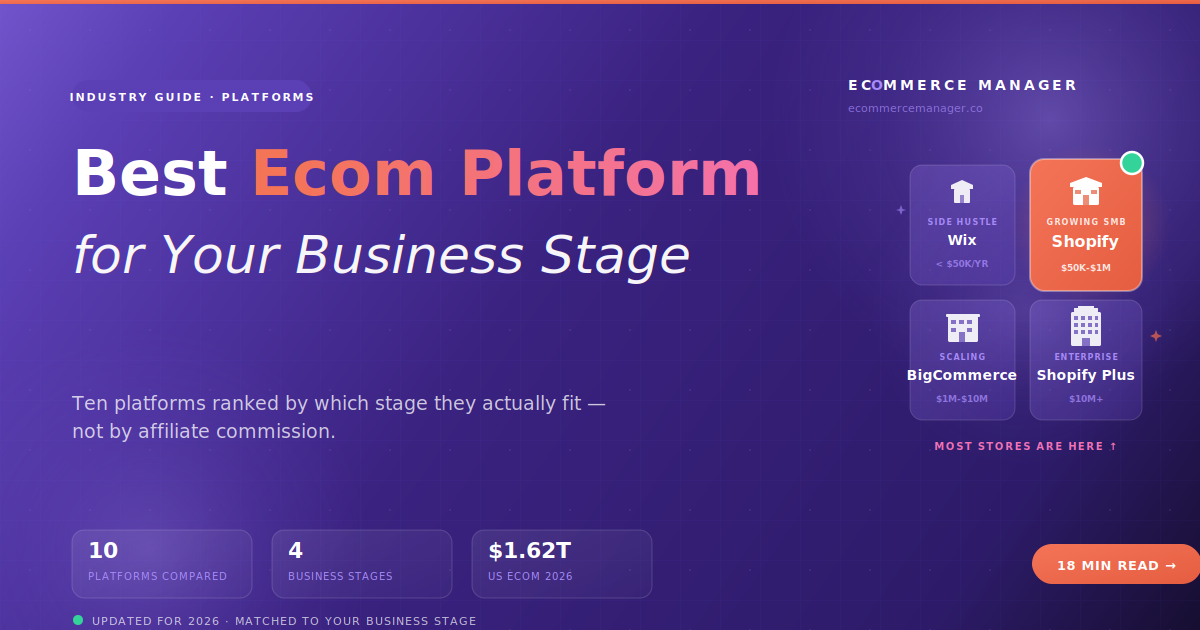
The Four Business Stages (Match Your Platform to Yours)
Before comparing platforms, be honest about which stage you're actually in — not which stage you wish you were in. Picking a $2,300/month enterprise platform when you're pre-launch is how you burn 12 months of runway on a platform your traffic will never justify. Picking a $12/month plan for a business projected to hit $500K this year is how you outgrow your platform in month five and lose two weeks migrating.
Side Hustle
Testing a concept, launching solo, few products. You need cheap, fast to launch, and functional. Not scalable.
Growing SMB
Store generates real revenue. You need reliable, extensible, and priced for a business that can absorb $50-200/month in platform costs.
Scaling
Transaction fees start mattering more than platform fees. Need advanced features, integrations, and a growth ceiling that isn't in sight yet.
Enterprise
Custom checkout, complex catalog, dedicated support, and integrations with ERP/CRM. Migration is a six-figure decision.
The Four Criteria That Actually Matter to Merchants
Every platform will claim "easy to use" and "scales with your business." Here are the four things that actually decide whether a platform works for your store:
1. Setup time (how fast to sell)
How long from "I want to launch a store" to "I'm processing my first order"? For side-hustle platforms, this should be measured in hours (Wix, Squarespace, BigCartel). For SMB platforms, in days (Shopify, BigCommerce). For enterprise, in weeks or months (Adobe Commerce, Shopify Plus with implementation). Match the setup complexity to your urgency and technical comfort.
2. True total cost (not the sticker price)
The platform sticker price is a starting point, not the real cost. Add: monthly subscription + payment processing fees (typically 2.9% + $0.30) + platform transaction fees (Shopify charges 0.5-2% unless you use Shopify Payments; BigCommerce charges 0%) + essential apps (usually $50-300/month for anything serious) + theme + domain. A "$39/month" Shopify store often costs $200-400/month in reality. A "free" WooCommerce store often costs $50-150/month once you add hosting, plugins, and a theme.
3. Growth path (can you stay or must you migrate?)
Migrating between platforms is technically possible and operationally brutal. Orders, customer data, product SEO equity, integrations, and every custom bit you've built all need to come with you. The right platform is one you can stay on for 3-5 years. That means picking something you can grow into, not just something that fits today.
4. Merchant experience (admin, apps, support)
You'll spend more time in the admin than any other software you use. Admin quality matters. So does the app ecosystem (Shopify has 17,000+; smaller platforms have hundreds). So does support quality — some platforms have 24/7 phone support with real humans; others have community forums and hope you figure it out.
Quick Comparison: 10 Ecommerce Platforms for Your Online Store
Side-by-side, sorted by stage fit. "Total cost realistic" adds typical monthly cost of the platform plus common apps, transaction fees, and payment processing on a $10K/month store. This is the number the sticker price hides.
| Platform | Stage Fit | Sticker Price | Realistic Monthly | Best For |
|---|---|---|---|---|
SH Shopify |
SMB → Scaling | $39/mo (Basic) | $200-400/mo | The default choice |
BC BigCommerce |
SMB → Scaling | $39/mo (Standard) | $150-350/mo | No transaction fees |
WC WooCommerce |
SMB → Scaling | Free + hosting | $50-250/mo | WordPress users |
WX Wix eCommerce |
Starter → SMB | $29/mo (Core) | $70-150/mo | All-in-one small stores |
SQ Squarespace |
Starter → SMB | $23/mo (Core) | $60-130/mo | Design-forward brands |
SP Shopify Plus |
Scaling → Enterprise | $2,300/mo | $3,000-8,000/mo | $3M+ DTC stores |
SO Square Online |
Starter | Free tier | $30-80/mo | Retail + online hybrid |
EW Ecwid |
Starter | Free / $19/mo | $40-100/mo | Existing sites needing commerce |
BG BigCartel |
Creator | Free / $12/mo | $15-50/mo | Artists & small creators |
AC Adobe Commerce |
Enterprise | ~$22K+/yr | $2,000+/mo (all-in) | Complex catalogs, B2B |
The "realistic monthly" column assumes a store doing about $10,000/month in sales, using the platform's standard payment processor, running 3-5 common apps (email marketing, reviews, upsells, analytics), and paying transaction fees where applicable. Your actual number varies with volume, apps chosen, and payment method. The point isn't precision — it's that sticker prices lie by 3-5x across the board.
1. Shopify — The Default Answer for Most Stores
Shopify
Shopify is the default answer for most ecommerce stores because it's genuinely good at almost everything and rarely bad at anything. The admin is polished, the app ecosystem is unmatched (17,000+ apps handle almost every edge case), the checkout converts well, and the platform scales from a Basic $39/month store to Plus tier at $2,300/month without a full migration. For anyone who doesn't have a specific reason to pick something else, Shopify is the pragmatic pick — and the pragmatic pick is often the right pick.
The trade-offs to know about: Shopify charges 0.5-2% platform transaction fees on top of card processing unless you use Shopify Payments (which forces you to use their processor). The apps ecosystem is powerful but expensive — a $39/month store often becomes $200-400/month once you add the apps needed for real operations. And custom checkout logic is limited unless you're on Shopify Plus (which does support Checkout Extensibility). For most SMB and scaling stores, none of these are dealbreakers.
2. BigCommerce — The No-Transaction-Fee Alternative
BigCommerce
BigCommerce is the strongest alternative to Shopify for merchants who care about total cost of ownership. The headline advantage: zero platform transaction fees on any payment gateway. Shopify charges 0.5-2% on every sale unless you use Shopify Payments. For a store processing $100,000/month, that's $6,000-24,000 per year in savings — enough to pay for the plan several times over. BigCommerce also ships with deeper out-of-box features: product ratings, real-time shipping quotes, abandoned cart recovery, faceted search, custom price lists, and multi-currency selling. On Shopify, several of these require paid apps.
The trade-off: smaller ecosystem. Fewer apps, fewer prebuilt themes, less community content, and less brand recognition when hiring. If you value ecosystem depth and everyone-knows-Shopify familiarity, Shopify wins. If you care about not paying platform transaction fees and want more depth without add-ons, BigCommerce wins. For high-volume stores, the transaction fee math often decides it.
3. WooCommerce — The WordPress-Native Choice
WooCommerce
WooCommerce is the plugin that adds full ecommerce functionality to any WordPress site. Free to install, no platform fees, no per-transaction commission — but you're responsible for hosting, security, updates, and everything WordPress requires. For merchants already deep in the WordPress ecosystem, WooCommerce is the pragmatic choice: you keep your existing site, add commerce, and get access to the largest plugin marketplace in the world (100,000+ plugins). It powers roughly 28% of all online stores globally.
The trade-offs are real. WooCommerce is genuinely free, but running it in production requires managed hosting ($30-100+/month), premium plugins for anything serious, and either technical skill or a developer on call. For serious ecommerce, most operators use managed WooCommerce hosting which starts around $15-30/month at the entry level. Total cost of ownership ends up similar to Shopify for most stores — you're paying with time and complexity instead of platform fees.
4. Wix eCommerce — All-in-One for Small Stores
Wix eCommerce
Wix is what you pick when you want an all-in-one website (portfolio, blog, booking, ecommerce) rather than a commerce-first platform. The drag-and-drop builder is genuinely good, the templates are professional, and setup takes hours instead of days. Zero platform transaction fees on all commerce plans (a nice surprise). Best fit: small stores where the "store" is one part of a broader website, service businesses adding light ecommerce, or founders who value design flexibility over commerce depth.
The trade-off: Wix isn't purpose-built for ecommerce the way Shopify is. Multichannel selling is weaker, the checkout has fewer conversion optimizations, and the growth ceiling comes sooner. For a store doing under $500K/year, Wix is genuinely competitive and often more affordable. For anything approaching $1M+, most operators migrate to Shopify or BigCommerce for the deeper feature set.
5. Squarespace Commerce — Design-Forward Small Stores
Squarespace Commerce
Squarespace is what design-conscious founders pick when they can't stand the "another Shopify store" look. The templates are the most polished in the category — every one of them ships as a genuinely beautiful starting point, not something you'll spend a weekend customizing to look decent. For service businesses, portfolios with light selling, digital product creators, and design-forward brands, Squarespace is often the cleanest fit. Commerce transaction fees drop as low as 2% on the Commerce Basic tier and 0% for digital products and memberships on higher tiers.
The trade-off: commerce depth. Squarespace doesn't do multi-currency, has weaker multichannel selling than Shopify or BigCommerce, and the app ecosystem is smaller. For product-heavy stores planning to scale past $500K-1M/year, you'll likely outgrow it. For brands where design matters more than commerce depth and you're operating in a single currency, it's genuinely excellent.
6. Shopify Plus — The Enterprise Tier
Shopify Plus
Shopify Plus is the same platform you already know, upgraded for stores that have outgrown the standard plans. What you actually get for $2,300+/month: significantly higher API rate limits, custom checkout via Shopify Functions and Checkout Extensibility, up to 10 international storefronts included, dedicated account management, priority support, and lower Shopify Payments processing rates. Most DTC brands doing $3M+ per year graduate to Plus for the combination of custom checkout capability and the transaction fee savings on Shopify Payments (which more than covers the plan cost at their volume).
The trade-off is the price and what you don't get. Plus isn't a fundamentally different platform — it's Shopify with extras. If Shopify doesn't fit your needs, Plus won't fix that. What Plus is genuinely good for: fast-scaling brands where the standard Shopify Advanced plan hits its ceiling (API rate limits, transaction fees eating into margins, need for real checkout customization).
7. Square Online — For Physical Retail Going Online
Square Online
Square Online exists for one specific customer: physical retailers, restaurants, and service businesses who already use Square for in-person payments and want to add online sales without a separate system. The integration is genuinely tight — inventory, orders, customers, and payments all sync between your physical POS and online store automatically. The free tier is real (not a trial), with paid tiers at $29 and $79 for additional features. For local businesses running a restaurant, boutique, or salon that want online ordering, Square Online is often the fastest and cheapest path.
The trade-off: Square Online isn't built for pure-DTC ecommerce. The store templates are limited, the app ecosystem is small, and the platform assumes you have a physical business as your primary operation. For online-first brands, Shopify or BigCommerce will be dramatically better. For retail-first businesses adding online: Square Online is genuinely the best-fit option.
8. Ecwid by Lightspeed — Add Commerce to an Existing Site
Ecwid by Lightspeed
Ecwid is a genuinely useful in-between option: a hosted ecommerce platform designed to embed into any existing website (WordPress, Wix, Squarespace, static HTML — anything). If you already have a website you like and don't want to migrate, Ecwid lets you add a full commerce layer with cart, checkout, and product management without rebuilding anything. Free plan supports up to 5 products; paid plans scale up. Owned by Lightspeed since 2021, so POS integration is native.
The trade-off: Ecwid is limited compared to dedicated commerce platforms. Fewer apps, less customization, and the growth ceiling is lower than Shopify or BigCommerce. It shines specifically as an add-on to an existing site, not as a primary commerce platform for a serious store. For a service business selling a small product line alongside their main offering, it's often the right answer.
9. BigCartel — For Artists, Makers, and Small Creators
BigCartel
BigCartel is the platform artists, illustrators, indie brands, and small creators have quietly loved for over 20 years. Free for up to 5 products, $12/month for 50 products, $22/month for 500. Zero platform transaction fees. Templates are minimal (which for creator brands is often exactly right). No app ecosystem, no complex features — just an inexpensive way to sell your work online without giving Shopify $50/month you don't have. For makers, band merch stores, small print shops, and hobby brands, BigCartel is often the cleanest fit.
The trade-off: no growth ceiling worth mentioning. BigCartel isn't going to scale you to $1M/year. It's not trying to. If you outgrow it, you migrate to Shopify or WooCommerce like everyone else. But for the entry-level creator segment where a $12/month platform beats a $200/month all-in Shopify setup, BigCartel is the honest answer.
10. Adobe Commerce — Enterprise for Complex Catalogs
Adobe Commerce (Magento)
Adobe Commerce (formerly Magento) sits at the enterprise end of the market — a PHP-based platform with unmatched flexibility for complex catalogs, sophisticated B2B, and deep customization. Adidas, Ford, Land Rover, and other global brands run on it. The trade-offs are meaningful: implementation typically requires a specialized agency and 6-12 months of engineering work, ongoing operational cost is significant (developers, hosting, integrations), and the platform is genuinely difficult to work with compared to modern alternatives.
Adobe Commerce is the right answer when: your catalog complexity or B2B requirements genuinely exceed what Shopify Plus or BigCommerce Enterprise can express, you have dedicated technical resources or an agency relationship, and you're operating at a scale where the enterprise license makes financial sense ($10M+/year typically). For anything smaller or simpler, this platform is overkill — pick Shopify Plus or BigCommerce Enterprise instead.
The Transaction Fee Trap Nobody Warns You About
Almost every platform comparison focuses on monthly subscription cost. The bigger hidden cost is transaction fees. Here's what actually happens at scale:
Shopify charges 0.5-2% platform transaction fees on every sale unless you use Shopify Payments (which forces their processor at 2.9% + $0.30). BigCommerce charges 0% platform transaction fees on any gateway. Wix charges 0% platform fees but uses its own processor. Squarespace charges 3% on Core tier, dropping to 0% on higher tiers for digital products.
For a store doing $10,000/month, the difference is minor — maybe $100-200/month either way. For a store doing $100,000/month, that same 1-2% differential is $12,000-24,000/year. For a $1M/month enterprise store, we're talking $120,000-240,000/year. This is why serious operators at scale often pick BigCommerce over Shopify, or upgrade to Shopify Plus specifically to unlock lower payment processing rates. Sticker price rarely tells you the truth about total cost.
The Migration Reality
Migrating between ecommerce platforms is technically possible and operationally painful. You'll move products, orders, customer data, subscription state, SEO redirects, and every custom integration. Most migrations take 2-4 weeks and cost thousands of dollars in engineering time. Pick a platform you can grow into for 3-5 years, not the cheapest one that fits today. Cheap upfront often means expensive later.
How to Actually Pick Your Platform
Skip the sticker-price comparisons. Answer these questions honestly:
1. What stage are you actually in?
🌱 Side hustle (< $50K/yr)
Wix, Squarespace, BigCartel
📈 Growing SMB ($50K – $1M/yr)
Shopify or BigCommerce
🚀 Scaling ($1M – $10M/yr)
Shopify Advanced, BigCommerce Pro
🏢 Enterprise ($10M+/yr)
Shopify Plus, BigCommerce Enterprise, Adobe Commerce
2. Do you already have a website you want to keep?
If yes: Ecwid lets you add commerce to an existing site without rebuilding. If your existing site is on WordPress: WooCommerce is the natural add-on. Everyone else should just start fresh on a commerce-first platform.
3. Do you have physical retail already?
If yes: Square Online integrates with your existing Square POS for free. Shopify has the strongest POS if you want a unified system built for retail + online from the ground up.
4. Are you design-obsessed or ecom-obsessed?
If design matters more than commerce depth: Squarespace. If you want deep commerce features and can accept "another Shopify store" visual DNA: Shopify. If you want both, you'll spend $10K+ on a custom Shopify theme.
- Comparing only sticker prices. The $23/month platform can cost more than the $39/month one once you add apps, transaction fees, and payment processing. Compare realistic monthly totals at your projected volume, not the marketing page.
- Picking based on what an agency wants to sell you. Agencies are heavily incentivized toward the platform they specialize in. Get an unbiased evaluation from someone who doesn't stand to make money on your choice.
- Overbuying for aspirational scale. A $2,300/month Shopify Plus subscription for a business that isn't doing $100K/month yet is expensive theater. Start where you actually are.
- Underbuying to save $30/month. BigCartel is right for creators. It's wrong for a growing DTC brand. Don't stay on a starter platform out of stubbornness once you've outgrown it.
- Ignoring the ecosystem. An obscure platform that "does everything" isn't a good deal if you can't hire anyone who knows it. Familiarity has real economic value.
The Honest Bottom Line
For most stores, Shopify is the pragmatic default and rarely a mistake. For serious operators focused on total cost of ownership at scale, BigCommerce often wins on the numbers. For WordPress-native shops, WooCommerce is the sensible extension. For small stores prioritizing design, Squarespace wins. For all-in-one small business sites, Wix works. For creators and side hustles, BigCartel is genuinely the best fit. For hybrid retail + online, Square Online. For enterprise complexity, Shopify Plus or Adobe Commerce depending on your specific requirements.
The wrong question is "which is best?" The right question is "which fits where I actually am, with a growth path to where I'll be in three years?" Pick that one. And don't over-engineer for a future that hasn't happened yet.
Need Help Picking Your Platform?
The eCommerce Manager helps merchants pressure-test platform choices against real revenue projections and total cost of ownership — no affiliate pressure, no agency upsells.
Get an Unbiased Second Opinion →