


Last Updated on July 20, 2026
Volusion in 2026: 120 statistics on consumer behavior, social, email, mobile, personalization, and AI
The 120 numbers B2C operators evaluating or running Volusion need on hand — pulled from Volusion's own data, StoreLeads, BuiltWith, Capital One Shopping, Publicis Sapient, and 22 other sources.
On this page
The state of Volusion in 2026
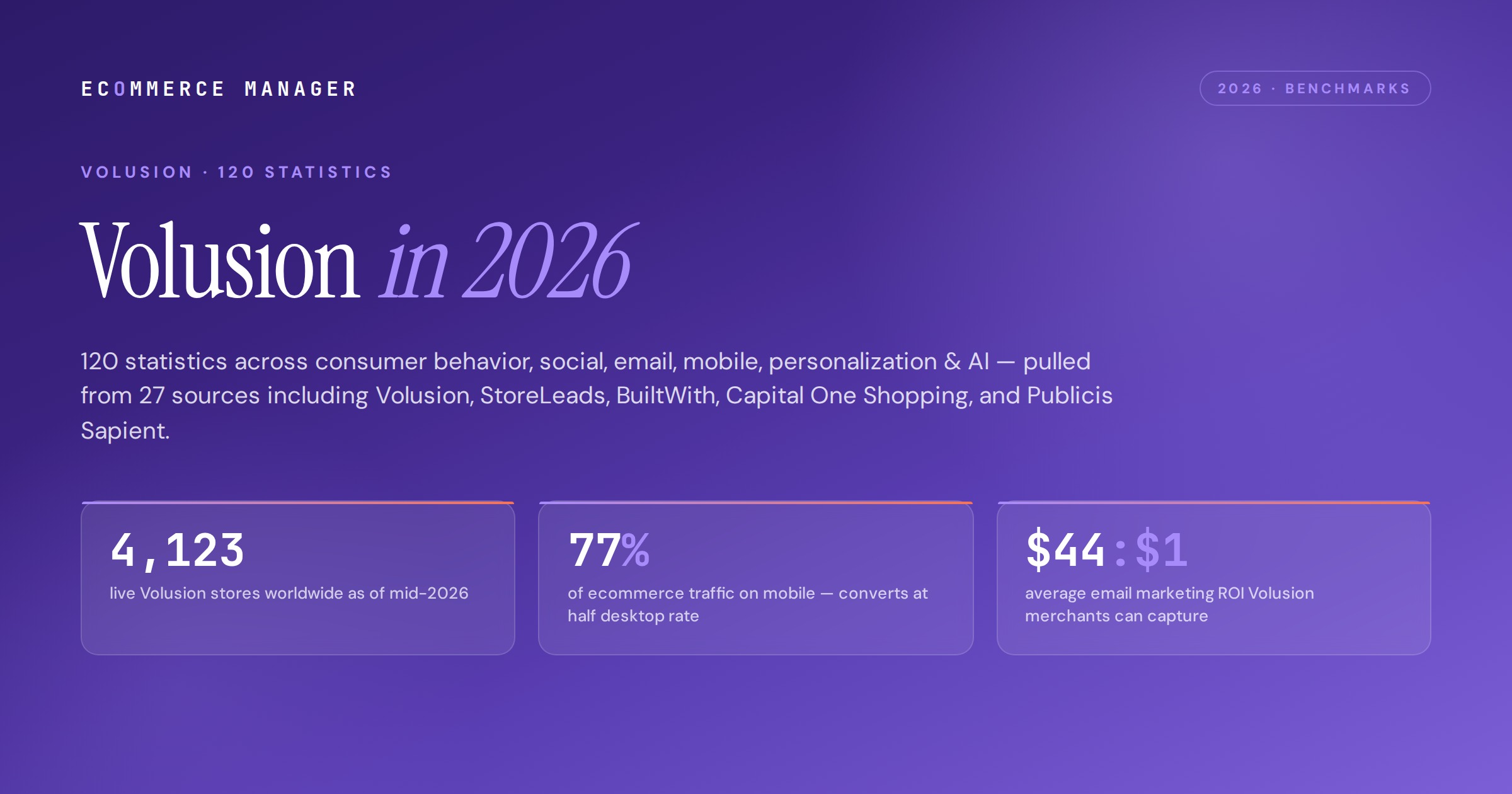
Volusion is one of the oldest platforms in ecommerce and, in 2026, one of the most quietly consequential to understand — because the merchants still running on it face a specific set of trade-offs that reveal a lot about how platform decisions age. StoreLeads pegs the active Volusion merchant base at 4,123 live stores as of mid-2026, down 19% year-over-year, and BuiltWith counts 47,904 historical users. The trajectory is unambiguous: the platform is shrinking, but the remaining base is real, active, and mostly composed of long-tail small businesses with stable operations rather than growth-mode startups.
The 120 statistics below are drawn from 27 sources: Volusion's own help documentation, StoreLeads and BuiltWith platform trend data, Capital One Shopping's 2025 consumer behavior research, industry analysts (Publicis Sapient, Lumina Datamatics, Digital Commerce 360, Akeneo, Salesforce), and specialist coverage on email marketing (Campaign Monitor, Forbes Advisor, HubSpot, CodeCrew) and mobile commerce (Growth-Engines, Contentsquare). They're organized into six sections: consumer behavior, social commerce, email marketing, mobile UX, personalization, and AI in B2C.
This is not a Volusion product review. It's the benchmark set every Volusion operator — or every operator weighing whether to stay on Volusion vs migrate to Shopify or BigCommerce — should have on hand for planning 2026 targets, budget requests, and platform decisions.
Volusion + consumer behavior
Volusion is in the middle of a demographic transition — a shrinking merchant base of long-tail SMBs operating in a consumer market that rewards trust, sustainability, and seamless logistics over surface-level novelty. The data below explains what those shoppers actually care about in 2026.
-
01BuiltWith data show 52,027 websites have used Volusion, with 4,123 live Volusion stores and 47,904 historical users as of mid-2026.
-
02StoreLeads reports Volusion stores decreased 0.8% quarter-over-quarter in 2026 Q2, and decreased 19% year-over-year, indicating a shrinking but still active merchant base.
-
03Volusion is now a smaller, mature platform used mainly by long-tail small businesses rather than high-growth startups.
-
04Publicis Sapient's 2026 ecommerce trends note that AI-driven personalization and sustainability are among the top trends accelerating ecommerce.
-
05Lumina Datamatics identifies AI-driven personalization at scale as the first major trend, with generic storefronts rapidly disappearing.
-
06Lumina notes retailers are using predictive analytics for demand and churn, reducing overstocking and preventing customer loss.
-
07Capital One Shopping finds 86% of US consumers read online reviews before purchases, and 66% use search engines to research companies or products.
-
0894% of consumers say good customer service inspires brand loyalty, and 82% recommend brands based on good service — making CX critical for Volusion merchants.
-
0975% of consumers tried different brands and new ways to shop within three months, and 73% of those intend to keep exploring — meaning low brand lock-in and frequent switching.
-
10American consumers spend 87.9% of after-tax income on goods and services, with per-person spending projected at $32,732 in 2025, sustaining demand for retail.
-
1172% of consumers worry about increasing everyday costs, increasing price sensitivity and demand for value.
-
12Over five years, online searches for sustainable products jumped 71%, showing rising interest in ethical and eco-friendly offerings.
-
1373% of consumers compare prices across three or more retailers before buying, increasing competitive pressure on Volusion stores.
-
1477% often view return policies before buying, making clear policies on Volusion product and checkout pages essential.
-
1557% of consumers research intended purchases extensively, shifting focus from pure discounts to content and transparency.
-
16288.5 million Americans shop online, and 254 million shop via smartphones, giving Volusion merchants access to a large digital audience.
-
17The primary reasons for online shopping are home delivery (58%) and convenience (51%), reinforcing the need for strong logistics and UX.
-
18Digital Commerce 360 notes 2026 ecommerce focus is moving away from surface innovation toward logistics and structure, including fulfilment and returns.
-
19Lumina highlights automation across the ecommerce lifecycle (catalog, order management, support) as a major trend, helping retailers manage rising consumer expectations.
-
20Overall, Volusion merchants operate in a space where price sensitivity, trust, sustainability, and seamless logistics drive behaviour more than novelty alone.
Weighing Volusion vs a migration to Shopify or BigCommerce?
Model the 3-year total cost — including replatforming fees, app tax, expected mobile conversion uplift, and migration risk — for your revenue tier in under two minutes.
Email marketing & lifecycle
Volusion's built-in email tools are functional but lag modern ESP standards, meaning most serious operators run their lifecycle stack through Klaviyo, Omnisend, or similar via API. The ROI math justifies it: email averages $44 per $1 spent and produces 174% more conversions than social in some benchmarks.
-
01Forbes Advisor's July 2026 report notes 4.48 billion email users worldwide, and 81% of companies use email in their marketing strategy.
-
0264% of small businesses use email marketing regularly, making it a near-universal channel for SMBs like Volusion merchants.
-
03Nearly 90% of marketers plan to maintain or increase email spend, reflecting its proven effectiveness.
-
04About 50% of marketers rank email as the most powerful channel in their mix for engagement and conversion.
-
05Email marketing ROI typically ranges from 10:1 to 36:1, with top programs exceeding 50:1.
-
06Campaign Monitor data show email drives an average of $44 for every $1 spent, and email produces 174% more conversions than social media in some benchmarks.
-
07Personalized emails generate a 26% higher open rate than non-personalised emails, highlighting the impact of tailoring content.
-
08Automated emails generate 320% more revenue than non-automated emails, and transactional emails have 8x more opens and clicks and can generate 6x more revenue.
-
09Cart-abandonment emails achieve an average 50.5% open rate and recover 3–5% of lost sales, while sending three emails in sequence recovers 69% more than a single reminder.
-
1077% of email ROI comes from segmented, targeted, and triggered campaigns, not bulk sends.
-
1178% of marketers say list segmentation is the automation feature they can't live without, showing heavy reliance on segmentation.
-
12Email marketing produces an average of 174% more conversions than social media, underscoring its role in turning interest into purchases.
-
13Roughly half of marketers feel they can increase interaction by increasing email personalization, and 50% of companies actively pursue this.
-
14With email automation, conversion rates are 180% higher than batch emails, thanks to timely, behaviour-based triggers.
-
15For B2C ecommerce, cart recovery and win-back flows often deliver 3–5% additional revenue with minimal extra cost.
-
16HubSpot and other studies show email remains one of the highest-ROI digital channels, often outperforming paid social and display.
-
17Volusion merchants can integrate ESPs and automation platforms to implement segmented campaigns, behaviour-based flows, and dynamic product blocks, aligning with these stats.
-
18Consumers are increasingly willing to share data for personalised experiences, provided brands respect privacy and deliver value.
-
19Finding the right frequency is crucial: most companies send 2–4 emails per month to maintain engagement without overwhelming subscribers.
-
20Overall, email in 2026 is a high-ROI, automation-friendly channel that Volusion merchants should use for cart recovery, post-purchase flows, and personalised offers.
Mobile commerce & UX
Mobile drives 77% of Volusion-relevant ecommerce traffic — but converts at half the desktop rate. That's the single biggest structural gap in the Volusion stack. The legacy mobile commerce module doesn't support all store configurations, which pushes serious operators toward modern responsive themes and headless architecture.
-
01Growth-Engines reports mobile drives 77% of ecommerce traffic but converts at about half the desktop rate, highlighting a large performance gap.
-
02Mobile commerce sales are projected to reach $2.51 trillion, reflecting dominant mobile shopping behaviour globally.
-
03Capital One data show 254 million Americans shop via smartphones, and 76% have purchased products on their phone, versus 69% on desktop/laptop.
-
0440% shop online because it's cheaper than in-store, 36% value 24-hour availability, and 34% seek wider product ranges — all easily accessed via mobile.
-
0530% say online shopping is appealing because it's easier to compare products, a behaviour often conducted on mobile.
-
06Volusion's mobile commerce help centre notes mobile commerce support for Android 4.1x and iOS7, with some newer store configurations not supported by legacy mobile features — signalling the need for modern responsive themes.
-
07That same documentation implies Volusion mobile commerce doesn't support all store configurations, so merchants should test mobile thoroughly.
-
08Contentsquare's benchmark shows cross-device behaviour is standard, with users switching between mobile and desktop before deciding.
-
09The benchmark aggregates 99 billion web/app sessions across 6,500+ sites, giving robust insight into cross-device UX patterns.
-
10Many sectors see higher session volumes on mobile but better conversion on desktop, driven by UX friction and data entry challenges.
-
11Digital Commerce 360's trends note ecommerce is shifting focus to logistics, fulfilment, and structural optimisation — which includes mobile checkout and returns flows.
-
12Consumers demand fast websites, intuitive layouts, and clear checkout flows: slow or confusing mobile UX quickly causes abandonment.
-
13AI-driven UX tools now analyse session paths, scroll depth, and time on page, helping brands improve mobile experiences.
-
14As social commerce and short-form video are mobile-native, many visits to Volusion stores will start on mobile from social links or ads.
-
15AI-powered search and discovery will increasingly surface mobile pages and PWAs, making structured content and good mobile UX essential.
-
16Voice and visual search are growing, requiring clear images, alt text, and structured product data to support mobile discovery.
-
17Mobile checkout friction — extra fields, poor auto-fill, unclear shipping options — remains one of the main drivers of cart abandonment on mobile.
-
18Retailers addressing mobile gaps via simplified checkout, wallet payments, and better navigation see meaningful uplifts in mobile conversion.
-
19Automation and AI can help test and adjust mobile funnels quickly, iterating toward higher conversion without manual analysis.
-
20Overall, Volusion merchants must treat mobile as the dominant traffic source, investing in modern responsive themes, streamlined checkout, and data-driven UX improvements.
Need help closing the mobile conversion gap on Volusion?
Browse vetted CRO, mobile UX, and headless commerce agencies that work with Volusion merchants on responsive themes, checkout optimization, and API-connected AI stacks.
Personalization in B2C for Volusion
Volusion's native personalization is minimal — the platform doesn't ship with a recommendation engine or dynamic content blocks. The lift comes from external stacks: Klaviyo for segmented email, third-party recommendation widgets, and clean product data feeding AI search. Where operators do this well, the numbers are outsized.
-
01Lumina Datamatics lists AI-driven personalization at scale as the top ecommerce trend for 2026, with AI models personalising recommendations, pricing, content, and promotions in real time.
-
02Publicis Sapient notes that as AI advances, it increasingly personalises products, content, and promotions to each customer, making personalization core to future ecommerce.
-
03Hyper-accurate product data management is another key trend: clean, enriched, consistent data directly impacts search visibility, conversions, and returns.
-
04Campaign Monitor reports 188% average open rates for personalised emails compared to 12.1% without personalization, showing huge engagement differences.
-
05Personalized subject lines with first-name tokens are 26% more likely to be opened than generic ones.
-
0694% of customer-insights and marketing professionals state that personalization is "extremely important" for meeting email objectives.
-
07Marketers have seen 760% revenue increases from segmented campaigns, highlighting the power of targeted, personalised messaging.
-
0877% of email ROI comes from segmented, targeted, triggered campaigns, not generic blasts.
-
09Netguru reports AI-driven recommendations can increase conversion rates by 70%, but only 41% of consumers feel benefits justify privacy trade-offs.
-
1064% of consumers express genuine interest in tailored experiences, especially when tied to value and relevance.
-
11Consumers are increasingly willing to share data for personalisation if brands are transparent and deliver clear value.
-
12Behavioural segmentation — categorising customers by actions and patterns — is highlighted as a key strategy for effective personalization.
-
13Vizologi notes behavioural segmentation helps identify high-value segments, frequent buyers, and specific interest clusters, enabling targeted campaigns.
-
14Campaign Monitor data show automated emails generate 320% more revenue, and transactional emails outperform general campaigns significantly, making personalised lifecycle flows critical.
-
15Automated emails drive conversion rates 180% higher than batch emails, especially when personalised by behaviour.
-
16CodeCrew's stats show cart email sequences can recover 69% more revenue when three emails are sent instead of one, a powerful personalised sequence.
-
17Lumina emphasises predictive analytics for demand and churn, allowing personalised offers and outreach before customers disengage.
-
18Publicis Sapient highlights sustainability and responsible consumption as trends: personalisation that surfaces sustainable products can tap into rising demand.
-
19For Volusion merchants, personalisation hinges on segmentation, accurate product data, behavioural tracking, and AI-assisted recommendations, even if delivered via external tools.
-
20In 2026, personalization for Volusion stores means moving from generic catalogues to data-driven experiences, aligning products, content, and offers with individual behaviour and values.
AI in B2C & the Volusion ecosystem
Volusion has almost no native AI. That's not necessarily a problem in 2026 — composable and headless architectures let AI services plug into older platforms via APIs — but it does mean the AI competitiveness of a Volusion store depends entirely on the external stack the operator wires around it.
-
01Publicis Sapient's 2026 ecommerce trends report lists generative AI and personalization among eight trends accelerating ecommerce, with AI mediating more customer interactions.
-
02Lumina emphasises AI-driven personalization, predictive analytics, and automation as the most impactful trends, all centred around intelligence, speed, and experience.
-
03AI models now personalize product recommendations, pricing, content, and promotions in real time, based on behaviour and intent.
-
04Retailers increasingly use predictive analytics to forecast demand and customer churn, acting proactively to prevent loss.
-
05Composable and headless architectures allow AI services to plug into ecommerce stacks, even older platforms like Volusion via APIs.
-
06Automation across the ecommerce lifecycle — catalog creation, order management, support — is driven by AI-powered tools improving speed and cost efficiency.
-
07Salesforce data show 63% of marketers are using generative AI, and 83% of AI-using sales teams saw revenue growth vs 66% who didn't — linking AI adoption to performance.
-
08AI marketing revenue is expected to reach $107 billion by 2028, reflecting rapid investment in AI-driven martech.
-
09AI is highly effective for data-heavy tasks like analysing behaviour, predicting churn, and optimising campaigns, freeing humans to focus on strategy.
-
10Growth-Engines and others show AI is used to analyse mobile vs desktop behaviour, improving conversion rates by targeting friction points.
-
11Akeneo's 2026 trends highlight AI-powered product search and discovery and the first steps toward agentic commerce, where AI agents transact for users.
-
12SEMrush (via Akeneo) predicts AI-search will overtake traditional search by 2028, making AI a primary gateway to ecommerce sites.
-
13Akeneo reports 49% of Americans say AI recommendations already influence what they buy, and 64% are willing to purchase AI-recommended items — confirming AI's impact.
-
14Consumer insights tools like Vtion.ai help brands measure digital campaign impact and behaviour in one place, enabling smarter AI modelling.
-
15SurveyMonkey notes consumer insights uncover the "why" behind behaviour, which can feed AI models for better, human-aligned outputs.
-
16Email and marketing stats show AI-driven personalization increases open rates, conversions, and revenue, especially when combined with automation.
-
17Digital Commerce 360 sees ecommerce moving toward structural optimisation and logistics, where AI helps route orders, manage inventory, and orchestrate fulfilment.
-
18AI is also central to workforce optimisation, automating repetitive tasks while humans handle high-impact CX work.
-
19For Volusion merchants, AI is typically accessed via external tools (recommendation engines, email platforms, analytics suites) connected to Volusion rather than built in.
-
20In 2026, AI in B2C around Volusion effectively means AI-augmented marketing, search, and logistics — built on strong data foundations and used to deliver faster, more personalised, and more efficient customer experiences.
What matters most for Volusion operators in 2026
Volusion is a shrinking, mature platform in 2026 — 4,123 live stores, down 19% year-over-year — best suited to long-tail SMBs with simple operations. Growth-stage brands typically outgrow it within their first year of serious traction and migrate to Shopify or BigCommerce.
The platform's biggest structural gap is mobile: 77% of traffic arrives on mobile but converts at half the desktop rate, and Volusion's own documentation flags that legacy mobile commerce features don't support all store configurations. Modern responsive themes and headless setups are the workaround.
Email remains the single highest-ROI lever available to Volusion merchants — $44 per $1 spent, 174% more conversions than social. But Volusion's native email tools aren't competitive; the real programs run through Klaviyo or Omnisend via API. That's a required part of the stack, not an optional add-on.
AI on Volusion is entirely external. Composable architectures let AI services plug in via API, and 63% of marketers already use generative AI — but the merchant carries the full burden of integration. Where operators do this well, personalization can lift conversion by up to 70% and segmented campaigns can drive 760% revenue increases.
Frequently asked questions
Is Volusion still worth using in 2026?
For long-tail small businesses with straightforward catalogs and low-complexity operations, Volusion remains functionally adequate — its stability and lower monthly cost than Shopify at similar tiers are the main reasons merchants stay. But StoreLeads data shows the merchant base shrunk 19% year-over-year in 2026 Q2, and the platform lacks native AI, modern personalization tools, and comprehensive mobile support for newer configurations. Serious growth brands typically migrate to Shopify or BigCommerce within their first $1M in revenue.
How does Volusion compare to Shopify for SMB ecommerce?
Volusion offers a lower entry price and simpler admin, but Shopify wins decisively on ecosystem depth (tens of thousands of apps vs a fraction of that for Volusion), mobile theme quality, native AI features, and third-party ESP integrations. Shopify's checkout is measurably faster and converts better on mobile. If a merchant already runs Volusion profitably at low volume, staying is defensible. For any brand expecting to scale past $500K–$1M in annual revenue, Shopify's advantages typically justify the migration cost.
What are the biggest limitations of Volusion in 2026?
Three limitations matter most: (1) no native AI or built-in recommendation engine, so personalization requires third-party tools bolted on via API; (2) legacy mobile commerce support that doesn't cover all store configurations, per Volusion's own help documentation; and (3) a shrinking merchant base and developer ecosystem, which means fewer new integrations, themes, and specialists compared to Shopify or BigCommerce. Operators can work around all three, but the workarounds add complexity and cost.
What ROI can Volusion merchants expect from email marketing?
Email is the highest-ROI channel available to Volusion merchants. Industry ROI ranges from 10:1 to 36:1, with top programs exceeding 50:1. Campaign Monitor benchmarks show $44 in revenue per $1 spent, and 174% more conversions than social media in comparable programs. Cart abandonment sequences alone can recover 3–5% of lost revenue with minimal incremental cost. The catch: Volusion's built-in email tools are limited, so most operators route email through Klaviyo, Omnisend, or similar via API integration.
Should I migrate off Volusion to another platform?
The migration decision hinges on three factors: (1) whether your growth trajectory will require app ecosystem depth Volusion can't match, (2) whether mobile conversion is a material weakness in your current store, and (3) whether your team has bandwidth to manage the migration cost and downtime risk. Brands under $500K in revenue with stable, simple operations often stay. Brands over $1M with growth ambitions typically migrate to Shopify or BigCommerce. The ECM platform calculator models the 3-year total cost of migration vs staying, including replatforming fees, app costs, and expected uplift.
The playbook top eComm operators actually read
One weekly brief. Five stories that matter. Zero fluff. Written for managers at $5M–$50M DTC brands who want to sound sharper than everyone else in the meeting.
References
- 01 BuiltWith — Volusion Trends — trends.builtwith.com
- 02 StoreLeads — Volusion Reports — storeleads.app
- 03 Publicis Sapient — Future Ecommerce Trends — publicissapient.com
- 04 Lumina Datamatics — Biggest Ecommerce Trends 2026 — luminadatamatics.com
- 05 Capital One Shopping — Consumer Behavior Statistics — capitaloneshopping.com
- 06 Digital Commerce 360 — Top 15 Ecommerce Trends 2026 — digitalcommerce360.com
- 07 SellersCommerce — Social Commerce Statistics — sellerscommerce.com
- 08 Escalent — Top Consumer Trends 2026 — escalent.co
- 09 Netguru — Consumer Behavior Trends — netguru.com
- 10 Unilever — Leveraging Social Insights and Technology — unilever.com
- 11 Salesforce — Marketing Statistics 2026 — salesforce.com
- 12 Forge Apollo — Digital Marketing Statistics 2026 — forgeapollo.com
- 13 Akeneo — 2026 Ecommerce Trends — akeneo.com
- 14 Forbes Advisor — Email Marketing Statistics — forbes.com
- 15 HubSpot — Email Marketing Stats — hubspot.com
- 16 Campaign Monitor — 24 Email Marketing Stats — campaignmonitor.com
- 17 CodeCrew — Email Marketing Stats — codecrew.us
- 18 Growth-Engines — Mobile Commerce Optimization — growth-engines.com
- 19 Volusion Help — Mobile Commerce — help.volusion.com
- 20 Contentsquare — 2026 Digital Experience Benchmark — contentsquare.com
- 21 Exeed College — Consumer Buying Behaviour in 2026 — exeedcollege.com
- 22 Shift4Shop — Ecommerce Market Statistics — shift4shop.com
- 23 Square AI — Product Page — squareup.com
- 24 Vizologi — Consumer Customer Segments Behavior — vizologi.com
- 25 Adobe — AI Marketing Trends — adobe.com
- 26 Vtion.ai — Consumer Insights — vtion.ai
- 27 SurveyMonkey — Consumer Insights — surveymonkey.com
Make every platform decision data-backed
Join 12,000+ ecommerce managers reading the ECM newsletter every Wednesday — or browse the directory to find vetted CRO, mobile UX, and retention partners for your Volusion stack.

Social media & social commerce
Facebook dominates the Volusion ecosystem — 38.3% of stores use it as their primary social channel. That concentration means Volusion merchants have less exposure to the TikTok and Instagram growth curves than newer-platform peers, but stronger footing in the demographic segments that still buy on Facebook and Marketplace.