ECM Header

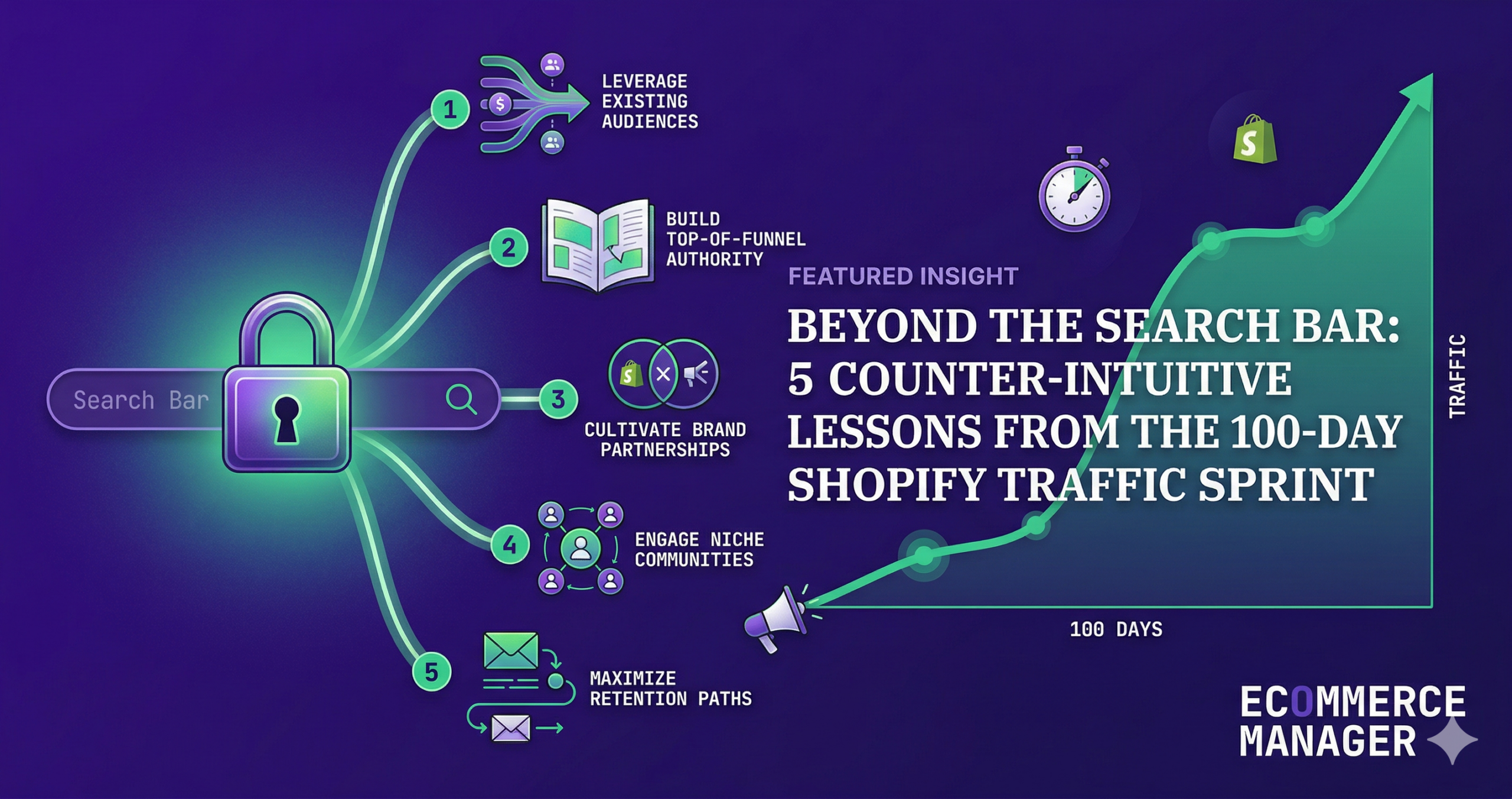
Beyond the Search Bar: 5 Counter-Intuitive Lessons from the 100-Day Shopify Traffic Sprint

Reading Time: 4 minutes
Listen to this article

Last Updated on February 11, 2026

Beyond the Search Bar: 5 Counter-Intuitive Lessons from the 100-Day Shopify Traffic Sprint
Growth Engineering

Beyond the Search Bar

5 Counter-Intuitive Lessons from the 100-Day Shopify Traffic Sprint

Sprint Report

Advanced SEO & AEO

12 min read

1. The "Invisible Store" Problem

For many Shopify store owners, the digital landscape feels increasingly hostile. Organic reach is plateauing, and the rise of AI-generated answers threatens to bury even the most optimized stores under a layer of synthesized text. There is a palpable anxiety that a brand can do everything "right" and still remain invisible. In this new era, being discoverable is merely the baseline; the new mandate is to become "cite-worthy."

The 100-Day Traffic Sprint is not a generic SEO checklist; it is a rigorous re-engineering of the Shopify growth engine. It is a systematic transition from "hoping for clicks" to "architecting authority." By focusing on foundational health and revenue-adjacent content clusters over a 14-week period, merchants move away from chasing algorithm volatility and toward a model of compounding gains.

1

SEO Brings Discovery, But AEO Wins the Sale

The fundamental shift in modern commerce is the evolution from Search Engine Optimization (SEO) to AI Engine Optimization (AEO). While traditional SEO focuses on winning a spot in a list of blue links, AEO is about being the singular answer an AI selects to present to the user. In the age of generative search, a rank without a citation is a ghost—it exists, but it haunts the second page where no one looks.

"SEO brings discoverability. AEO brings selection. The sprint builds pages that (1) rank, (2) answer, and (3) convert."

This shift recalibrates the merchant’s priority: we are no longer just "getting clicks." We are providing the definitive, structured answer. When your page serves as the most direct and useful response to a buyer’s query, you cease being one of many options and become the recommended solution.

2

Flip the Funnel with "Revenue-First" Topic Selection

Traditional content marketing often traps brands on a "content treadmill," producing broad informational posts that fail to convert. The 100-Day Sprint flips this funnel, prioritizing collection and product-adjacent intents. We view AEO potential as a vital financial metric. If an AI cites your store for free, your cost of acquisition (CAC) drops significantly.

Our Rule of Thumb: If a topic cannot be connected to a collection or product within two clicks, it is not a sprint priority.

Topic Selection Filter

Field / What to Check The Good Sign (Strategic Alignment)
Intent Direct path to collection/product (Buyer, comparison, sizing, compatibility).
Inventory You can fulfill demand without substitutions; you stock enough variants.
Margin High margin or high LTV category; you can afford the traffic.
SERP Type You can win with structure (Lists, FAQs, comparisons, guides).
AEO Potential Topic can be answered in 2-4 sentences (Clear 'quick answer' + takeaways).
3

The Power of the "Answer Block" Template

To capture AI visibility, your "money pages" must be "Answer Ready." This requires moving beyond standard feature lists and adopting a high-leverage architectural module. According to our Collection Page Blueprint, a high-performing hub must include:

  • A Precision H1: Matches the primary buyer-intent phrase exactly.
  • Structured Intro (120-180 words): Defines who the collection is for, how to choose, and your unique value proposition.
  • Curated Best Sellers Module: Specific picks with 1-2 lines of expert commentary, rather than just a product grid.
  • The AEO Answer Block: A module containing a 2-4 sentence Quick Answer, a bulleted list of Key Takeaways, and 6-10 FAQs pulled from real customer queries.

Structured formatting—such as comparison tables and short, declarative definitions—is significantly more valuable to an AI crawler than long-form prose. By organizing your data into these predictable patterns, you provide the "hooks" the algorithm needs to extract your brand as the authority.

4

Stop the Content Treadmill—Prioritize the "Link Loop"

The 100-Day Sprint operates on a "Quality Beats Volume" philosophy. Instead of aggressive, disconnected publishing, we use a Hub-and-Spoke model called the "Link Loop." In this framework, an Informational Guide (the Spoke) serves a singular purpose: to drive authority and traffic back to a Primary Collection Page (the Hub).

Definition of Done - Page QA Checklist

  • Title Tag: Matches intent and includes the primary phrase naturally.
  • The 120-Word Rule: The first 120 words include a clear definition and "who it is for."
  • Structured Elements: At least one table, list, or step-by-step comparison.
  • Internal Link Loop: Minimum of 3 links to relevant money pages and 2 links to supporting guides.
  • Schema Integration: Breadcrumb, Product, and FAQ schema are present and validated.
  • Human-Centric Proof: Inclusion of review snippets, certifications, or sizing/care clarity.
5

The "Snippet Engineering" Secret for AI Citations

Earning featured snippets and AI citations is a matter of technical engineering, not editorial luck. It requires the precise application of schema and a strategic rewrite of your page introductions to match AI extraction patterns. We utilize four primary formats to earn these citations:

1. Define

Provide a concise, objective definition of the topic or product category.

2. List

Use bulleted lists to outline selection criteria or feature sets.

3. Compare

Use tables to highlight the differences between models, materials, or price tiers.

4. Step-by-Step

Break down complex processes (like installation or sizing) into numbered sequences.

In a world of AI-summarized results, being the source the AI cites is the ultimate competitive advantage.


From Volatility to Compounding Gains

The 100-day mindset is about moving away from the exhaustion of daily algorithm chasing. As you evaluate your current digital storefront, ask yourself: If an AI were asked to recommend the best product in your category today, would your store provide the clear, structured answer it needs?

Review your SEO foundation & build your revenue-first topical map.

Author

Share the Post:

Related Posts