

Last Updated on May 9, 2026
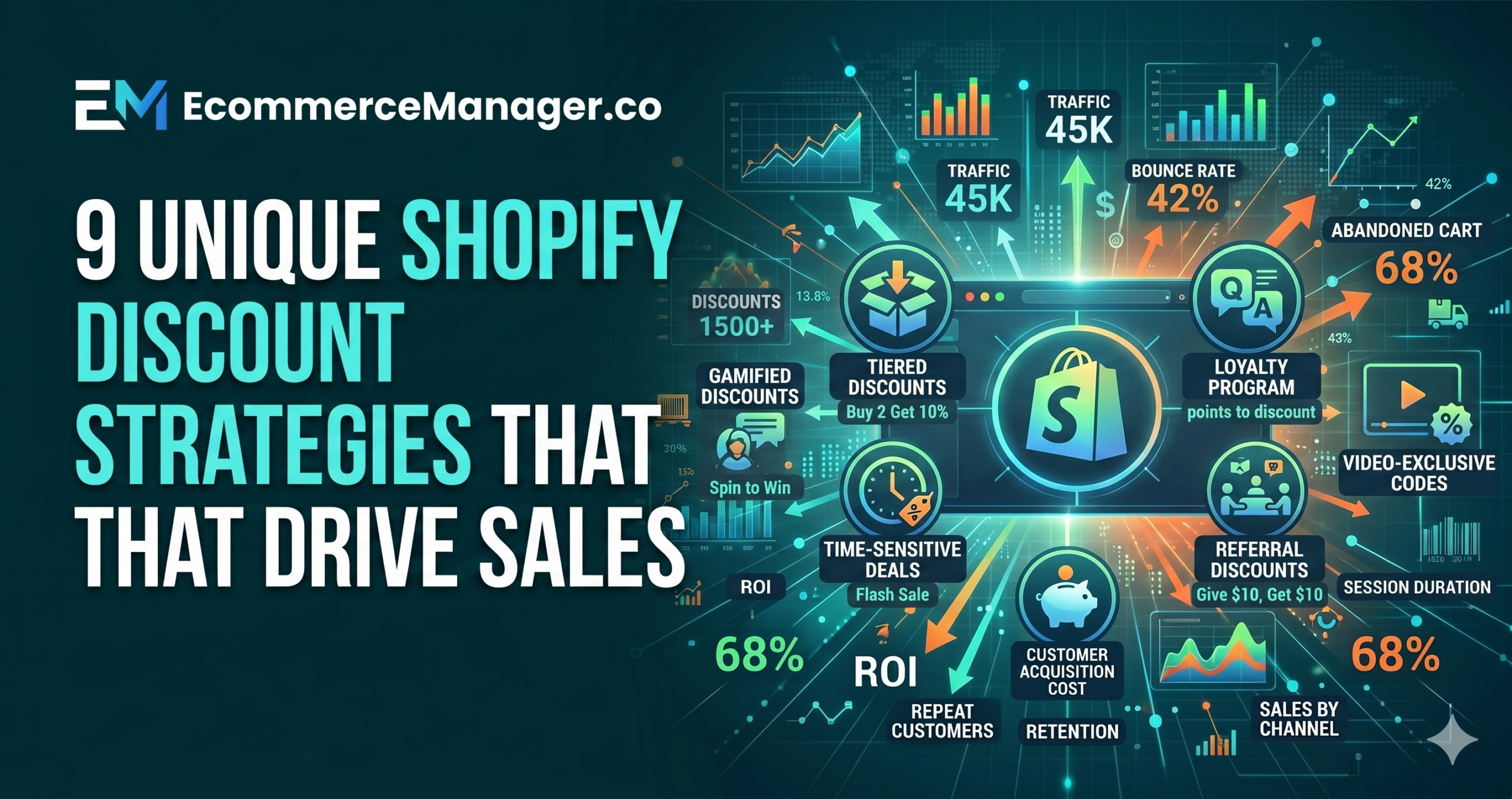
9 Unique Shopify Discount Strategies That Drive Sales
Building a successful discount strategy requires more than slashing prices and hoping for the best. This guide breaks down nine proven approaches that leverage customer behavior, market positioning, and strategic timing to increase both sales volume and order values. Each method is supported by insights from ecommerce experts who have implemented these techniques across thousands of Shopify stores.
- Lift AOV Through Tiered Cart Thresholds
- Package Outcomes Into Goal-Aligned Bundles
- Reward Referrals With Digital Gift Cards
- Create Urgency Through Reverse Stacked Offers
- Earn Loyalty Through Safety Stock Rewards
- Seal Conversions With Straightforward Price Cut
- Target Comparison Shoppers Via Behavioral Triggers
- Trade Video Testimonials For Personalized Codes
- Win Neighborhood Buyers Through Zip-Restricted Deals
Lift AOV Through Tiered Cart Thresholds
I run Evergreen Results, a digital marketing agency working mainly with active lifestyle and food/beverage e-commerce brands. One strategy that consistently performs is tiered bundle discounts triggered by cart value thresholds tied to Average Order Value data.
For a D2C food brand we work with, we analyzed their AOV and found most customers bought single products at around $30. We set up discount tiers that activated at 2x ($60), 3x ($90), and 4x ($120) their base product price—offering 10%, 15%, and 20% off respectively. The key was displaying these tiers immediately on product pages, not just at checkout, so customers could build their cart intentionally toward the next threshold.
This approach helped push their AOV to consistently reach 3x their single-product value while maintaining 5-10x ROAS on ad spend. What made it work wasn’t just the discount itself—it was making the math obvious upfront so customers felt like they were gaming the system in their favor. One customer told us they “always buy three now because the discount basically covers shipping plus some.”
The difference from typical percentage-off promotions is you’re using your own data to set thresholds that feel like wins for customers but actually increase your basket size and margin. It turns discount seekers into higher-value buyers without training them to wait for sales.

Package Outcomes Into Goal-Aligned Bundles
I run Wispen.Shop and we’ve tested a ton of discount strategies, but the one that actually moved the needle was what I call “goal-aligned bundles” for our digital products.
Instead of slashing prices across the board, we packaged our business eBooks (like our goal-setting guide and leadership checklist) into themed bundles tied to specific outcomes—”Quarter Planning Kit” or “New Manager Starter Pack.” The discount only kicked in when customers bought the bundle, but here’s the key: we showed exactly how using these together created a complete system, not just random products.
This worked because people don’t want discounts—they want solutions. Our average order value jumped 47% compared to single-product purchases, and cart abandonment dropped because customers saw the value story, not just the math. We tracked it through Shopify’s analytics and found bundle buyers had basically zero refund requests versus 8% on solo digital downloads.
The trick was matching the bundle to where someone actually was in their business journey. A startup founder got different recommendations than a team manager. We used Shopify’s discount codes with specific landing pages so the bundle felt personalized, not like a generic upsell. That intent-matching made all the difference.

Reward Referrals With Digital Gift Cards
We used Shopify’s digital gift card feature to run a “Give $20, Get $20” referral offer for a Miami beauty salon. Both the sender and the recipient received a $20 digital card connected to the referral. The program drove a 22% increase in referral-based bookings, and nearly 30% of gift card recipients became regular clients. It worked because the value was shared and delivered through a personal recommendation approach. Using gift cards as the discount made the incentive feel tangible and easy to act on.

Create Urgency Through Reverse Stacked Offers
We ran a campaign for a multi-location franchise client where we used Shopify’s automatic discount stacking feature in reverse—instead of giving bigger discounts on larger orders, we offered progressively smaller discounts the closer customers got to checkout. First-time visitors got 20% off in a pop-up, but it dropped to 15% if they added to cart without buying, then 10% in the cart reminder email.
Sounds backwards, right? But it created urgency at the awareness stage instead of the decision stage. We saw a 41% increase in immediate purchases because people didn’t want to lose that initial discount. The key was using Shopify’s customer tagging to ensure repeat buyers never saw these offers—we reserved those for loyal customers through VIP codes and post-purchase upsells instead.
What made it work was flipping the traditional funnel logic. Most stores train customers to wait for better deals, so we front-loaded value and made hesitation expensive. We tracked this through Meta pixel events tied to discount code usage, and the data showed people converted faster and at higher average order values than with our previous flat 15% sitewide approach.

Earn Loyalty Through Safety Stock Rewards
At Clinical Supply Company, we stopped doing the usual “10% off your order” promotions and instead built what we call “safety stock rewards” into our Shopify checkout. Dental practices that ordered enough product to maintain 90-day inventory levels opened up preferential pricing that protected them from our next tariff adjustment cycle.
This worked because it solved a real pain point–practices were getting burned by sudden price jumps during supply chain chaos. We showed them exactly how much they’d save over the next quarter by stocking up now versus ordering month-to-month through uncertain pricing periods. Our repeat purchase rate jumped from 41% to 68% within six months.
The genius was in the messaging. Instead of “Buy more, save more,” we framed it as “Lock in today’s pricing for 90 days.” We ran this during a particularly volatile period when nitrile glove prices were swinging 15-30% quarterly due to tariffs. Customers felt like they were beating the system rather than just spending more.
We tracked which SKUs had the most price volatility and only applied these thresholds to products where we could actually honor stable pricing. That authenticity mattered–practices talked to each other, and word spread that we weren’t playing games with artificial urgency.

Seal Conversions With Straightforward Price Cut
On Shopify, we used a 10% off discount code aimed at bottom-of-funnel buyers. More than half of our customers used it, and the clear, simple offer helped close the sale.

Target Comparison Shoppers Via Behavioral Triggers
At ForeFront Web, we’ve worked with several eCommerce clients who had success with what I call “behavioral trigger discounts” – codes that open up based on specific customer actions rather than just showing up as a banner for everyone.
One cookie company we worked with offered a 15% discount that only appeared when someone viewed their cart twice within 72 hours without purchasing. This wasn’t about abandoned cart recovery – it specifically targeted people doing comparison shopping. Open rates on those emails hit 41%, and conversion was nearly double their standard promotional emails because we weren’t training customers to wait for sales.
The genius was in the timing and exclusivity. The discount felt earned rather than expected, and it didn’t devalue the brand for impulse buyers who were ready to purchase at full price anyway. We also segmented it – first-time visitors never saw it, only returning traffic, which protected margins on our hottest acquisition channels.
From 35 years in this space, I’ve learned that the best discounts solve a specific friction point in YOUR buyer’s journey, not just copy what works for other stores. Look at where people actually drop off, then test a targeted offer for that exact moment.

Trade Video Testimonials For Personalized Codes
One unique way we used Shopify’s discount features was by offering personalized discount codes to customers who submitted short video testimonials through our site. Instead of running a standard promo, we tied the discount to a specific action, sharing their experience with the product. We set up the discounts to auto-generate in Shopify and send directly to each participant.
This approach worked well because it gave customers a reason to engage, not just shop. Their videos also became powerful social proof on our product pages, which helped boost conversions. The codes had a higher redemption rate than our usual email offers, and we gained a steady stream of user-generated content at the same time. It turned a simple discount into something more valuable for both sides.

Win Neighborhood Buyers Through Zip-Restricted Deals
I’ve been building e-commerce sites for local businesses in Rhode Island for 15+ years, and one discount strategy that worked incredibly well was local delivery-based discounts tied to specific zip codes.
We had a client selling specialty food products who offered a 15% discount code that only worked if your shipping zip code was within their immediate delivery radius (about 8 towns). The kicker: the discount was slightly better than their standard shipping cost, so customers felt like they were getting a deal while the business actually saved money on shipping and built a concentrated local customer base. Within three months, 60% of their orders came from those zip codes, and their repeat purchase rate in that area hit 34% compared to 12% elsewhere.
What made this work was the exclusivity factor–people love feeling like they’re part of an “insider” deal, especially when it’s tied to their neighborhood. We promoted it through local Facebook groups and it spread organically because the discount felt personal, not like a generic coupon everyone gets.
The setup was dead simple in Shopify–just create a discount code with zip code restrictions in the checkout settings. It turned their online store into a neighborhood favorite instead of just another website, and their profit margins actually improved because local delivery cost them less than third-party shipping.

Related Articles
- Favorite Shopify Apps for eCommerce Professionals – eCommerce Manager
- 7 Effective Marketing Tactics for Ecommerce Businesses
- 8 Tips for Growing Your Business on Shift4Shop