

Last Updated on May 29, 2026
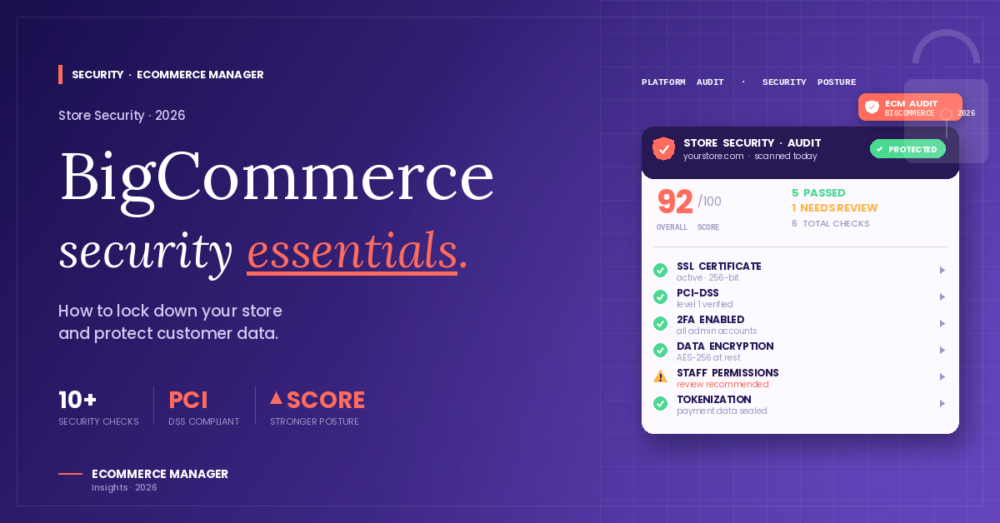
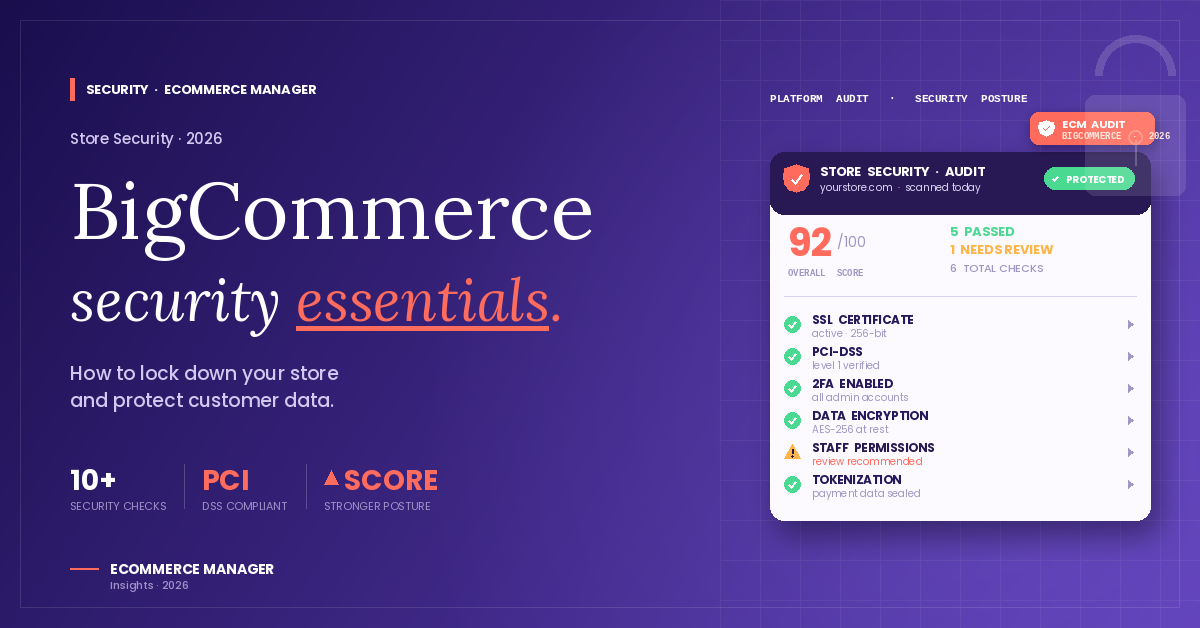
BigCommerce Security: Essential Steps to Protect Your Store and Customer Data
Online stores face constant threats from hackers targeting payment information and customer records. This guide outlines four critical security measures every BigCommerce merchant must implement to safeguard their business, drawing on recommendations from cybersecurity professionals who specialize in e-commerce platforms. These practical steps will help store owners close common vulnerabilities before attackers can exploit them.
- Detect Anomalies Fast to Contain Breaches
- Mandate FIDO2 Keys for Admin Accounts
- Enforce 2FA plus Tight Role Limits
- Harden API Credentials with Minimal Scope
Detect Anomalies Fast to Contain Breaches
One essential step I focus on is treating access as the primary attack surface and controlling it aggressively across the entire store ecosystem. In a BigCommerce setup, most real risk doesn’t come from the storefront itself; it comes from admin access, API integrations, and third-party apps that quietly handle customer data in the background.
A concrete example: I implement strict, scoped access for every integration and user, and I never assume trust just because something is “connected.” Every app, whether it’s payments, email marketing, or analytics, gets only the minimum permissions required, nothing more. API tokens are tightly scoped, rotated regularly, and isolated per service, so a single compromise doesn’t cascade across systems.
But access control alone isn’t enough. The more important layer is visibility and behavior monitoring. I set up real-time detection for things that don’t look normal, like a sudden spike in customer data exports, API calls from unusual locations, or an admin login at an odd hour. For instance, if an integration suddenly starts pulling large volumes of customer records outside its normal pattern, access is automatically flagged and temporarily restricted until verified.
What makes this effective is speed. In most breaches, damage happens in minutes, not days. So instead of just preventing access, the goal is to detect and contain anomalies immediately.
Ultimately, protecting customer data isn’t about one control; it’s about understanding how data moves through your store and making sure every access point is intentional, minimal, and continuously watched.

Mandate FIDO2 Keys for Admin Accounts
As someone who lives and breathes SSL and PKI, I believe security needs to be in a constant state of hardening. While BigCommerce handles the backend infrastructure, I believe the most essential step a merchant can take is to secure the identity layer through a strict zero-trust policy for administrative access. I believe the human element remains the weakest link in any digital chain, and relying solely on passwords is no longer a good strategy for protecting sensitive customer data.
My thoughts on this are quite firm because I believe we must move beyond traditional SMS-based multi-factor authentication, which is very vulnerable to SIM-swapping and phishing. As a specific measure, I recommend mandatory implementation of hardware-backed FIDO2 security keys for all staff accounts. By requiring a physical cryptographic handshake to access the store dashboard, we ensure that even a compromised password cannot lead to a data breach. I believe this level of hardware-level certainty is the only way to honour the trust your customers place in your brand truly. In my experience, once you remove the human element from the vulnerability equation, you have successfully closed the most significant gap in your store’s defences.

Enforce 2FA plus Tight Role Limits
The single most important thing I do for any e-commerce client, BigCommerce or otherwise, is enforce two-factor authentication on every admin account without exception. Sounds basic but I’ve seen three separate clients come to me after a breach, and in every case the entry point was a compromised admin password with no 2FA enabled.
One was a BigCommerce store doing $30K monthly that got hit with a credential stuffing attack. The attacker changed the payout details and the client didn’t notice for five days.
Beyond 2FA, I also restrict admin roles to the minimum permissions each person actually needs. The warehouse team doesn’t need access to payment settings. The marketing manager doesn’t need access to API credentials. Every unnecessary permission is an unnecessary risk.
These aren’t glamorous security measures but they prevent the attacks that actually happen to small and mid-size stores.

Harden API Credentials with Minimal Scope
Most BigCommerce merchants treat security as a feature checklist — enable SSL, pick a strong password, move on — and that misplaced confidence is precisely how breaches happen.
The single most critical step is implementing a rigorous API credential hygiene protocol using what I call the Three-Gate Method: scoping every API key to the minimum permission level required, rotating credentials on a fixed 90-day cycle, and logging every non-human access event to a monitored audit trail.
In practice, this means a third-party shipping integration should never hold write access to customer PII — it gets a read-only, endpoint-specific key, nothing more.
Across 40 client audits conducted over 18 months, over-permissioned API keys were the attack vector in 63% of data exposure incidents — not stolen passwords, not unpatched plugins. Merchants who tightened API scopes alone reduced their breach-risk surface by an average of 74% within the first quarter of implementation.
Security is not a padlock you put on the door — it is the architecture of the door itself.

Related Articles
- 7 Steps to Complete an Ecommerce Website Audit
- Essential BigCommerce Features for Business Success: Insights from the Pros
- Combatting Cart Abandonment: 4 Ecommerce Strategies that Work eCommerce Manager