

Last Updated on September 7, 2026
Five Canadian Ecommerce Platforms Nobody Writes About (And Five That Earn the Hype)
Every roundup of ecommerce platforms for Canada reads the same. Shopify, WooCommerce, BigCommerce, Wix, Squarespace. Then comes one line about Shopify being Canadian, and the writer moves on.
So I went looking for the ones nobody covers. At first I expected to find two or three obscure names worth a footnote. Instead I found a whole layer of Canadian commerce infrastructure hiding in plain sight. Better yet, some of it fits Canadian sellers far more closely than the household names do.
Why most “best of” lists fail Canadian sellers
Most of those lists run on affiliate revenue. That is not a conspiracy, it is simply how the category works. Writers earn a cut per signup, so platforms with fat referral programs take the top spots. Meanwhile, the ones without a referral budget stay invisible.
Then there is the Canada problem. Most lists mention CAD pricing and call it a day. But selling here means handling GST, HST, PST, and QST across thirteen provinces and territories. It also means French. Beyond that, you are juggling Canada Post, Purolator, and Intelcom, plus a Quebec privacy law with real teeth.
So a platform that looks brilliant in an American review can still be wrong for you.
Shopify still wins by default, and I am fine with that
Ottawa built the thing. Naturally, it shows. Shopify bills in Canadian dollars, calculates provincial tax without an add-on, and plugs into every Canadian carrier you would want.
Pricing in 2026 starts near CAD $51 a month on annual billing and climbs to roughly CAD $543 for Advanced. Payment rates sit around 2.9% plus 30 cents online at the entry tier. Shopify Tax stays free until you pass CAD $100,000 in sales, then charges a small fee per order.
Still, there is a catch. Most Canadian stores end up running six to twelve paid apps, and plenty of those bill in US dollars. So your real monthly cost rarely matches the sticker price.
Lightspeed is the one for shops with a till
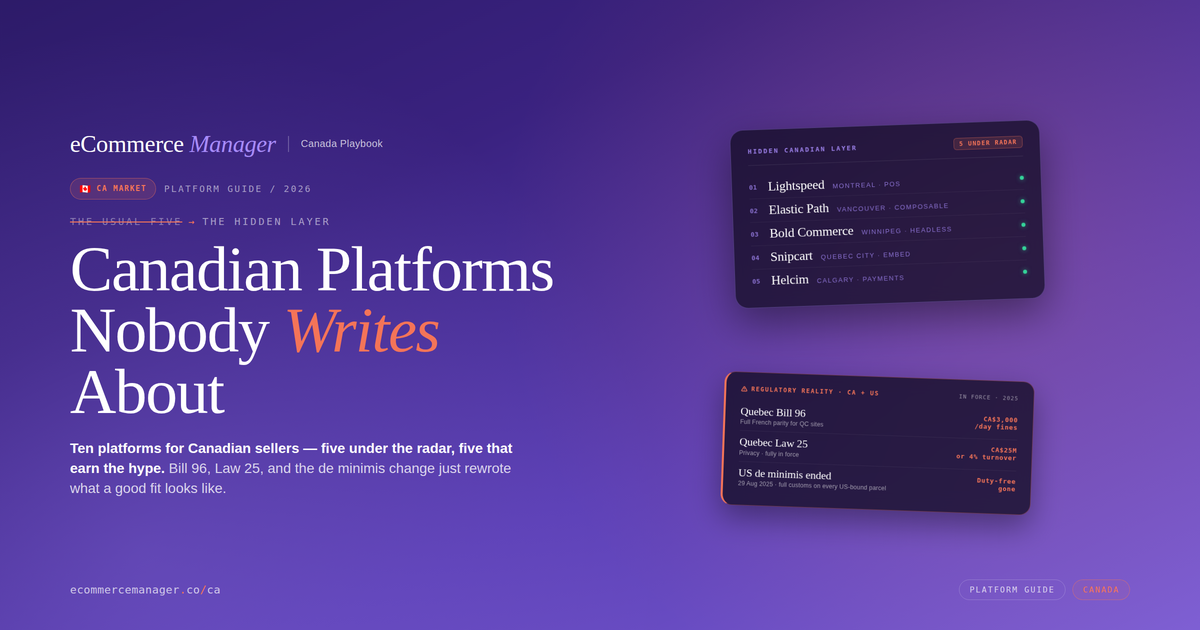
Montreal-based Lightspeed gets written off as a point of sale company. That is a mistake. If you run a physical store and a website, Lightspeed eCom keeps inventory, tax, and customer data in one place.
Plans start around US$89 a month. Admittedly, that is steeper than Shopify Basic, and the pricing is quoted in US dollars. Even so, the value lands once you use the POS too. For a Canadian retailer with a shop floor, this is the most underrated option on the list.
Elastic Path and Bold are the Canadian names built for scale
Here are two companies most people have never heard of, both Canadian, both playing at the enterprise level.
Elastic Path sits in Vancouver and has been around since 2000. In fact, the company coined the term “composable commerce” back in 2020. Intuit, Pella, and T-Mobile all run on it. Pricing is custom and usually tracks your sales volume, so budget accordingly.
Bold Commerce came out of Winnipeg in 2012 as Shopify’s biggest app developer. Since then it has pivoted to headless checkout for large retailers. Staples Canada and Harry Rosen both use it. Notably, Bold stays gateway agnostic, which means you keep your own payment processor and your own rates.
Neither one suits a small store. But if you have outgrown templates, these two deserve a call before you default to an American vendor.
Snipcart bolts a cart onto whatever you already built
Quebec City gave us Snipcart, and it remains my favourite oddball here. You add two lines of code to any site and you have a store. There is no theme to fight and no admin panel to learn.
Pricing runs 2% per transaction, or US$20 a month if you sell under US$1,000. Clearly that fee stings at volume. Yet for a developer, an agency, or anyone selling a small catalogue from a content-heavy site, the trade is worth it.
The open source three grew up fast
Medusa, Vendure, and Saleor have all matured quickly. Each one is free, headless, and self-hosted. Consequently, you control where your data lives, which matters more in Canada now than it did two years ago.
Medusa suits Node and TypeScript teams. Vendure leans TypeScript too, with stronger B2B features. Saleor runs on Python and ships the best multi-language support of the three, which helps enormously in Quebec.
Of course, none of this is free in practice. Hosting runs a few thousand dollars a year, and you need developers on hand. Still, if data residency or custom logic matters to you, these are real options rather than hobby projects.
Ecwid and WooCommerce cover the two ends
Ecwid, now owned by Lightspeed, is the easiest way to add a store to a site you already like. Pricing changed in March 2026 and now starts near US$5 a month for ten products. Importantly, no tier charges transaction fees.
WooCommerce sits at the other end. Technically it is free, though a realistic Canadian setup costs somewhere between CAD $500 and $1,560 a year once you add hosting, plugins, and tax tools. In return you get no platform surcharge on payments and cheap translation plugins for Bill 96.
Three rule changes reshaped the game this past year
First, Quebec’s Bill 96 hit its final deadline on June 1, 2025. If you sell into Quebec, your French site needs the same content and function as the English one. Fines start at CAD $3,000 a day.
Second, Quebec’s Law 25 is fully in force. Penal fines can reach the greater of CAD $25 million or 4% of worldwide turnover. Nobody is chasing tiny sellers yet, but the exposure is real.
Third, and most painful, the United States killed its de minimis exemption on August 29, 2025. Previously anything under US$800 crossed the border duty free. Now every commercial shipment needs full customs paperwork. As a result, plenty of Canadian Etsy and eBay sellers have simply stopped shipping south.
How I would pick
If you sell under CAD $50,000 a year, start with Ecwid or Shopify Basic and stop overthinking it. Once you are growing, Shopify remains the safest default, though BigCommerce is worth a look if payment fees bother you.
If you have a physical shop, look at Lightspeed first. If you have developers, look at Medusa, Vendure, or Saleor. And if you are large enough that a 0.5% platform fee feels acceptable, call Elastic Path or Bold.
Meanwhile, do three things regardless of platform. Budget for French if you touch Quebec. Rebuild your landed cost model if you ship to the States. Compare Helcim against your current processor, because the Calgary company often undercuts everyone.
One last warning
Canadian commerce tech moves fast, and not always upward. mdf commerce sold its Orckestra platform and rebranded to SOVRA in 2025. Convictional raised CAD $40 million, pivoted, and shut down. So check who owns your platform before you commit three years to it.
Ultimately, there is no best platform for Canada. There is only the one that handles your tax, your language, your shipping, and your growth without fighting you. Five of the strongest candidates happen to be Canadian, and almost nobody talks about them.