

Last Updated on September 7, 2026
10 Best SaaS Ecommerce Platforms for Different Business Models in 2026
Choosing an ecommerce platform in 2026 is no longer a matter of identifying one universal market leader. A direct-to-consumer startup, an international retailer, a B2B manufacturer and a brand running limited-edition drops may all require fundamentally different infrastructure.
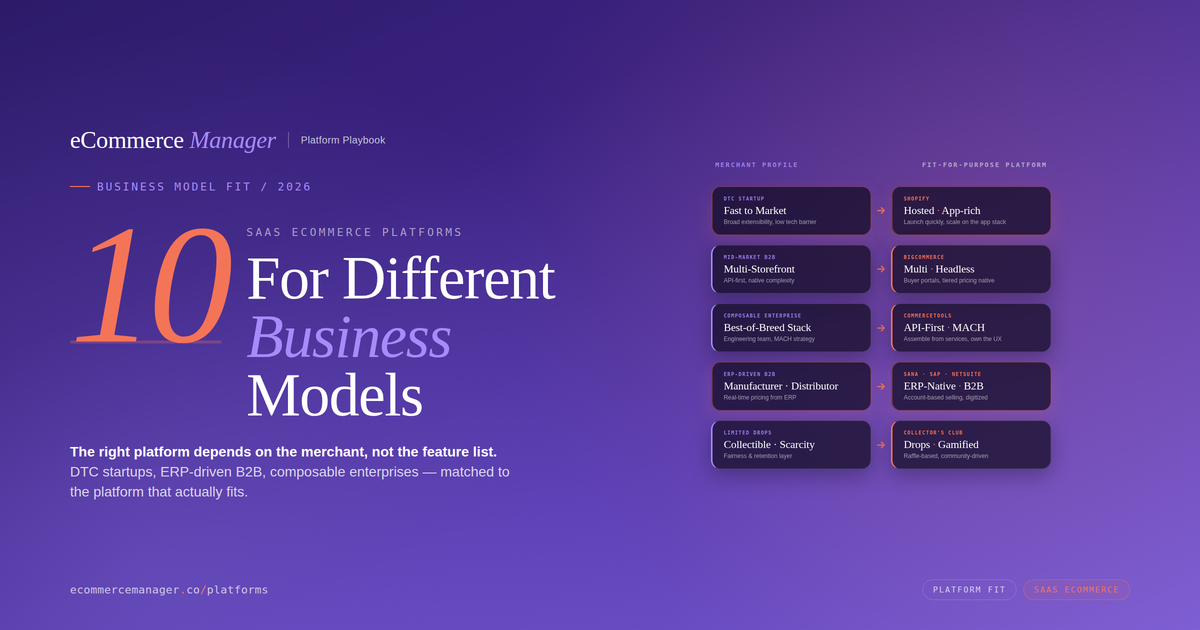
The most useful comparison is therefore not “Which platform is best?” but “Which platform is best suited to this merchant’s business model, technical resources, growth stage and customer experience?”
This review compares established storefront platforms, enterprise commerce suites, composable infrastructure, ERP-connected systems and one specialized launch and retention layer. Each should be evaluated according to implementation complexity, integrations, total cost of ownership, scalability and suitability for its intended use case.
Disclosure: I am the founder of Portraits de Famille and created the Collector’s Club, one of the specialized platforms discussed below. Its inclusion reflects a distinct use case, gamified, limited-edition releases, rather than a claim that it can replace a complete ecommerce platform.
- Shopify
Best for: Direct-to-consumer brands, small businesses, growing retailers and merchants seeking a fast route to market.
Shopify remains one of the most accessible and broadly capable SaaS ecommerce platforms. Its hosted infrastructure, integrated checkout, payment tools, app ecosystem and omnichannel capabilities allow brands to launch quickly without maintaining their own commerce infrastructure.
Its greatest advantage is also a potential weakness: businesses can install applications rapidly, but an expanding app stack may increase costs, create overlapping functionality and affect site performance.
Strengths
- Fast setup and relatively low technical barrier
- Extensive application and partner ecosystem
- Strong checkout and payment infrastructure
- International, B2B, POS and omnichannel capabilities
- Suitable for a wide range of growth stages
Limitations
- Application costs can accumulate
- Complex customization may require specialist development
- Merchants can become dependent on third-party applications
Ideal merchant: A brand that wants to launch and scale without building or maintaining core ecommerce infrastructure.
- BigCommerce
Best for: Mid-market retailers, multi-storefront businesses and B2B merchants.
BigCommerce combines hosted SaaS convenience with an architecture designed to support more complex storefront requirements. Its API capabilities and multi-storefront functionality make it particularly relevant for merchants operating across brands, customer groups or regions.
It has a smaller application and developer ecosystem than Shopify, but businesses may find more required functionality available natively.
Strengths
- Strong B2B capabilities
- Multi-storefront support
- API-first and headless-ready architecture
- Flexibility regarding payment providers
- Substantial functionality available natively
Limitations
- Smaller partner ecosystem than Shopify
- Fewer developers and integrations in some markets
- May require more technical involvement than simpler platforms
Ideal merchant: A growing B2B or mid-market company requiring greater native complexity without moving to a full enterprise suite.
- Adobe Commerce
Best for: Enterprises with complex catalogs, customer groups and customization requirements.
Adobe Commerce offers extensive control over product catalogs, merchandising, content and B2B workflows. Its broader Adobe ecosystem can also support content management, analytics and personalization strategies.
That flexibility carries substantial implementation and operational requirements. It is generally more appropriate for organizations with dedicated technical teams and experienced implementation partners than for resource-constrained merchants.
Strengths
- Extensive customization
- Sophisticated catalog and merchandising controls
- Strong B2B functionality
- Integration with Adobe’s wider experience ecosystem
- Appropriate for complex international deployments
Limitations
- High implementation and maintenance costs
- Longer deployment cycles
- Requires specialist technical resources
Ideal merchant: An enterprise for which unique commerce requirements justify the additional cost and complexity.
- Salesforce Commerce Cloud
Best for: Large organizations already invested in Salesforce.
Salesforce Commerce Cloud is most compelling when commerce is part of a broader Salesforce environment. Connecting storefront activity with CRM, service, marketing, and customer data can help enterprises develop more unified customer journeys.
It is less compelling when evaluated as an isolated storefront. Its cost and implementation requirements are typically justified by extensive use of the wider Salesforce ecosystem.
Strengths
- Deep CRM and customer-data integration
- Enterprise scalability
- Personalization and merchandising capabilities
- Support for complex omnichannel operations
- Broad Salesforce product ecosystem
Limitations
- High total cost of ownership
- Complex implementation
- Greatest value often depends on adopting multiple Salesforce products
Ideal merchant: A global retailer seeking to connect commerce with an established Salesforce technology stack.
- commercetools
Best for: Enterprises building composable and highly customized commerce experiences.
Commercetools is based on API-first, composable architecture rather than a conventional all-in-one storefront. Businesses can select and combine different services for content, search, checkout, payments and other capabilities.
This provides significant flexibility but transfers more responsibility to the merchant and its implementation partners. Composable commerce is not automatically simpler or less expensive, its value depends on whether a company genuinely needs that degree of control.
Strengths
- API-first, MACH-oriented architecture
- High level of flexibility
- Supports multiple channels and touchpoints
- Reduces dependence on a monolithic frontend
- Suitable for complex digital transformation programs
Limitations
- Requires substantial development resources
- Longer and more complex implementation
- Multiple vendors can increase governance demands
Ideal merchant: A technically mature enterprise that considers commerce experience a strategic differentiator.
- Shopware
Best for: European mid-market merchants and B2B companies.
Shopware has developed a strong position in Europe through flexible commerce architecture, headless capabilities and support for both consumer and B2B models. It can be especially relevant to companies seeking a European ecosystem and localization capabilities.
Its international partner and application network is smaller than Shopify’s, making regional implementation support an important consideration.
Strengths
- Strong European presence
- B2B and API capabilities
- Headless commerce support
- Flexible merchandising options
- Suitable for mid-market complexity
Limitations
- Smaller global ecosystem
- Regional variation in implementation resources
- Fewer plug-and-play integrations than larger platforms
Ideal merchant: A European retailer or manufacturer seeking modern commerce infrastructure with regional expertise.
- SAP Commerce Cloud
Best for: Global manufacturers, distributors and enterprises already using SAP.
SAP Commerce Cloud is designed for organizations with complex catalogs, pricing structures, account relationships, and ERP-dependent operations. It is particularly relevant where ecommerce must work closely with established supply-chain and enterprise processes.
Its complexity and cost make it unsuitable for most small or early-stage retailers.
Strengths
- Strong ERP connectivity
- Complex B2B workflows
- Global catalog and commerce management
- Enterprise-grade scalability
- Suitable for sophisticated organizational structures
Limitations
- High cost and implementation complexity
- Long deployment timelines
- Requires specialized expertise
Ideal merchant: A large manufacturer or multinational enterprise whose commerce operations depend heavily on SAP.
- NetSuite Commerce
Best for: Businesses prioritizing unified commerce, inventory, finance and operations.
NetSuite Commerce connects ecommerce with NetSuite’s ERP environment. This can reduce fragmented data across inventory, orders, accounting, and customer operations.
The tradeoff is that the experience may feel more ERP-led than design-led. Brands requiring unusually expressive storefront experiences should evaluate frontend flexibility carefully.
Strengths
- Native ERP integration
- Unified inventory and financial data
- Omnichannel order management
- Useful for operationally complex retailers
- Reduced need to synchronize separate back-office systems
Limitations
- Frontend flexibility may be more limited
- Implementation can become ERP-centric
- May be excessive for straightforward storefronts
Ideal merchant: A retailer whose primary challenge is coordinating commerce with inventory, finance, and operational data.
- Sana Commerce Cloud
Best for: Manufacturers, wholesalers and distributors with ERP-driven B2B commerce.
Sana Commerce Cloud focuses on using ERP data directly within the ecommerce experience. Customer-specific pricing, inventory, ordering rules, and product information can be presented without maintaining separate data structures across multiple systems.
Its specialization is valuable for B2B use cases but makes it less suitable for consumer brands seeking editorial storytelling or highly expressive merchandising.
Strengths
- ERP-native commerce model
- Real-time pricing and inventory
- Customer-specific catalogs
- Strong repeat-ordering workflows
- Designed around B2B requirements
Limitations
- Less appropriate for DTC-first brands
- Smaller ecosystem than mainstream platforms
- Experience depends heavily on ERP quality
Ideal merchant: An industrial supplier or distributor seeking to digitize existing account-based sales processes.
- Collector’s Club
Best for: Brands running limited-edition drops, releasing limited quantities or seeking a gamified retention layer without discounting.
The Collector’s Club is not a complete ecommerce platform and should not be compared directly with Shopify or BigCommerce as a storefront replacement. It is a specialized launch and retention engine designed to sit alongside a brand’s existing commerce infrastructure.
The platform uses raffle-inspired mechanics for exclusive releases. Participants receive a pass associated with a limited edition, select the pieces they want within that edition and enter a draw. Winners then unlock the ability to purchase the corresponding products.
Its purpose is to address several weaknesses of conventional drops: first-come-first-served pressure, unclear rarity, short-lived hype and limited engagement between launches.
Transparent availability and randomized allocation are intended to make access fairer while turning the release into a recurring community event.
Strengths
- Specialized for limited-edition releases
- Transparent rarity and availability
- Fairer alternative to speed-based drops
- Gamification can encourage repeat participation
- Creates a retention mechanism without product discounting
Limitations
- Not a standalone storefront or general commerce platform
- Best suited to brands with a credible scarcity proposition
- Requires customer education and thoughtful onboarding
- Not appropriate for ordinary, continuously available products without a collector proposition
Ideal merchant: A fashion, art, lifestyle or collectible brand seeking to make limited releases more transparent, participatory and retention-oriented.
How to Choose the Right Platform
The correct platform depends on the business problem being solved.
- For rapid DTC launch and broad extensibility: Shopify
- For mid-market and B2B flexibility: BigCommerce
- For highly customized enterprise commerce: Adobe Commerce
- For Salesforce-centered organizations: Salesforce Commerce Cloud
- For composable architecture: commercetools
- For European mid-market commerce: Shopware
- For SAP-dependent global operations: SAP Commerce Cloud
- For unified ERP and ecommerce: NetSuite Commerce
- For ERP-driven B2B ordering: Sana Commerce Cloud
- For gamified limited-edition releases: Collector’s Club
Merchants should evaluate total cost of ownership rather than subscription price alone. Relevant costs include implementation, applications, development, integrations, maintenance, payment processing, training and the internal resources required to operate the system.
The best SaaS ecommerce platform in 2026 is not necessarily the one with the longest feature list. It is the platform or combination of platforms that solves the merchant’s actual constraint without creating unnecessary operational complexity.