

Last Updated on September 7, 2026
The Best Ecommerce Platform to Sell Products Everywhere in 2026
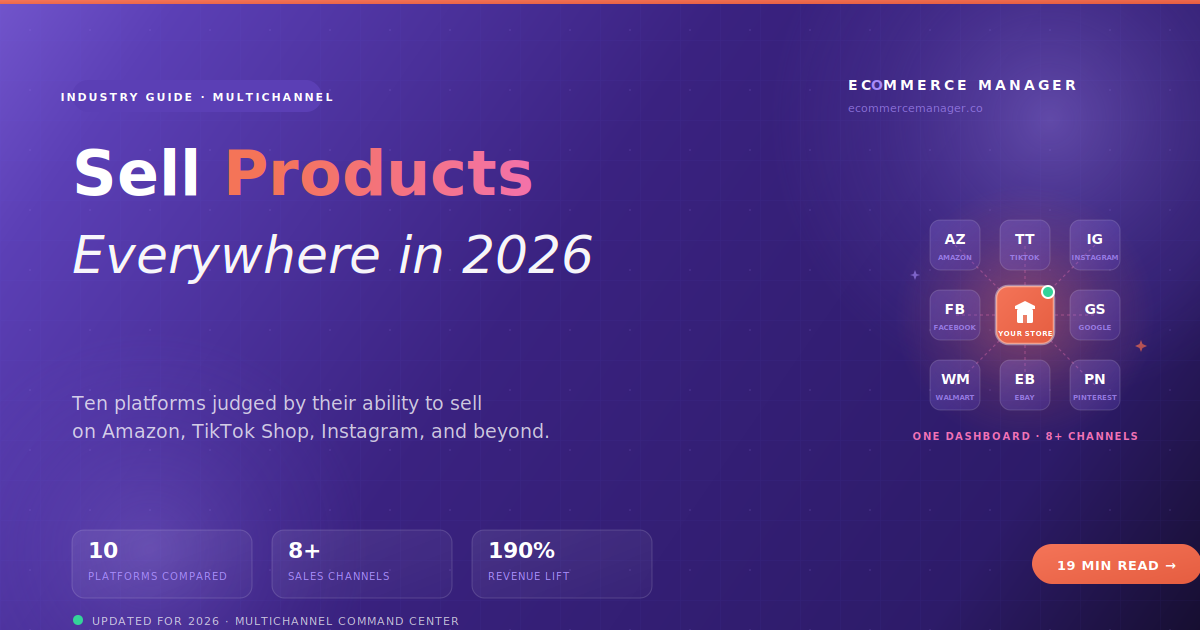
Your storefront is one channel. Buyers today discover on Amazon, TikTok Shop, Instagram, Google Shopping — and if you're not there, your competitors are. This guide ranks platforms by their ability to sell across every channel from one dashboard.
"Best platform to sell products" is a different question from "best platform for my online store," and most articles conflate them. If you only sell from your own website, the answer is straightforward — Shopify wins for most, BigCommerce wins for high volume, WooCommerce wins for WordPress shops. But if you actually want to sell products in 2026, your storefront is one channel out of a dozen. Amazon has 300 million+ active buyers. TikTok Shop grew over 40% in 2025. Google Shopping still drives massive discovery traffic. Instagram Shopping, Meta Shop, Etsy, Walmart Marketplace — every one of them is a place where your products could be earning money right now. This guide ranks the 10 platforms that actually let you sell across all of them, not just one.
The Multichannel Reality Every Merchant Ignores at Their Own Cost
Here's the awkward truth most single-channel merchants haven't confronted. Your customers aren't loyal to your website. They're loyal to whichever tab they had open when they decided to buy. And in 2026, that tab is usually Amazon, TikTok, or Instagram — not your DTC storefront. Amazon alone captures roughly 40% of US ecommerce spending. TikTok Shop, which barely existed three years ago, is projected to hit $30B+ in US GMV this year. Google Shopping still drives massive first-touch discovery. Every channel you're not on is a place your competitors are earning revenue you're not.
The counterargument is real: selling on Amazon means giving Amazon 15% of every sale, playing their algorithm, and never owning the customer relationship. Selling on TikTok Shop means dealing with their fulfillment requirements and creator dependencies. That's why the answer for most brands isn't "abandon your store for Amazon" — it's "run your store AND be everywhere buyers look." The platform you pick decides whether that's a two-week integration project or a monthly nightmare of manual inventory updates across five dashboards.
Data on this is clear: multichannel sellers generate up to 190% more revenue than single-channel sellers, and 73% of shoppers use multiple channels during a purchase journey. Not being multichannel in 2026 is the digital equivalent of running a store with the lights off.
The Four Types of Sales Channels You Should Be On
Before comparing platforms, understand the four channel categories every ecom operation should consider. Different platforms handle these very differently — some are strong in one category and useless in others.
Marketplaces
Amazon, eBay, Etsy, Walmart Marketplace, Faire (B2B). Huge built-in buyer bases, high fees (10-15%), and the platform owns the customer. Where 40%+ of US ecom happens.
Social Commerce
TikTok Shop, Instagram Shopping, Facebook Shop, Pinterest Shopping. Discovery-driven, growing 30-50% YoY. Where impulse purchases and creator-driven brands live.
Comparison & Search
Google Shopping, Bing Shopping, Google Merchant Center. Intent-driven — people searching for exact products. Massive traffic source most brands underinvest in.
Your Own Store (DTC)
Your Shopify, BigCommerce, WooCommerce site. You own the customer, the data, the margin. Lower traffic than marketplaces but highest lifetime value.
The Four Criteria That Actually Matter for Multichannel
Every platform will claim "multichannel selling." Here's what separates real multichannel platforms from ones that just have a "channels" tab in the admin:
1. Native channel integrations (not "connect via a paid app")
The best multichannel platforms have direct, built-in connections to Amazon, eBay, Walmart, TikTok Shop, Instagram, Google Shopping, and Facebook — not "install this third-party app for $30/month per channel." Native integrations are maintained by the platform, updated with API changes, and don't add another vendor to your monthly bill. This is where most platforms fail — they'll say they "support Amazon" but really mean "you can install Codisto or CedCommerce and pay extra."
2. Real-time inventory sync (not once-a-day scheduled)
If your platform syncs inventory to marketplaces once every 4 hours, you're going to oversell — someone buys the last unit on Amazon, then someone buys it on your store 15 minutes later, and now you're canceling an order and eating a chargeback. Real-time or near-real-time (under 5 minutes) sync is table stakes for anyone selling on more than 2 channels. Scheduled or manual sync is a lawsuit waiting to happen at any real volume.
3. Unified order management
Orders from Amazon, TikTok Shop, your store, and Instagram should all appear in one dashboard where you fulfill them the same way. Ideally with unified shipping labels, unified customer records, and unified inventory deductions. Managing orders from five channels in five separate dashboards is how solo operators burn out at $200K/year.
4. Consolidated reporting
Which channel is actually most profitable? Which product sells best on TikTok Shop vs Amazon vs your DTC site? Which channel has the highest return rate? Without consolidated reporting, you're flying blind and probably over-investing in the channel that feels loudest (TikTok) instead of the one that actually pays (email + DTC).
Complete Comparison: 10 Platforms for Selling Products Everywhere
Channel coverage columns: M = Marketplaces (Amazon/eBay/Walmart), S = Social Commerce (TikTok/Instagram/Facebook), G = Google Shopping, D = Your DTC Store. Coral dots = strong native integration. Purple dots = supported. Grey dots = missing or requires third-party.
| Platform | Type | Channels (M · S · G · D) | Sync | Starting Price |
|---|---|---|---|---|
SH Shopify |
Store + Channels | MSGD | Real-time | $39/mo |
BC BigCommerce |
Store + Channels | MSGD | Real-time | $39/mo |
EW Ecwid |
Store + Channels | MSGD | Real-time | Free / $19/mo |
WC WooCommerce + CedCommerce |
Plugin Stack | MSGD | Scheduled | Free + plugins |
SQ Square Online |
Store + POS | MSGD | Real-time | Free / $29/mo |
WX Wix eCommerce |
Store + Channels | MSGD | Scheduled | $29/mo |
SB Sellbrite by GoDaddy |
Channel Manager | MSGD | Real-time | $29/mo |
LW LinnWorks |
Channel Manager | MSGD | Real-time | Custom |
RT Rithum (ChannelAdvisor) |
Enterprise Manager | MSGD | Real-time | Custom ($$$) |
AZ Amazon Seller Central |
Marketplace | MSGD | Real-time | $39.99/mo |
Coral dots mean the platform has strong native integration (built by the platform, well-maintained, minimal setup). Purple dots mean supported but may require setup or a paid connector. Grey dots mean not supported natively — you'd need to bolt on Sellbrite or LinnWorks on top. The best multichannel platforms have coral dots across all four columns; the honest weak spot for most is social commerce (TikTok Shop and Instagram Shopping integrations still lag).
1. Shopify — The Multichannel Leader (Not Just the Storefront Leader)
Shopify
Shopify's multichannel offering is genuinely underrated because their marketing pushes the storefront angle so hard. Under the hood, Shopify has native integrations for Amazon (via their acquired Codisto connector), TikTok Shop, Instagram Shopping, Facebook Shop, Google Shopping, eBay, and Walmart Marketplace — all managed from the Shopify admin with real-time inventory sync. You can list a product once, publish to any combination of channels, and see all orders in one unified fulfillment queue. This is the workflow every serious multichannel seller wants, and Shopify does it better than any dedicated channel manager for stores under $10M/year.
The trade-off: some channel integrations (Walmart Marketplace, TikTok Shop) require additional setup and marketplace approval, which Shopify doesn't do for you. But the plumbing works, the sync is real-time, and orders route cleanly. For most stores wanting to sell everywhere without hiring an ops person to babysit five dashboards, Shopify is the pragmatic pick.
2. BigCommerce — Deepest Marketplace Integrations
BigCommerce
BigCommerce takes multichannel more seriously as a platform-level feature than any other SaaS commerce platform. Their Channel Manager gives you native Amazon (including Fulfilled by Amazon), Walmart Marketplace, eBay, Facebook, Instagram, TikTok Shop, and Google Shopping — all with real-time inventory sync and a unified fulfillment queue. Where BigCommerce edges Shopify is Amazon and Walmart depth — the integrations were built earlier and are more mature for high-volume marketplace sellers. Combined with zero platform transaction fees, this is a genuinely strong pick for stores doing serious marketplace volume.
The trade-off: smaller app ecosystem overall, fewer prebuilt themes, and less community content than Shopify. For stores where multichannel is central to the business model, BigCommerce is often the better fit. For stores where the DTC site is the primary channel, Shopify wins on ecosystem.
3. Ecwid by Lightspeed — Multichannel from Day One
Ecwid by Lightspeed
Ecwid is quietly one of the strongest multichannel picks for smaller stores. Native integrations with Amazon, eBay, Walmart, Facebook Shop, Instagram Shopping, Google Shopping, and even Snapchat and TikTok Shop — all managed from Ecwid's admin with real-time sync. The catch is that Ecwid is a lighter platform overall (fewer apps, less depth per feature), so it fits best for stores where the multichannel breadth matters more than any single channel's depth.
Where Ecwid uniquely wins: the ability to embed your store into any existing website (WordPress, Wix, Squarespace, static site) while still managing all multichannel sales from one place. For creators, service businesses, and small stores who want to be on Amazon + Instagram + their own site without the complexity of a full Shopify setup, Ecwid is often the underrated right answer.
4. WooCommerce + CedCommerce — The Plugin-Stack Approach
WooCommerce + CedCommerce
WooCommerce alone has weak multichannel — its native channel support is limited to Google Shopping and Facebook. To get Amazon, eBay, Walmart, and TikTok Shop into a WooCommerce workflow, you install channel-specific plugins. CedCommerce is the largest ecosystem here, with dedicated plugins for every major marketplace ($20-60/month per channel). Alternatively, WP-Lister for Amazon and eBay is well-regarded. The stack gets you real multichannel functionality but as an assembly job — you're wiring together WooCommerce + 3-5 plugins + hosting to get what Shopify or BigCommerce give you natively.
The trade-off: total cost of ownership isn't cheaper once you count 5 plugin subscriptions plus managed hosting (see the managed WooCommerce hosting guide). But if you're already deep in WordPress and don't want to migrate, this is the pragmatic multichannel path. Inventory sync is typically scheduled (every 15-60 min) rather than real-time, which limits how comfortably you can operate at high volume.
5. Square Online — Retail + Online + Amazon (in That Order)
Square Online
Square Online is the multichannel pick specifically for businesses that started with a physical store and want to add online + marketplace selling without switching payment systems. Native integrations for Google Shopping, Facebook Shop, and Instagram. Amazon integration is available via connectors. The killer feature: everything syncs with your Square POS, so if you sell a unit in your physical store, inventory drops on your website and Amazon listing simultaneously.
The trade-off: Square Online isn't a serious pick for pure DTC or high-volume marketplace sellers. Fewer channels, weaker marketplace-specific features, and the platform is optimized for hybrid retail-online businesses. But for that specific use case — a coffee shop, boutique, or salon adding online commerce — it's genuinely the best fit and hard to beat on price.
6. Wix eCommerce — Improving Multichannel for Small Stores
Wix eCommerce
Wix's multichannel capabilities have improved significantly in the last two years. Native integrations with Amazon, eBay, Facebook Shop, Instagram Shopping, and Google Shopping — all managed from the Wix admin. Inventory sync runs on a schedule (typically every 15-30 minutes) rather than real-time, which is fine for lower volumes but risky at scale. For small businesses that want an all-in-one site (portfolio + booking + store) with basic multichannel reach, Wix works.
The trade-off: multichannel is a secondary feature for Wix, not the core focus. If multichannel is central to your business model, Shopify, BigCommerce, or Ecwid will serve you better. If multichannel is nice-to-have alongside a broader website: Wix delivers.
7. Sellbrite by GoDaddy — The Channel Manager Layer
Sellbrite by GoDaddy
Sellbrite is different from the platforms above — it's not a storefront, it's a dedicated multichannel manager that connects to Amazon, eBay, Walmart, Etsy, and your existing Shopify, WooCommerce, or BigCommerce store, then unifies inventory and orders across all of them. Owned by GoDaddy since 2020. The core value: real-time inventory sync across marketplaces even if your storefront platform doesn't offer it natively. Best fit for stores that already have a platform they love (WooCommerce, most commonly) but need better marketplace management than the plugin ecosystem provides.
The trade-off: adds a monthly cost on top of your existing platform. For merchants running Shopify or BigCommerce, the native multichannel is usually enough — Sellbrite adds meaningful value primarily for WooCommerce users or multi-platform sellers.
8. LinnWorks — Enterprise Multichannel Operations
LinnWorks
LinnWorks operates at the enterprise end of multichannel — designed for stores selling thousands of SKUs across 5+ channels who need serious inventory management, warehouse operations, and multi-location fulfillment logic. UK-strong but growing in the US. Integrates with Amazon, eBay, Walmart, TikTok Shop, Shopify, BigCommerce, Magento, WooCommerce, and just about every major marketplace globally. Custom pricing, sales-driven procurement.
The trade-off: overkill for stores under $2M/year. Genuinely powerful for stores that have outgrown Shopify's native multichannel and need warehouse-level inventory management with automated repricing, bundling logic, and multi-location fulfillment rules.
9. Rithum (formerly ChannelAdvisor) — The Enterprise Standard
Rithum (ChannelAdvisor)
Rithum (rebranded from ChannelAdvisor in 2024) is the platform enterprise brands use to manage multichannel selling at massive scale. Global marketplace coverage (400+ channels), sophisticated feed management, dynamic repricing, digital shelf analytics, and integration with essentially every ERP and commerce platform. Adidas, Samsung, and Bosch use it. Pricing is enterprise-only — expect $2K-10K+/month minimum, depending on volume and modules.
The trade-off: not for mid-market. If you're doing under $10M/year in marketplace revenue, this is more platform than the problem needs. For genuine enterprise multichannel operations with dedicated marketplace teams: Rithum is one of very few platforms that can express the requirements without heroic custom work.
10. Amazon Seller Central — The Marketplace-First Alternative
Amazon Seller Central
For some products, some brands, some business models, the honest answer is that you don't need your own store yet. Amazon has 300M+ active buyers already looking for products, Fulfilled by Amazon (FBA) handles fulfillment for you, and getting listed is measured in days, not weeks. Professional Seller account is $39.99/month plus category fees (typically 8-15% per sale). For pure product sales in commodity or private-label categories, Amazon-first is a legitimate strategy — many multi-million-dollar brands run entirely from Seller Central without their own website.
The trade-off is massive and well-documented: you don't own the customer, Amazon owns the search and can promote competitors, the algorithm can bury your listing overnight, and category fees eat 15-25% of every sale after all costs. Most brands eventually add their own DTC site (Shopify + Amazon combined is the most common serious ecom setup) to escape Amazon dependency. But for launching, testing, or validating a product, Amazon-first often makes financial sense.
The Sync Frequency Nobody Warns You About
When a platform says "syncs with Amazon," ask "how often?" The difference between real-time sync and scheduled 15-minute sync is the difference between a smooth operation and canceling 10 orders a week because you oversold. At $500K/year in revenue, oversells cost you real money and Amazon account health. At $5M/year, they cost you your Buy Box eligibility. Shopify, BigCommerce, Ecwid, and Sellbrite offer real-time. Most WooCommerce plugins and Wix are scheduled. Choose accordingly.
The Store-First vs Amazon-First Debate (Settle It)
Every merchant considering multichannel eventually asks the same question: should I build my own store first and add marketplaces, or start on Amazon and add my own site later? The honest answer depends on your product and your goals.
Start on Amazon first if: you sell commodity or private-label products, you don't have brand equity yet, you want fastest possible time-to-revenue, you're testing product-market fit before investing in a brand, or you're comfortable with never owning the customer relationship. The upside: fastest revenue, no need to drive traffic, Amazon FBA solves fulfillment. The downside: no customer list, no brand-building leverage, permanent Amazon fee tax.
Start with your own store if: you have brand equity or a story to tell, your margins can't absorb 15-25% marketplace fees, you want a customer email list to remarket to, or you're building for exit (brands with DTC channels sell for higher multiples than Amazon-only brands). Add Amazon as a second channel once your DTC operation is running smoothly.
The pragmatic middle path most successful multichannel brands take: launch on Shopify with Amazon integration turned on from day one. Push products to both. Amazon gives you immediate discovery traffic; Shopify gives you the customer relationship. Add TikTok Shop and Instagram Shopping when your team can support it. Add Walmart Marketplace when you're doing enough volume to matter.
How to Actually Pick Your Multichannel Platform
Skip the sales calls. Answer these four questions honestly:
1. Which channels do YOUR customers actually shop on?
Not every channel matters for every product. Beauty and fashion win on TikTok Shop and Instagram. Home goods win on Amazon and Wayfair. B2B products win on Faire and your own site. Match your channel investment to where your specific customers actually are, not where every "multichannel guide" says everyone should be.
2. How many channels will you actually operate?
🎯 Just DTC + 1-2 marketplaces
Shopify or Ecwid native
🌐 DTC + 3-5 channels including social
Shopify or BigCommerce
🏗️ Heavy marketplace focus (5+ marketplaces)
Sellbrite or LinnWorks
🏢 Enterprise scale (10+ channels globally)
Rithum or LinnWorks Enterprise
3. What's your ops capacity?
Solo operator with three channels: pick a platform with native integrations that Just Work (Shopify, Ecwid). Team of 3-5 managing more channels: BigCommerce or Shopify + a channel manager add-on. Dedicated marketplace ops team: LinnWorks or Rithum earns its cost by removing per-channel manual work.
4. What's your migration risk tolerance?
If you're already on Shopify or BigCommerce, adding channels is straightforward — turn on native integrations, list products, done. If you're on WooCommerce, plan for 2-4 weeks of plugin setup per channel and expect scheduled (not real-time) sync. If you're not on any platform yet, pick multichannel-first from day one — retrofitting multichannel into a store built without it is painful.
- Launching on 5 channels at once. Every channel has a learning curve — pricing rules, image requirements, category-specific listing formats. Launch one at a time, get it profitable, then add the next. Trying to launch everywhere simultaneously is how solo operators quit.
- Ignoring channel-specific SEO/optimization. Amazon SEO isn't Google SEO. TikTok Shop discovery isn't Instagram discovery. Copy-pasting product listings across channels leaves 30-50% of channel-specific traffic on the table.
- Underpricing on marketplaces to win the Buy Box. Amazon's fee structure means what looks like a competitive price often produces a loss after all costs. Model actual per-channel margins before pricing.
- Not tracking channel profitability separately. Amazon revenue looks great until you account for 15% category fees, FBA costs, PPC ads, returns, and long-term storage fees. What looks like 30% margin often nets to 8%.
- Assuming customer data comes with the sale. Marketplaces own the customer. Amazon gives you almost no customer data. Selling on marketplaces means you can't remarket via email. Plan for that in your CAC calculations.
The Honest Bottom Line
The best "platform to sell products" isn't a single-channel storefront in 2026 — it's a multichannel command center. For most operators, Shopify is the pragmatic pick that combines the best storefront with the best native multichannel breadth. BigCommerce wins for heavy marketplace focus and Amazon/Walmart depth. Ecwid is the underrated option for small stores that want breadth without complexity. WooCommerce + CedCommerce works for WordPress-native shops willing to assemble a plugin stack. Sellbrite and LinnWorks are the right answer for stores that need dedicated marketplace management on top of an existing platform. Rithum for enterprise. Amazon Seller Central as the marketplace-first alternative when the numbers make sense.
The wrong question is "which single platform is best." The right question is "which platform lets me be everywhere my customers actually shop, with the sync reliability and unified operations to make that manageable." Pick the platform that answers that question for your specific channel mix, and you're set up to sell products everywhere without drowning in dashboards.
Need Help Building Your Multichannel Stack?
The eCommerce Manager helps operators map platform capabilities against actual channel mix and revenue projections — no vendor bias, no affiliate ordering.
Get a Multichannel Audit →