

Last Updated on September 7, 2026
How to Choose a Shopify Agency in 2026: The Operator's Guide
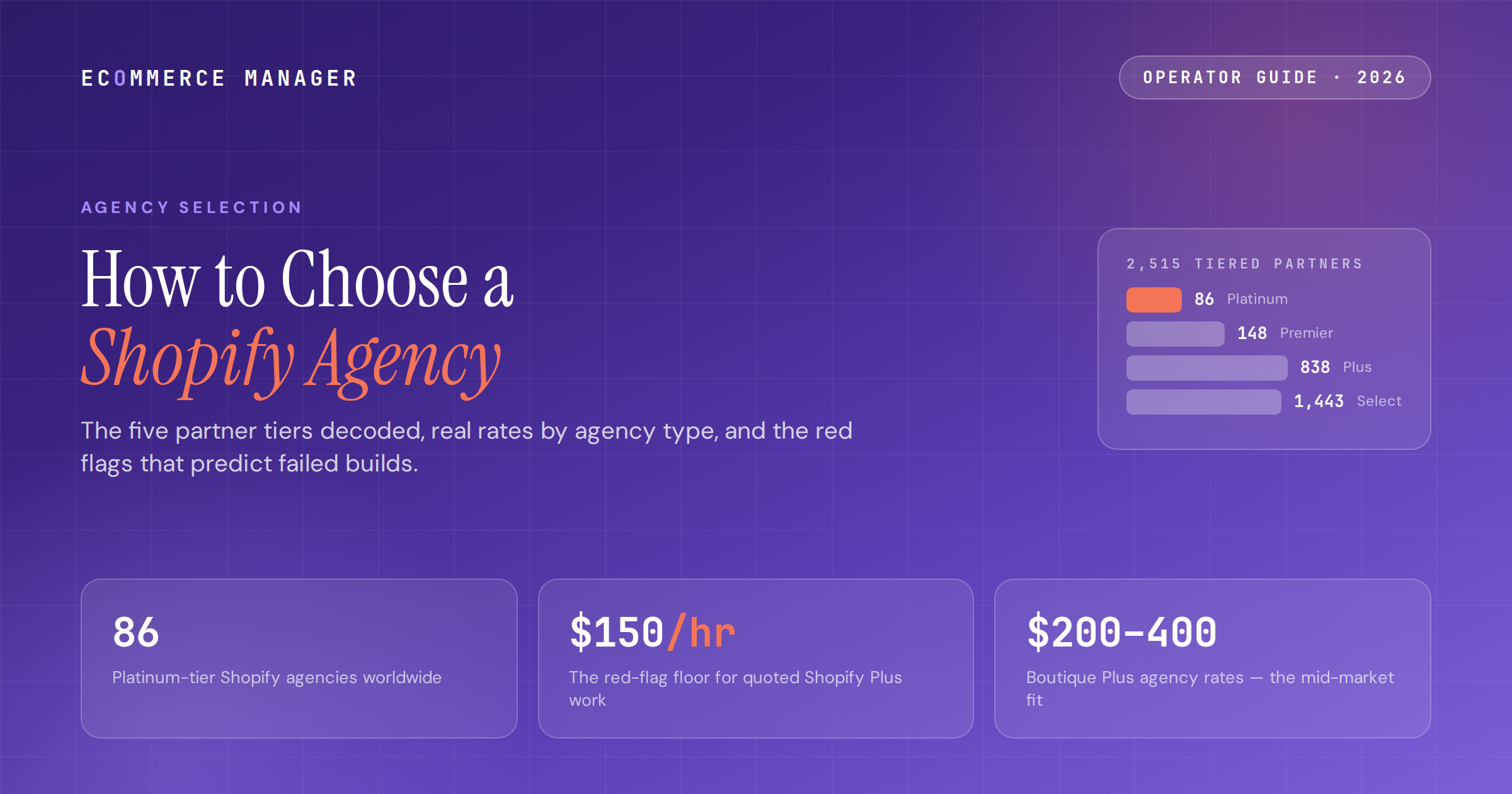
The five partner tiers decoded, real rates by agency type, the discovery-call questions that expose weak teams, and the red flags that predict failed builds. Written for the operator wiring the money, not the agency receiving it.
On this page
The listicles rank themselves first — here's the vetting framework instead
Search "best Shopify agency" and most of what ranks is agencies ranking themselves. Useful if you want a vendor list; useless if you want to know how to vet one, price the engagement, and avoid wiring money to the wrong team. This guide does the second job.
The structural facts first. Shopify rebuilt its partner program with five service tiers — Registered, Select, Plus, Premier, Platinum, after sunsetting the legacy Plus Partner program on December 31, 2024. As of mid-2026, roughly 1,443 agencies hold Select, 838 hold Plus, 148 hold Premier, and only about 86 worldwide hold Platinum: 2,515 tiered partners against tens of thousands of Registered ones with no vetting at all. Knowing what each tier actually requires is the fastest way to read through inflated claims.
Then the money. Rates in 2026 run from $75/hour freelancers to $800/hour enterprise consultancies, and the correlation between rate and fit is weaker than agencies want you to believe. The correlation between suspiciously low rates and failed builds, though, is strong. The cheapest hourly rate is usually the most expensive decision, paid for in missed redirects, botched billing cutovers, and the rebuild that follows. What's below: the tiers decoded, real rates by agency type, the discovery-call questions that expose weak teams, and how to structure the engagement so you own what you paid for.
The five partner tiers, decoded
The tier badge is the single most abused credential in agency marketing. Here's what each level actually requires, and what it does and doesn't tell you.
-
01Registered: the entry point that means almost nothing. Anyone can join the Shopify Partner Program free — no vetting, no minimum projects, no credentials. Registered Partners don't appear in Shopify's Partner Directory and carry no endorsement. 'Official Shopify Partner' on a homepage, alone, is marketing.
-
02Select (~1,443 agencies): the first earned tier. Requires demonstrated SMB merchant success and at least 3 team members holding Verified Skills. Select gets a directory listing and a badge. A solid signal for standard-Shopify projects; not evidence of Plus-scale capability.
-
03Plus (838 agencies): the first tier that means Plus experience. Requires at least 5 active Shopify Plus client engagements with positive outcomes and 10+ team members with Verified Skills. Typical project entry points at this tier run $5K–$10K+, which makes it the accessible entry point for most $5M–$50M brands.
-
04Premier (148) and Platinum (~86): earned by merchant impact, not marketing spend. Premier is awarded for multi-million-dollar merchant outcomes and repeated Plus and Enterprise engagements; Platinum is the top of the program. Minimum budgets typically start at $25K–$50K+. Premier agencies often deliver enterprise-caliber work with leaner teams and more direct senior involvement — sometimes the better buy than Platinum for a mid-market brand.
-
05Verify the tier yourself in the Partner Directory — including the review record. A 5.0 rating across 17 named client reviews is a track record; a wall of client logos with no verifiable reviews is a design choice. The legacy 'Shopify Plus Partner' badge from the pre-2025 program is expired credentialing if that's all an agency can point to.
-
06The tier is a filter, not the decision. It tells you Shopify has verified capability at a scale; it doesn't tell you the agency fits your vertical, your budget, or your working style. That's what the vetting call below is for — and what verified client reviews on the ECM agency directory exist to surface.
Real rates by agency type in 2026
Rates cluster by team type more than by geography or tier badge. Here's the honest sheet, with the fit guidance the proposals leave out.
The rate bands
-
→Freelancers: $75–$125/hour for standard Shopify work. If you're under $1M in revenue with straightforward needs (theme setup, product configuration, a Klaviyo connection), a good freelancer beats an agency at $150–$200+ — the agency's overhead buys you nothing at that scope. Plus-specialized freelancers run $150–$400/hour or $5K–$50K per project and work well for individual Plus features.
-
→Boutique Plus agencies: $200–$400/hour, $25K–$200K+ projects. The sweet spot for mid-market Plus work — B2B implementation, Checkout Extensibility, multi-store coordination. Plus Certified Partners cluster at $175–$300/hour, and published boutique retainers sit around $4,500/month.
-
→Established Plus partners: $300–$500/hour, $75K–$1M+ projects. The tier for enterprise migrations, Hydrogen builds, and ERP-integrated replatforms. Enterprise consultancies at $400–$800+/hour are for Fortune 500 compliance environments, not DTC brands.
-
→Full implementation ranges: €10K for a no-code migration to €1M+ for custom enterprise builds, with most fashion and lifestyle brands landing at €35K–€350K. Offshore rates of $10–$55/hour exist and can work for well-defined sub-$5K projects; above $20K with complex integrations, the risk reduction of an experienced US/EU team usually pays for itself.
The engagement model shift
-
→The monthly retainer has replaced the project as the primary engagement model at serious Shopify agencies — fractional access to developers, designers, and strategists instead of a fixed scope. It fits how stores actually evolve, and it changes your vetting: you're hiring a team you'll work with monthly, not a vendor you'll see at handover.
-
→In-house beats any agency at a threshold: when continuous Plus development is core to the business at roughly $10M+ revenue, a hired team out-economizes retainers. The agency's honest job at that scale is architecture and surge capacity, not everything.
-
→Price the engagement against the project, not the rate card. A $300/hour senior team that ships in 8 weeks costs less than a $120/hour team that takes 20 and misses the redirect map. Model the total in the ECM platform calculator alongside your platform costs so the budget conversation starts with real numbers.
Skip the self-ranked listicles.
The ECM directory lists Shopify agencies with verified client reviews, structured ratings across results, communication, and value — filterable by budget, platform, and vertical.
The discovery questions that expose weak teams
Portfolios are curated; answers under questioning aren't. These questions, assembled from agency-side and merchant-side sources, tell you more than any case study page.
-
01"Are the people who scope and architect this build the same people who ship it?" The classic failure: senior strategists sell the project, junior developers inherit it on day one. Ask for the senior-to-junior ratio on a project your size, and ask who your named project lead is, and what else they're working on while your build is in flight.
-
02"How many builds have you done at my revenue tier, and can I speak to two of those clients directly?" Recent, relevant, referenceable work is the whole test. An agency that can't produce two willing references at your scale is telling you something the portfolio won't.
-
03"What percentage of your work is custom development versus theme customization?" An agency that installs themes and configures apps is a different animal from one that writes Shopify Functions, builds Checkout Extensibility, and handles ERP integrations — the same split that separates CRO specialists from SEO specialists on the services side. Neither is wrong; hiring one to do the other's job is.
-
04"Do you subcontract any of the work — and if so, which parts, and how is it managed?" Subcontracting isn't disqualifying, but undisclosed subcontracting is, because it breaks the accountability chain exactly where builds fail: in QA and handover.
-
05"What do I own at handover?" Theme code, app configurations, documentation, and access credentials should transfer to you, in writing, in the contract. Agencies that retain ownership of your theme repository are building a switching cost, not a partnership.
-
06"How would you make my store legible to AI shopping agents?" The 2026 tiebreaker question. A current agency talks about structured product data, machine-readable content, and native-first builds over app sprawl; an agency that hasn't thought about agentic commerce is running a 2023 playbook. ECM tracks this shift in weekly Insights.
The signals that predict failed builds
Assembled from post-mortems, not hypotheticals. Any one of these is a pause; two or more is a pass.
-
01Plus work quoted under $150/hour. The most reliable single predictor of a rebuild. Genuine Plus capability doesn't price there, so either the team isn't what it claims or the scope is about to grow after signing.
-
02No recent Plus case studies, or vague answers about Plus-native capabilities. An agency that recommends building what Plus already provides natively — B2B logic, Functions-based discounts, checkout customization — is either out of date or padding scope. Both cost you.
-
03The disappearing senior team. If everyone on the sales call is a strategist and nobody can name your project lead, you've met the pitch team, not the delivery team.
-
04Guaranteed rankings, guaranteed timelines under a month for real scope, or pressure to sign before scoping. Migration and build work has known failure modes with known prevention costs; anyone guaranteeing around them is pricing in your inexperience.
-
05No migration discipline in the proposal. For any project touching a replatform, the redirect map, staging validation, and baseline measurement should appear in the scope unprompted — the failure mode of the cheap bid is paying for it in lost organic traffic and botched billing cutovers. The full protection framework is in the ECM replatforming SEO guide; a serious agency's proposal reads like it.
Want the shortlist built for you?
Answer five questions about your platform, budget, and project, and the Find My Agency matcher returns the top agencies fitting your actual requirements — with match scores.
Structuring the engagement so you own what you paid for
The contract stage is where good vetting gets converted into protection, or wasted. Five terms to get in writing before any kickoff.
-
01Scope with named deliverables and a change process — not 'website redesign' but the theme, the integrations, the redirect map, the QA checklist, and what a change request costs. Vague scope is how $40K projects invoice $70K.
-
02Ownership and access on day one: you hold admin on the store, the theme repository, and every third-party account created for the project. Handover of code, configurations, documentation, and credentials is a contract clause, not a courtesy.
-
03Milestone payments tied to acceptance, not dates. A staging build you've tested is a milestone; a calendar month is not. Hold a meaningful final payment against the post-launch stabilization window.
-
04The measurement baseline in the scope: pre-project checkout conversion, organic sessions, and page speed from your core KPIs, with the 90-day review against it named as a deliverable. Agencies that welcome measurement are telling you something good; agencies that resist it are too.
-
05Match the shortlist to the actual project before you ever take a call. Filter by specialty, budget tier, platform, and verified client reviews in the ECM agency directory, or answer five questions in the Find My Agency matcher and let the structured requirements do the first cut. Three well-matched discovery calls beat ten generic ones.
What a smart operator does with this
Use the tier as a filter and verify it yourself. Only 2,515 agencies hold an earned tier and only 86 hold Platinum, so the badge narrows the field fast — but check it in the Partner Directory along with the review record, and treat pre-2025 'Plus Partner' badges as expired credentials. For most $5M–$50M brands, the Plus and Premier tiers are where fit and price meet.
Price the outcome, not the rate. The bands are real — $75–$125 freelance, $200–$400 boutique, $300–$500 established — but the failure data lives at the bottom: Plus work under $150/hour is the single most reliable predictor of paying for the build twice. A senior team that ships in eight weeks with the redirect map done beats a cheap team that takes twenty without it.
Run the vetting call like the money depends on it, then convert it into contract terms: named delivery team, referenceable work at your revenue tier, disclosed subcontracting, full ownership at handover, milestone payments against acceptance, and the 90-day measurement baseline in the scope. The agencies that welcome all six are the ones worth wiring money to.
Frequently asked questions
What do Shopify's partner tiers mean when choosing an agency?
Shopify's five-tier system (introduced after the legacy Plus Partner program ended December 31, 2024) runs Registered, Select, Plus, Premier, Platinum. Registered means nothing — anyone joins free with no vetting. Select (~1,443 agencies) requires 3+ credentialed team members and proven SMB work. Plus (838 agencies) requires 5+ active Shopify Plus engagements and 10+ credentialed staff. Premier (148) and Platinum (~86) are awarded for multi-million-dollar merchant impact. Verify any claimed tier in Shopify's Partner Directory, where earned tiers and client reviews are visible.
How much does a Shopify agency cost in 2026?
Freelancers run $75–$125/hour for standard work and $150–$400 for Plus specialization. Boutique Plus agencies charge $200–$400/hour with projects at $25,000–$200,000+; established Plus partners run $300–$500/hour with projects from $75,000 to $1M+. Full implementations range from €10,000 no-code migrations to €1M+ enterprise builds, with most fashion and lifestyle brands landing between €35,000 and €350,000. Typical minimum budgets by tier: $5K–$10K+ at Plus-tier agencies, $25K–$50K+ at Premier and Platinum. Boutique retainers sit around $4,500/month.
What are the red flags when hiring a Shopify agency?
The most predictive: Shopify Plus work quoted under $150/hour, no recent Plus case studies, inability to explain Plus-native capabilities (or recommending custom builds of features Plus provides natively), a sales call full of strategists who can't name your project lead, undisclosed subcontracting, guaranteed rankings or sub-month timelines for real scope, pressure to sign before scoping, and proposals for migration-adjacent work that never mention redirect maps, staging validation, or baseline measurement. Any one is a pause; two or more is a pass.
Should I hire a freelancer or an agency for my Shopify store?
Match the team to the scope. Under $1M in revenue with straightforward needs — theme setup, product configuration, standard integrations — a freelancer at $75–$125/hour serves you better than an agency at $150–$200+. Mid-market Plus projects (B2B implementation, Checkout Extensibility, multi-store work) fit boutique Plus agencies at $200–$400/hour. Enterprise migrations and Hydrogen builds fit established Plus partners. And at roughly $10M+ revenue with continuous development needs, an in-house team out-economizes any retainer, with agencies reserved for architecture and surge capacity.
What questions should I ask a Shopify agency before hiring?
Six that expose the most: Are the people scoping the build the same people shipping it, and what's the senior-to-junior ratio on my project? How many builds have you done at my revenue tier, and can I speak to two of those clients? What share of your work is custom development versus theme customization? Do you subcontract, which parts, and how is it managed? What do I own at handover — theme code, configurations, documentation, credentials? And how would you make my store legible to AI shopping agents? The answers tell you more than the portfolio.
The playbook top eComm operators actually read
One weekly brief. Five stories that matter. Zero fluff. Written for managers at $5M–$50M DTC brands who want to sound sharper than everyone else in the meeting.
References
- 01 Shopify Plus Partners in 2026: Tiers, What They Do, and How to Choose — askphill.com
- 02 Shopify Plus Partner Agency: How to Vet, Hire, and Budget — ringly.io
- 03 Shopify Plus Development Cost: What You Should Actually Pay (2026 Guide) — shopexperts.com
- 04 Top 26 US Shopify Agencies Ranked by Tier for 2026 — sherocommerce.com
- 05 How to Choose a Shopify Plus Agency in 2026 — softlimit.com
- 06 How to Choose a Shopify Agency: The Expert Framework for 2026 — craftberry.co
- 07 Top Shopify Plus Agencies 2026: Enterprise Partner Guide — wearepresta.com
- 08 How to Pick the Right Shopify Development Agency in 2026 — exactwhy.com
- 09 Shopify Plus vs Advanced: 2026 Pricing, Features & When to Upgrade — charleagency.com
- 10 Shopify Checkout Is the Best-Converting in the World — shopify.com
- 11 SEO Site Migration in 2026: Zero-Traffic-Loss Playbook — digitalapplied.com
- 12 27 Ecommerce Migration Statistics That Guide Successful Platform Transitions — swell.is
Make your agency decision data-backed
Join 12,000+ ecommerce managers reading the ECM newsletter every Wednesday — or browse the directory to find vetted Shopify, migration, and CRO specialists.