

Last Updated on September 4, 2026
10 Lesser-Known Product Data Tools I’d Shortlist Before the Usual Five
Every roundup of product data software lands on the same five names. Akeneo, Salsify, Plytix, Pimcore, inRiver. They earned those spots, so I have no argument with any of them. But most brands walking into my agency sit nowhere near that budget, and they carry the same mess anyway.
Their product data lives across three spreadsheets, a shared Dropbox folder and one staff member’s memory. Then the Google Shopping feed starts throwing disapprovals, and nobody can say which field broke it.
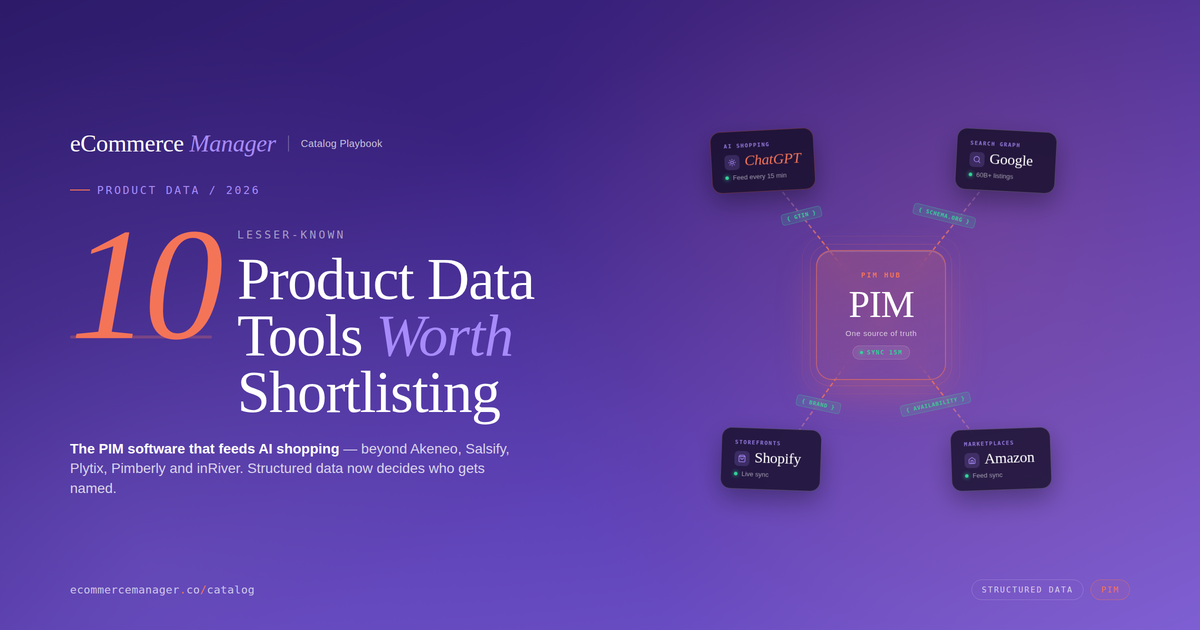
Something shifted over the past two years though. Product data stopped being a back-office chore. Instead it became the thing that decides whether an AI shopping answer names your product or your competitor’s. Google says its Shopping Graph passed 60 billion listings by mid-2026, and it refreshes billions of them every hour. OpenAI now takes merchant feeds as often as every 15 minutes. Neither system reads your carefully written product page prose. Both read your structured data.
So I went hunting outside the usual five. Here are ten worth a look, along with the bits I would push on before anyone signs.
Apimio, for shops that never leave Shopify
Apimio is a small Canadian team that built its whole product inside Shopify. You keep one master record, then push it out to several storefronts at once. Its Quality Guard feature scores every product between zero and 100 for completeness, and it breaks the score down field by field. That single feature does more for a messy catalogue than most agencies manage in a month of manual cleanup.
Pricing sits between $199 and $999 a month on their website. Here is my problem though. The Shopify listing shows different numbers, and the only public review there sits at two stars, complaining from January 2026 about exactly that gap. Almost nobody has reviewed the product anywhere else. The team is tiny and has raised no outside funding, so I would ask hard questions about longevity before moving a catalogue in.
Pimberly, if you have real budget and real volume
Pimberly runs out of Manchester and aims squarely at mid-market and enterprise retail. Unlike most tools on this list, it carries a genuine review base, sitting at 4.4 across roughly 200 reviews on G2. Channels, languages and workflows all come uncapped, which suits brands juggling dozens of markets.
Cost is the catch. Published figures run from about $30,000 a year at 50,000 SKUs up to $90,000 at 250,000. Reviewers also flag a steep learning curve and sluggish performance on large files. If your client has three people and 4,000 SKUs, look elsewhere.
Jasper PIM, the BigCommerce specialist
Jasper has been going since 2012 out of Toronto, and it solves a problem BigCommerce never fixed properly. Multi-storefront management works well here, which is why several merchants say they chose it. You also get scheduled price books, promotional pricing, kits and bundles, and syndication out to a few hundred channels.
Entry pricing starts around $999 a month, though their US site references cheaper plans. Reviews sit at 4.9, but only about 15 people have left one. Small sample, strong signal, so treat it as promising rather than proven.
Quable, built for fashion-style catalogues
Quable comes out of Paris and handles multi-level product structures better than most. Think garments with seasons, colourways and size runs sitting under one parent. Even the entry tier gives you unlimited products, assets and channels, which is refreshing after all the SKU-metered pricing elsewhere.
French reviewers do call it expensive at EUR 890 to EUR 2,499 a month. Beyond price, they mention limited workflow flexibility and no email alerts when product completeness changes. So plan on watching your data quality manually.
Kontainer, when your problem is really assets
Kontainer is Danish, and it earned the best review record of anything here. Nearly 290 Capterra reviews sit at 4.6, with almost no complaints about support. The tool leads with digital asset management and adds product data on top, so it previews over 100 file types, tracks versions and tags GDPR consent on imagery.
That order matters. If your client drowns in photography, lookbooks and PR assets, Kontainer fits beautifully. Yet if the real problem is 12,000 SKUs with missing attributes, you are buying the wrong shape of tool.
Ergonode, the one your team will not hate
Ergonode came out of Poland as an open-source project and turned into a company in 2021. Its whole pitch rests on user experience, which sounds soft until you watch a marketing team abandon a PIM because the interface fought them. Drag-and-drop editing, comments and task assignment all live inside the product.
Its AI Complete feature pulls attributes straight out of supplier PDFs, and that saves genuine hours. Two things give me pause though. The originally open licence has quietly tightened, and even the free plan carries a EUR 1,500 onboarding fee. Paid plans start near EUR 5,990 a year.
AtroPIM, free in the way that counts
AtroPIM is German, GPLv3, and free with no feature paywall. Compare that with the community editions of the big open-source names, where the useful parts sit behind a licence. Its no-code Entity Manager lets you build entities, fields and relationships from the interface, and the API covers everything the UI does.
Distributors get real value here because of unit conversion, nested attributes and field-level permissions. You can also wire it into Gemini or ChatGPT for enrichment. Still, somebody has to host it, patch it and maintain it. Without a developer on hand, skip this one.
Proton PIM, if your client is a distributor
Proton raised $20 million from Felicis and built something narrow on purpose. Its AI agents crawl manufacturer websites, PDFs and catalogues to find missing specifications, then cite every source so a human can verify the change. Cleaned records sync back into Prophet 21, Epicor, Infor, SAP or NetSuite.
For a distributor sitting on 80,000 half-described SKUs, nothing else on this list comes close. But the fit really is narrow. Pricing stays behind a quote form, and DTC brands on Shopify will get nothing from it.
WISEPIM, the most AI-native option here
WISEPIM is Dutch, tiny, and free up to 100 products. It generates descriptions, extracts attributes from supplier text, categorises against your own taxonomy and translates across 90 languages. It also logs every AI action with the prompt and model version, which I appreciate more than the generation features themselves.
Most relevant to my world, it publishes schema.org-compliant output by default. That directly serves the AI search problem I mentioned earlier. Even so, no independent reviews exist yet, the team is very small, and the claims come mostly from the vendor. Trial it hard before committing.
Gepard, a syndication engine rather than a PIM
Gepard has run since 2015 and quietly processes over 120 million product descriptions a month. Its strength lies in mapping your data to each retailer’s exact requirements and validating it in real time. Regulated categories get proper attention too, including EPREL compliance content for lighting.
Public reviews are close to nonexistent, and pricing sits behind a sales call. So think of Gepard as plumbing for manufacturers with big retailer networks, not as a merchandising interface your marketing team will enjoy.
The part these lists usually skip
Choosing software matters less than the data you put in it. Every tool above will happily store an incomplete catalogue.
Right now the fields that move the needle are the boring ones. GTINs on every eligible product, because AI shopping layers recommend specific items and quietly distrust anything without an identifier. Brand, condition, availability, multiple images. Review counts and average ratings, which most feeds omit. Return policy and shipping, which almost nobody fills in.
Structured markup on the page still matters alongside the feed. One analysis of 15,000 URLs found 61 per cent of pages cited by ChatGPT carried structured data, against 25 per cent of standard Google top results. Correlation, not proof, though the gap is wide enough to act on. The peer-reviewed work on generative engine optimisation from KDD 2024 points the same direction, reporting visibility gains up to 40 per cent from better-structured content.
How I would choose
First, work out your real year-one cost rather than the sticker price. Licence, setup, per-channel extras and feed apps all add up, and four of the ten above will not quote you publicly.
Second, be honest about who maintains it. AtroPIM is free until you count developer time. Meanwhile Ergonode and WISEPIM will get a marketing coordinator productive in an afternoon.
Third, check the review count, not just the score. A 4.9 from 12 people tells you far less than a 4.4 from 200.
Finally, ask any vendor how their output reaches Google Merchant Center and OpenAI’s feed spec. If they look blank, they are selling you a filing cabinet. You need a distribution system.