


Last Updated on August 4, 2026
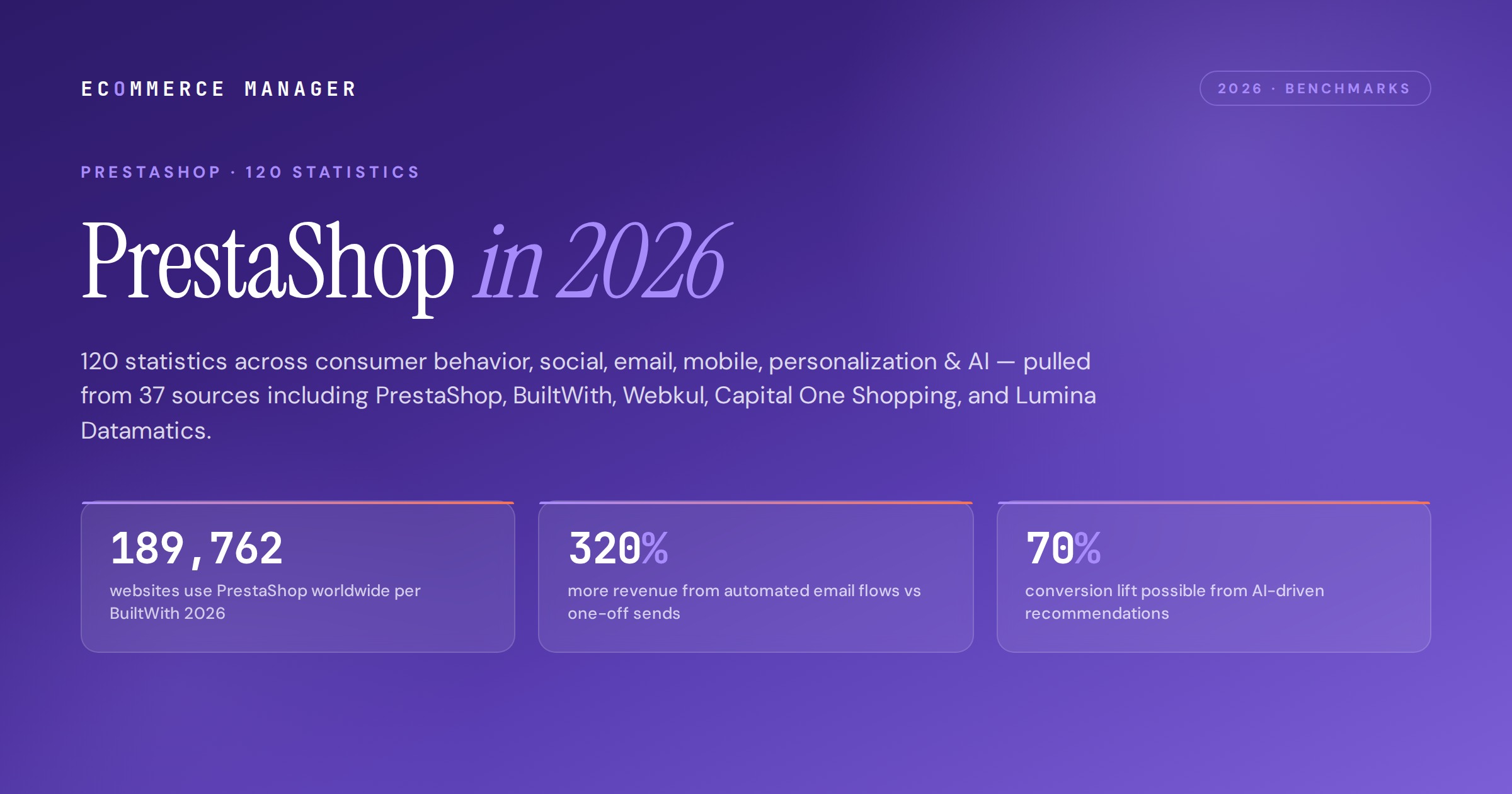
PrestaShop in 2026: 120 statistics on consumer behavior, social, email, mobile, personalization, and AI
The 120 numbers B2C operators evaluating or running PrestaShop need on hand — pulled from PrestaShop's own documentation and roadmap, BuiltWith, Webkul, Capital One Shopping, Lumina Datamatics, and 32 other sources.
On this page
The state of PrestaShop in 2026
PrestaShop is one of the largest open-source ecommerce platforms in the world — BuiltWith counts 189,762 websites using it, with 170,785 currently live — but its footprint is disproportionately European and Latin American, which is why the platform gets less Anglophone media coverage than its scale justifies. That footprint matters: it means active community support, a rich extension marketplace, and multi-region localization that competitors like OpenCart or Shift4Shop can't match.
The 120 statistics below are drawn from 37 sources: PrestaShop's own documentation, blog, and 2026 roadmap; BuiltWith platform data; Capital One Shopping's 2025 consumer behavior research; industry analysts (Publicis Sapient, Lumina Datamatics, Digital Commerce 360, Akeneo, Salesforce); specialist coverage on PrestaShop's mobile-app ecosystem (Webkul, Mobikul, FMEModules) and email integrations (MailerLite, ActiveCampaign, Zigpoll); and consumer-insights platforms (Vtion.ai, SurveyMonkey). They're organized into six sections: consumer behavior, social commerce, email marketing, mobile UX, personalization, and AI in B2C.
This is not a PrestaShop product review. It's the benchmark set every PrestaShop operator — or every operator weighing PrestaShop against WooCommerce, Shopify, or BigCommerce — should have on hand for planning 2026 targets, upgrade decisions, and stack investments.
PrestaShop + consumer behavior
PrestaShop is one of the largest open-source ecommerce platforms globally — 189,762 websites, 170,785 live, with especially strong bases across Europe and Latin America. PrestaShop 9.x's built-in visitor behavior statistics are unusually deep, giving operators native tools to understand how traffic converts, where the friction sits, and which channels deliver value.
-
01BuiltWith data show 189,762 websites use PrestaShop, including 170,785 live PrestaShop sites, making it one of the larger open-source ecommerce platforms globally.
-
02PrestaShop stores span many countries: usage is especially strong across Europe and Latin America, where open-source and self-hosted solutions are popular.
-
03PrestaShop 9.x documentation emphasises visitor behaviour graphs and statistics showing visits vs orders, helping merchants see how traffic converts.
-
04Statistics include visits, orders, conversion, and revenue over time, allowing merchants to identify demand patterns and seasonality.
-
05The payment distribution section shows which payment methods customers most often choose, guiding optimisation toward preferred methods.
-
06PrestaShop's customer-behaviour blog highlights unique visits by channel, giving insight into which acquisition sources bring shoppers.
-
07Key metrics include average visit length, pageviews per visit, visits before order, and average order value (AOV), which together summarise engagement and intent.
-
08AOV by channel shows how much customers are willing to spend per visit, and which channels deliver higher-value customers.
-
09The Failed Discovery Rate (browse abandonment) metric captures visitors who browse catalogues but leave without adding items to cart, highlighting UX and merchandising issues.
-
10PrestaShop data points help merchants map how many pages shoppers view and how many visits they need before purchasing, revealing purchase friction.
-
11Webkul's marketplace seller statistics module lets sellers see visitors and visits per shop page and per product, revealing product-level demand.
-
12Sellers can view channels driving shop and product visits (marketplace, Facebook, Pinterest, other), supporting channel-specific strategy.
-
13Country-wise shop and product visit statistics show where customers are coming from geographically, guiding localisation and shipping policies.
-
14The Search Keyword stats reveal how often specific keywords are entered and how many related products appear, exposing gaps in catalog or search UX.
-
15Capital One data show 86% of US consumers read online reviews and 66% use search engines to research products, reinforcing the importance of content and social proof for PrestaShop stores.
-
1694% of consumers say good customer service inspires loyalty, and 82% recommend brands based on good service, making post-purchase support critical.
-
1775% of consumers tried new brands and ways of shopping within three months, and 73% intend to keep exploring — indicating low long-term lock-in and high experimentation.
-
18Americans spend 87.9% of after-tax income on goods and services, with per-person consumer spending projected at $32,732 in 2025.
-
1972% of consumers worry about increasing everyday costs, putting pressure on PrestaShop merchants to communicate value and justify prices clearly.
-
20Searches for sustainable products have risen 71% in five years, showing strong interest in ethical, eco-friendly offerings that PrestaShop brands can highlight.
Weighing PrestaShop vs WooCommerce, Shopify, or BigCommerce?
Model the 3-year total cost — including hosting, addons, developer time, and expected uplift — across self-hosted and SaaS options for your revenue tier in under two minutes.
Email marketing & automation
PrestaShop Automation ships with native segmentation tools, and MailerLite and ActiveCampaign both have deep official integrations that pull PrestaShop data (customers, orders, categories) directly into email flows. That means PrestaShop merchants can run modern lifecycle programs without the app-tax stack Shopify demands — provided they understand the segmentation math.
-
01PrestaShop's automation essentials highlight that merchants can automate marketing campaigns and send tailor-made content to targeted leads, increasing conversion.
-
02Automation uses customer data (location, profile, shopping habits) to reach the right audience segments, improving relevance.
-
03PrestaShop Automation is designed to engage better with audiences and increase conversion rates by leveraging behavioural and profile data.
-
04MailerLite's PrestaShop integration gives access to built-in ecommerce features that enhance email performance, including product blocks and purchase-based triggers.
-
05ActiveCampaign integration enables automated, personalised email campaigns, using PrestaShop data to drive engagement and revenue.
-
06Zigpoll's win-back guide recommends segmenting inactive customers (e.g., 180+ days) by purchase frequency, AOV, and product preferences, then targeting with tailored emails.
-
07Proven win-back strategies include personalised subject lines referencing names and past purchases, which boost open rates.
-
08Time-limited discounts, free shipping, and exclusive deals create urgency in win-back sequences, nudging dormant customers to purchase again.
-
09Zigpoll suggests 3–5-email multi-touch win-back sequences over several weeks, mixing reminders, offers, educational content, and feedback requests.
-
10Exit-intent surveys and feedback emails help understand why customers stopped buying, enabling better messaging and offers.
-
11Automated templates can dynamically pull new or trending products using PrestaShop tags and categories, keeping email content relevant without manual updates.
-
12Implementation checklist steps include exporting inactive customers, segmenting by history, connecting an email platform, designing dynamic templates, scheduling sequences, embedding surveys, and A/B testing.
-
13Forbes Advisor's 2026 statistics note 4.48 billion global email users, and 81% of companies use email in their marketing strategy — making email a core channel.
-
1464% of small businesses use email marketing regularly, showing its ubiquity among SMBs like PrestaShop merchants.
-
15Nearly 90% of marketers plan to maintain or increase email budget, reflecting confidence in email's performance.
-
16Campaign Monitor data show email drives an average of $44 for every $1 spent, and 77% of email ROI comes from segmented, targeted, triggered campaigns.
-
17Automated emails generate 320% more revenue than non-automated ones, and transactional emails have 8x more opens and clicks and can generate 6x more revenue.
-
18Cart-abandonment sequences achieve 50.5% average open rates and recover 3–5% of lost sales, while three-email sequences recover 69% more than single reminders.
-
19Personalised emails deliver 26% higher open rates, and personalised subject lines are 26% more likely to be opened than generic ones.
-
20Overall, PrestaShop sellers can achieve strong email ROI by combining platform data, automation modules, and integrated ESPs for segmented, multi-touch lifecycle campaigns.
Mobile commerce & UX
PrestaShop's mobile story is stronger than most open-source competitors: a rich extension marketplace for native app builders (Webkul, Mobikul, FMEModules), a headless architecture roadmap for 2026, and the new Hummingbird 2.0 theme built explicitly for performance. That combination gives operators genuine flexibility across responsive, PWA, and native app strategies.
-
01Webkul's PrestaShop Mobile App Builder provides Android and iOS apps for PrestaShop stores, allowing users to make purchases via native apps.
-
02The app builder connects directly to PrestaShop via secure APIs, syncing products, customers, categories, and other visible data.
-
03Webkul's Mobikul PrestaShop app converts a store into an Android mobile application where all products, customers, and categories are accessible.
-
04FMEModules notes a PrestaShop mobile app is a dedicated Android/iOS application connected via APIs, providing seamless mobile shopping experiences.
-
05Mobile apps support features like easy login, product browsing, wishlists, carts, and checkout, along with multiple payment options — delivering smooth UX.
-
06FMEModules emphasises that mobile apps help capture the growing mobile commerce market, where many customers prefer app-based journeys.
-
07PrestaShop documentation on statistics shows visits, conversion, and revenue over time, which merchants can analyse by device using analytics tools.
-
08Contentsquare's 2026 benchmark covers 99 billion web/app sessions across 6,500+ sites, showing cross-device behaviour where users routinely switch between web and mobile before buying.
-
09Growth-Engines reports mobile drives 77% of ecommerce traffic but converts at around half the desktop rate, highlighting UX gaps.
-
10Global mobile commerce sales are projected to reach $2.51 trillion, confirming mobile as the dominant shopping context.
-
11Capital One data show 254 million Americans shop via smartphones, and 76% have purchased products on phones, compared with 69% on desktops/laptops.
-
12Consumers shop online because it's cheaper (40%), available 24/7 (36%), offers wider ranges (34%), and makes comparison easier (30%) — behaviours often enabled via mobile.
-
13FMEModules stress that a mobile app can use push notifications to re-engage customers with offers and updates, improving mobile retention.
-
14PrestaShop's roadmap includes headless architecture and new themes (Hummingbird 2.0) designed to support modern, responsive frontends suitable for mobile.
-
15Headless setups allow brands to use mobile frontends, PWAs, and native apps while keeping PrestaShop as the backend engine.
-
16AI-driven UX tools analyse scroll depth, session paths, and friction points to optimise mobile experiences: PrestaShop stores can benefit via integrated analytics.
-
17As social commerce and short-form video are mobile-native, many first visits to PrestaShop stores originate from mobile social links or ads.
-
18Voice and visual search trends require clear images, alt text, and structured data to help mobile assistants surface PrestaShop products.
-
19Improving mobile checkout via wallet payments, fewer fields, and clear shipping options reduces cart abandonment and closes the mobile conversion gap.
-
20Overall, PrestaShop's mobile-app ecosystem and headless roadmap position it well for mobile-first B2C journeys, provided merchants invest in UX and performance.
Need help wiring up personalization or a mobile app on PrestaShop?
Browse vetted CRO, mobile UX, and AI-personalization agencies that specialize in PrestaShop, WooCommerce, and other self-hosted platforms with headless or API-connected stacks.
Personalization in B2C on PrestaShop
PrestaShop's built-in statistics — AOV by channel, visits before order, Failed Discovery Rate, Search Keyword stats — give operators a native behavioral data foundation that most self-hosted platforms require external tools to replicate. Combined with automation modules and ESP integrations, that foundation makes rich segmentation and personalization achievable without heavy custom development.
-
01PrestaShop Automation encourages merchants to use customer data (location, profile, shopping habits) to send tailor-made content, enabling audience-specific campaigns.
-
02Automation helps merchants reach the audience they need and engage better, ultimately increasing conversion rates via personalised content.
-
03PrestaShop's customer-behaviour blog emphasises metrics like visits before order and AOV by channel, which reveal how different segments behave and spend.
-
04Failed Discovery Rate (browse abandonment) shows how many people browse but leave without cart adds, indicating where product discovery and recommendations need improvement.
-
05Webkul's marketplace seller statistics module allows sellers to view shop and product stats by channel and country, supporting geo- and channel-personalisation strategies.
-
06Search Keyword stats reveal what customers are looking for, and how often relevant products appear, guiding personalised merchandising and SEO.
-
07Zigpoll's win-back guide stresses segmentation by behaviour and purchase history (one-time vs frequent buyers, high vs low spenders) for targeted re-engagement.
-
08Zigpoll recommends dynamic personalisation in emails — names, past purchases, and related suggestions — to boost open rates and engagement.
-
09Time-limited discounts and exclusive deals create urgency, tailored to segments that respond best to price incentives.
-
10Highlighting new or trending products dynamically via tags and categories ensures personalised win-back emails show relevant merchandise for each segment.
-
11Campaign Monitor data show marketers have seen 760% revenue increases from segmented campaigns, demonstrating the financial impact of effective personalization.
-
1294% of customer-insights and marketing professionals say personalization is "extremely important" for meeting email objectives.
-
1377% of email ROI comes from segmented, targeted, triggered campaigns, underlining the ROI of personalization.
-
14Netguru reports AI-driven recommendations can increase conversion rates by up to 70%, though only 41% of consumers feel benefits justify privacy trade-offs — personalisation must be transparent.
-
1564% of consumers express genuine interest in tailored experiences, especially when offers are clearly relevant.
-
16Salsify data show 37% of shoppers buy more often when they receive personalised recommendations, and 25% are willing to buy AI-recommended items with personalised explanations.
-
17Lumina notes AI-driven personalization at scale is a top trend, with models tailoring products, pricing, content, and promotions in real time.
-
18PrestaShop's roadmap includes headless and advanced theming, enabling flexible frontends where personalised experiences can be implemented more easily.
-
19Combining PrestaShop statistics (behaviour, searches, channels) with automation and ESP integrations allows rich behavioural segmentation and targeted experiences even without heavy custom dev.
-
20In 2026, personalization for PrestaShop B2C brands means using behavioural data, automation, and AI-assisted tools to align products, content, and offers with individual customer journeys and values.
AI in B2C & the PrestaShop ecosystem
PrestaShop's 2026 roadmap explicitly targets AI compatibility: PrestaShop 9.2 introduces headless architecture, Hummingbird 2.0 is designed for the flexibility AI-driven experiences require, and the platform won the OW2 Best Project Award. The AI itself is still external — but the plumbing to connect it is being built into the core, which is a meaningful competitive advantage over legacy self-hosted platforms.
-
01PrestaShop's product roadmap lists PrestaShop 9.2 and a headless architecture for 2026, making it easier to plug in AI services and modern frontends.
-
02The roadmap also highlights Hummingbird 2.0 theme — designed for performance and flexibility — key for AI-driven, dynamic experiences.
-
03PrestaShop Monthly updates show ongoing community collaboration and recognition (OW2 Best Project Award), ensuring the platform evolves to meet modern demands including AI integration.
-
04Lumina's 2026 trends put AI-driven CX, automation, data intelligence, and workforce optimisation at the center of ecommerce innovation.
-
05AI models now personalise recommendations, pricing, content, and promotions in real time, based on behaviour and intent.
-
06Predictive analytics enable retailers to forecast demand and churn, helping them act before stockouts or customer loss occur.
-
07Automation across catalog, order management, and support is increasingly handled by AI-powered tools, improving speed and cost efficiency.
-
08Publicis Sapient's 2026 ecommerce trends list generative AI and personalization among eight trends accelerating ecommerce, with AI mediating more interactions.
-
09Salesforce's 2026 data show 63% of marketers currently use generative AI, and 83% of sales teams using AI saw revenue growth vs 66% not using AI — linking AI adoption to performance.
-
10AI marketing revenue is expected to reach $107 billion by 2028, reflecting rapid martech investment.
-
11AI is highly effective for data-heavy tasks like behaviour analysis, churn prediction, and campaign optimisation, freeing human teams to focus on higher-level CX.
-
12Akeneo's 2026 trends emphasise AI-powered product search and discovery, and early steps toward agentic commerce, where AI agents transact for users.
-
13SEMrush (via Akeneo) predicts AI-powered search will overtake traditional search by 2028, making AI engines primary gateways to ecommerce sites.
-
14Akeneo reports 49% of Americans say AI recommendations already influence what they buy, and 64% are willing to purchase items recommended by generative AI.
-
15DHL's 2026 trends note AI is going mainstream for younger shoppers and large businesses, but misinterpretation and trust issues remain major concerns.
-
16Netguru warns that while AI personalization can boost conversions up to 70%, transparency and privacy are essential to maintain trust.
-
17Consumer-insights tools like Vtion.ai let brands measure digital campaign impact and behaviours, feeding richer data into AI models.
-
18SurveyMonkey emphasises consumer insights as the "why" behind behaviour, which can inform more human-aligned AI outputs.
-
19PrestaShop's headless and integration-friendly architecture allows brands to connect AI recommendation engines, chatbots, analytics suites, and marketing automation via APIs.
-
20In 2026, AI in B2C around PrestaShop effectively means AI-augmented search, recommendations, analytics, and marketing — built on strong behavioural and product data to deliver faster, more personalised, and more efficient customer experiences.
What matters most for PrestaShop operators in 2026
PrestaShop's scale is bigger than its Anglophone media coverage suggests — 189,762 websites, 170,785 live — and the European and Latin American merchant bases are especially deep. That distribution matters for extension availability, community support, and multi-region localization needs.
The native statistics module is PrestaShop's most underrated competitive advantage. AOV by channel, Failed Discovery Rate, visits before order, and Search Keyword stats give operators native behavioral data most self-hosted platforms require external tools to replicate — making segmented email and personalization achievable without expensive stacks.
The 2026 roadmap is credible and material. PrestaShop 9.2's headless architecture and Hummingbird 2.0 theme are prerequisites for the AI-driven, mobile-first experiences the industry is moving toward. That combination positions PrestaShop meaningfully ahead of legacy self-hosted competitors on modernization trajectory.
Email and automation are the highest-ROI levers available to PrestaShop merchants. Native automation modules plus deep MailerLite and ActiveCampaign integrations allow segmented, behavior-triggered campaigns that can generate 320% more revenue than static sends and recover 3–5% of otherwise-lost cart revenue.
Frequently asked questions
How does PrestaShop compare to WooCommerce and OpenCart?
PrestaShop, WooCommerce, and OpenCart are the three largest open-source, self-hosted ecommerce platforms. PrestaShop's differentiators are unusually deep native statistics (AOV by channel, Failed Discovery Rate, Search Keyword stats), a strong European and Latin American merchant base, and an active 2026 roadmap with headless architecture and the Hummingbird 2.0 theme. WooCommerce wins on WordPress-native content integration and sheer developer ecosystem. OpenCart wins on lighter footprint and lower complexity. For pure ecommerce operators who want native behavioral analytics without third-party dependencies, PrestaShop makes the strongest case.
What's new in PrestaShop 9.x for 2026?
PrestaShop 9.x brought a modernized statistics module with visitor behavior graphs, expanded conversion and revenue tracking, and payment method distribution reporting. The 2026 roadmap adds PrestaShop 9.2 with headless architecture support, plus Hummingbird 2.0 — a new theme designed for performance and flexibility, which is a prerequisite for the kind of dynamic, AI-driven experiences the rest of the industry is moving toward. PrestaShop also won the OW2 Best Project Award, signaling continued community and technical momentum.
Is PrestaShop really free? What are the total costs?
The PrestaShop core is free and open-source. Total cost of ownership comes from hosting ($10–$300/month depending on traffic and requirements), commercial modules from the PrestaShop Addons marketplace ($50–$400 typical), premium themes ($60–$250), payment processing fees, and development or maintenance time. For a mid-market B2C store, real all-in monthly cost typically runs $100–$500 — meaningfully lower than Shopify Plus at comparable revenue, provided the operator has technical resources or works with a specialist agency.
What are PrestaShop's biggest limitations in 2026?
Three limitations stand out: (1) native AI capabilities are minimal — recommendation engines, predictive analytics, and personalization all require external tools connected via API; (2) the Addons marketplace has uneven module quality, and abandonware is a real risk when key modules stop being maintained; and (3) upgrades between major versions (1.7 → 8 → 9) can be complex for heavily customized stores. Merchants without technical resources typically pay this back in developer fees for maintenance and upgrades.
Should I upgrade from PrestaShop 1.7 or 8 to PrestaShop 9?
PrestaShop 9's improvements are material: modernized statistics module, better payment method reporting, and — with the 9.2 roadmap — headless architecture and Hummingbird 2.0. For new stores, 9.x is the clear choice. For established 1.7 or 8 stores, the upgrade is worth planning if you rely on statistics for decision-making or want to run modern integrations. Audit module compatibility first: some older 1.7 modules haven't been updated for the 9.x architecture, and the migration path is more involved for heavily customized stores. Budget for developer time regardless of store complexity.
The playbook top eComm operators actually read
One weekly brief. Five stories that matter. Zero fluff. Written for managers at $5M–$50M DTC brands who want to sound sharper than everyone else in the meeting.
References
- 01 BuiltWith — PrestaShop Trends — trends.builtwith.com
- 02 PrestaShop Docs — Understanding Statistics (v9) — docs.prestashop-project.org
- 03 PrestaShop Blog — Ecommerce Data to Understand Customer Behavior — prestashop.com
- 04 Webkul — PrestaShop Marketplace Seller Statistics — webkul.com
- 05 Capital One Shopping — Consumer Behavior Statistics — capitaloneshopping.com
- 06 SellersCommerce — Social Commerce Statistics — sellerscommerce.com
- 07 Escalent — Top Consumer Trends 2026 — escalent.co
- 08 Netguru — Consumer Behavior Trends — netguru.com
- 09 Unilever — Leveraging Social Insights and Technology — unilever.com
- 10 Publicis Sapient — Future Ecommerce Trends — publicissapient.com
- 11 MailerLite — PrestaShop Email Marketing Integration — mailerlite.com
- 12 Webkul — PrestaShop ActiveCampaign Email Marketing — webkul.com
- 13 Forge Apollo — Digital Marketing Statistics 2026 — forgeapollo.com
- 14 Salesforce — Marketing Statistics 2026 — salesforce.com
- 15 PrestaShop Essentials — Automation — prestashop.com
- 16 Zigpoll — PrestaShop Win-back Email Sequence — zigpoll.com
- 17 Forbes Advisor — Email Marketing Statistics — forbes.com
- 18 Campaign Monitor — 24 Email Marketing Stats — campaignmonitor.com
- 19 CodeCrew — Email Marketing Stats — codecrew.us
- 20 Webkul — PrestaShop Mobile App Builder — webkul.com
- 21 Google Play — Mobikul PrestaShop App — play.google.com
- 22 FMEModules — Why Your PrestaShop Store Needs a Mobile App — fmemodules.com
- 23 ScalaHosting — OpenCart Reports Guide — scalahosting.com
- 24 Contentsquare — 2026 Digital Experience Benchmark — contentsquare.com
- 25 Growth-Engines — Mobile Commerce Optimization — growth-engines.com
- 26 PrestaShop Blog — PrestaShop Monthly March 2026 — prestashop.com
- 27 PrestaShop Roadmap — prestashop.com
- 28 Lumina Datamatics — Biggest Ecommerce Trends 2026 — luminadatamatics.com
- 29 Akeneo — 2026 Ecommerce Trends — akeneo.com
- 30 Digital Commerce 360 — Top 15 Ecommerce Trends 2026 — digitalcommerce360.com
- 31 Salsify — How Consumer Buying Behavior Is Changing in 2026 — salsify.com
- 32 PrestaShop Blog — PrestaShop Monthly May 2026 — prestashop.com
- 33 Adobe — AI Marketing Trends — adobe.com
- 34 DHL — 2026 Ecommerce Trends Report — dhl.com
- 35 Vtion.ai — Consumer Insights — vtion.ai
- 36 SurveyMonkey — Consumer Insights — surveymonkey.com
- 37 PrestaShop Versions — prestashop.com
Make every platform decision data-backed
Join 12,000+ ecommerce managers reading the ECM newsletter every Wednesday — or browse the directory to find vetted CRO, mobile UX, and AI-personalization partners for your PrestaShop stack.

Social media & social commerce
PrestaShop's Marketplace Seller Statistics module is unusual in the open-source ecommerce world: it tracks visits by channel (Facebook, Pinterest, marketplace, other) natively, and by country. That gives PrestaShop merchants social attribution data that competitors typically need external analytics tools to replicate.